A high or substantial collar changes more than the neckline of a crochet cardigan. It can turn a simple open layer into a structured jacket, add warmth around the neck, balance an oversized body, or become the main visual feature of a cropped design. The projects below range from upright high-neck coats and fold-over ribbed collars to generous shawl collars, granny-square constructions, bombers, and child-size cardigans.
The differences matter when choosing a project. Some collars need enough body to hold their shape, while others are meant to drape or roll naturally. Cardigan width, shoulder construction, closure style, yarn weight, and collar depth can all affect how the finished garment sits. This collection pairs each idea with an original tutorial so you can compare the silhouettes first, then use the creator’s instructions for the exact construction.
Quick List
- Crochet Cropped Lemon-Peel Collar Cardigan
- Crochet Contrast-Collar Tie-Front Cardigan
- Crochet Granny-Stitch Cinched-Sleeve Collar Cardigan
- Crochet Unisex Midwest Shawl-Collar Cardigan
- Crochet Cropped Bomber Cardigan With Oversized Collar
- Crochet Cocoon Cardigan With Deep Fold-Over Collar
- Crochet Beacon Bomber With Fold-Over Collar
- Crochet Granny-Square High-Collar Cardigan
- Crochet Men’s Knit-Look Shawl-Collar Cardigan
- Crochet Cozy Collar Oversized Cardigan
- Crochet Little-Girl Shell-Stitch Collar Cardigan
- Crochet Patchwork Cardigan With Contrast Collar
- Crochet Girl’s High-Neck Cardigan Coat
- Crochet Origami Kimono-Sleeve Shawl-Collar Cardigan
Choose the Collar by How You Want It to Behave
“High collar” can describe several very different effects. An upright collar sits closer to the neck and generally benefits from fabric with enough stability to resist collapsing. A folded ribbed collar can be softer because its doubled structure provides some substance. Shawl collars travel around the neckline and front opening, so their width affects both warmth and the visual weight of the entire cardigan.
Oversized collars behave differently again. On a bomber or cocoon cardigan, the collar may deliberately spread across the shoulders instead of standing vertically. Before choosing a tutorial, look at the finished result rather than the collar name alone. Decide whether you want neck coverage, a dramatic face-framing edge, or simply more structure around the opening. That choice will narrow the list faster than color or stitch texture.
Check Fit at the Neck, Shoulders, and Front Opening
Bust measurement is only one checkpoint on a high-collar cardigan. A collar that rises close to the neck also depends on the neckline opening, shoulder position, and how much the front panels separate when the cardigan is worn. A garment can fit through the body yet still feel restrictive at the base of the neck or pull backward if the shoulder area is too narrow.
For buttoned and zip-front designs, check how the fronts meet before adding the final collar treatment. With open cardigans, consider whether the collar is meant to fall away from the body or remain close to it. If you are changing yarn, size, or garment length, try the cardigan on at the points recommended by the original designer. Collar proportions that work on the sample may need reconsideration if the body is made significantly longer, wider, or heavier.
Yarn Choice Changes Collar Structure
A high collar concentrates extra fabric around the neckline, so yarn substitution can change the result more noticeably than it might on a plain crew-neck cardigan. A firm, resilient fabric can emphasize an upright or sculptural collar. A softer yarn may create a more relaxed fold, which is useful for shawl and cocoon styles but may make a stand collar collapse.
Weight matters too. A heavy body can pull downward on the neckline, while a thick collar can feel disproportionate on a light cardigan. Swatch the actual stitch pattern whenever the tutorial provides a gauge, and handle the swatch as you expect to care for the finished garment. If you substitute fiber or yarn weight, compare both stitch gauge and the fabric’s behavior rather than assuming matching hook size will preserve the original collar.
1. Crochet Cropped Lemon Peel Collar Cardigan
 SAVE
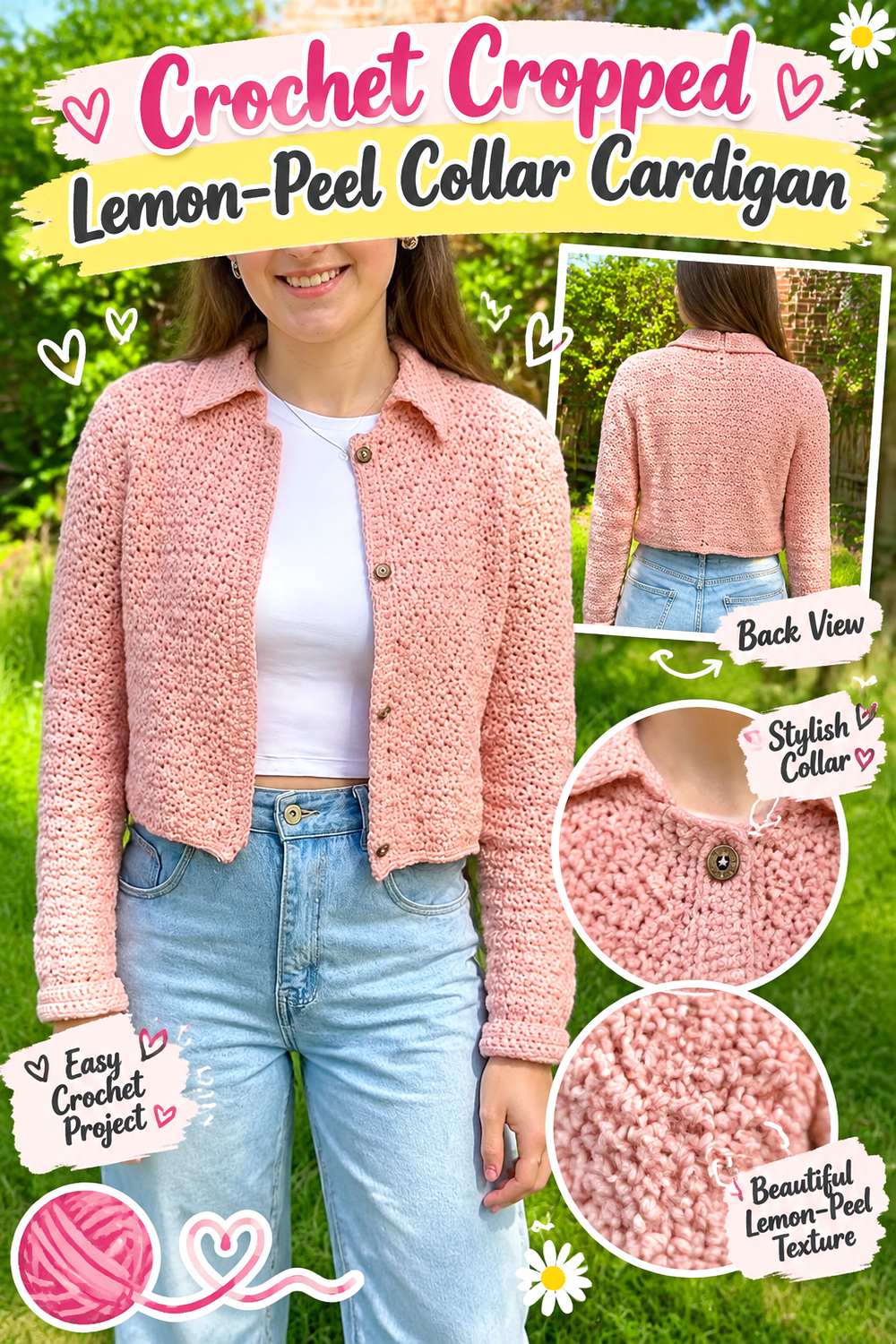
SAVEThis cropped cardigan uses a compact silhouette and an applied collar to create a more tailored look than a loose, open-front crochet layer. Stephanie Tashi’s tutorial identifies lemon peel stitch as the main texture and shows a buttoned front, cropped body, sleeves, collar, and finishing details. The creator also describes the sample as adjustable rather than presenting the demonstrated size as the only option.
The shorter body keeps the collar visually important without requiring an oversized neckline treatment. It is a useful direction when you want a cardigan that can function almost like a textured jacket over high-waisted trousers, skirts, or dresses.
Keep the Cropped Proportions Intentional
A shorter cardigan makes small length changes more noticeable. Before committing to the final body length, compare where the hem will meet the clothes you expect to wear underneath. Extending the torso is possible in many panel-based designs, but doing so can change the relationship between the neat collar, button spacing, and waistline.
If you alter length, also consider whether sleeve proportions still look balanced. A dramatically longer body paired with the original collar may turn the project into a different silhouette rather than simply a longer version.
Watch Collar and Button-Band Tension
The front edging and collar frame the most visible part of this cardigan. If those sections are substantially tighter than the body fabric, the front may draw upward or the collar may refuse to lie as intended.
Treat the edge as a structural finish rather than decoration added at the end. Before sewing on buttons, lay the cardigan flat and check that both fronts are the same length. Then try it on to see whether the collar remains balanced when the front is fastened.
Original Tutorial and Creator Credit
Creator: Stephanie Tashi
2. Crochet Contrast Collar Tie Front Cardigan
 SAVE
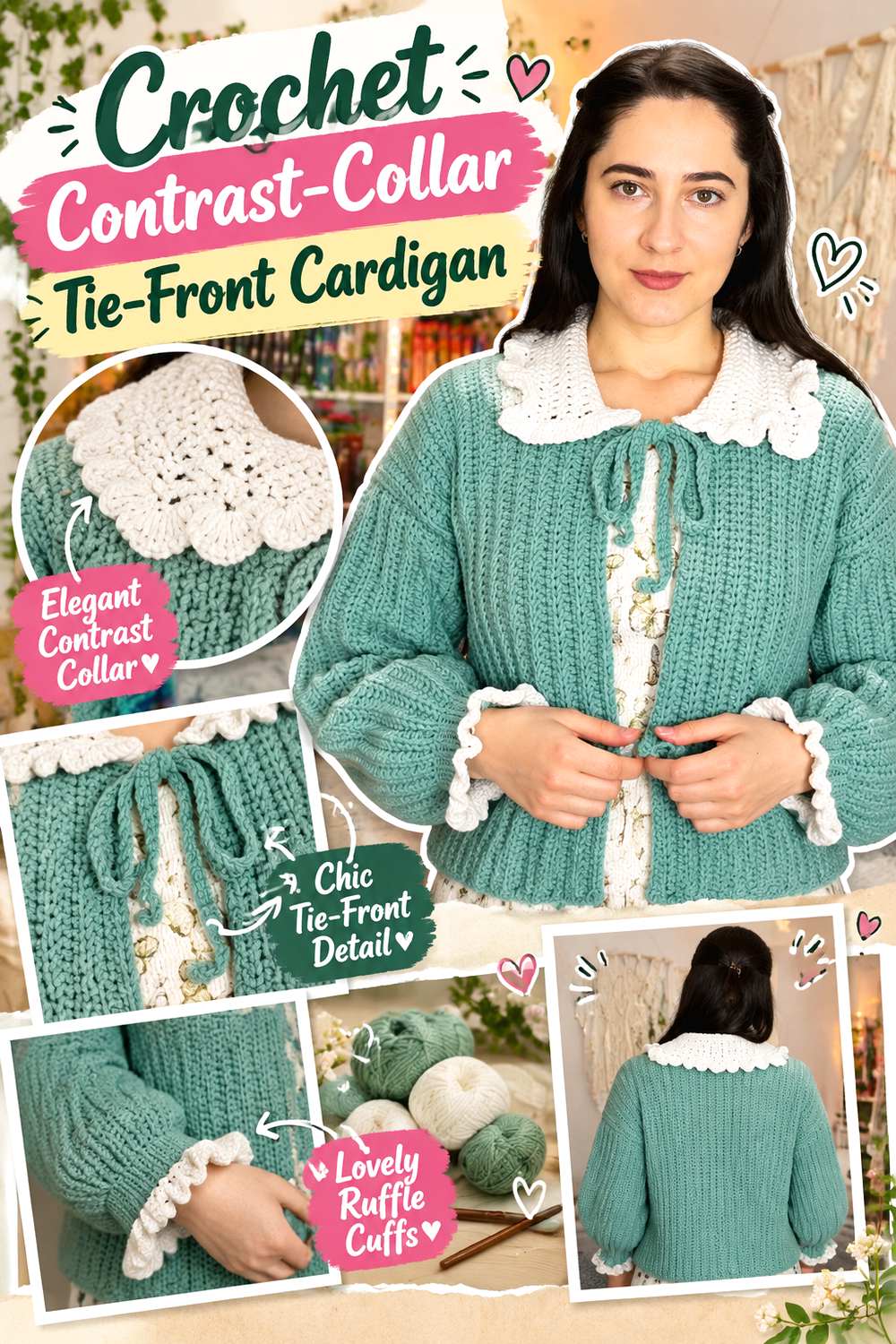
SAVEThis cardigan takes a softer approach to the front opening. The tutorial from Вика с крючком🧶 shows separate body pieces, long sleeves, a contrasting collar and sleeve edging, plus front ties rather than a conventional row of buttons. The contrast color makes the neckline easy to read visually and helps separate the collar from the main fabric.
Because the front is tied rather than continuously fastened, the cardigan has a lighter, less jacket-like effect than several other projects here. It works particularly well as inspiration when you want the high-collar idea without turning the entire front into a heavy button band.
Decide How Much Front Coverage You Need
Ties create a different fit from buttons or a zipper. They secure specific points but allow the fabric above and below them to separate naturally.
When evaluating this style, think about what you expect to wear underneath. A tie-front cardigan can work well as a visible layering piece, while someone wanting wind protection or continuous front coverage may prefer a buttoned or zipped option elsewhere in the list. Do not assume changing the closure will be purely cosmetic; it can alter how the neckline and collar sit.
Use Contrast Where It Clarifies the Shape
A contrasting collar emphasizes every irregularity in the neckline because the eye naturally follows the color change. Before starting the accent yarn, check that both front neck edges are symmetrical and that the shoulder seams sit where expected.
If you prefer a quieter look, the same general concept can be made in one color. The structural contrast between the collar and body will remain, but minor differences in stitch placement will be less visually prominent.
Original Tutorial and Creator Credit
Creator: Вика с крючком🧶
3. Crochet Granny Stitch Cinched Sleeve Collar Cardigan
 SAVE
SAVEHannah Drapinski’s cardigan combines granny-stitch fabric with a distinct collar, cinched sleeves, and an option to add buttons. That combination gives the cardigan an open, familiar crochet texture while reserving more definition for the neckline and cuffs.
Compared with a dense high-neck cardigan, this version reads lighter and more relaxed. The collar provides a clear frame without requiring the whole garment to be heavy. It is also a useful reference if you like traditional granny-style stitch groupings but want something more shaped than a basic rectangular motif cardigan.
Keep Open Fabric From Losing Its Shape
Granny-style fabric can behave differently from dense ribbing or compact stitches, particularly when a cardigan becomes long or heavy. The collar and sleeve finishes create firmer boundaries, so check whether the body is stretching after the garment is assembled.
Blocking can help even the stitch groups, but it should not be used to force a badly proportioned garment into shape. Measure the pieces before and after blocking so you understand how your chosen yarn responds.
Choose Buttons for Function or Leave the Front Relaxed
The tutorial allows for buttons, which means you can decide whether the cardigan should close or remain primarily an open layer. That choice affects how carefully you need the two front edges to align.
If you add buttons, test the cardigan while worn before final placement. Open crochet fabric can shift more visibly around a closure point than a dense fabric. Make sure the button does not pull one cluster out of shape or create an unwanted gap between fastening points.
Original Tutorial and Creator Credit
Creator: Hannah Drapinski
4. Crochet Unisex Midwest Shawl Collar Cardigan
 SAVE
SAVEThe Midwest Cardigan from Bag-O-Day Crochet uses a substantial shawl collar and a relaxed, buttonable silhouette intended for either men or women. The tutorial also shows a textured body and optional toggle-style closures, giving the project more of a jacket character than a lightweight indoor cardigan.
A shawl collar is a practical high-collar alternative when you want warmth without a narrow neck opening. Instead of standing straight up, it spreads around the back neck and rolls into the front edges. That makes this design particularly useful for layering over shirts and other tops with their own necklines.
Allow Room for the Layer Underneath
A substantial cardigan should be evaluated over the type of clothing you actually plan to wear beneath it. If you measure yourself over a thin shirt but expect to use the finished piece over a sweater, the shoulders and upper arms may feel more restricted than anticipated.
Pay particular attention to positive ease recommendations in the creator’s tutorial. Changing the intended ease can affect not only the body width but also how the wide collar rests across the shoulders.
Check the Collar Before Attaching Closures
The collar and front fastening system visually intersect, so decide how you want the cardigan to sit when closed. A shawl collar may overlap or roll differently once the fronts are pulled together.
Before permanently placing toggles or alternative buttons, pin the closures temporarily and wear the cardigan for a few minutes. Check that the collar stays even and that the fastening does not pull the fronts into a shape you dislike.
Original Tutorial and Creator Credit
Creator: Bag-O-Day Crochet
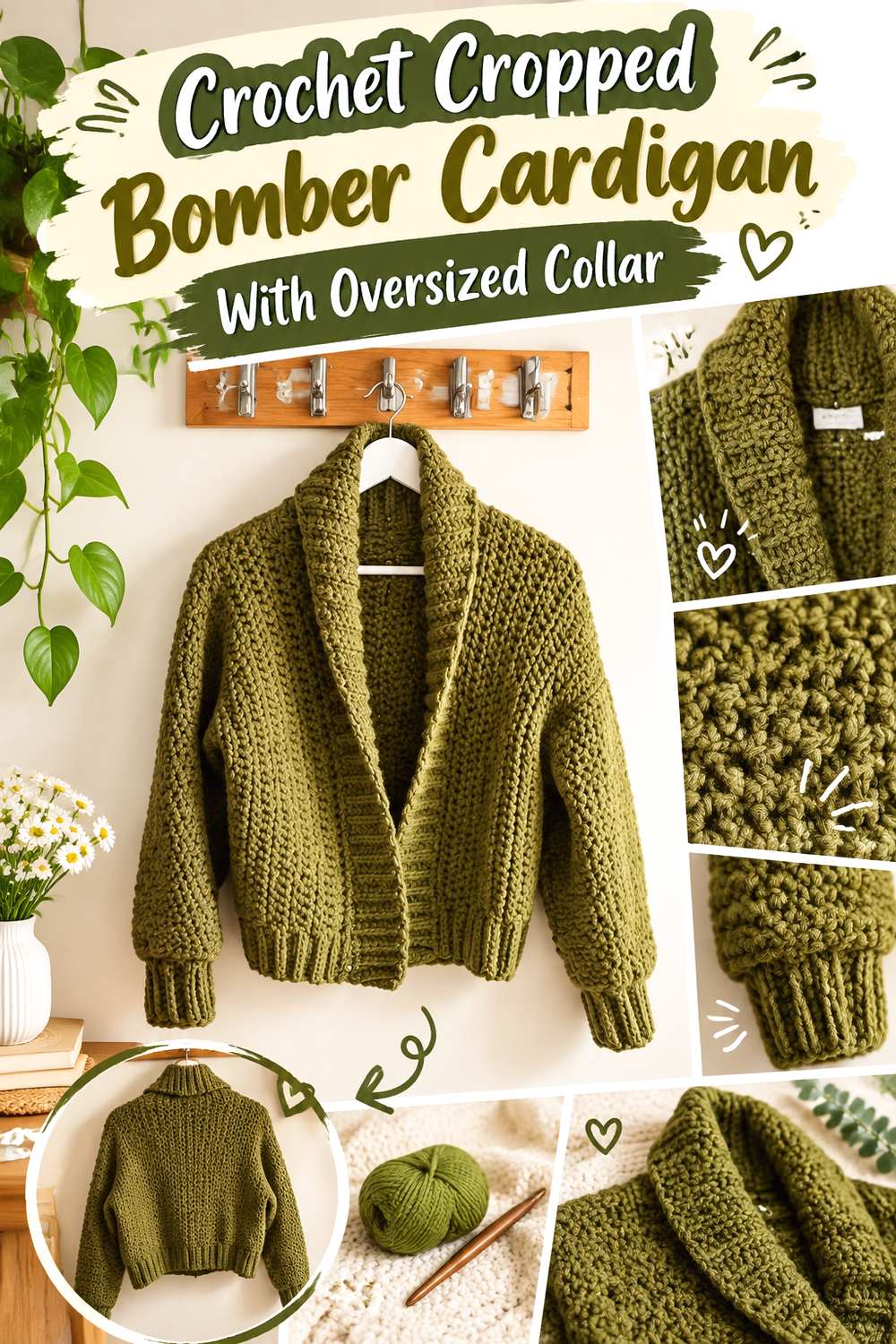
5. Crochet Cropped Bomber Cardigan With Oversized Collar
 SAVE
SAVEBlue Star Crochet’s Los Angeles-style bomber cardigan has a waist-length body, roomy straight sleeves that create a slightly ballooned effect, and a large collar that wraps broadly around the neckline. The original tutorial uses a super-chunky construction, making the collar a major part of the silhouette rather than a narrow finishing band.
This is one of the strongest choices in the collection when the collar itself is the statement. The cropped bomber shape keeps the visual weight concentrated near the upper body, while the substantial yarn gives the collar enough presence to balance the sleeves.
Balance Collar Bulk With Sleeve Volume
Large collars and full sleeves compete for visual space. On this bomber, that volume is intentional, but substitutions can exaggerate it.
If your yarn creates a denser or stiffer fabric than the sample, make a generous swatch and fold it the way the collar will sit. A fabric that feels pleasant as a flat square can become cumbersome when doubled or gathered around the neck. Conversely, an extremely soft substitute may make the oversized collar collapse more than expected.
Cropped Does Not Mean Close-Fitting
Bomber proportions often combine a shorter body with ease through the torso and sleeves. Reducing width simply because the cardigan is cropped can remove the relaxed character that supports the oversized collar.
Choose size by the designer’s measurements and intended ease rather than by the hem position. If you want a longer bomber, length is often a safer area to customize than aggressively reducing body width.
Original Tutorial and Creator Credit
Creator/Site: Blue Star Crochet
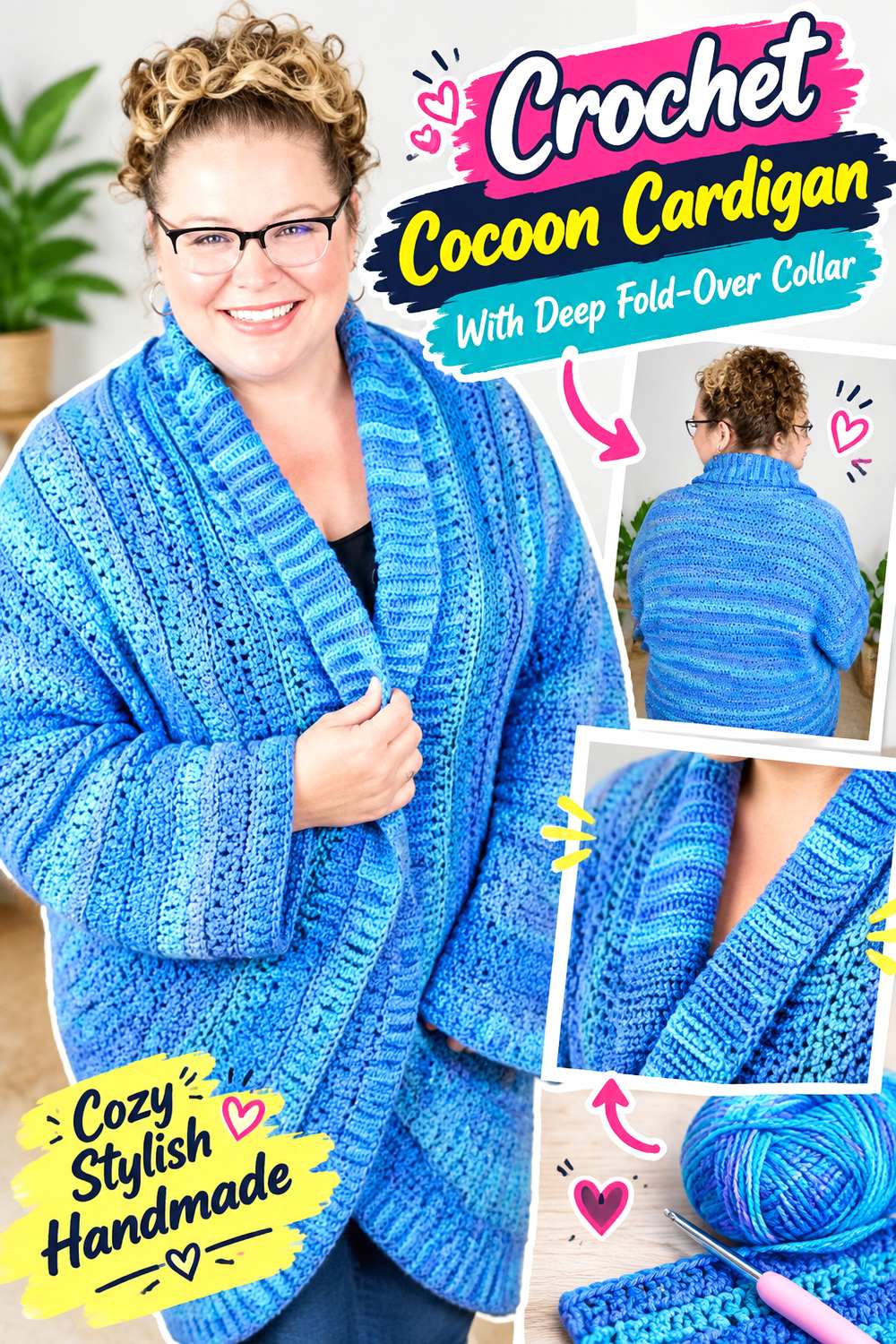
6. Crochet Cocoon Cardigan With Deep Fold Over Collar
 SAVE
SAVEThe You Are Valued Cocoon Cardigan from Marly Bird starts with a simple oversized body shape and finishes it with a dramatic ribbed fold-over collar. The tutorial describes a one-rectangle construction with minimal seaming and a join-as-you-go treatment for the cuffs and collar. The collar itself is intentionally deep, making it one of the most neckline-focused options in this roundup.
Unlike a conventional cardigan with shaped front panels, a cocoon wraps around the body. That changes how the collar functions: it is both a neckline finish and a major part of the cardigan’s outer frame.
Prioritize Drape Through the Body
A cocoon shape needs enough movement to fold around the wearer. If the fabric is too rigid, the cardigan can stand away from the back instead of forming the intended curved silhouette.
The collar can be firmer than the body, but it still needs to bend smoothly around the opening. When substituting yarn, compare the drape of a washed swatch with the sample shown in the tutorial instead of judging the yarn only from the skein.
Decide Collar Depth Before You Commit
Marly Bird’s design makes the collar a deliberate feature, and the tutorial notes that collar dimensions can be adjusted.
A very deep collar increases drama but also adds yarn, weight, and bulk around the shoulders. If you are petite, using a particularly heavy fiber, or prefer a cleaner neckline, consider a shallower version while preserving enough depth for a visible fold. Pin a strip of swatched fabric around the opening to preview the scale.
Original Tutorial and Creator Credit
Creator: Marly Bird
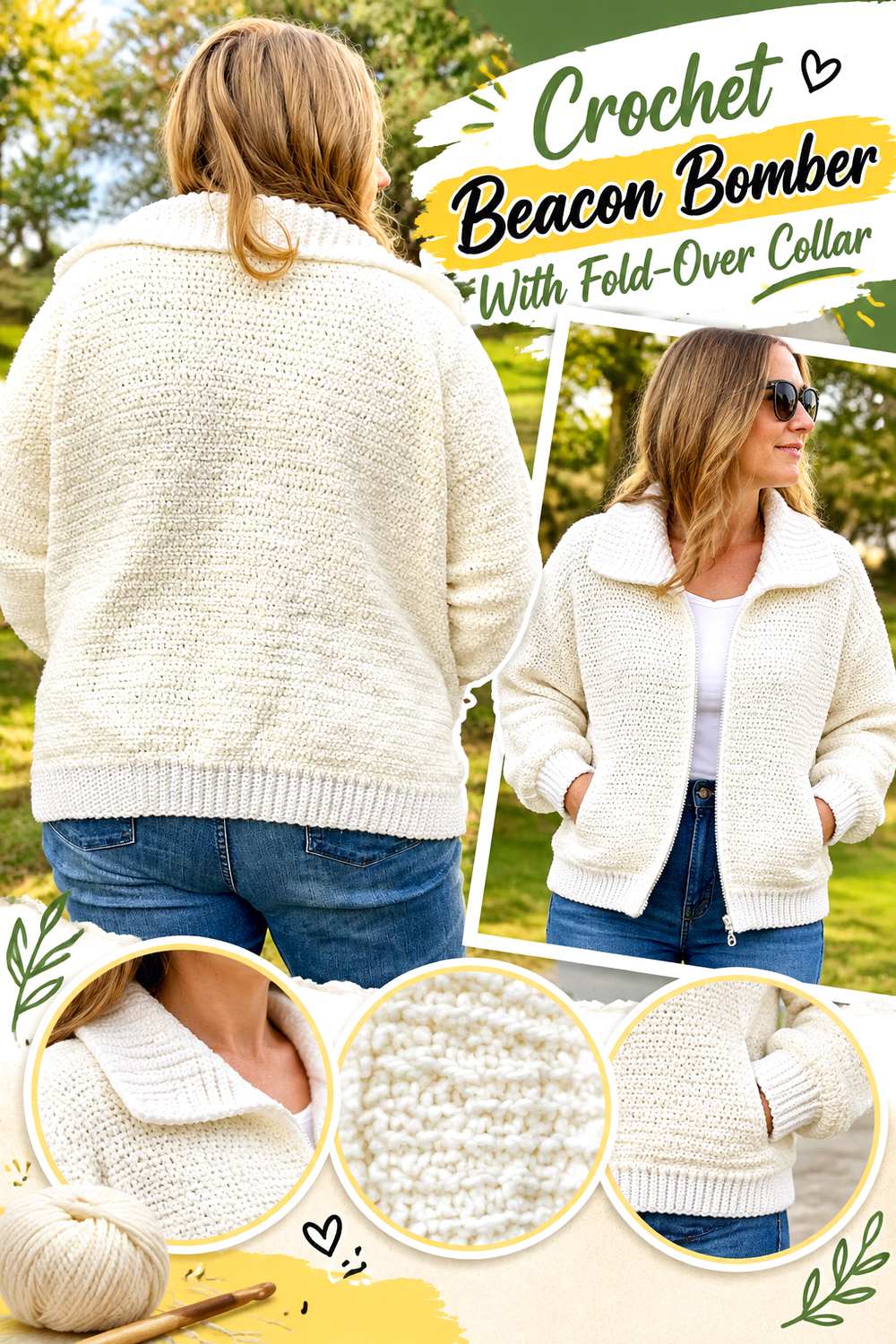
7. Crochet Beacon Bomber With Fold Over Collar
 SAVE
SAVEThe Beacon Bomber from Meghan Makes Do brings a more defined jacket silhouette into the collection. Its finishing stage includes a fold-over collar and front edgings, giving the bomber a structured frame around the neckline and opening. The original crochet-along also provides focused guidance for seaming and collar construction rather than treating the neckline as an afterthought.
This project works well for readers who like bomber styling but want something more tailored than an oversized shawl collar. The applied collar creates a distinct boundary at the neck while the front edges remain clearly separated.
Make the Shoulder Seams a Checkpoint
An applied collar can only sit as evenly as the neckline beneath it. Before adding the collar, check that the shoulder seams meet symmetrically and that the back neck opening is centered.
If one shoulder is longer or the fronts were seamed at slightly different depths, the collar can make that discrepancy more obvious. Correct the base garment first rather than trying to disguise unevenness with the edging.
Keep the Front Edges From Waving
Applied edging adds stitches along an existing edge. Too many picked-up stitches can make the band ripple, while too few can pull the cardigan upward.
Use the pattern’s placement guidance as the starting point and check the fabric frequently. Lay the cardigan flat without stretching it. A clean bomber front should remain smooth before you move on to any closure or final finishing.
Original Tutorial and Creator Credit
Creator/Site: Meghan Makes Do
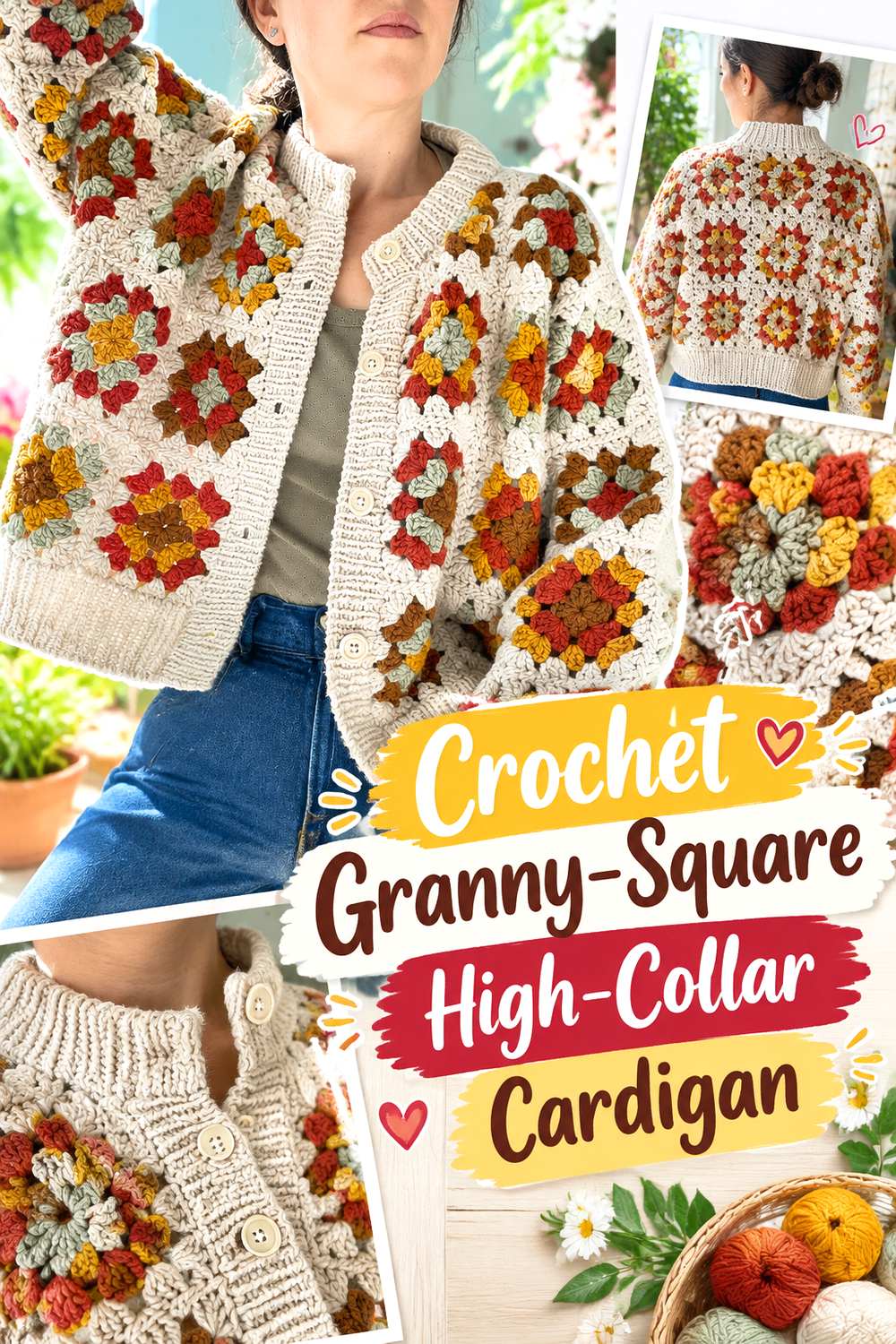
8. Crochet Granny Square High Collar Cardigan
 SAVE
SAVEBethany Lynne’s Sunlight Cardigan is one of the most distinctive projects here because the body is formed from crochet granny squares while the finishing incorporates knitted ribbing. The finished cardigan is oversized and slightly cropped, with a higher neckline, folded collar, and gently bell-shaped sleeves.
The combination produces a strong contrast between colorful modular crochet and restrained ribbed finishing. It is a useful idea for experienced makers who enjoy granny squares but want a neckline that looks more substantial and controlled than a basic crochet border. Note that the original tutorial deliberately combines crochet and knitting.
Plan Motif Size Before Body Size
On a motif cardigan, sizing changes are not always as simple as adding a few stitches. The Sunlight tutorial explains that changing square size or changing the number of squares can alter width and length.
Before making dozens of motifs, create and block a sample square. Calculate how the finished motif dimensions will affect the body and sleeves. Small differences multiplied across several squares can produce a much larger garment than expected.
Let the Collar Calm the Colorwork
A high folded collar can act as a visual resting point on a colorful motif garment. Keeping the collar in the main joining color creates a clearer frame around the face and prevents every area of the cardigan from competing equally.
If you change the palette, lay several completed squares beside a sample of the planned collar color. Strong contrast can make the collar a graphic feature, while a color repeated throughout the motifs will integrate it more quietly.
Respect the Hybrid Construction
This is not a fully crocheted finishing system: the original project combines crochet motifs with knitted ribbing.
If you want an all-crochet version, treat that as an adaptation rather than assuming crochet ribbing will behave identically. A replacement band may have different stretch, recovery, and thickness. Make a test section before committing it to the entire neckline.
Original Tutorial and Creator Credit
Creator/Site: Bethany Lynne Makes
9. Crochet Mens Knit Look Shawl Collar Cardigan
 SAVE
SAVEA Crocheted Simplicity’s Men’s Shawl Collar Crochet Cardigan offers a more traditional sweater-jacket direction. The design uses knit-look crochet texture, a broad shawl collar, buttoned front, and optional side-seam pockets. The original pattern is presented in multiple men’s sizes.
The collar is substantial without being an upright turtleneck, making this a strong option when you want neck coverage that can still sit comfortably over a shirt collar. Its classic proportions also contrast sharply with the cropped bombers, granny-square cardigan, and cocoon shapes elsewhere in the list.
Fit the Chest and Shoulders Before the Collar
A shawl collar can make a cardigan feel generous at the neckline, but it cannot compensate for a body that is too narrow through the chest or shoulders.
Use the pattern’s finished measurements and intended fit as your main sizing guide. If making the cardigan for someone else, compare a well-fitting existing cardigan with the pattern measurements rather than relying only on a general clothing size.
Consider Pocket Weight
Side-seam pockets add function without interrupting the front visually, but anything placed inside them contributes weight to the garment.
Keys, a phone, or other heavy contents can pull on a soft crochet fabric. If pockets are important to you, evaluate the finished fabric before treating them as load-bearing storage. A pocket that works well for hands or light items may distort when regularly overloaded.
Original Tutorial and Creator Credit
Creator/Site: A Crocheted Simplicity
10. Crochet Cozy Collar Oversized Cardigan
 SAVE
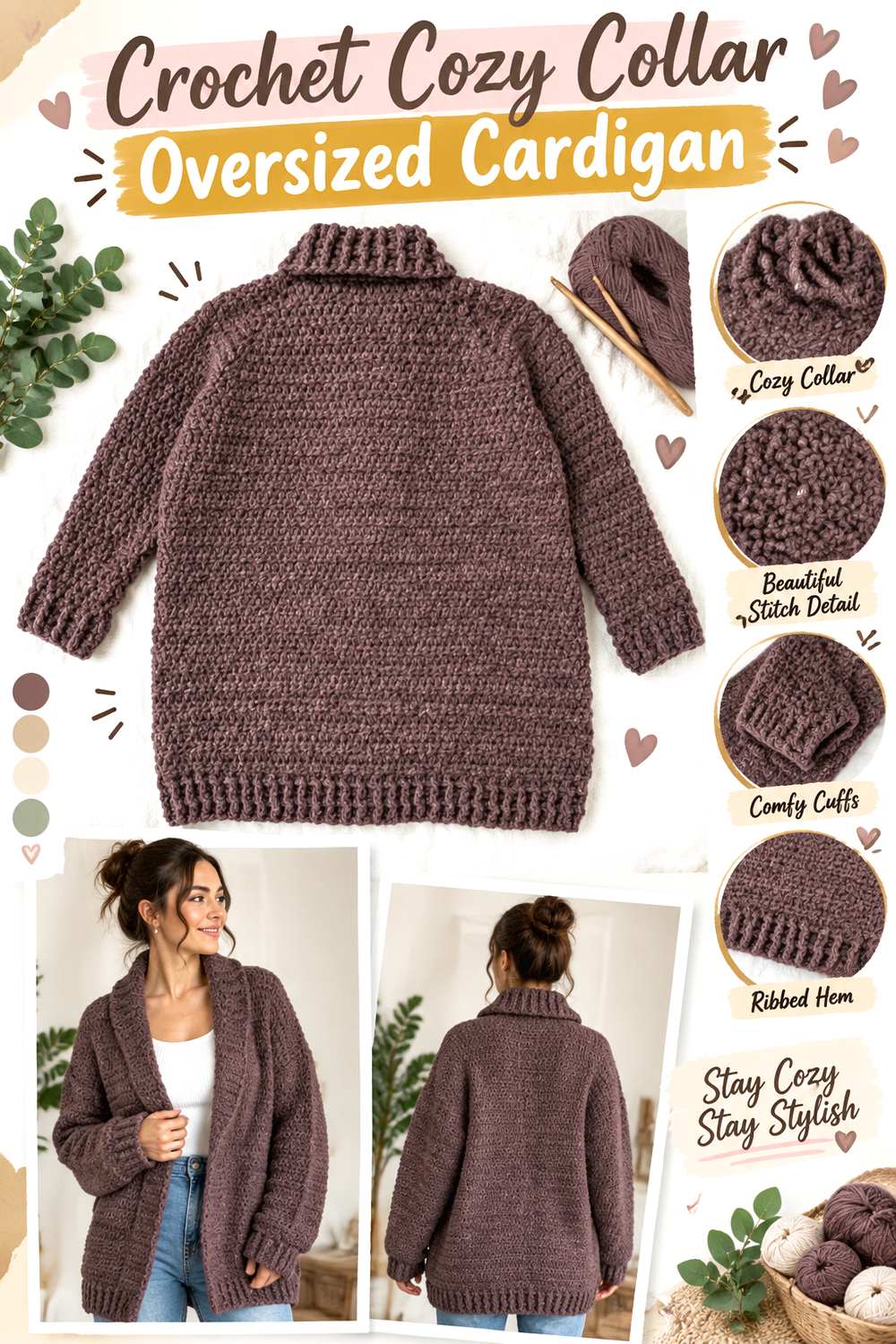
SAVEThe Patons Cozy Collar Crochet Cardigan is deliberately roomy, with a generous collar that extends the relaxed shape around the neckline. Yarnspirations describes the design as an intermediate crochet cardigan and provides finished measurements across a broad size range, with substantial positive ease visible between body and finished-garment measurements.
This is a strong choice if you want the high-collar idea to feel soft and enveloping rather than cropped or jacket-like. The body and collar work together as one oversized silhouette, so the result is better treated as a layering cardigan than a close-fitting sweater.
Read Finished Measurements, Not Just Size Labels
Oversized patterns can vary dramatically in how much ease they include. A size label such as medium does not tell you how loose the finished cardigan will actually be.
Compare your body measurement with the pattern’s finished garment measurement before choosing. If you are between sizes, decide whether you prefer the designer’s roomy effect or a slightly closer result. Avoid automatically sizing down several categories without considering sleeve and armhole dimensions as well.
Avoid Making the Collar Too Heavy
A generous collar already contains a considerable amount of fabric. Substituting a much heavier yarn can increase downward pull at the back neck and front edges.
Match the pattern gauge and consider the yarn’s weight per yard as well as its labeled category. Two yarns sold under the same weight class can produce noticeably different garment weight. A swatch large enough to feel in your hand gives more useful information than a tiny gauge square.
Original Tutorial and Creator Credit
Creator/Site: Yarnspirations
11. Crochet Little Girl Shell Stitch Collar Cardigan
 SAVE
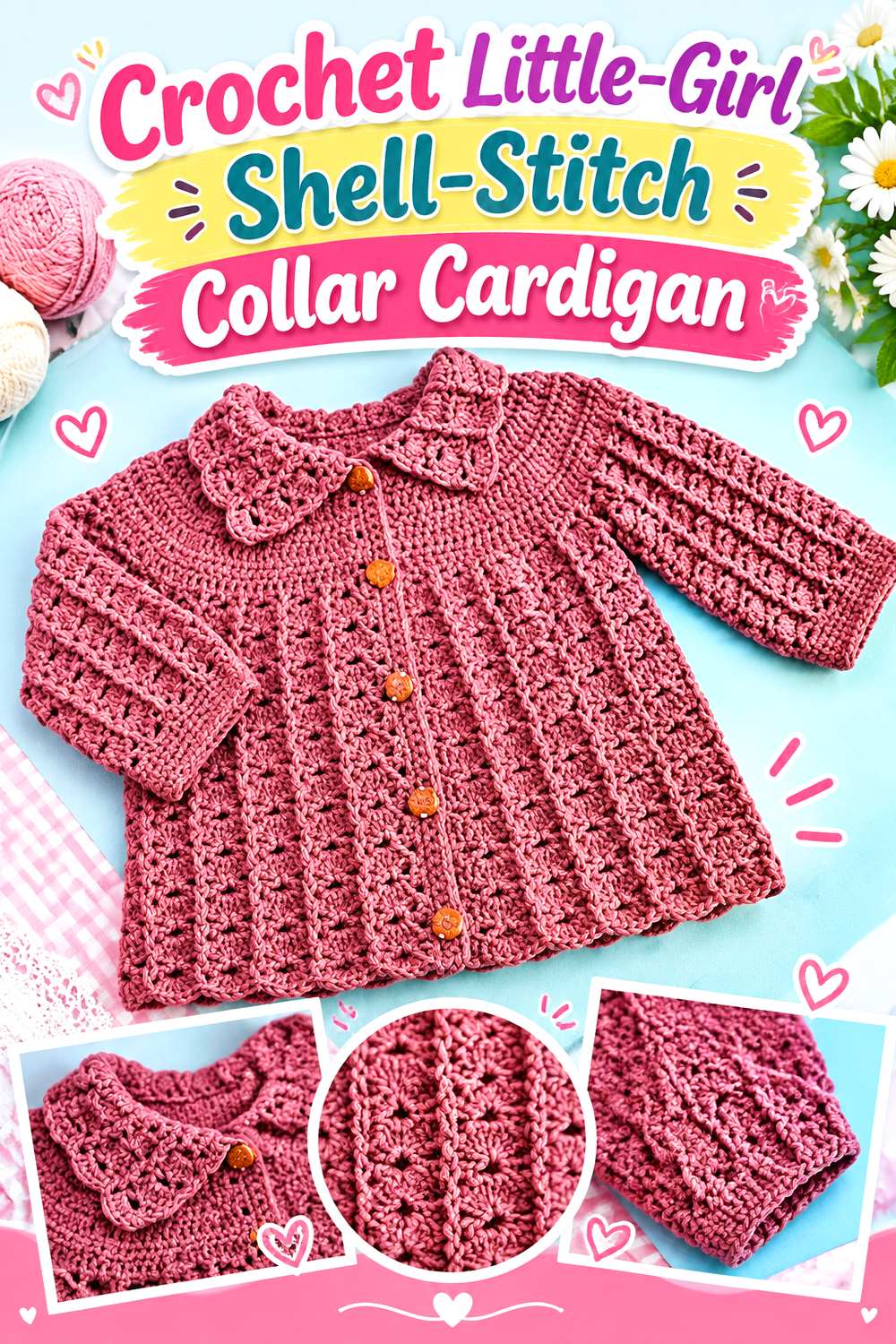
SAVECrochet Crosia’s child-size collar cardigan uses a buttoned coat-like shape with long sleeves and a decorative collar that continues the project’s shell and post-stitch texture. The original tutorial provides a 3–4-year sample along with additional sizing guidance and a video series.
This project adds a smaller-scale option to the collection and shows how a pronounced collar can become a decorative feature rather than merely extra neck coverage. The repeated shell texture gives the collar a shaped, scalloped appearance that is quite different from the ribbed and shawl collars used on adult cardigans.
Children’s Sizing Needs More Than Age
Age ranges are useful starting points, but children of the same age can have very different chest, arm, and torso measurements.
Compare the tutorial’s garment measurements with the intended wearer whenever possible. Allow comfortable movement and realistic room for the clothing that will be worn underneath. Do not enlarge a child garment solely by extending the body; sleeve width, armhole depth, neckline, and overall proportions may also need adjustment.
Treat Buttons as a Safety Detail
For a child’s cardigan, securely attach every button and inspect the garment periodically for loosened findings. Small detachable pieces can pose a hazard to very young children.
If the intended wearer is still likely to mouth or pull at clothing components, consider whether another closure treatment is more suitable. The tutorial provides the construction; responsibility for adapting closures to the specific child and use remains with the maker.
Original Tutorial and Creator Credit
Creator/Site: Crochet Crosia
12. Crochet Patchwork Cardigan With Contrast Collar
 SAVE
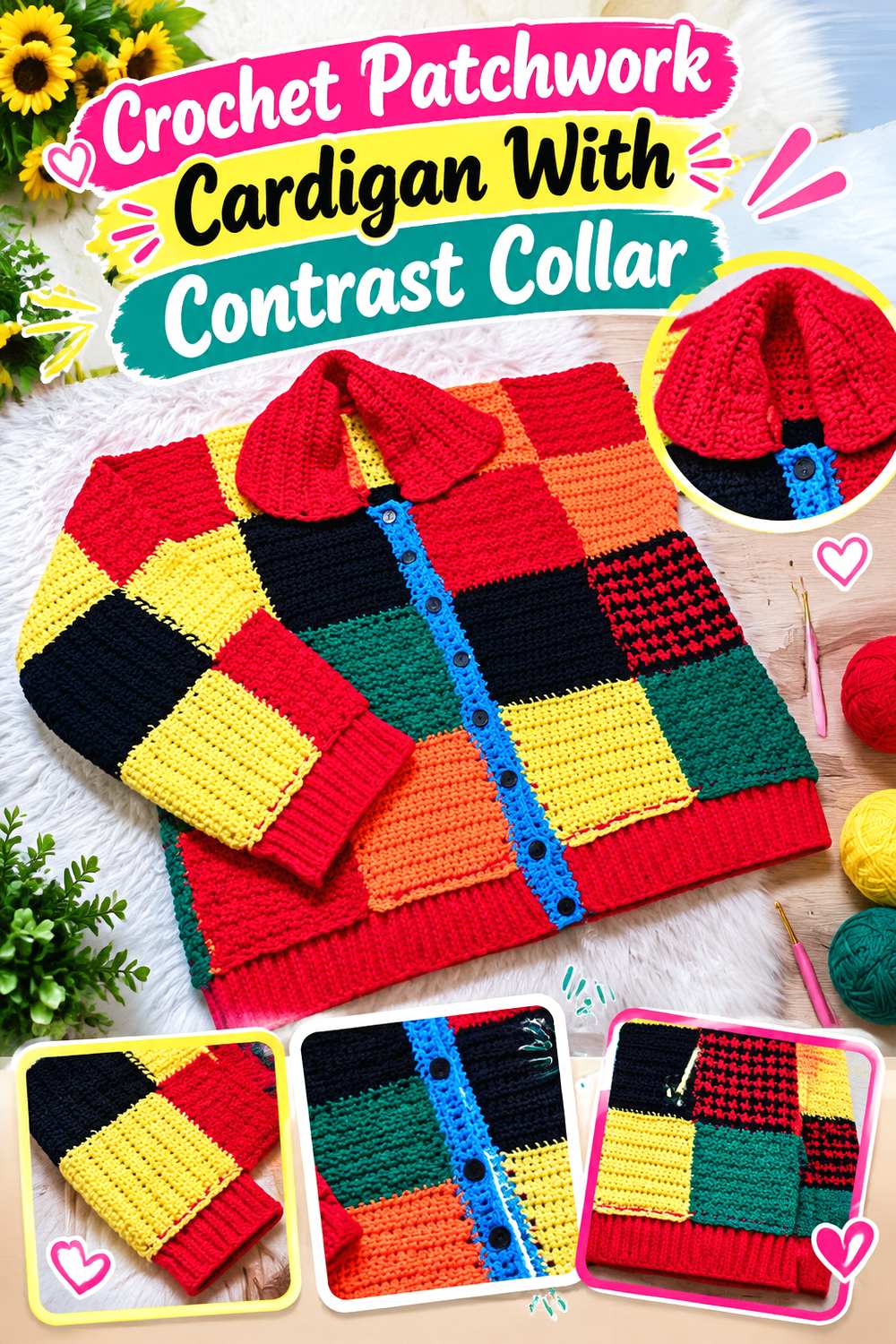
SAVESelina Veronique’s Iconic Patchwork Cardigan uses multiple colored blocks and finishes the neckline with a contrasting red collar. The tutorial also discusses ways to alter the overall size, making it a useful source for readers drawn to oversized patchwork cardigans but concerned about proportion.
Unlike a monochrome high-collar cardigan, this project makes the collar part of a broader color-placement strategy. The red neckline does not need to be extremely deep to stand out because the contrast is already strong. That makes this project valuable for understanding how color can give a moderate collar the same visual importance as a physically oversized one.
Map the Colors Before Joining
Patchwork garments can become visually uneven when the strongest colors accidentally cluster in one area. Lay out the completed sections before permanent assembly and view them from several feet away.
Pay particular attention to the blocks directly beneath the collar. If they are all similar in intensity to the collar color, the neckline may disappear into the patchwork. A little contrast around the neck can make the finished shape easier to read.
Size the Blocks as a System
Changing square dimensions changes nearly every part of a patchwork cardigan simultaneously. Smaller blocks can reduce overall width and length, but they may also affect armhole depth and sleeve proportions.
The original tutorial discusses resizing approaches. Before altering block size, calculate the complete body layout and compare it with a garment that fits you. Do not wait until all the blocks are finished to check total dimensions.
Original Tutorial and Creator Credit
Creator/Site: Selina Veronique
13. Crochet Girls High Neck Cardigan Coat
 SAVE
SAVESimona Crochet’s tutorial is explicitly built around a high-neck crochet coat for a girl, making it one of the closest literal matches to the high-collar theme. The project is presented as a multipart tutorial, with the first video establishing the cardigan-coat construction and a linked second installment continuing the project.
The high neckline gives this option a different purpose from decorative flat collars. It brings the fabric noticeably higher around the neck, making the garment read as cold-weather outerwear rather than a simple indoor cardigan.
Check Neck Comfort Before Adding Height
A tall collar should provide coverage without pressing uncomfortably against the throat. Children can also be more sensitive to scratchy fibers or stiff seams at the neck.
Before completing the full collar height, try the garment on the intended wearer when practical. Check that the neckline does not restrict turning the head and that the yarn feels comfortable against bare skin. If changing fiber, softness at the neck deserves more attention than it might elsewhere on the coat.
Keep Growing Room Proportional
Adding extra body width for future growth can be useful, but an oversized neckline can become awkward if every dimension is enlarged equally.
When adapting a child cardigan, treat chest room, body length, sleeve length, and collar opening as separate decisions. A coat can have extra ease through the torso while maintaining a reasonably controlled neckline. Follow the creator’s tutorial for construction and make measurement-based changes cautiously.
Original Tutorial and Creator Credit
Creator: Simona Crochet
14. Crochet Origami Kimono Sleeve Shawl Collar Cardigan
 SAVE
SAVEThe Bernat Origami Crochet Cardigan takes the high-collar idea into a broad, architectural silhouette. Yarnspirations describes the design with a shawl collar and kimono sleeves, while the finished measurements are grouped into generous size ranges rather than a close, tailored fit.
The wide sleeves and collar make this cardigan feel more like a wraparound outer layer than a conventional buttoned sweater. It is particularly distinct from the fitted cropped options because width, drape, and folded structure are more important than waist shaping or precise front closure.
Give Wide Sleeves Enough Space
Kimono-style sleeves create a continuous visual line through the shoulder and upper body. If the fabric is too stiff, that width can look angular rather than relaxed.
Swatch for drape as well as gauge, especially when changing yarn. Consider how the cardigan will fit under coats as well. A wide sleeve that looks balanced on its own may be uncomfortable under narrow outerwear.
Keep the Shawl Collar in Scale
The collar needs enough width to register against the broad cardigan body. Reducing it substantially can make the front look unfinished, while dramatically enlarging it adds even more fabric to an already voluminous shape.
If you alter the body size or yarn thickness, reassess collar depth after the main cardigan has taken shape. Use temporary pins or folded swatches to preview the proportion before committing to the full edging.
Original Tutorial and Creator Credit
Creator/Site: Yarnspirations
Comparing the High-Collar Cardigan Styles
| If you want… | Consider… | Main planning issue |
|---|---|---|
| A neat cropped layer | Lemon-peel or contrast-collar cardigan | Hem and button/tie proportions |
| Open crochet texture | Granny-stitch collared cardigan | Stretch and front-edge stability |
| A traditional substantial layer | Midwest or men’s shawl-collar cardigan | Ease through chest and shoulders |
| A dramatic neckline | Blue Star bomber or cocoon cardigan | Collar weight and yarn drape |
| Color as the main feature | Sunlight or patchwork cardigan | Motif/block dimensions and placement |
| Child-size outerwear | Shell-stitch collar or high-neck coat | Measurements, comfort, closures |
| Maximum relaxed width | Origami cardigan | Sleeve volume and overall drape |
Conclusion
These 14 crochet high collar cardigan ideas show that neck coverage can be achieved in very different ways. Upright collars create the clearest high-neck effect, while shawl collars give warmth with a more open front. Deep ribbed collars suit cocoons and bombers, and contrast collars can create strong definition without adding as much bulk. Granny-square, patchwork, child-size, cropped, unisex, and kimono-sleeve constructions also prove that a noticeable collar does not require one standard cardigan shape.
Choose the silhouette first, then look closely at how the collar interacts with the shoulders, front opening, and yarn. Once you have selected a project, use the linked original tutorial for its exact sizing, materials, construction, and finishing details.
Frequently Asked Questions
How high should a crochet cardigan collar be?
There is no single ideal height. A true stand or high-neck collar needs enough depth to rise around the neck comfortably, while a shawl collar can provide similar visual weight by spreading outward rather than upward. Consider the wearer’s neck length, sensitivity to fabric near the throat, and the yarn’s stiffness. If you are adapting a tutorial, sample the collar depth before permanently finishing the neckline rather than choosing a measurement by appearance alone.
Can I use a different yarn for a high-collar cardigan?
Usually, but gauge is only part of the decision. A substitution can match stitch dimensions while producing a fabric that is heavier, stiffer, stretchier, or much softer than the designer’s sample. Those differences are particularly noticeable in a collar because the fabric may be doubled or concentrated around the neck. Make a generous swatch, wash or block it according to the fiber’s care instructions, and check both its measurements and how naturally it folds.
How do I stop a crochet collar from flopping over?
First confirm that the original design is actually intended to stand upright. If it is, a collar may collapse because the yarn is too soft, the stitches are too loose, or the collar has been made taller than the fabric can support. A denser stitch or smaller hook might change the structure, but altering those elements can also change gauge. When following a tutorial, preserve the designer’s gauge before experimenting with reinforcement or construction changes.
Can I add a high collar to a regular crochet cardigan?
It is possible, but it is not always a simple add-on. The existing neckline must provide a suitable base, and extra collar fabric can pull, flare, or become too tight depending on stitch pickup and shaping. Test the idea with a removable or partially worked collar first. If the original cardigan has a deep V-neck or very wide opening, converting it to a close high collar may require neckline redesign rather than just additional rows.
Should a high-collar cardigan be blocked before adding buttons or a zipper?
Blocking before final closure placement is often useful because it lets the main fabric settle into its finished dimensions. That matters when buttons or a zipper need two front edges to meet evenly. However, follow the sequence given by the original tutorial if it specifies something different. Fiber content also affects blocking methods, so use the yarn label and creator guidance rather than assuming every cardigan should be wet-blocked in the same way.
Which high-collar style is easiest to layer?
A broad shawl or fold-over collar generally leaves more room around the throat for shirts and lightweight tops than a close stand collar. Cocoon and oversized cardigans also provide generous body ease, although their volume can make them harder to wear beneath another coat. If the cardigan itself will be your outer layer, a higher upright neck may be appealing. If it needs to fit beneath outerwear, evaluate sleeve and collar bulk together rather than considering the neckline alone.