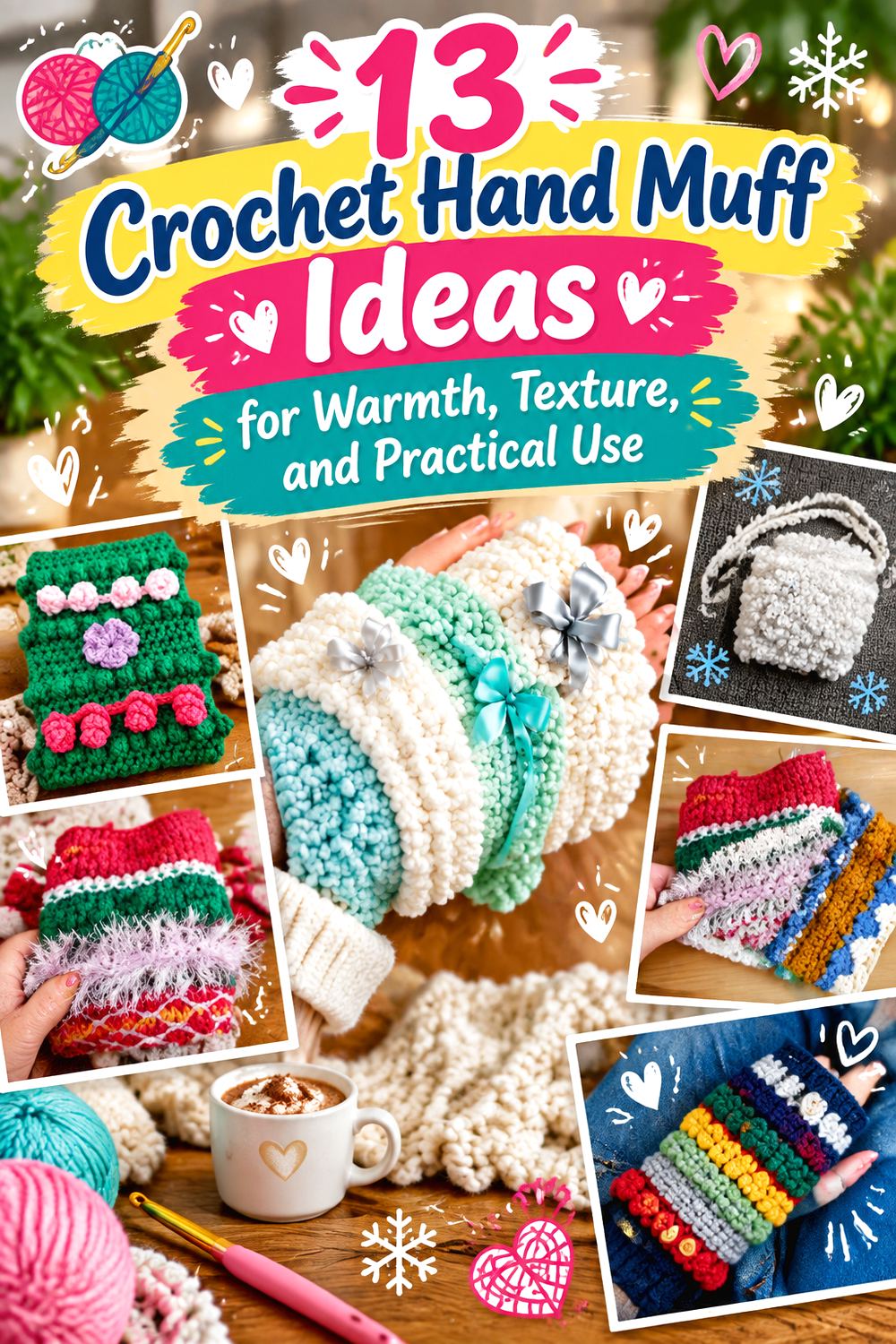
13 Crochet Hand Muff Ideas for Warmth, Texture, and Practical Use
A crochet hand muff can be a straightforward winter warmer, but the basic open-ended tube leaves much more room for variation than it first appears. Some designs emphasize dense fabric and plush yarn, while others add lining, cuffs, carrying cords, hidden storage, decorative openings, or even integrate the muff into another accessory. Sensory and twiddle muffs form another branch of the category, where contrasting textures and carefully chosen activity elements become central to the design.
These 13 ideas cover that wider range rather than repeating the same cylinder in different colors. You can compare simple cold-weather muffs with more structured fashion versions, then look at sensory constructions that use one-piece fabric, double layers, separate panels, bobbles, mixed yarns, and surface details. The accompanying original tutorials provide the exact construction information; the guidance here focuses on choosing, adapting, and checking each approach responsibly.
Quick List
- Crochet Double-Layer Faux-Fur Hand Muff
- Crochet Super-Bulky Corded Winter Hand Muff
- Crochet Balloon-Stitch Textured Hand Muff
- Crochet Hidden-Pocket Hand Muff Purse
- Crochet Scarf-End Faux-Fur Hand Muff
- Crochet Cuffed Faux-Fur Hand Muff
- Crochet Ruffled-Opening Hand Muff
- Crochet One-Piece Texture-Sampler Twiddle Muff
- Crochet Double-Layer Stash Twiddle Muff
- Crochet Two-Panel Decorated Twiddle Muff
- Crochet Freestyle Color-and-Texture Twiddle Muff
- Crochet Scrap-Yarn Sensory Hand Muff
- Crochet Bobble-Texture Fidget Hand Muff
Choose the Muff by Its Real Job
Start with function rather than stitch pattern. A traditional winter muff mainly needs comfortable hand access and enough substance to work with the wearer’s actual outerwear. Once a project gains a lining, faux-fur exterior, dramatic edging, purse compartment, or attached scarf, those features change how much room is available and how the piece hangs.
Sensory and twiddle muffs need a different decision process. Their texture is intentional rather than merely decorative, so the intended recipient matters before embellishments are chosen. A highly decorated sensory muff should not automatically be treated as interchangeable with an ordinary winter hand warmer. If the piece is being donated, check the receiving organization’s current requirements before deciding on size, materials, hard objects, loops, ribbons, or detachable-looking components.
Plan Opening Size, Bulk, and Carrying Details
The openings determine whether a winter muff is pleasant to use. Compare them with the wearer’s hands and with the sleeves or cuffs that will actually approach the muff. A thick border, plush yarn, lining, or inward-curving trim can reduce usable space even when the outside dimensions look generous.
Bulk also changes the balance. Faux fur and deeply raised stitches can make a muff visually fuller, while a pocket introduces objects and extra layers into the center. Neck cords, wrist loops, or scarf attachments put additional pull on specific areas of the crochet. When adapting a tutorial, check the unfinished project in its real wearing position before deciding that a carrying detail is the right length or that the hand openings are finished.
Treat Sensory Attachments as Recipient-Specific
Buttons, beads, bells, ribbons, rings, pompoms, zippers, flowers, and loops appear in various sensory-muff tutorials, but their presence in a tutorial does not mean every feature suits every user. Consider how firmly an item can be attached, whether fingers can become caught, whether an object could be pulled loose, and how the entire muff will be inspected and cleaned.
For donation projects, the recipient organization should have the final say on acceptable embellishments. Integrated crochet texture can be a useful alternative when separately attached pieces are inappropriate: bobbles, ridges, raised stitches, loops worked directly into the fabric, and contrasting stitch zones can create tactile differences without depending entirely on add-ons. Care also becomes easier to plan when the yarns and embellishments have compatible maintenance requirements.
1. Crochet Double Layer Faux Fur Hand Muff
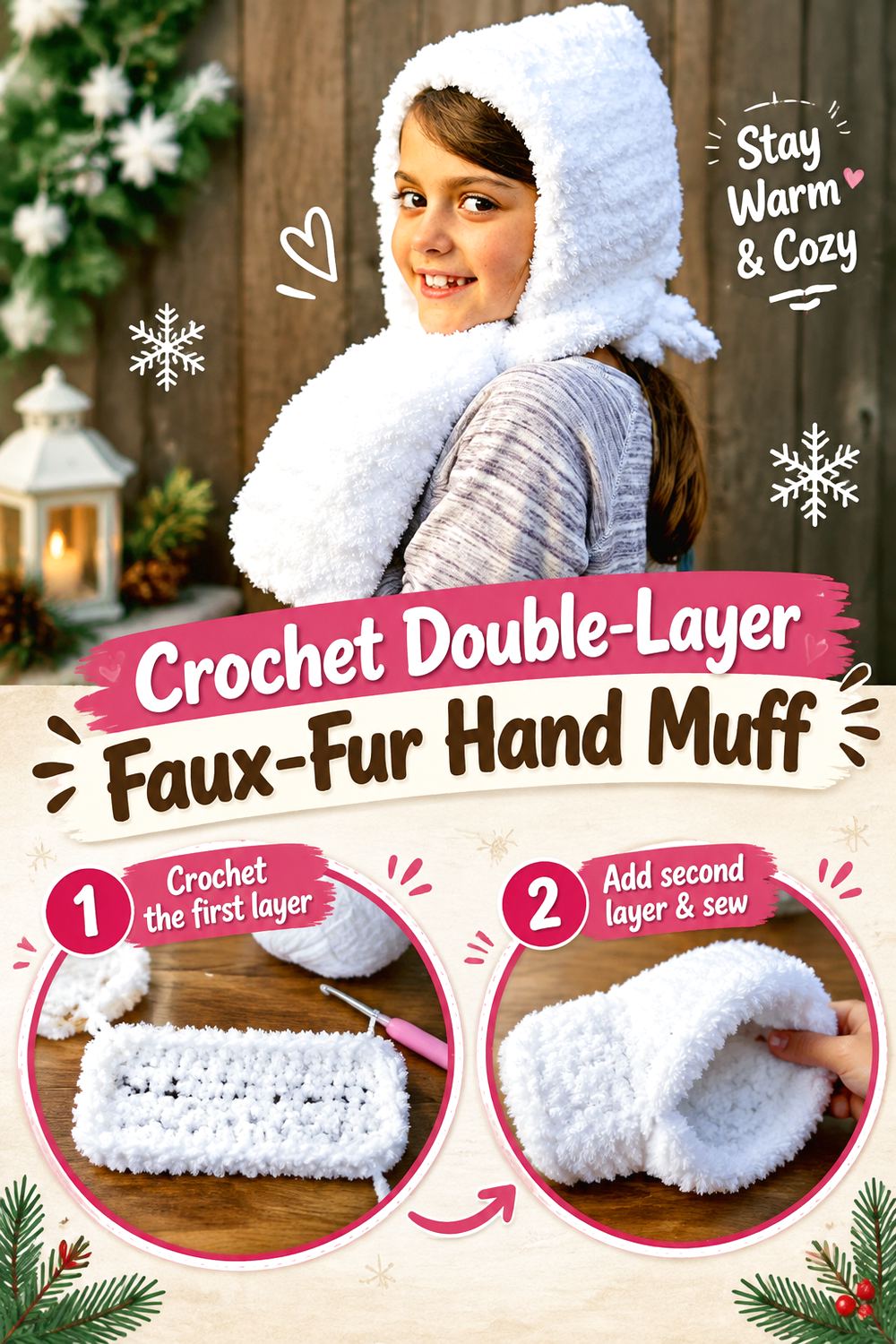
Pattern Paradise approaches the winter muff as a layered accessory rather than a single plush tube. The original design combines a smoother inner section with a longer faux-fur exterior that folds toward the openings, and it includes a carrying strap. The pattern is offered in child-oriented sizing, making this particularly useful when you want the appearance of fluffy fur without having the fuzzy fabric as the only surface against the hands.
That double-layer structure is the defining difference. It can give the openings a fuller framed look while keeping the internal fabric easier to feel and inspect than an all-fur construction.
A Lining Changes the Usable Interior
An inner layer takes up physical space, so outside circumference alone does not tell you how roomy the completed muff will feel. Before permanently closing the layers, place one inside the other and check whether hands can enter comfortably without dragging the lining toward the opening.
This becomes particularly important when the wearer has thick coat cuffs. If you adapt the dimensions, evaluate the lining and outer shell together rather than enlarging one layer in isolation.
Faux Fur Rewards Simple Checkpoints
Plush yarn can obscure individual stitches, which is useful aesthetically but less forgiving when you need to find a missed join or uneven edge. Mark important reference points while working and examine the underlying shape rather than judging only by the fluffy surface.
If substituting another faux-fur yarn, compare its thickness and behavior with the tutorial material before assuming the same proportions will result. A substantially bulkier substitute can affect both the opening and the fold-over effect.
A Child Strap Needs Its Own Safety Decision
The source includes a carrying strap, but adapting a corded wearable for a child deserves an age- and situation-specific check. Length, placement, supervision, and any optional decorative pieces should be considered according to the intended wearer rather than copied automatically.
If a strap is unnecessary, a muff can still function as a hand warmer without turning the cord into an essential design feature. For child projects, prioritize comfortable use and secure finishing over extra decoration.
Original Tutorial and Creator Credit
Creator/Site: Pattern Paradise
2. Crochet Super Bulky Corded Winter Hand Muff
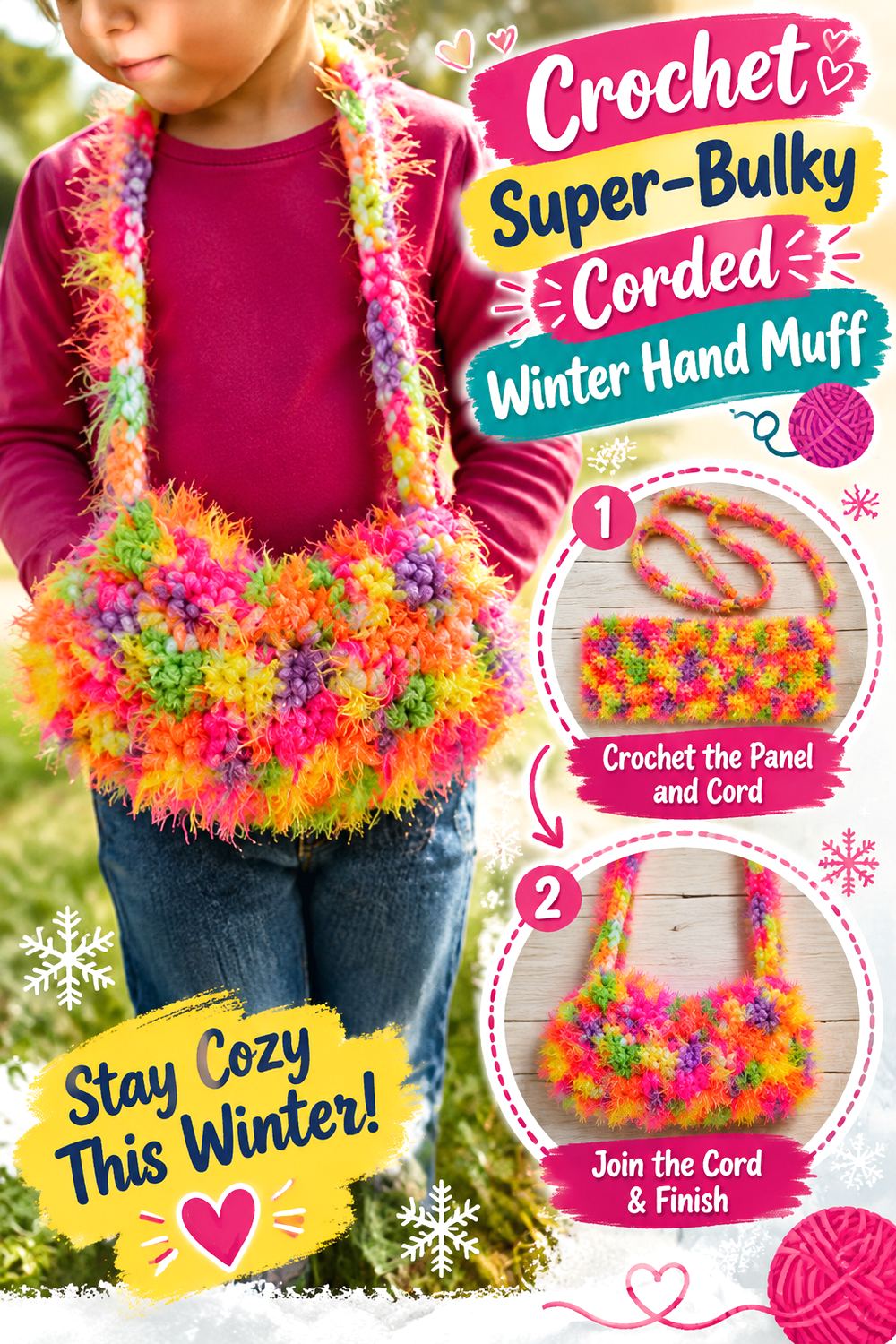
Swirls and Sprinkles keeps the construction much more direct. The original Winter Hand Muff uses super-bulky yarn, begins as a simple flat piece that is joined into a tube, and adds a separate crocheted cord through the muff. The creator describes the resulting size as workable for both herself and her daughter while noting that she has small hands.
That simplicity makes this a useful reference when you want the yarn’s softness and bulk to do most of the visual work. There is no need for lining, pockets, heavily shaped openings, or multiple decorative zones to define the finished accessory.
Test the Opening With Real Outerwear
A simple tube is easy to assess because the opening is not hidden by complicated trim. Use that advantage. Before finishing the seam, compare the circumference with the intended hands and any sleeves likely to sit beside the opening.
Super-bulky yarn can create substantial fabric quickly, but thick stitches also occupy interior room. Avoid assuming that a visually large tube will automatically feel loose once both hands and winter clothing are involved.
Decide Whether the Cord Helps the Wearer
The source includes a cord, but a carrying cord is optional from a practical standpoint. If you retain it, check where the muff hangs and whether the cord twists or pulls the tube out of shape.
A length that works for one wearer may sit awkwardly on another because height, coat bulk, and preferred hand position differ. Treat its placement as a fitting decision rather than a decorative measurement to copy blindly.
Original Tutorial and Creator Credit
Creator/Site: Swirls and Sprinkles
3. Crochet Balloon Stitch Textured Hand Muff
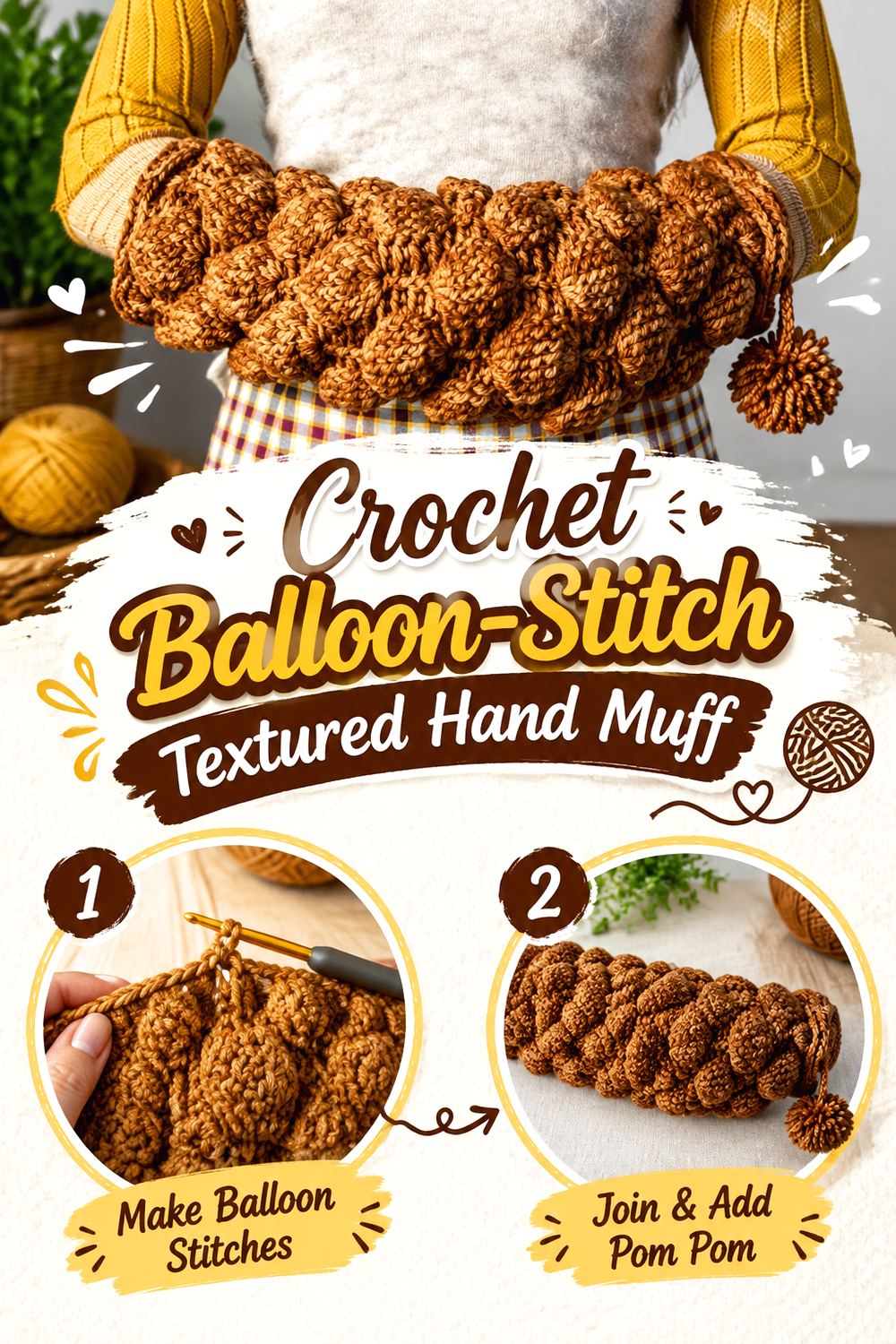
Nana’s Crafty Home gives the hand muff a much stronger stitch identity with the Embrace design. The project centers on the Balloon Stitch, a deeply textured fabric created with front- and back-post crochet techniques. Rather than relying on faux fur or attached ornaments for surface interest, the raised crochet itself becomes the visual feature.
This is a useful direction for a winter muff that should look detailed even in one restrained color. The pronounced texture also makes it meaningfully different from a smooth chunky tube: stitch depth, opening behavior, and the finished fabric’s thickness all become more important considerations.
Raised Texture Adds More Than Decoration
A deeply dimensional stitch changes fabric thickness as well as appearance. If you substitute yarn, make a useful sample large enough to feel the raised areas with your hand instead of judging only the front surface.
A yarn that produces crisp post stitches may emphasize the sculptural effect, while an especially fuzzy fiber can soften that definition. Decide whether you want the crochet architecture or the yarn texture to be the dominant feature.
Keep the Hand Openings From Becoming the Tightest Point
Strongly textured bodies often look substantial, so the openings can become visually understated. They still control comfort. Check whether the edge can accommodate the wearer’s hands without stretching aggressively each time the muff is used.
If you alter the border or add extra decorative finishing, reassess the opening afterward. An edging can behave more firmly than the main textured body even when both appear similar in width.
Let One Statement Stitch Carry the Design
Because the Balloon Stitch already creates a pronounced repeating surface, additional embellishment is optional rather than necessary. Too many unrelated trims can make it harder to appreciate the texture that distinguishes this muff.
For a more restrained accessory, use the stitch pattern as the focal point and keep other elements quieter. This also reduces the number of separate components that need to be maintained or checked during wear.
Original Tutorial and Creator Credit
Creator/Site: Nana’s Crafty Home
4. Crochet Hidden Pocket Hand Muff Purse
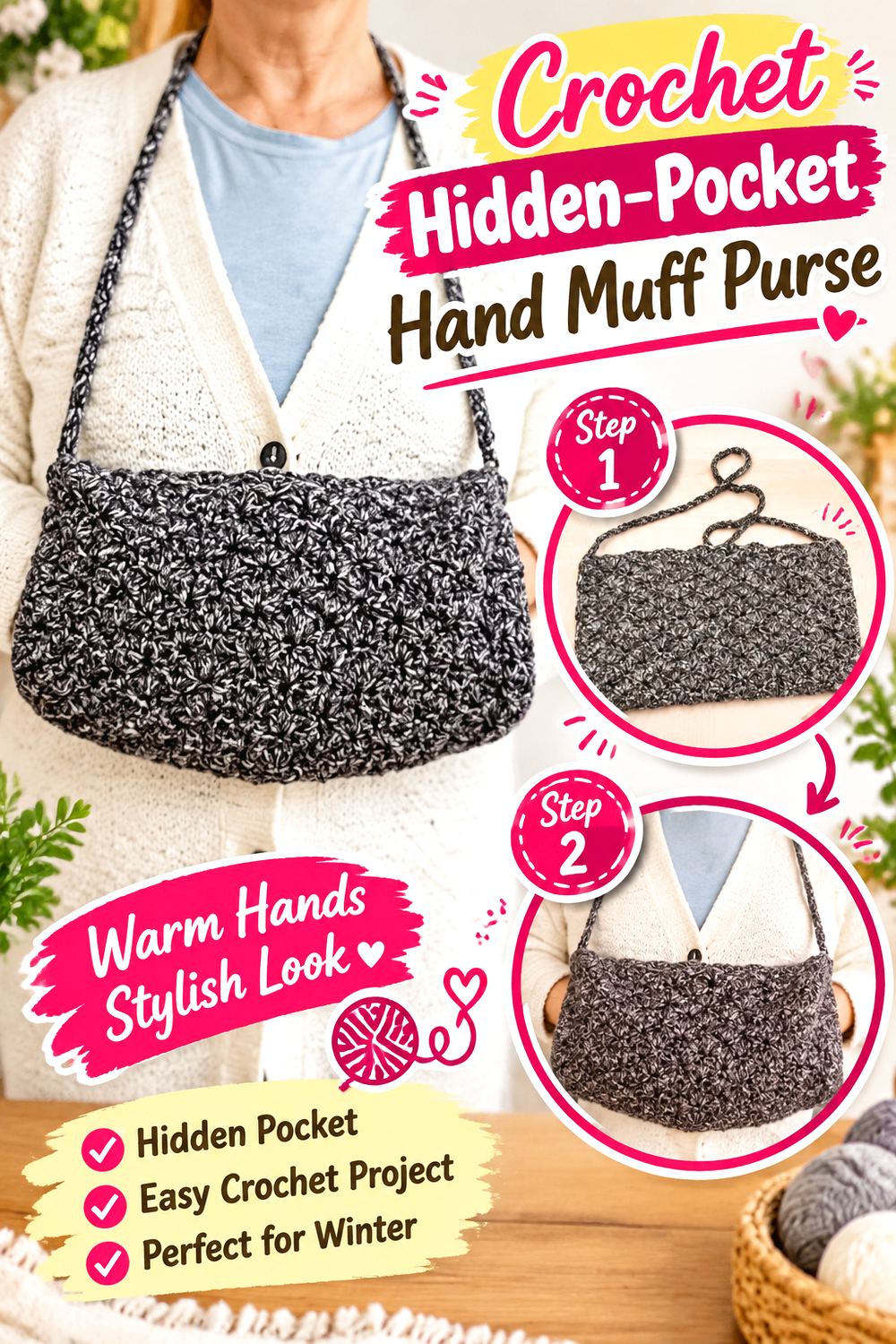
JoannesWeb turns the hand warmer into a hybrid accessory by combining a shell-textured crochet muff with a concealed bag, zipper, and carrying cord. That makes storage part of the construction rather than an afterthought. The tutorial specifically presents the project as a hand-warming muff with a hidden purse inside.
This version suits someone who likes the traditional two-hand warmer shape but also wants a place for a few small belongings. The trade-off is that the center can no longer be evaluated as empty hand space: the inner bag, zipper, contents, and crochet shell all need to coexist comfortably.
Stored Items Compete With Your Hands
A pocket that works well while empty may feel completely different after something rigid is added. Before modifying the storage area, test it with the type of objects you realistically expect to carry.
Flat cards have a different effect from keys or a phone. If the contents make the central space awkward, enlarging the outer shell is not the only possible answer; reducing what the pocket carries can preserve a more comfortable muff shape.
Balance Matters Once the Muff Carries Weight
A carrying cord supports more than crochet when the internal compartment contains belongings. Examine the attachment areas and how the muff hangs with representative contents inside.
If one side collapses or tilts noticeably, the issue may be weight distribution rather than overall size. Reinforcement can be worth considering where a strap meets the body, but any adaptation should preserve the original hand openings and zipper access.
Keep Decoration Clear of the Zipper
Shell texture already gives the exterior visible detail. Additional trims placed near the hidden pocket can interfere with opening the bag or make the zipper harder to locate by touch.
Before sewing on anything decorative, operate the pocket repeatedly while holding the muff in its normal position. The storage feature earns its place only if it remains convenient once the accessory is fully finished.
Original Tutorial and Creator Credit
Creator: JoannesWeb
5. Crochet Scarf End Faux Fur Hand Muff
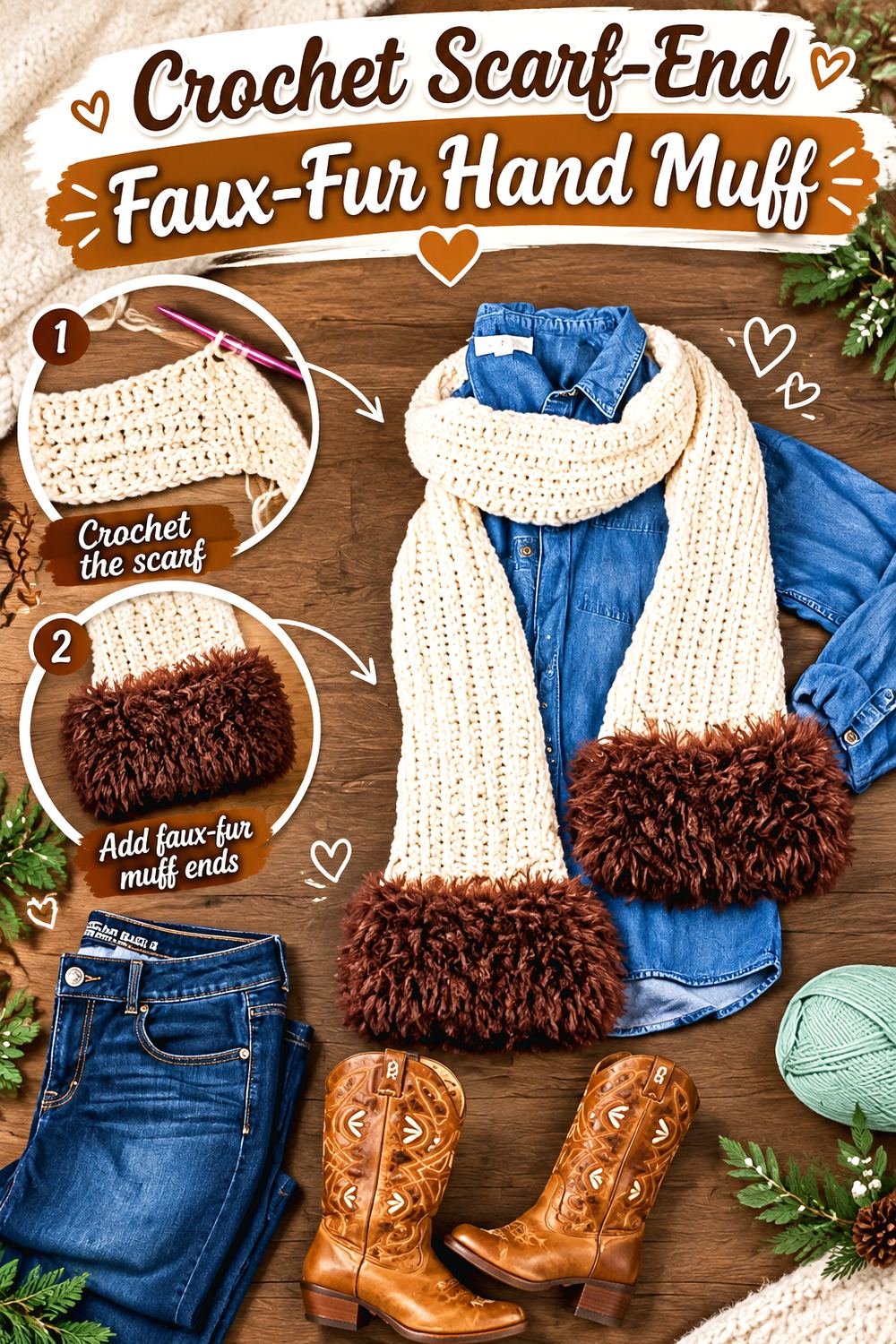
Salty Pearl Crochet takes the muff out of its usual standalone format. Katie Clary’s design places faux-fur muff sections at the short ends of a crocheted scarf, so the scarf itself provides the connection between the two hand-warming areas. The original page notes that the shown version is unlined and discusses lining as a possible adaptation for colder conditions.
This construction is useful when you dislike managing a separate muff or dangling cord. It also changes the fitting problem: scarf length, hand position, muff opening, and the way the whole piece sits around the neck now affect one another.
Scarf Length Controls Where the Hands Rest
With integrated end muffs, hand position cannot be adjusted independently from the scarf. Before finishing both ends, drape the scarf as it will actually be worn and check where your hands naturally reach.
Outerwear can change that relationship. A bulky coat collar or different wrapping style may shorten the effective drop, so test the accessory over the clothing it is intended to accompany rather than fitting it only over a lightweight top.
Two Muffs Should Feel Like a Matched Pair
Each scarf end forms its own hand-warmer section. Small differences in tension or joining can therefore become noticeable when both hands are placed in them simultaneously.
Compare the two openings before final finishing and check that neither side twists differently. Matching functional dimensions matters more here than making every individual stitch visually identical, particularly when faux-fur yarn hides much of the surface detail.
Consider Lining as a Climate Decision
The designer explains that her shown version is unlined, while noting that an added fleece layer could increase wind protection in colder conditions.
If you add any lining, remember that it changes thickness, flexibility, and care. Choose a material compatible with the intended yarn maintenance, and check the lined opening again before assuming it will feel the same as the original unlined construction.
Original Tutorial and Creator Credit
Creator/Site: Salty Pearl Crochet
6. Crochet Cuffed Faux Fur Hand Muff
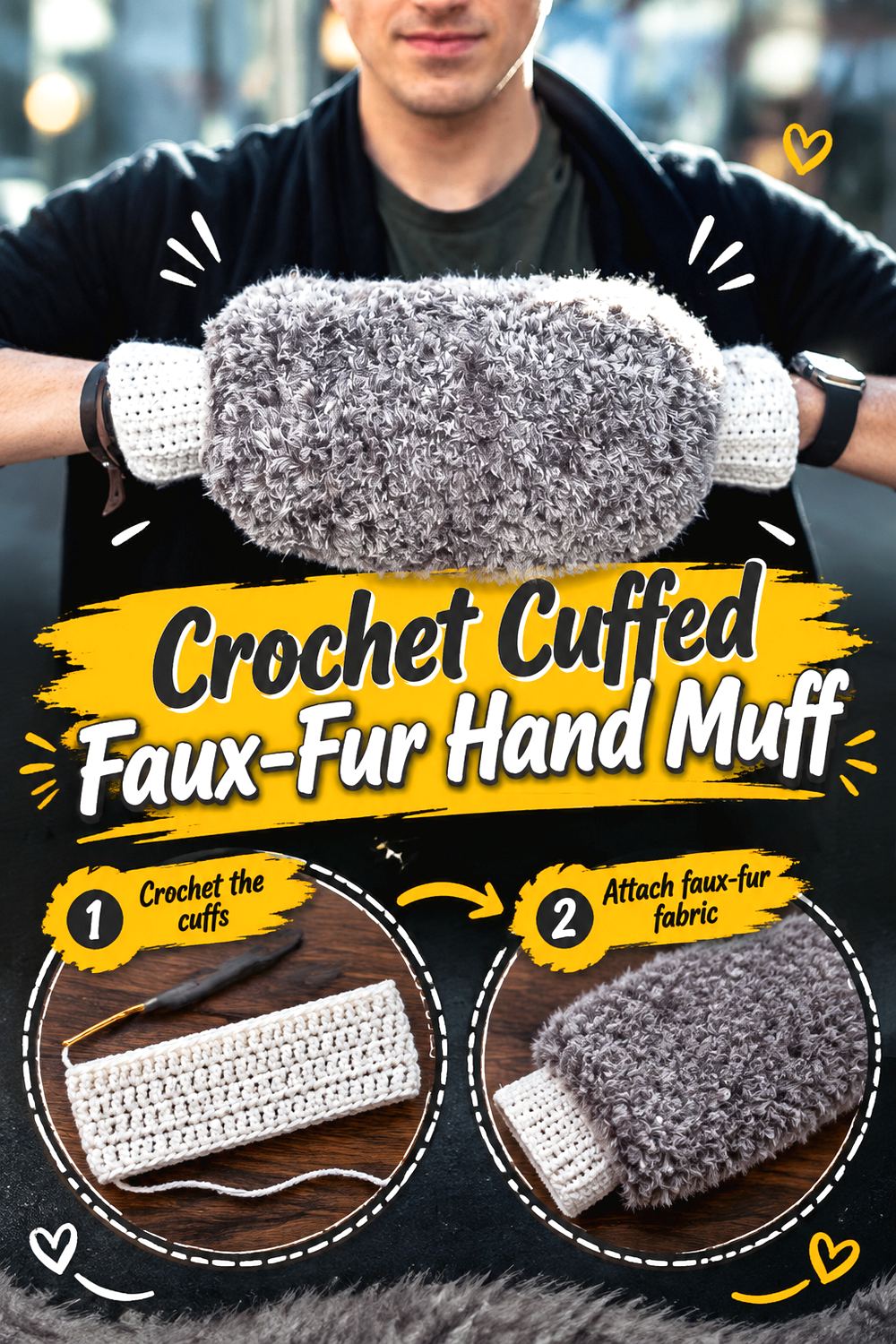
Knot Bad’s Crochet Fuzzy Muff creates a different plush structure from the fully lined faux-fur option above. Vincent Green-Hite’s pattern uses smooth crocheted wrist sections at the ends with a larger faux-fur body between them, producing clearly defined cuffs around the hand openings. The designer also notes that the dimensions can be adjusted for wrist size and preferred length.
Those contrasting cuffs give the fuzzy center a controlled frame and make the openings visually easier to identify. This is a useful route when you want a dramatic plush middle without making every part of the muff equally fluffy.
Cuffs Make Opening Fit More Obvious
A defined smooth cuff provides a clear place to evaluate fit. It should admit the hand without excessive pulling while still relating proportionally to the fuller central body.
If you resize the project, check both cuff circumference and center volume. Widening only the fuzzy section will not solve an opening that is uncomfortable, while loosening the cuff excessively can change the deliberate framed silhouette.
Fuzzy Yarn Can Conceal Shape Problems
The designer notes that stitches are difficult to see in the faux-fur portion. That makes tactile checking particularly useful.
Pause occasionally to feel the edge and confirm that the body has not unexpectedly narrowed or twisted. When substituting another plush yarn, sample enough fabric to understand how visible—or invisible—your stitch structure will be before committing to a full muff.
Original Tutorial and Creator Credit
Creator/Site: Knot Bad
7. Crochet Ruffled Opening Hand Muff
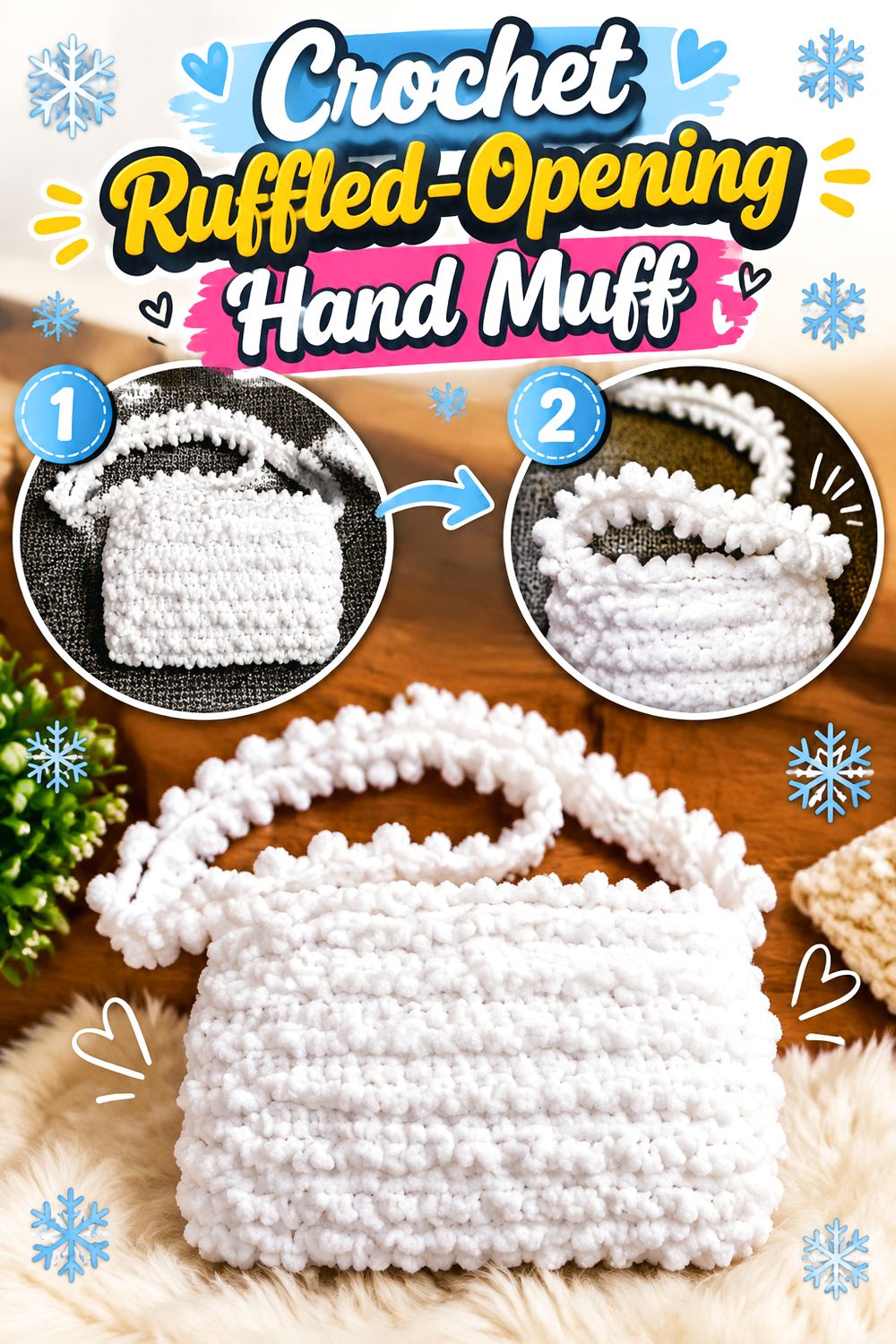
Häkelfreuden makes the hand openings the main decorative feature. The video tutorial presents a crochet muff with a prominent ruffle pattern, giving the edges movement and volume instead of leaving the tube ends plain.
This creates a more romantic fashion direction without requiring a hidden purse, scarf attachment, or shaggy faux-fur body. Because the embellishment occurs exactly where hands enter, however, appearance and function are closely connected. A deeper or denser ruffle may look impressive while lying flat yet behave differently next to coat cuffs and moving hands.
Ruffle Depth Can Reduce Practical Clearance
A decorative edge extends into the same area the wearer repeatedly handles. If you adapt the border, check it in motion rather than evaluating only a finished photograph.
Push both hands in and out several times while wearing the intended sleeves. If the ruffle consistently folds inward, catches, or bunches against the wrist, reducing its volume may improve everyday use without abandoning the decorative idea.
Give the Center Somewhere to Rest Visually
Strong ruffled openings already create two focal points. A relatively calmer central tube can help those edges read as intentional framing instead of one element in an overcrowded surface.
If changing colors, decide whether contrast belongs primarily at the ruffles or throughout the body. Repeating every decorative idea everywhere can weaken the feature that makes this version distinctive.
Original Tutorial and Creator Credit
Creator: Häkelfreuden
8. Crochet One Piece Texture Sampler Twiddle Muff
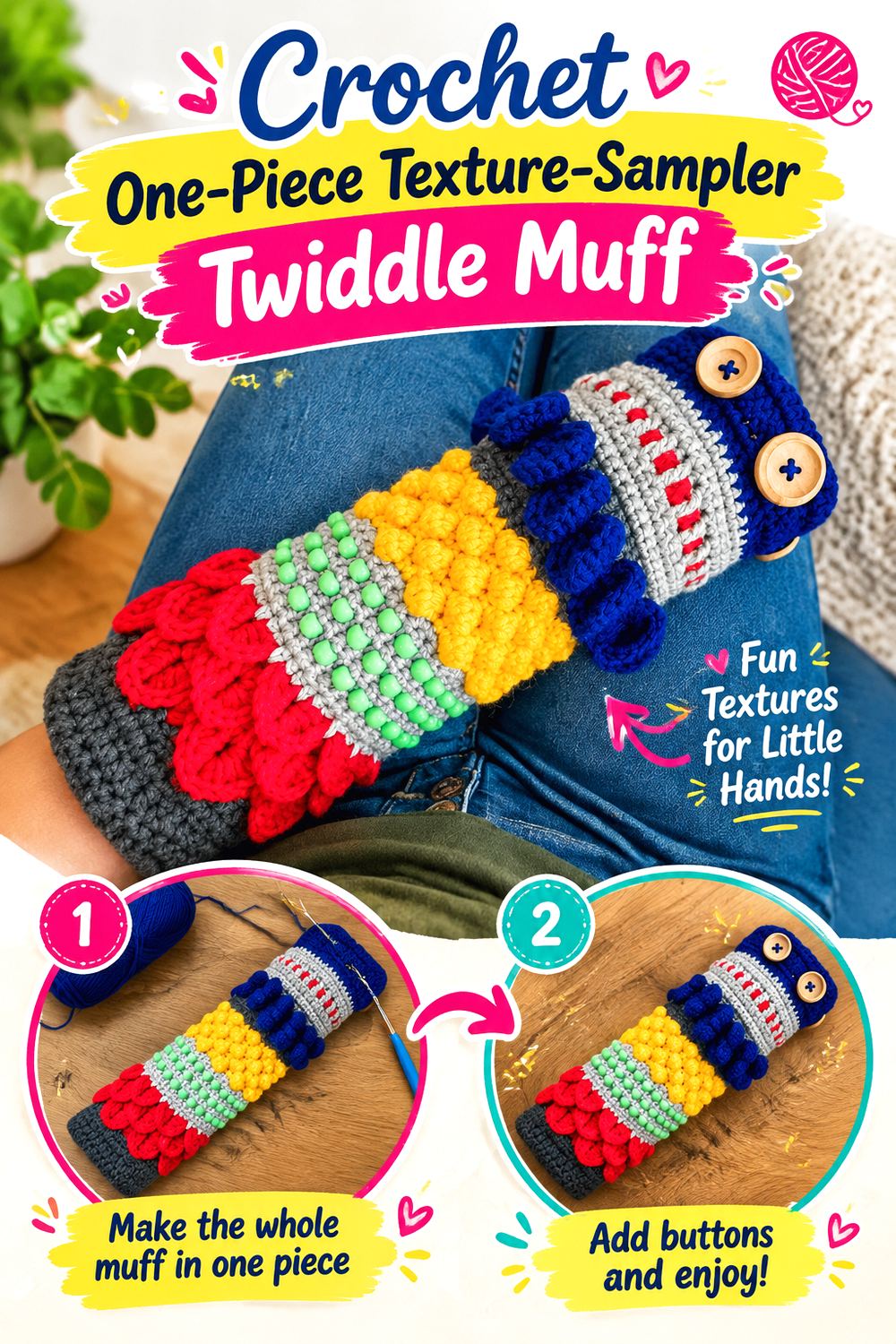
Heart Hook Home’s design shifts the category from winter fashion to intentional tactile variety. Ashlea’s Twiddle Muff is made as one crocheted piece using multiple stitch textures and colors, with additional options such as ribbon, buttons, and beads shown in the project. The completed fabric is ultimately formed into a wearable tube.
This one-piece approach is useful because much of the sensory interest exists directly in the crochet fabric before separate objects are considered. Different raised, flat, and dimensional stitch zones can create variety while keeping the underlying construction visually organized.
Build Tactile Contrast Into the Fabric First
Before collecting embellishments, consider what the crochet itself can contribute. Alternating smoother areas with bobbles, ridges, scales, or other integrated textures creates distinct zones that cannot simply fall off as separate objects.
That does not make every stitch automatically appropriate for every recipient, but it gives you more options when external attachments need to be minimized. Keep the hand openings comfortable rather than filling every available inch with maximum texture.
One Piece Simplifies Structural Inspection
A continuous base reduces the number of separate panels that must be aligned before the tube is formed. Use that simplicity to inspect tension changes between stitch sections.
Different crochet textures may contract or spread differently even when worked across the same nominal width. Lay the fabric flat periodically and look for sections that pull noticeably narrower, flare outward, or make the finished tube likely to twist.
Optional Objects Still Need Independent Approval
The source includes examples of buttons, beads, and ribbon, but those choices should not be treated as universal requirements.
For a personal project, assess the individual user. For a donation project, ask the facility what it accepts before attaching anything. A secure crochet base can still be useful even when some of the creator’s optional embellishment ideas are not suitable for your intended destination.
Original Tutorial and Creator Credit
Creator/Site: Heart Hook Home
9. Crochet Double Layer Stash Twiddle Muff
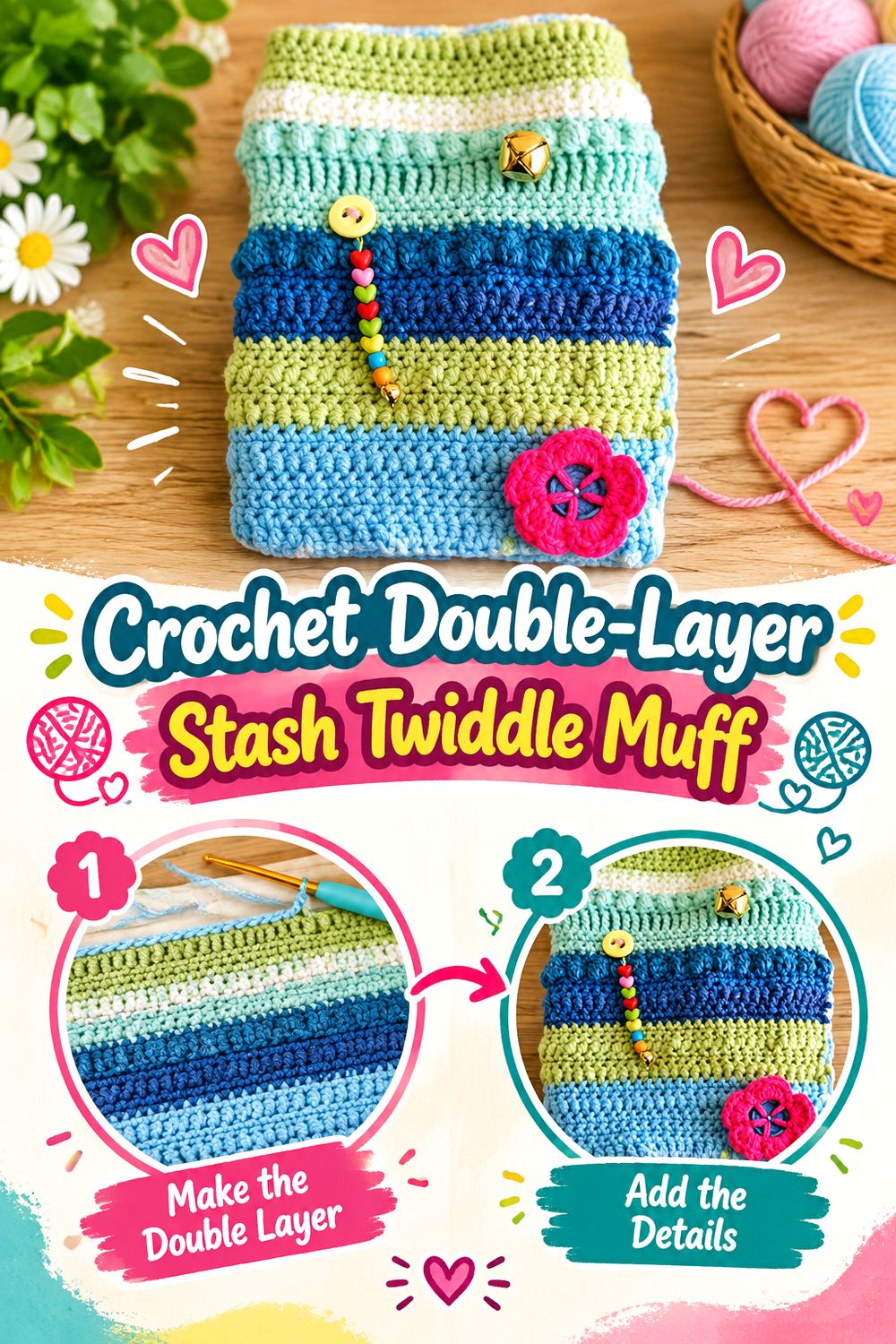
Love Charlie takes a deliberately flexible approach to the twiddle muff. The original tutorial uses separate inner and outer layers, incorporates varied crochet textures, and discusses using leftover yarns rather than requiring one uniform material or color. The two surfaces are later brought together into the completed tube.
The double-layer construction is the key distinction here. It gives the inside its own tactile role instead of treating it merely as the reverse of the exterior. That makes this approach useful when you want hands inside the muff to encounter purposeful crochet texture while the outer surface supports a different arrangement.
Interior Texture Deserves Equal Planning
The inside of a sensory muff is not visually prominent during use, but it may be the surface touched most consistently. Before closing the layers, feel the entire interior with your hands rather than inspecting it only from above.
Look for rough joins, stiff tails, hard attachment backs, or bulky areas that become more noticeable when enclosed. A texture that looks interesting on a flat panel still needs to feel appropriate once it surrounds the hands.
Double Layers Increase Warmth and Bulk Together
Two fabric layers can make the muff more substantial, but they also reduce interior room. If you substitute thicker yarns, assemble the layers temporarily and check the usable opening before the final join.
Do not assume that both layers need identical texture. A quieter interior and more varied exterior—or the reverse—can create contrast without making every surface equally bulky.
Arrange Add-Ons Before Closing the Construction
The source demonstrates arranging decorative and activity elements before completing the final layered tube. That planning stage is valuable even when you choose different embellishments.
Place candidate features where you can still inspect their backs. Check spacing, pull gently on attachments, and make sure one heavily decorated area does not become much stiffer than the rest of the muff.
Original Tutorial and Creator Credit
Creator/Site: Love Charlie
10. Crochet Two Panel Decorated Twiddle Muff
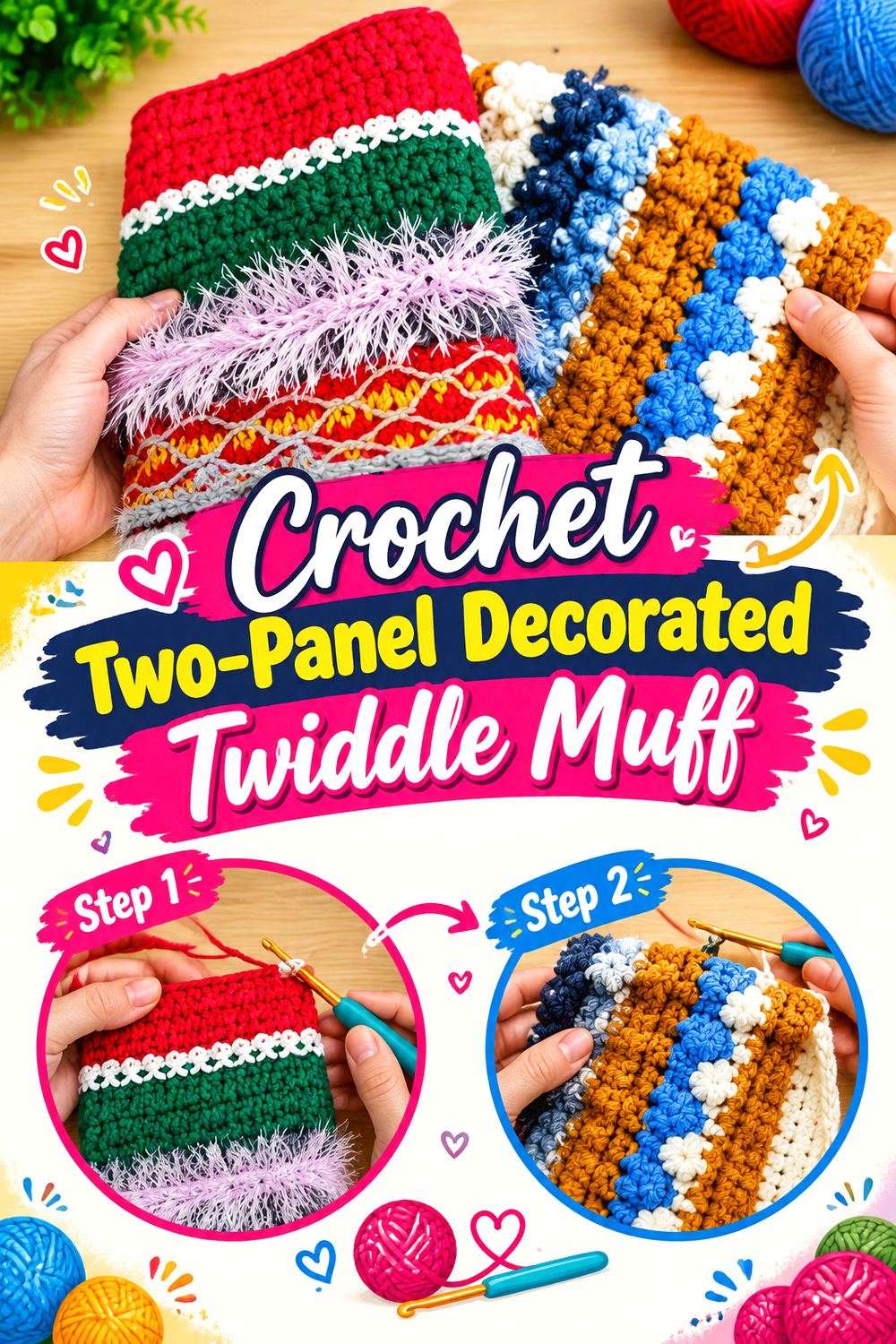
Girlybunches also separates the construction into parts, but the video places particular emphasis on talking through how the creator made the twiddle muff and how functional decoration can be incorporated. The project uses two crocheted parts that are joined, with texture and interactive surface details forming an important part of the finished object.
Compared with a single-piece sampler, separate panels give you a clear pause point for evaluating what will face inward or outward. They also make it easier to spread potential features across the surfaces before those areas become difficult to access.
Use the Flat-Panel Stage as an Inspection Window
Before joining the pieces, turn each panel over and examine the reverse. Attachments that appear neat from the front can leave hard knots, loose tails, or bulky stitching on the back.
Correcting those issues is much easier while everything remains flat. Consider this stage part of finishing rather than rushing toward assembly as soon as the decorative front looks complete.
Interactive Features Need Finger Space
Pockets, zippers, loops, and other movable details are less useful when several are crowded into the same small area. Leave enough surrounding fabric for the hand to locate and manipulate each feature independently.
Spacing also helps the underlying crochet remain flexible. A heavily stitched cluster of accessories can stiffen one section and make the finished muff feel uneven even when the decorations are individually secure.
Check Crochet Terminology Before Following Along
Girlybunches notes the use of British crochet terminology and provides conversion help in the video information.
US crocheters should confirm stitch terminology before interpreting any verbal instruction. This is particularly important when adapting rather than copying dimensions, because misunderstanding a stitch name can change fabric height, density, and the proportions of a panel.
Original Tutorial and Creator Credit
Creator: Girlybunches
11. Crochet Freestyle Color and Texture Twiddle Muff
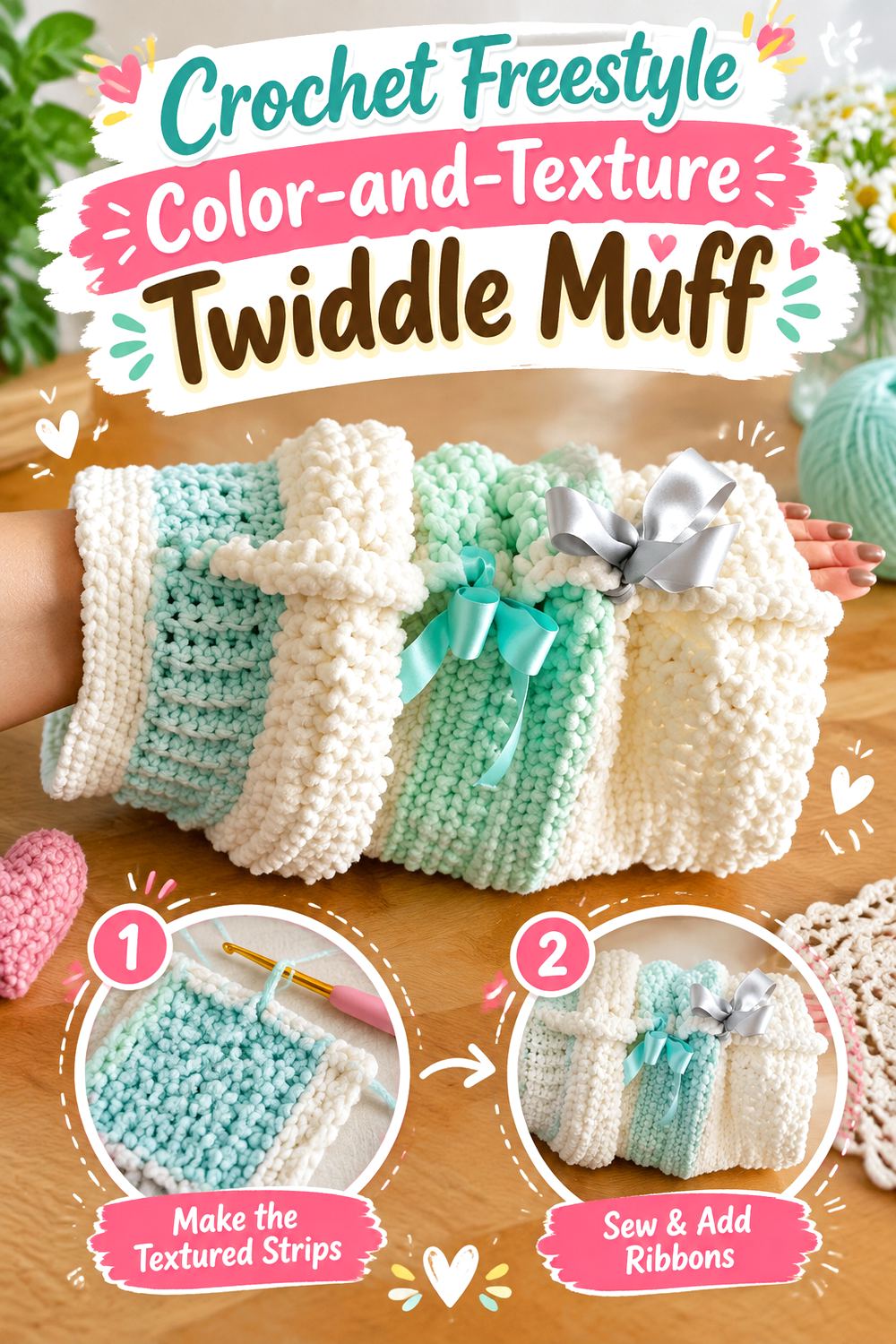
LoveCrafts presents the twiddlemuff as a flexible crochet tube where different stitches, colors, textures, and optional accessories can be combined rather than prescribing one decorative surface. Its tutorial emphasizes the broad concept and shows how crochet itself can vary across the muff.
That freestyle approach is useful when you have several techniques you want to incorporate without turning the article or project into a reconstruction of someone else’s exact layout. The important design task is creating recognizable contrast while preserving an opening and body that remain comfortable and manageable.
Variation Works Better When It Has a Rhythm
“Different” does not need to mean random. Repeating a calmer stitch between highly raised areas can give fingers a clearer change in surface while preventing the entire muff from becoming uniformly bulky.
The same applies to color. A recurring shade can visually connect unrelated scrap sections and make a multi-texture project feel planned rather than like every leftover yarn was added without editing.
Hard and Soft Features Are Not Interchangeable
The source mentions various optional accessories, but a soft crocheted ridge behaves very differently from a hard button, bell, or similar object.
Evaluate each feature according to the intended user and destination. When requirements are restrictive or uncertain, increasing the variety of integrated stitches may be a better direction than simply increasing the number of attached objects.
Plan Cleaning Before Mixing Materials
A sensory muff may combine yarn, ribbon, hardware, and other components with different care limitations. Before permanently mixing materials, check yarn labels and any creator or facility guidance relevant to the intended item.
If one embellishment cannot tolerate the cleaning method expected for the rest of the muff, reconsider it. Practical maintenance matters more than preserving every decorative idea from an inspiration layout.
Original Tutorial and Creator Credit
Creator/Site: LoveCrafts
12. Crochet Scrap Yarn Sensory Hand Muff
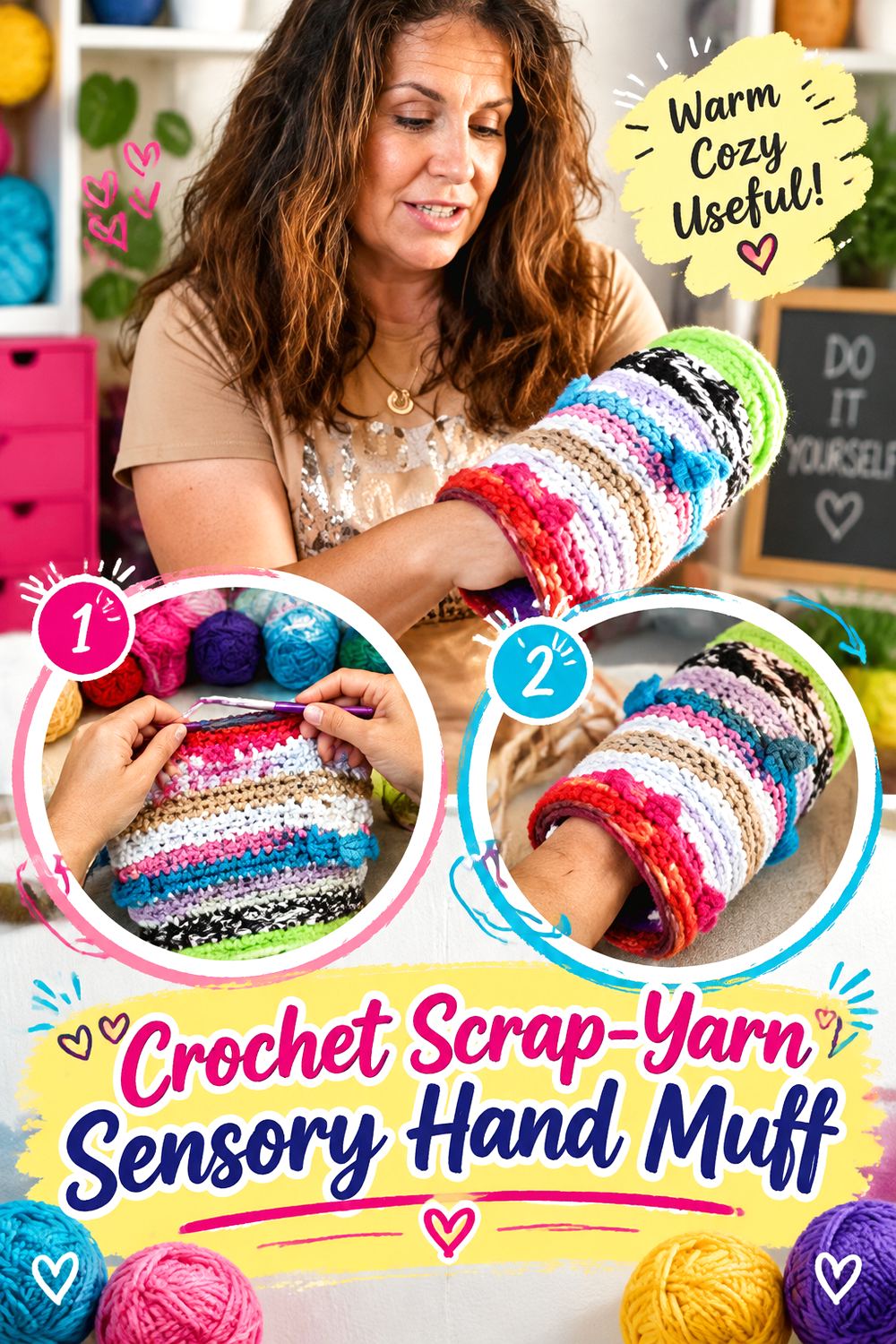
Cukicrochet’s Spanish-language sensory-muff tutorial places mixed leftover yarns at the center of the project. The creator describes using scraps with differences in fiber and thickness, forming the crochet into a cylinder and adding varied motifs and textures such as flowers and tassel-like details.
This makes the design particularly useful as a material-exploration idea. Instead of choosing scraps only because their colors coordinate, you can consider how smooth, fuzzy, firm, soft, thick, and fine yarns feel in relation to one another. Mixed materials, however, also make compatibility and laundering more important.
Sort Scraps by Feel as Well as Color
Lay possible yarns together and handle them before crocheting. Two skeins that look almost identical can produce very different tactile surfaces because of twist, fiber, halo, or thickness.
Aim for deliberate contrast rather than using every scrap available. A few clearly differentiated textures may communicate more effectively than many yarns whose surfaces feel nearly the same once crocheted.
Mixed Fibers Can Complicate Care
A stash-based muff can combine yarns with incompatible washing or drying instructions. Check the labels you still have and use the most restrictive care requirement as an important planning signal.
If you cannot identify an old yarn, consider whether it belongs in a donation project where predictable laundering may matter. A beautiful scrap is not automatically the most practical choice simply because its texture is interesting.
Preview the Spanish Tutorial for Fit With Your Skills
The video title and description are in Spanish. If Spanish is not a language you follow comfortably, watch enough of the tutorial first to determine whether its visual demonstrations and your existing crochet knowledge make it a workable source for you.
Do not borrow measurements or instructions from another sensory-muff pattern to fill any language gaps. The creator’s own tutorial should remain the reference for this particular construction.
Original Tutorial and Creator Credit
Creator: Cukicrochet
13. Crochet Bobble Texture Fidget Hand Muff
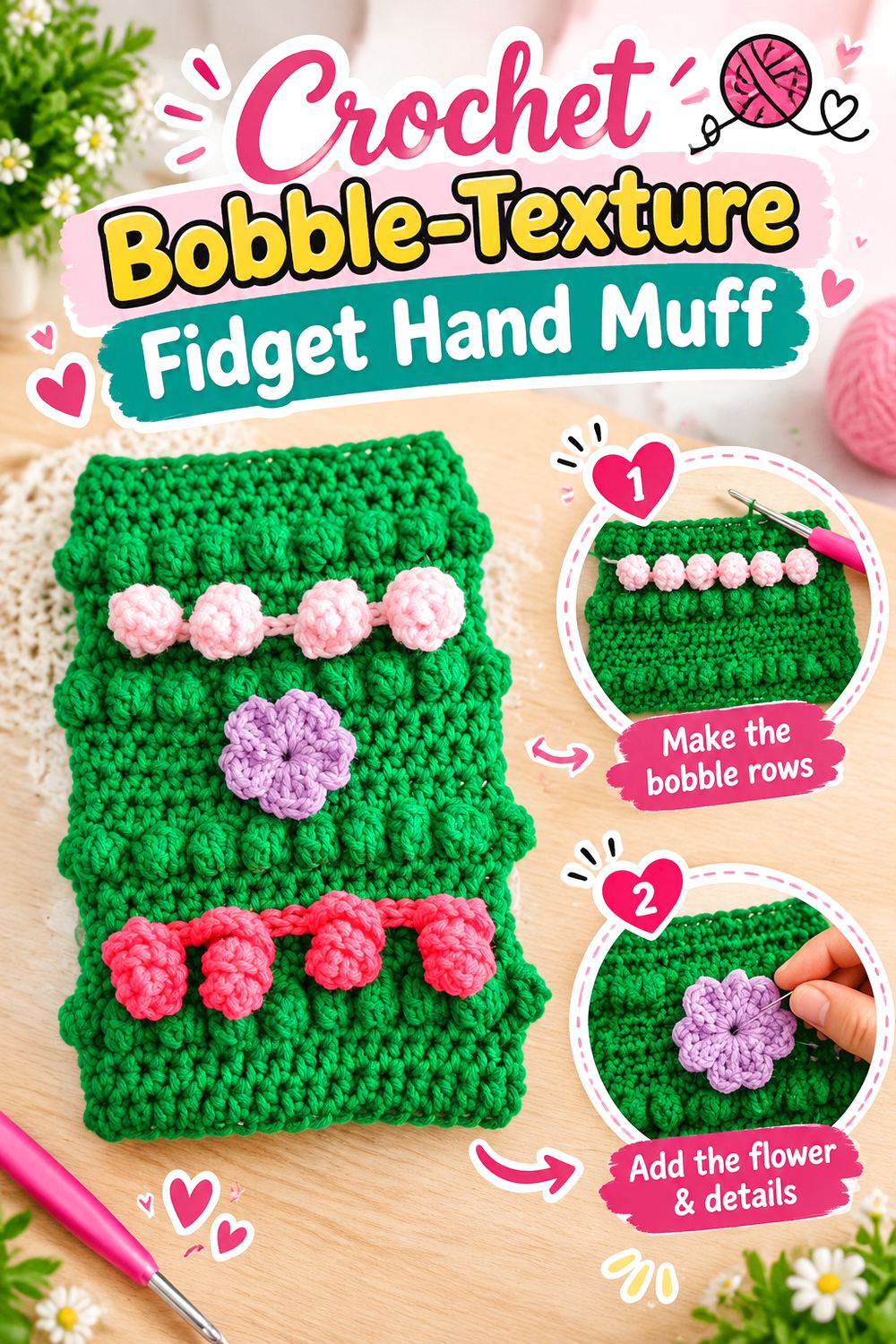
Crochet With Aayesha offers a comparatively restrained sensory base. The Fidget Sensory Muff pattern is worked as a tube with repeated bands of bobble texture, followed by suggestions for optional small embellishments.
The bobbles give this project a clear reason to stand apart from attachment-heavy twiddle muffs: tactile interest is already embedded in the fabric. That makes it a useful starting point when you want a recognizable repeated texture without combining many unrelated stitch patterns. You can then decide whether the finished recipient actually needs any additional elements instead of assuming decoration is mandatory.
Bobbles Create Built-In Tactile Landmarks
Repeated raised sections give the fingers distinct points to find while keeping the basic tube construction visually coherent. When substituting yarn, make a sample and check whether the bobbles remain clearly defined without becoming uncomfortably rigid.
A very fuzzy yarn can blur their shape, while a much stiffer substitute may exaggerate the raised surface. The desirable result depends on the intended user rather than on maximum relief.
Leave the Openings Quieter Than the Center
Strong texture is generally easier to accommodate away from the exact point where hands enter. If modifying the design, resist extending bulky bobble treatment into an opening without checking comfort first.
A smoother edge can provide an obvious transition between the exterior and the hand-access area while letting the repeated central texture remain the project’s main feature.
Extra Embellishment Is a Choice, Not a Requirement
The source suggests adding items such as crochet flowers, curls, ribbons, or pompoms after the base is complete.
Assess those suggestions independently for the intended recipient. A finished bobble-texture tube already provides tactile variety, so it is reasonable to stop there when facility rules, cleaning needs, or attachment concerns make additional pieces undesirable.
Original Tutorial and Creator Credit
Creator/Site: Crochet With Aayesha
How These Crochet Hand Muffs Compare
For uncomplicated winter use, the super-bulky corded muff keeps the structure simple, while the cuffed and double-layer faux-fur designs put more emphasis on plush texture and opening treatment. The Balloon-Stitch and ruffled versions use crochet technique itself as the main decorative feature. If functionality matters beyond warmth, the hidden-pocket muff adds storage, while the scarf-end design removes the need to carry a separate hand warmer.
The sensory projects call for a different comparison. Heart Hook Home offers a one-piece stitch sampler; Love Charlie emphasizes separate inner and outer layers; Girlybunches uses two panels with functional decoration; LoveCrafts takes a freestyle approach; Cukicrochet highlights mixed scrap textures; and Crochet With Aayesha keeps the base more consistent through repeated bobbles. For donation projects, the receiving organization’s requirements should narrow the choice before embellishment style does.
Conclusion
These crochet hand muff ideas show how far the basic open-ended warmer can be adapted without reducing the category to color changes. A winter version may rely on plush yarn, strong stitch texture, a cord, ruffled openings, hidden storage, or an attached scarf. Sensory muffs shift the priority toward tactile contrast, accessible construction, secure finishing, and recipient-specific decisions.
Choose according to real use first, then consider yarn and decoration. Check openings with the clothing involved, account for the space taken by linings or pockets, and be especially selective about sensory attachments. Once you have chosen the construction that fits your goal, use the original tutorials credited above for the creators’ exact project instructions and details.
Frequently Asked Questions
What is the difference between a crochet hand muff and wrist warmers?
A traditional hand muff is one open-ended tube into which both hands can be placed, usually meeting inside the same central space. Wrist warmers or fingerless gloves are separate pieces worn individually on each hand or arm.
That distinction matters when choosing a tutorial. A true muff needs enough internal width for shared hand space, while fitted wrist warmers depend much more heavily on individual circumference and hand shaping.
Does a crochet winter hand muff need a lining?
Not necessarily. Several workable crochet muffs are unlined, while other designs deliberately add an inner layer for comfort or additional coverage. The best choice depends on the crochet fabric, yarn, climate, and how the muff will be used.
Remember that lining reduces interior room and changes care requirements. If you add one to a tutorial that does not include it, check the opening and hand space again after both layers are temporarily assembled.
How should I size a crochet hand muff?
Use the intended wearer rather than assuming “one size” will fit everyone. The openings need to admit the hands comfortably, and winter versions should also be checked with the sleeves or cuffs that will actually be worn.
Length affects how naturally both hands meet inside. When a tutorial provides its own sizing or adjustment guidance, follow that source rather than applying measurements from an unrelated pattern, especially when the projects use different yarn thicknesses or construction methods.
Can I add a carrying strap to any crochet hand muff?
A strap can sometimes be adapted, but it should not be treated as an automatic addition. Its attachment points need to support the muff without distorting the openings, and the correct hanging length depends on the wearer and outerwear.
Pocketed muffs need extra thought because stored belongings add weight. For children or sensory users, cords also require recipient-specific safety judgment. When the strap is not essential, leaving it off may be the simpler choice.
What type of yarn works well for a hand muff?
There is no single ideal yarn because the projects serve different purposes. Smooth yarn shows raised stitch patterns clearly, plush yarn creates a fur-like surface, and bulky yarn can make a winter muff feel substantial. Sensory projects may deliberately combine contrasting textures.
Before substituting, compare yarn thickness, softness, stitch definition, stretch, and care requirements with the original design. Follow the yarn label and creator guidance rather than assuming fibers with similar appearance will behave identically.
Are buttons, beads, ribbons, and other objects suitable for every sensory muff?
No. A feature shown in a tutorial is not automatically suitable for every recipient or care environment. Separately attached objects can introduce concerns involving pulling, catching, maintenance, or organization-specific rules.
If the muff will be donated, ask the receiving facility what it currently accepts before adding decorations. Integrated crochet features such as bobbles, ridges, and other securely worked texture can provide another route when separate attachments are inappropriate.