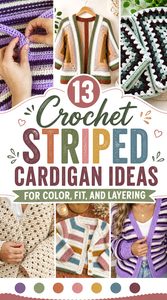
Striped crochet cardigans can look dramatically different even when they use similar color palettes. A fitted buttoned cardigan puts the focus on tidy horizontal bands, while a granny-stripe version creates a more open, graphic surface. Hexagon construction sends the stripes around corners, textured stitches make color bands appear deeper, and a long duster turns the same basic idea into a much more substantial layering piece.
These 13 ideas cover those differences rather than simply changing colors from one project to the next. You’ll find made-to-measure options, oversized shapes, balloon sleeves, shaped shoulders, solid-center designs, and several ways to handle granny-style stripes. Use the comparisons and planning notes to decide which construction, fit, stripe scale, and yarn character make sense before following the original creator’s tutorial.
Quick List
- Crochet Classic Button-Front Stripe Cardigan
- Crochet Made-to-Measure Narrow Stripe Cardigan
- Crochet Oversized Granny-Stripe Layering Cardigan
- Crochet Soft-Halo Pink Stripe Cardigan
- Crochet Earth-Tone Moss-Stitch Stripe Cardigan
- Crochet Hexagon Stripe-Edge Button Cardigan
- Crochet Shaped DK Stripe Button Cardigan
- Crochet Collegiate Texture-Stripe Balloon Cardigan
- Crochet Paneled Granny-Stripe Wool Cardigan
- Crochet Concentric Solid-Stitch Hexagon Cardigan
- Crochet Earthy Hexagon Stripe Cardigan
- Crochet Fitted Purple Stripe Cardigan
- Crochet Long Moss-Stitch Stripe Duster Cardigan
Choose the Stripe Construction Before Choosing the Colors
Color gets most of the attention in a striped cardigan, but construction decides where those colors actually travel. Flat front and back panels create straightforward horizontal bands that are relatively easy to compare across seams. Granny-stripe fabric adds open spaces and a more obviously crocheted texture. A hexagon cardigan works outward in rounds, so the bands turn with the motif instead of remaining horizontal from one side of the garment to the other.
Think about the finished silhouette before building a palette. If you want calm, continuous bands, a paneled cardigan is the clearer choice. If you want the color changes to become part of the geometry, a hexagon construction does more of the visual work. For a cardigan with several bright shades, keeping the edging or a main background color consistent can also stop the garment from feeling overly fragmented.
Plan Fit and Ease Before Repeating a Long Stripe Sequence
A stripe repeat can make it tempting to focus on color and postpone fit decisions, but cardigans are easier to adjust before large sections are complete. First decide whether you want a close fit, ordinary layering room, or an intentionally oversized silhouette. Then check the tutorial’s sizing method rather than assuming the same finished width will work across different constructions.
Made-to-measure tutorials are particularly useful when you want to compare the growing fabric directly with your body or an existing cardigan. With paneled patterns, check the width of the back and fronts, shoulder placement, armhole depth, and sleeve circumference before finishing the seams. Hexagon cardigans need a different checkpoint: fold the growing shapes into garment form periodically. A hexagon that looks surprisingly large while flat may behave very differently once folded into body and sleeve sections.
Yarn Weight, Drape, and Stripe Definition Work Together
A striped cardigan needs enough stitch definition for the bands to remain readable, but the yarn also affects how the garment hangs. Finer or softer yarns can produce a lighter-looking layer, while bulkier or more structured yarns can make each stripe feel visually heavier. Fuzzy halo yarn softens the edge between colors; smooth yarn generally makes the transition appear sharper.
Before substituting yarn, compare more than the label’s weight category. Make a swatch and assess its width, row height, flexibility, and how much it changes after the finishing method you intend to use. This is especially important when adapting stripe widths, because a “few rows” in one yarn may create a visibly different band depth in another. Also consider the number of color changes: narrow stripes create more ends unless the construction safely allows another method of managing them.
1. Crochet Classic Button Front Stripe Cardigan
 SAVE
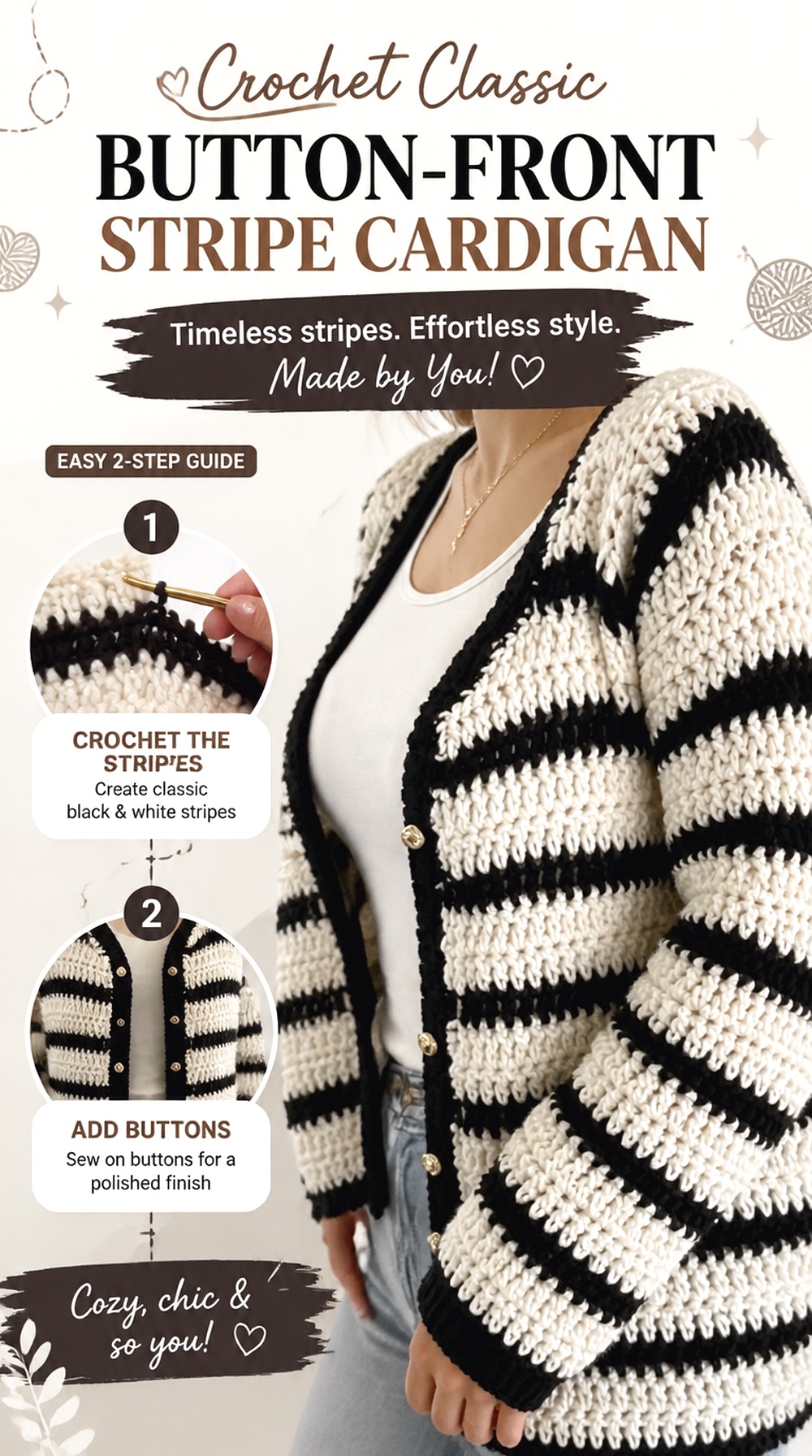
SAVEThis version has the familiar proportions of a traditional cardigan: distinct back and front sections, long sleeves, a front band, and functional buttons. Cat Kemble’s tutorial uses two contrasting yarn colors to form clear horizontal bands, so the stripe pattern remains easy to read without competing with complicated surface texture. The buttoned opening also makes this option feel more structured than the loose open-front cardigans later in the list. It is a useful direction if you want stripes to be the main decorative feature while keeping the overall garment shape recognizable and straightforward.
Button Placement Becomes Part of the Stripe Rhythm
With bold horizontal bands, the center front is visually prominent, so buttons can either reinforce the orderly look or interrupt it. Before finishing the band, lay the cardigan flat and judge the buttons against the full stripe sequence rather than viewing each one separately. A button color close to one of the yarn shades creates a quieter result, while a contrasting button becomes another repeated design element.
Check the Fronts Against the Back Before Final Assembly
Straightforward panels make comparison easier, which is an advantage worth using. Lay the two fronts over the back before joining and check whether equivalent stripe sections sit where you expect around the shoulders and hem. Perfect color alignment is not mandatory, but deliberate alignment looks different from an accidental half-band shift. Correct a panel-length problem before adding the final front treatment, when adjustments are usually less disruptive.
Original Tutorial and Creator Credit
Creator: Cat Kemble
2. Crochet Made to Measure Narrow Stripe Cardigan
 SAVE
SAVEGranny Gaia’s updated striped cardigan takes a measurement-led approach rather than asking every maker to rely on one fixed finished size. The sample uses a restrained two-color palette with frequent stripe changes, producing a finer visual rhythm than wide statement bands. Ribbed sections frame the body and sleeves, while the front remains open rather than using a full button closure. This is a useful choice when your priority is controlling garment proportions yourself and you prefer narrow stripes that read more like an all-over pattern than a handful of large color blocks.
Frequent Color Changes Magnify Small Tension Differences
Narrow stripes repeat quickly, so variations in row height can become noticeable across a large panel. Make a useful-sized swatch in both colors and check whether you unconsciously work one yarn more tightly than the other. If the yarns differ in fiber, twist, or texture, the effect can be stronger. Consistent tension matters more here than making every transition look mathematically identical.
Measure the Garment in the Way You Plan to Wear It
A made-to-measure project is only as useful as the measurements you choose. Decide whether the cardigan will sit over a thin top or a thicker layer, then compare the work with that intended use. Check body width, shoulder position, sleeve room, and overall length separately instead of relying on a single bust measurement. The tutorial provides the construction method; your intended ease still requires a deliberate choice.
Original Tutorial and Creator Credit
Creator: Granny Gaia
3. Crochet Oversized Granny Stripe Layering Cardigan
 SAVE
SAVEThe classic granny-stripe construction from Craft and a Cuppa® creates a noticeably different surface from dense horizontal-row cardigans. Clustered stitches leave small openings between groups, and repeated color changes turn the entire fabric into a lively striped field. The tutorial is made to measure, is designed with an oversized silhouette, and works most of the main garment in one piece with relatively little seaming. That combination makes this idea particularly suited to readers who like relaxed layering and want scrap-friendly color variety without constructing several completely separate body panels.
Open Granny Fabric Needs a Different Drape Check
A granny-stripe swatch can feel much more flexible than a dense crochet swatch made with the same yarn. Hold the swatch vertically as well as laying it flat, because garment weight acts downward when the cardigan is worn. If the fabric lengthens noticeably under its own weight, factor that behavior into your length decision before adding a large lower section.
Oversized Should Still Have Intentional Shoulder Placement
Extra width is part of the design, but “oversized” does not remove the need to check proportions. Look at where the upper body transitions toward the sleeves and how far the shoulder line extends when worn. If you want only gentle ease, compare your work against a cardigan you already like rather than automatically reproducing the most generous sample proportions.
Use Color Repetition to Control a Scrap-Yarn Look
Many colors can work beautifully in granny stripes, but a completely random sequence may become visually noisy. One practical approach is to repeat a neutral or dominant shade at intervals while rotating smaller quantities of accent colors. This does not require copying the source palette; it simply gives the eye something consistent to follow across a cardigan with numerous color changes.
Original Tutorial and Creator Credit
Creator: Craft and a Cuppa®
4. Crochet Soft Halo Pink Stripe Cardigan
 SAVE
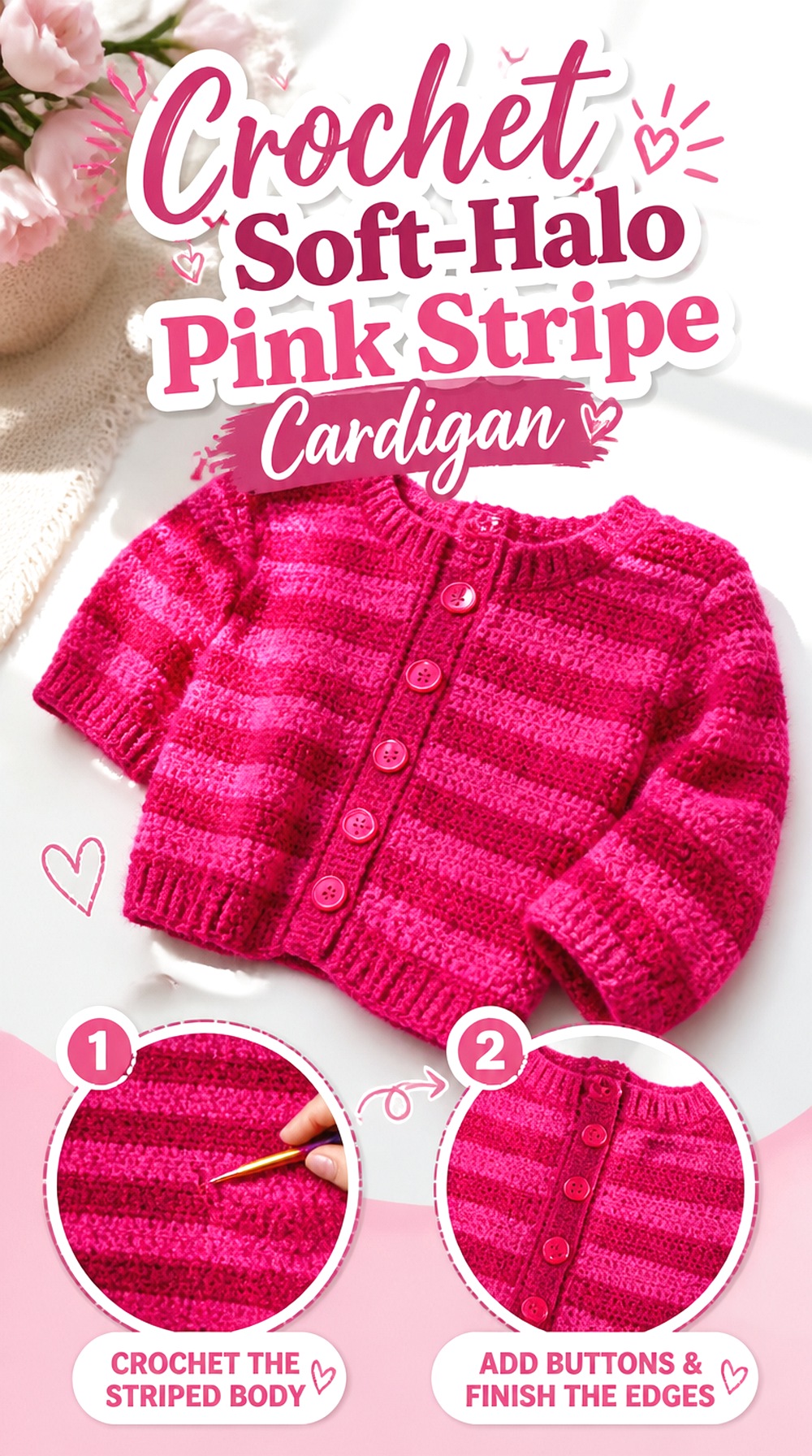
SAVEKatie Joslin’s striped cardigan uses doubled Hobbii Diablo in hot pink and magenta in the source project, giving the two-color design a noticeably soft, fuzzy surface. The pattern is made to measure and includes buttons, so it combines a conventional cardigan opening with a much less crisp stripe edge than smooth cotton or acrylic versions. That softened boundary is the main reason this idea earns its own place in the collection: the colors remain distinct, but the halo visually blends them. It is a good reference when you want bold color without hard-edged, graphic bands.
Halo Yarn Softens Color Boundaries—and Stitch Visibility
A fuzzy yarn can make neighboring shades appear more blended, especially when the colors are close in value. That may be exactly the effect you want, but make a swatch before committing to complicated stitch texture. If the yarn hides subtle stitch details, let the color and silhouette do more of the visual work instead of adding surface features that will barely show.
Test the Front Band Before Choosing Final Buttons
Buttons add small points of definition against a soft fabric. Place several candidate buttons on the finished or swatched yarn and judge them at normal viewing distance. Very delicate buttons can disappear into a fuzzy surface, while large high-contrast buttons may dominate the stripes. Also check that the button size works with the opening method specified by the tutorial rather than choosing solely by appearance.
Original Tutorial and Creator Credit
Creator: Katie Joslin
5. Crochet Earth Tone Moss Stitch Stripe Cardigan
 SAVE
SAVEBloodimaryart Crochet’s cardigan pairs an oversized silhouette with moss-stitch fabric and a muted brown, sand, cream, and burnt-orange palette in the source project. Moss stitch distributes small stitches and spaces across the surface, giving the stripes a different texture from double-crochet panels or granny clusters. The tutorial separates the cardigan into front panels, a back, sleeves, and closure ribbing, making it a useful example for makers who like earthy multi-color garments but want something denser-looking than a granny-stripe cardigan. The generous proportions also give broad color sections room to register clearly.
Moss Stitch Can Make Wide Bands Feel Quieter
Because the stitch texture is small and regular, broad stripes can feel less stark than they would in a completely smooth fabric. If you are working with several earth tones or close-value shades, compare them under daylight before deciding their order. Two colors that look clearly different in skeins may merge visually once broken into the small rhythm of moss stitch.
Watch the Weight of an Oversized Multi-Panel Garment
An oversized body, long sleeves, and multiple panels can add up to substantial finished fabric. Your swatch should therefore answer more than a gauge question: hold it, bend it, and let it hang. If a substituted yarn produces a much heavier-feeling swatch, consider what that will mean at the shoulder seams and cuffs before increasing length or width.
Match Stripe Transitions Where They Matter Most
Not every seam needs perfectly continuous color, but shoulder and side areas can look more deliberate when major bands relate to one another. Before seaming, lay the panels in garment position and identify the most visually dominant transitions. Prioritize those rather than trying to force every narrow band into exact alignment if the construction does not naturally produce it.
Original Tutorial and Creator Credit
Creator: Bloodimaryart Crochet
6. Crochet Hexagon Stripe Edge Button Cardigan
 SAVE
SAVESusan’s Family takes a more selective approach to striping. Instead of covering the entire cardigan with equal bands, the source design keeps a solid-color area through the center and concentrates colorful stripes toward the edges. Its body and sleeves develop from two hexagon motifs that fold into garment shape, and the finished cardigan includes prominent wooden buttons. That combination makes the stripes function almost like framing rather than an all-over pattern. It is a strong choice for someone who likes colorful crochet but wants the center of the garment to remain visually calmer.
Concentrating Stripes at the Edges Reduces Visual Density
If five or six colors across an entire torso feel too busy, selective placement offers another solution. Keep the largest area in one main shade and reserve your accent palette for the outer rounds. Because the color changes occur around a hexagon, remember that those rounds eventually occupy several garment directions after folding; view the folded piece before deciding that another accent round is needed.
Hexagon Growth Affects Body and Sleeve at the Same Time
A hexagon cardigan does not behave like a rectangular back panel that can simply be widened independently. As the motif grows, more fabric is created around multiple sections of the eventual garment. Fold and try the pieces in position regularly, checking sleeve room and body coverage together. If one area already feels generous, do not assume another full round is the only possible adaptation.
Let the Buttons Relate to the Solid Center
Because the middle of this design is calmer than its colorful borders, the buttons have an unusually clear background. Natural wood gives one kind of contrast; a button close to the main yarn color gives another. Place the full set before attaching any one button permanently so you can judge their spacing as a vertical design line against the horizontal and angled color bands.
Original Tutorial and Creator Credit
Creator: Susan’s Family 蘇蘇姐家
7. Crochet Shaped DK Stripe Button Cardigan
 SAVE
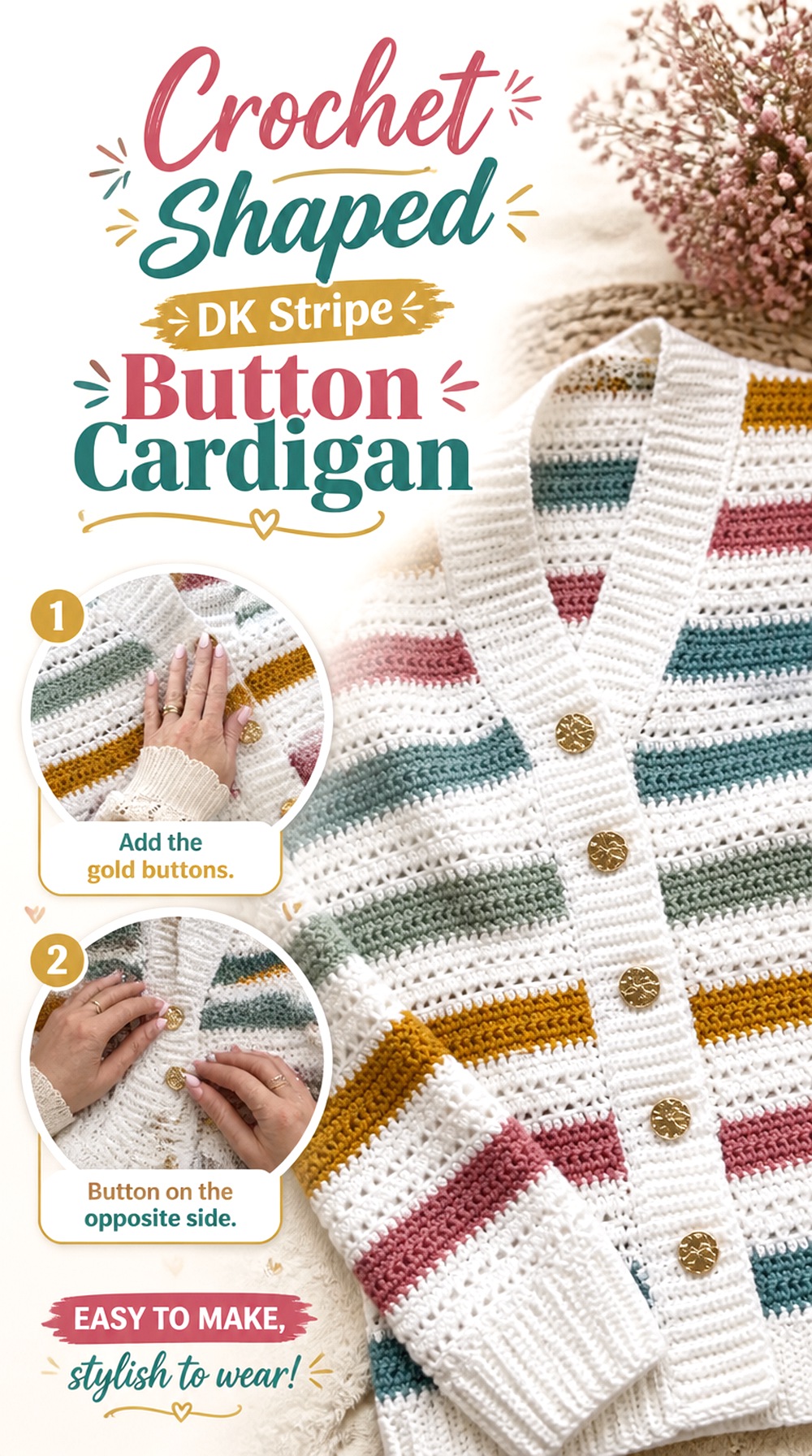
SAVEMJ’s Signature Cardigan offers a more tailored-looking route into stripes. The source design uses DK-weight yarn, separate bottom-up pieces, subtle shoulder shaping, a lightly relaxed fit, a ribbed collar, and a buttoned front. Its stripes alternate colorful contrast sections with a recurring main color, which gives the palette a controlled rhythm rather than uninterrupted rainbow banding. Compared with the boxier paneled projects, the shaping makes this idea particularly useful if you care about how the shoulder and neckline sit as much as you care about the color sequence.
A Recurring Main Color Can Organize Several Accents
When multiple contrast colors are separated by the same base shade, the eye reads them as a coordinated system instead of unrelated bands. If you adapt the palette, choose the main color first and test every accent against it. Two accents do not have to match each other closely when both relate well to the repeating background.
Shoulder Shaping Deserves Its Own Fit Check
Do not judge this cardigan only by finished bust width. Shoulder shaping influences where the sleeve begins and how the neckline settles, so compare the shoulder area with your body before assuming a larger size will simply provide more comfortable layering. More circumference and better shoulder placement are not always the same thing.
Keep the Collar Firm Enough to Frame the Stripes
A ribbed front treatment creates a strong vertical line beside horizontal color bands. If your substituted yarn produces very soft ribbing, the collar may lose some of that visual framing. Swatch the ribbing as well as the body stitch and compare how each behaves. A neat border can make a colorful cardigan look much more intentional without adding another color.
Original Tutorial and Creator Credit
Creator: MJ’s Off The Hook Designs
8. Crochet Collegiate Texture Stripe Balloon Cardigan
 SAVE
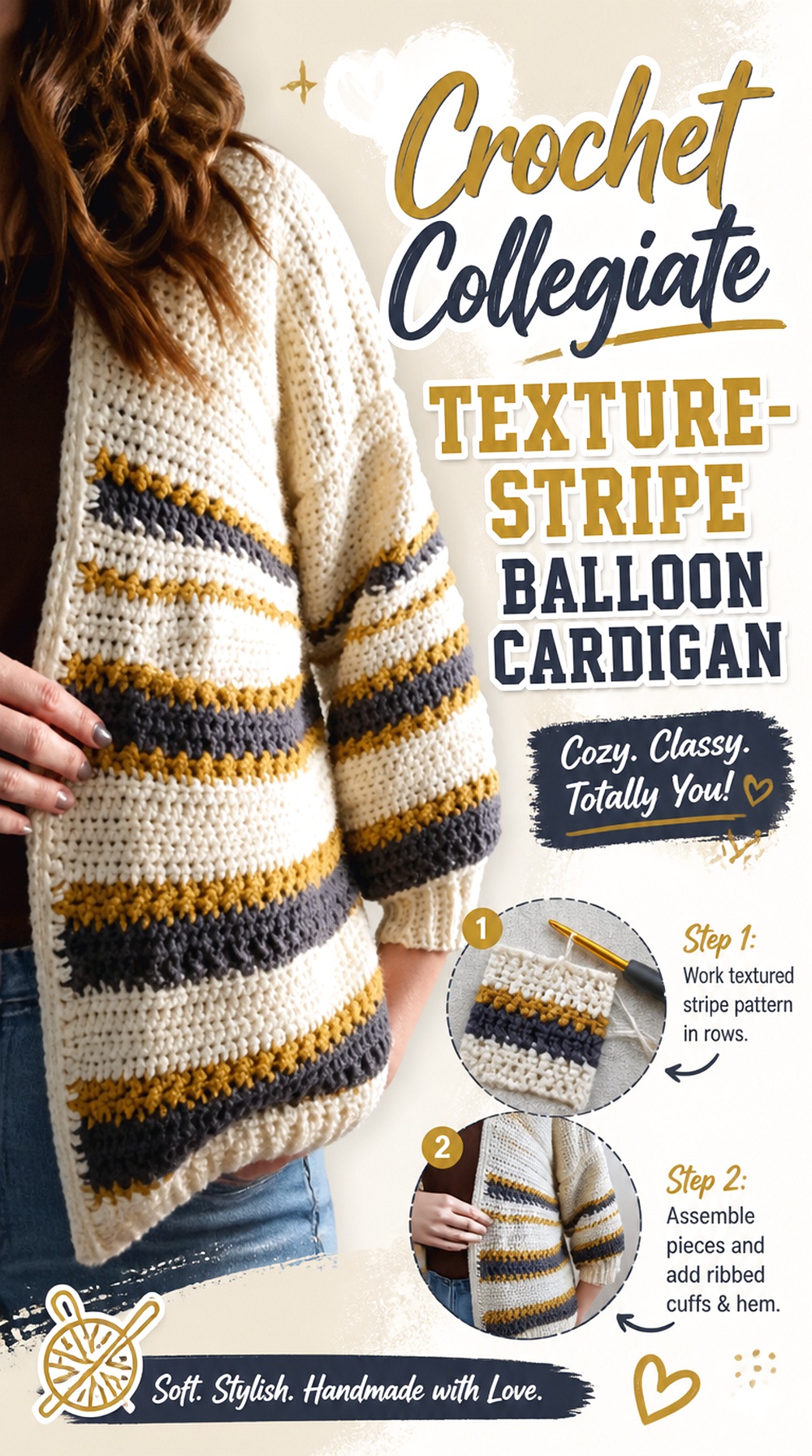
SAVEThe Teatime Cardigan from Evelyn And Peter Crochet combines color changes with different stitch effects, creating stripes that vary in texture as well as shade. The source describes a collegiate look, a slightly oversized fit, and balloon-style sleeves; the written companion pattern also includes pockets. This makes the cardigan feel more detailed than a simple two-color row repeat. It is a useful route when you want the bands themselves to provide surface interest and you like extra volume at the sleeves without turning the entire body into an extremely oversized garment.
Texture Can Change the Apparent Width of a Stripe
Two bands with the same row depth may not look equally wide when one is visually flatter and another casts stronger shadows. Make your color decisions after sampling the stitch textures together, not as isolated swatches. A bright shade paired with the most dimensional stitch can become much more dominant than expected.
Balloon Sleeves Shift the Garment’s Visual Weight Outward
Full sleeves create a wider silhouette around the arms, so body stripes do not need to carry every strong color. If your palette is very bold, consider whether repeating all accents equally on the sleeves creates the balance you want. A quieter sleeve sequence can keep the fullness from competing with an already busy body.
Plan Pocket Placement Around the Color Bands
Pockets are functional, but on striped fabric their upper edges also create visible horizontal lines. Before securing them, compare their position with the surrounding stripe changes. An edge that lands awkwardly through the middle of a high-contrast band may draw more attention than one that relates to an existing transition. Follow the source instructions for construction while treating color placement as a separate visual decision.
Original Tutorial and Creator Credit
Creator: Evelyn And Peter Crochet
9. Crochet Paneled Granny Stripe Wool Cardigan
 SAVE
SAVEMYO Make Your Own’s Linnea cardigan shows another way to use the granny stripe without duplicating the mostly one-piece construction earlier in this list. Here the tutorial works with a back and separate front pieces before assembly, then adds the sleeves and final edging. It is made to measure and the source sample has an oversized character, giving the classic granny pattern plenty of room across broad panels. The current written guidance recommends MYO Basic Wool, while noting that the video used an earlier yarn. This is therefore a useful reference for readers who want paneled construction and an adjustable, soft-looking granny-stripe layer.
Separate Front Panels Give You More Layout Control
Working the fronts independently lets you think deliberately about where each color appears beside the opening. Before starting the second front, decide whether you want mirrored stripes, matching stripes, or a less symmetrical sequence. All three can work, but documenting the first panel’s order prevents accidental near-matches that look like mistakes.
Oversized Granny Stripes Need a Length Check While Hanging
A loose cluster fabric can change once a full panel carries its own weight. Hold or hang the back vertically before deciding that it needs more length. If the yarn relaxes noticeably, the finished garment may sit lower than the same panel does on a table. This becomes increasingly important when extending an already oversized cardigan.
Compare Yarn Substitutions by Fabric, Not Name Alone
The source itself has changed its recommended yarn since the video was made, which is a useful reminder that material substitution requires judgment. Aim to reproduce a suitable fabric rather than chasing a label that sounds equivalent. Swatch for gauge, softness, drape, and recovery, then check the current written guidance for the creator’s latest material information before purchasing the full quantity.
Original Tutorial and Creator Credit
Creator: MYO Make Your Own
10. Crochet Concentric Solid Stitch Hexagon Cardigan
 SAVE
SAVEFiber Flux’s hexagon cardigan creates stripes through repeated rounds of two growing hexagons rather than through rows worked straight across a body panel. The source project uses medium-weight yarn and changes color around the motifs, so the finished bands bend naturally as the hexagons are folded and joined. Unlike a classic granny-cluster hexagon, this design uses a more solid double-crochet fabric, giving the color sections a denser visual surface. It is a useful alternative if you enjoy the geometry of a hexagon cardigan but prefer less open space between stitches.
Judge the Stripe Pattern With the Hexagon Folded
A flat hexagon does not show the final direction of every band. Fold both motifs into their cardigan shapes before making late-stage color decisions. A shade that seems confined to an outer ring can become visually prominent along a sleeve, front, or back after assembly. Photographing the folded pieces can make the distribution easier to assess.
Solid Fabric Makes Color Boundaries More Graphic
With fewer open gaps than granny-cluster fabric, neighboring colors can create a stronger block-like transition. If you want a softer result, use closer-value shades or repeat a neutral between stronger colors. If you want the geometry emphasized, higher contrast will make the turning stripe lines easier to see. Neither approach changes the underlying construction.
Original Tutorial and Creator Credit
Creator: Fiber Flux
11. Crochet Earthy Hexagon Stripe Cardigan
 SAVE
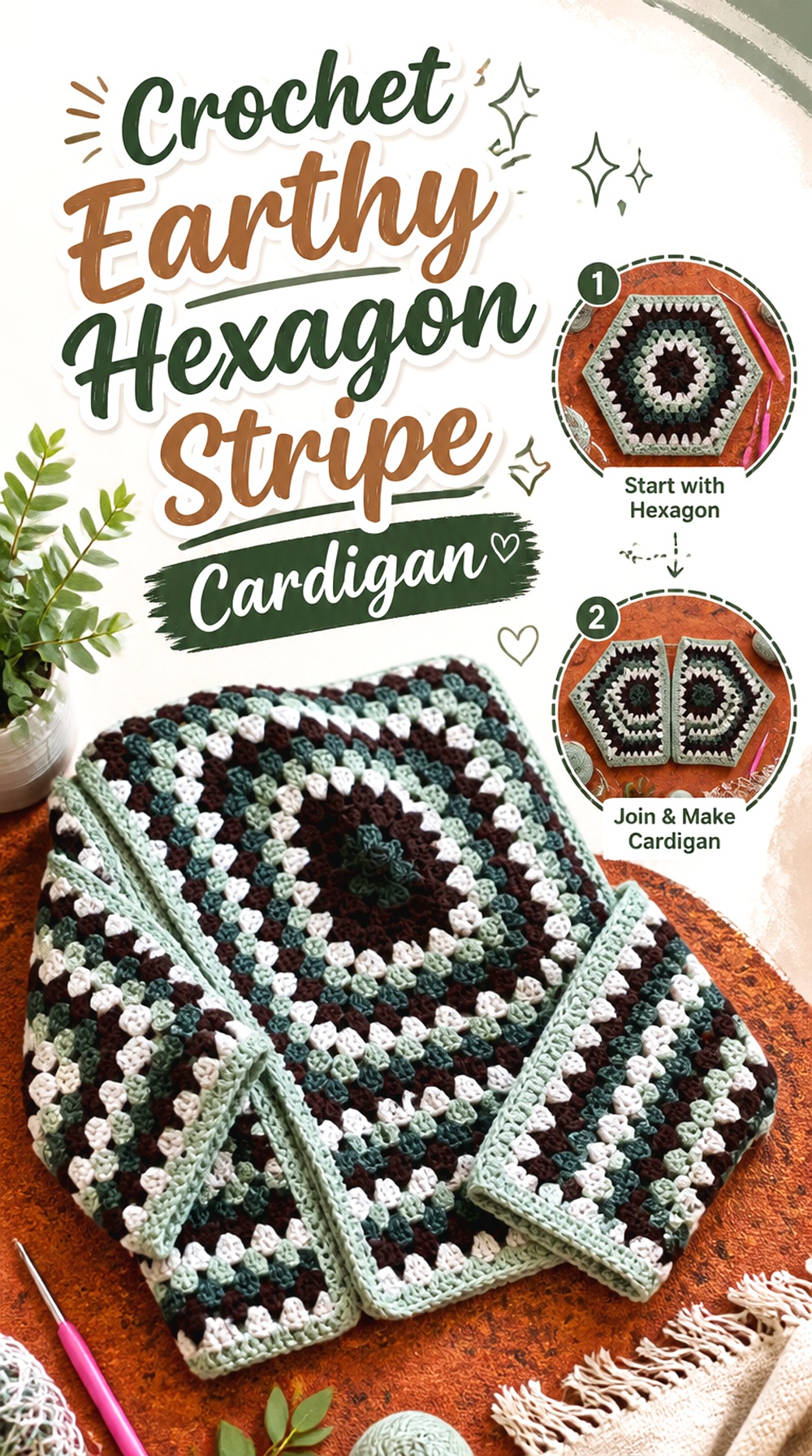
SAVEHannah Drapinski’s hexagon cardigan uses several earthy yarn colors, turning the expanding motif rounds into a casual multi-stripe garment. Its overall character is looser and more handmade-looking than a shaped button cardigan, with the geometry of the hexagons determining how the color bands travel around the body and sleeves. The creator also demonstrates that the basic approach can be adjusted for different sizes. This idea works well when you prefer an organic, mixed-palette look and are comfortable letting the construction itself create unexpected changes in stripe direction.
Earth Tones Still Need Enough Contrast to Separate
Brown, olive, rust, cream, and other muted shades can coordinate easily, but that does not guarantee each stripe will remain visible. Compare the yarns in grayscale on your phone or simply squint at the swatches from a distance. If several shades collapse into one value, use a lighter or darker band occasionally to restore definition.
Sleeve Stripes Will Not Behave Like Flat-Panel Sleeves
Because part of the sleeve grows from the folded motif, the bands wrap and change direction differently than rows worked straight from cuff to shoulder. Decide whether you enjoy that geometric effect before choosing a hexagon construction. Trying to make it imitate a perfectly horizontal paneled sleeve works against the main visual advantage of the method.
Fold Early Rather Than Waiting for the Final Round
The growing hexagon can be difficult to evaluate when spread flat. Periodically folding it gives you information about body coverage, sleeve opening, and overall visual scale before more yarn is committed. If you are modifying size, use those checks alongside the tutorial rather than assuming a set number of additional rounds will create the same fit for every body or yarn.
Original Tutorial and Creator Credit
Creator: Hannah Drapinski
12. Crochet Fitted Purple Stripe Cardigan
 SAVE
SAVEThe fitted striped cardigan from thisfairymade moves in the opposite direction from the oversized designs in this roundup. Its purple stripe treatment sits on a closer-fitting paneled body, and the tutorial includes decreases, sleeves, a border with buttonholes, and attached buttons. Because there is less excess fabric, the placement of shaping and the relationship between the front panels become more visible. This idea is particularly useful for readers who want crochet stripes in a compact cardigan silhouette rather than a blanket-like layer or roomy hexagon shape.
Fitted Panels Leave Less Room for Measurement Error
A small width difference matters more in a close-fitting cardigan than in an intentionally oversized one. Check the developing panels against your intended finished measurement before joining them, and remember to account for the front opening and whatever ease you actually want. Do not rely on the label “fitted” as a universal measurement; the tutorial’s construction still needs to be compared with your body.
Keep Both Fronts Visually Balanced Through the Shaping
Decreases change the edge of a panel at the same time the stripes continue across it. Lay the two fronts together periodically to check length, shaping, and color placement. If you alter stripe widths, record your color sequence so the second panel does not gradually drift from the first unless intentional asymmetry is part of your plan.
Original Tutorial and Creator Credit
Creator: thisfairymade
13. Crochet Long Moss Stitch Stripe Duster Cardigan
 SAVE
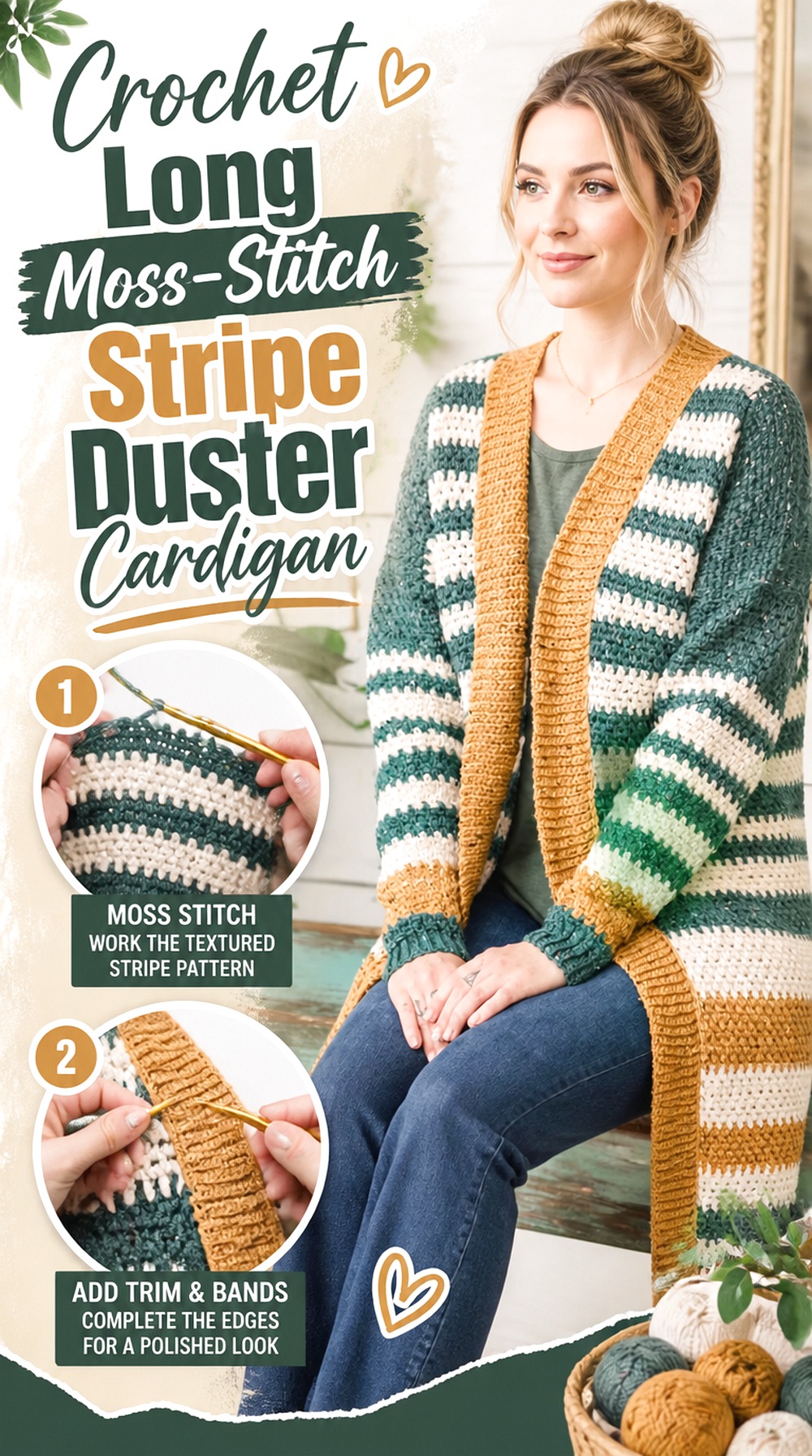
SAVEBriana K’s striped Shortbread Duster extends the cardigan idea into a long layering garment. The source design uses moss stitch, three colors, a bottom-up body that later divides for the armholes, flat-worked sleeves, and a separately finished front trim. The increased length changes the visual role of stripes: broad bands become part of a long vertical silhouette rather than sitting only around the torso. This option is useful when you want a cardigan to provide more lower-body coverage and prefer an intentionally substantial project rather than a cropped or hip-length layer.
Longer Garments Make Yarn Weight More Noticeable
Every added section contributes to the load hanging from the shoulders. If substituting yarn, compare the weight and drape of a reasonably large swatch rather than relying on a tiny gauge square alone. A yarn that feels pleasant in a small sample may become less comfortable when multiplied across a long duster, especially if you also extend the sleeves or body.
Unequal Stripe Widths Can Break Up a Long Silhouette
A long cardigan does not need identical bands from hem to shoulder. Varying the depth of color sections can prevent the eye from reading the garment as a stack of equal blocks. If you design your own palette, sketch the whole vertical sequence first so one unusually wide section does not accidentally land at a place where you would rather have less emphasis.
Check the Front Edges After the Body Has Settled
Long front edges make small tension differences easier to see. Before completing the final trim, let the assembled body hang and check whether both fronts reach the same point and whether the fabric has relaxed unevenly. The finishing band can frame a duster beautifully, but it should not be expected to correct a substantial length discrepancy created earlier.
Original Tutorial and Creator Credit
Creator: Briana K
Comparing the 13 Crochet Striped Cardigan Styles
| Idea | Main Construction | Stripe Character | Most Useful If You Want |
|---|---|---|---|
| Classic Button-Front | Separate panels | Clean two-color horizontal bands | Familiar cardigan proportions and buttons |
| Made-to-Measure Narrow Stripe | Measurement-led panels | Frequent narrow bands | More control over personal fit |
| Oversized Granny-Stripe | Mostly one-piece | Open clustered stripes | Relaxed layering and many colors |
| Soft-Halo Pink Stripe | Made-to-measure panels | Soft-edged fuzzy bands | Bold color with less graphic edges |
| Earth-Tone Moss Stitch | Separate panels | Muted textured stripes | Dense texture and an earthy palette |
| Hexagon Stripe-Edge | Two folded hexagons | Color concentrated near edges | A calmer solid center |
| Shaped DK Stripe | Bottom-up shaped pieces | Main-color-separated accents | Shoulder shaping and a polished button front |
| Collegiate Texture-Stripe | Separate panels | Color plus stitch-texture bands | Balloon sleeves and richer surface detail |
| Paneled Granny-Stripe | Back and front panels | Classic open granny bands | Adjustable fit with traditional panel assembly |
| Solid-Stitch Hexagon | Two hexagons | Dense concentric bands | Geometric stripes with less openwork |
| Earthy Hexagon Stripe | Growing hexagons | Casual multi-color rounds | Organic color placement and roomy geometry |
| Fitted Purple Stripe | Shaped panels | Close-fitting horizontal stripes | A compact buttoned silhouette |
| Long Stripe Duster | Long bottom-up body | Extended moss-stitch bands | Maximum length and lower-body coverage |
Conclusion
The most useful way to choose among these crochet striped cardigan ideas is to start with silhouette and construction, then choose the palette. For a neat buttoned layer, the classic, fitted, or shaped DK options keep the stripes controlled. Granny-stripe cardigans suit a more open, relaxed surface, while hexagon versions turn the color changes into part of the garment geometry. The halo-yarn and textured designs add another layer of visual interest, and the duster is the clear choice when length matters most.
Once you have chosen a direction, swatch the actual colors and yarn together and check fit before completing large sections. Use the original tutorials for their exact construction details and creator-specific instructions.
Frequently Asked Questions
Should the stripes on the fronts and back of a crochet cardigan line up exactly?
Not necessarily. On a traditionally paneled cardigan, aligning major color changes can create a tidy continuous appearance, but perfect matching is not required unless the design depends on it. Hexagon cardigans naturally send bands in different directions, so trying to force conventional alignment defeats their geometry. Decide what should look intentional, then compare the pieces in garment position before seaming.
How can I tell whether a striped crochet cardigan will become too heavy?
Make a larger swatch in the actual yarn and stitch, record its feel, then hold it vertically instead of assessing it only on a table. Consider how much fabric the chosen silhouette requires: an oversized cardigan or long duster contains much more material than a fitted cropped style. If you are changing the source yarn, confirm gauge and drape before buying or crocheting the full garment.
Are narrow or wide stripes better for a crochet cardigan?
Neither is universally better. Narrow stripes produce a busier, more continuous pattern and usually require more frequent color changes. Wide bands let individual colors occupy more visual space and can suit textured stitches particularly well. On a long cardigan, varying band widths can also break up the silhouette. Test a short sequence first because row height determines the actual visible width of each band.
Can I use a different yarn for a made-to-measure striped cardigan?
Made-to-measure construction gives you flexibility, but it does not make every yarn interchangeable. A different yarn can change stitch dimensions, drape, weight, stretch, and the apparent depth of every stripe. Swatch the substituted yarn in the actual stitch pattern, measure the blocked or finished fabric as appropriate, and compare how it hangs before using personal measurements to plan the garment.
Why do stripe directions change on a crochet hexagon cardigan?
The colors are worked around an expanding polygon rather than straight across a conventional back or front panel. When each hexagon is folded into part of the cardigan, different sides of those concentric rounds become the sleeve, body, front, and back areas. That is why one color band can appear horizontal in one section and angled or vertical in another. The change is a feature of the construction rather than an alignment mistake.
How can I keep a multicolor striped cardigan from looking too busy?
Limit the number of equally dominant elements. You might repeat one main color between accent stripes, concentrate color near the edges while keeping the center solid, or choose several shades with related values. Texture matters too: highly dimensional stitches plus many bright colors create more visual information than smooth fabric with the same palette. Swatch several consecutive bands so you can judge the combination as fabric rather than as separate skeins.