Christmas granny squares can go far beyond changing a classic square to red and green. This collection includes recognizable holiday motifs such as Santa, reindeer, snowflakes, poinsettias, lights, and peppermint, along with projects that turn granny squares into stockings, ornaments, gift bags, and a complete festive blanket.
The biggest differences are not just decorative. Some designs stay relatively flat and are easier to repeat in a large layout, while others use raised petals, leaves, facial features, or attached pieces that create more texture. A few tutorials use granny squares as building units rather than as standalone blocks. Use the comparisons below to decide which ideas fit your intended blanket, pillow, wall display, gift wrapping, or Christmas tree decor before committing to a large batch.
Quick List
- Crochet Evergreen Christmas Tree Granny Square
- Crochet Frosted Snowflake Granny Square
- Crochet Layered Poinsettia Granny Square
- Crochet Santa Gnome Granny Square
- Crochet Wrapped Gift Box Granny Square
- Crochet Penguin Holiday Granny Square
- Crochet Patchwork Granny Square Christmas Stocking
- Crochet Santa Face Granny Square
- Crochet Red-Nosed Reindeer Granny Square
- Crochet Snowman Face Granny Square
- Crochet Dimensional Christmas Wreath Granny Square
- Crochet 3D Holly Leaf Granny Square
- Crochet Christmas Lights Granny Square
- Crochet Elf Face Granny Square
- Crochet Peppermint Pinwheel Granny Square
- Crochet 3D Christmas Star Granny Square
- Crochet Granny Square Bauble Ornament
- Crochet Christmas Tree Granny Square Gift Bag
- Crochet Glitzy Christmas Granny Square Blanket
Match Square Size Before You Build a Christmas Sampler
These tutorials come from different designers, so their squares should not automatically be treated as interchangeable blocks. Yarn weight, hook choice, stitch density, border construction, dimensional details, and individual tension can all change the finished measurement. Make one sample of each design you want to combine, finish it as the tutorial recommends, and compare the resulting dimensions before producing multiples.
As a simple planning example, a square that blocks to 6 inches placed beside one measuring 5½ inches creates a half-inch mismatch before joining. A compatible border may sometimes help equalize two motifs, but it is better to discover that difference at the sample stage. Also compare stitch counts or usable joining points along each edge when the tutorials provide them; equal outside measurements alone do not guarantee an effortless join.
Choose Flat or Dimensional Motifs Based on the Final Project
A snowflake, peppermint spiral, light bulb, or color-based tree motif can be practical when you want many squares to lie predictably in a blanket. Poinsettias, wreaths, holly leaves, reindeer antlers, and layered facial details bring stronger relief, making them particularly effective as focal blocks, pillow fronts, wall pieces, or decorative panels.
That extra dimension also changes function. Raised elements can receive more friction on a frequently used throw and need more care during storage. For a mixed sampler, consider alternating highly dimensional blocks with quieter squares rather than putting every textured motif together. If the finished piece needs to fold compactly, check how the attached details behave when folded before committing to a full layout.
Plan Color Repetition, Orientation, and Finishing Early
Nineteen Christmas motifs can become visually busy even when every individual square looks good. A limited background palette is one way to connect very different designs. You might repeat one background color, use the same final border on compatible squares, or restrict accent colors so Santa, holly, lights, and peppermint still appear to belong to one collection.
Orientation deserves attention too. Trees, faces, stockings, lights, and characters have obvious tops, unlike an abstract granny square. Mark the upper edge while arranging a blanket so motifs do not accidentally rotate during joining. Finally, estimate the finishing work realistically. Squares with appliqués and dimensional pieces create more yarn ends and attachment points than color-only designs, so a 19-motif sampler may require substantially more finishing than 19 classic granny squares.
1. Crochet Evergreen Christmas Tree Granny Square
 SAVE
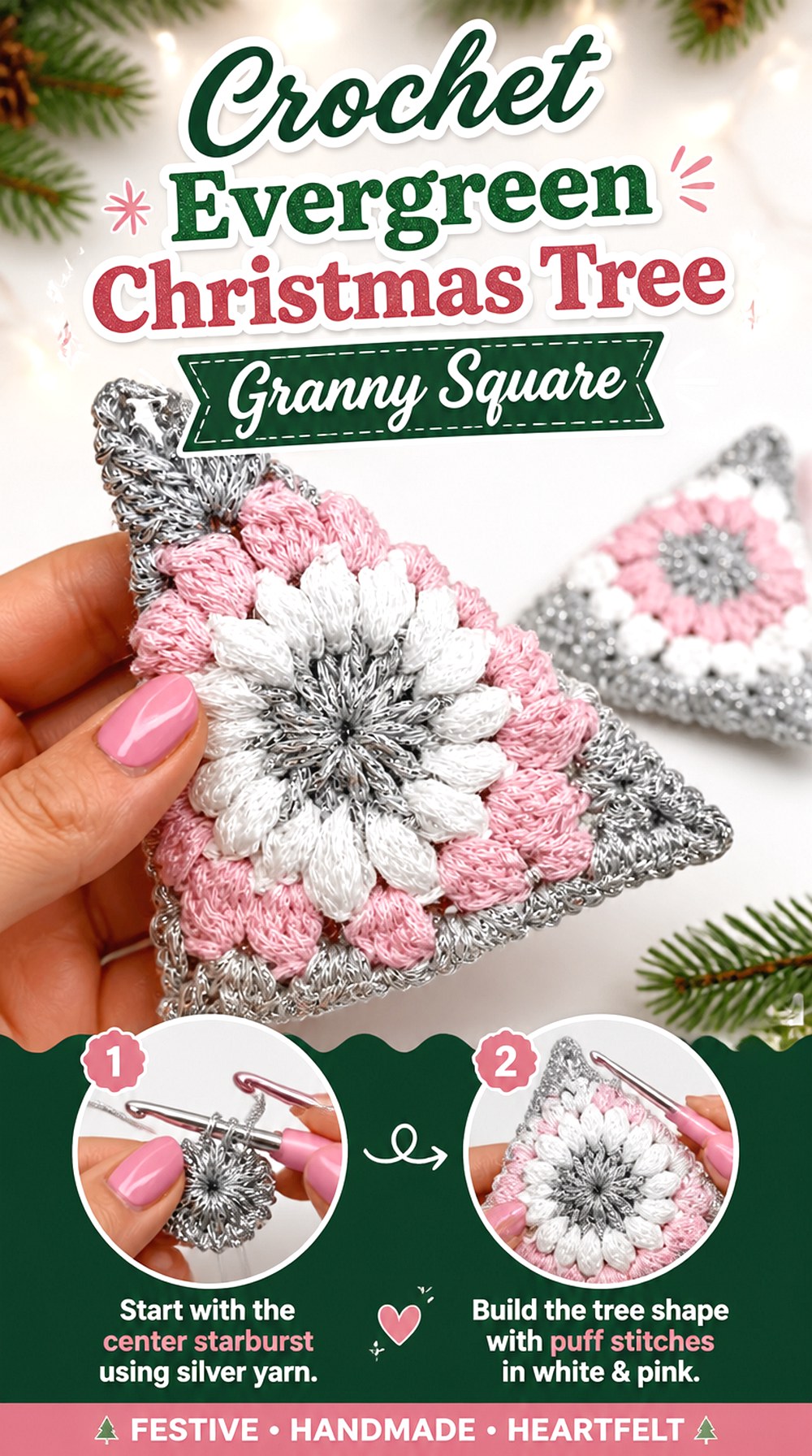
SAVEThis Christmas tree square puts the seasonal symbol directly into the motif rather than relying only on holiday colors. The recognizable triangular tree shape makes it suitable for a repeated blanket layout, a cushion panel, bunting, or an individual decorative block. Because the tree carries most of the visual weight, the surrounding background can stay relatively quiet.
It is also a useful option when you want a design that reads as Christmas immediately without adding faces or many separate embellishments. Claudetta Crochet’s tutorial is specifically devoted to a granny-square Christmas tree, giving this idea a direct project match.
Keep the Tree Silhouette Readable
Strong contrast between the tree and its surrounding stitches matters more than adding numerous small colors. If the green or chosen tree color sits too close in value to the background, the outline can disappear once several blocks are joined. Before making multiples, photograph the sample from a few feet away. If the tree still reads clearly at that distance, it should remain recognizable in a larger blanket or wall display.
Use It as a Repeat or a Focal Block
A tree motif can be repeated consistently for a more orderly project, but it can also act as the central block in a mixed Christmas sampler. For a mixed layout, compare the finished square with neighboring snowflake, star, or gift-box motifs before joining. If the tree is visually heavier, placing quieter blocks around it can prevent one section of the final piece from feeling crowded.
2. Crochet Frosted Snowflake Granny Square
 SAVE
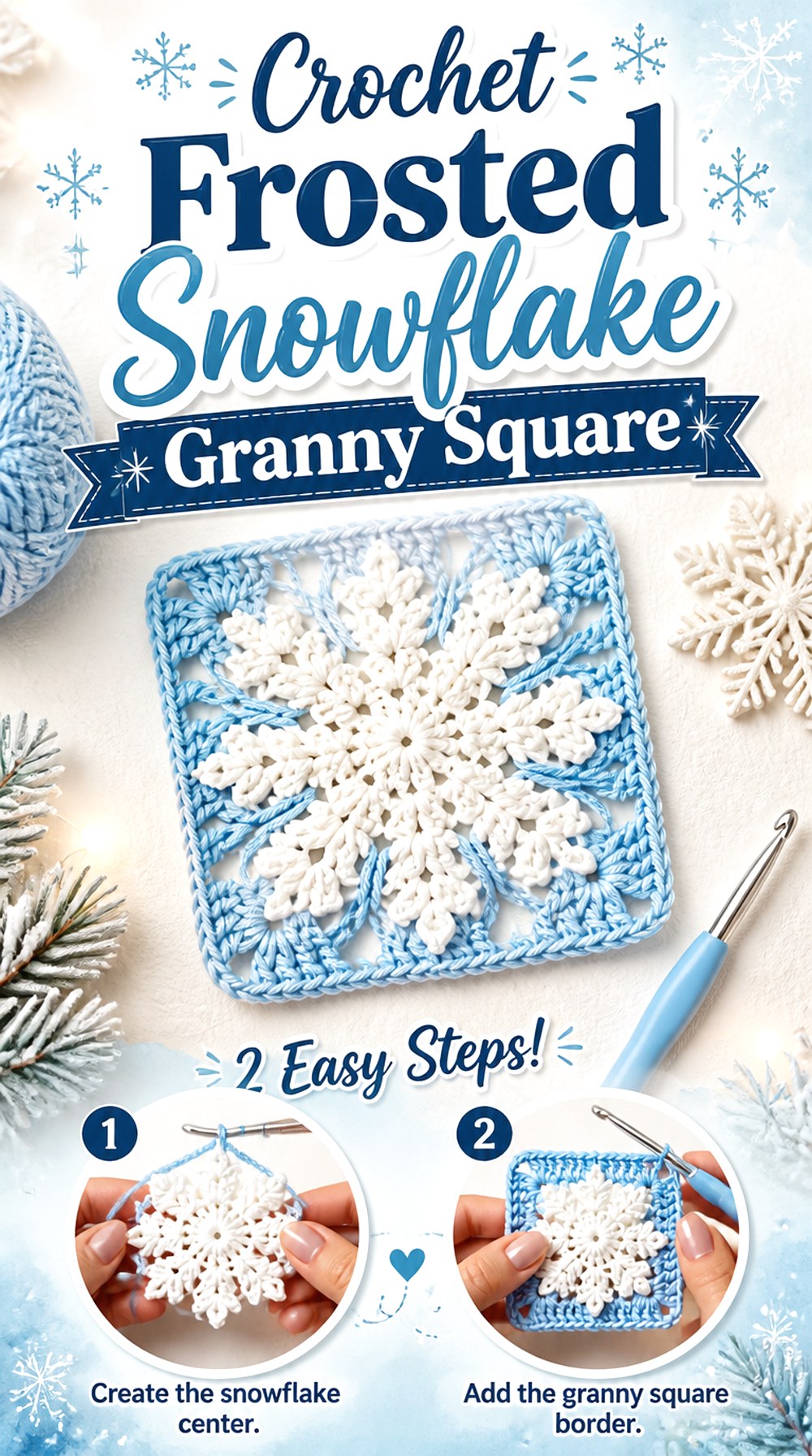
SAVEA snowflake square gives a Christmas collection a lighter visual break from character faces and dense appliqués. The branching motif naturally suits icy white, cream, pale blue, silver-toned, or high-contrast color schemes, although the square does not have to be limited to traditional winter colors.
This design is particularly useful in a sampler because its geometry feels festive without introducing another figure. The tutorial from by Kristine focuses specifically on a snowflake granny square and shows the motif developing into a finished square rather than using a separate snowflake merely as loose decoration.
Contrast Matters More Than Extra Color
A snowflake depends on the viewer being able to follow its arms and negative spaces. Two strongly separated colors often communicate the design more clearly than several similar shades. Before choosing yarn for a whole batch, place the motif color against the intended background under normal room lighting. Subtle contrast that looks attractive in a skein may become difficult to read once the stitches interlock.
Block Before Mixing With Denser Squares
Open or decorative snowflake areas can respond differently to blocking than dense character squares. Finish one complete sample and let it settle into its final shape before comparing it with another motif. Pulling a snowflake square aggressively to match a larger neighbor can distort both the outer edge and the central design, so size compatibility should come from controlled adjustment rather than stretching.
Openwork Changes the Joining Feel
If the outer portion of your chosen snowflake square is more open than neighboring motifs, a heavy raised join can dominate its delicate appearance. Lay sample squares side by side with a short test join before committing to a blanket-wide method. The goal is not merely to connect the pieces; the seam should visually support the snowflake rather than become the strongest line in the finished section.
Original Tutorial and Creator Credit
Creator: by Kristine
3. Crochet Layered Poinsettia Granny Square
 SAVE
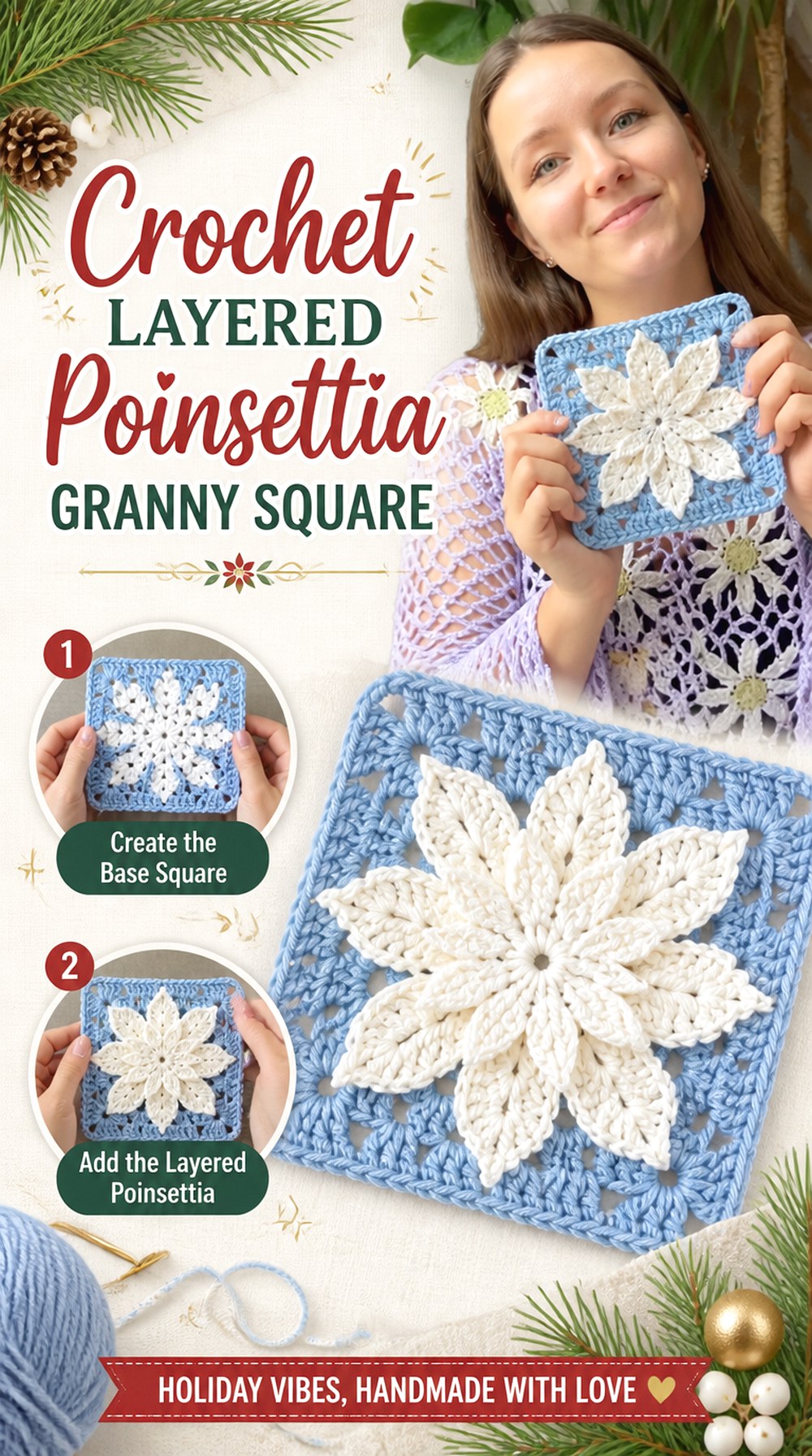
SAVEThe poinsettia square moves this collection toward dimensional floral crochet. Rather than depending on a printed-looking color motif, the flower creates a distinct center that can become the visual focus of a cushion, decorative panel, holiday bag, or selected blanket block. Oh My Crochet’s tutorial identifies the project specifically as a poinsettia flower granny square and uses a raised floral presentation.
Because poinsettias are recognizable through shape as well as color, this is also one of the designs that can tolerate a more restrained palette. The key planning question is how much surface depth you actually want in the finished item.
Dimensional Petals Need Breathing Room
Raised petals can lose their impact if equally dimensional motifs are packed tightly on every neighboring square. In a sampler, consider placing the poinsettia between flatter blocks such as a peppermint spiral or geometric star. That gives the flower enough visual space to remain the focal point while keeping the overall surface from becoming excessively busy.
Reserve Raised Flowers for Low-Abrasion Uses
A dimensional flower behaves differently from a flat color motif when rubbed, folded, or repeatedly washed. A pillow front, seasonal wall panel, decorative throw section, or bag exterior may showcase the relief more clearly than a surface that receives constant friction. Whatever the final use, inspect how securely every raised part is incorporated before assembly and follow the creator’s construction details rather than improvising attachment points.
Original Tutorial and Creator Credit
Creator: Oh My Crochet
4. Crochet Santa Gnome Granny Square
 SAVE
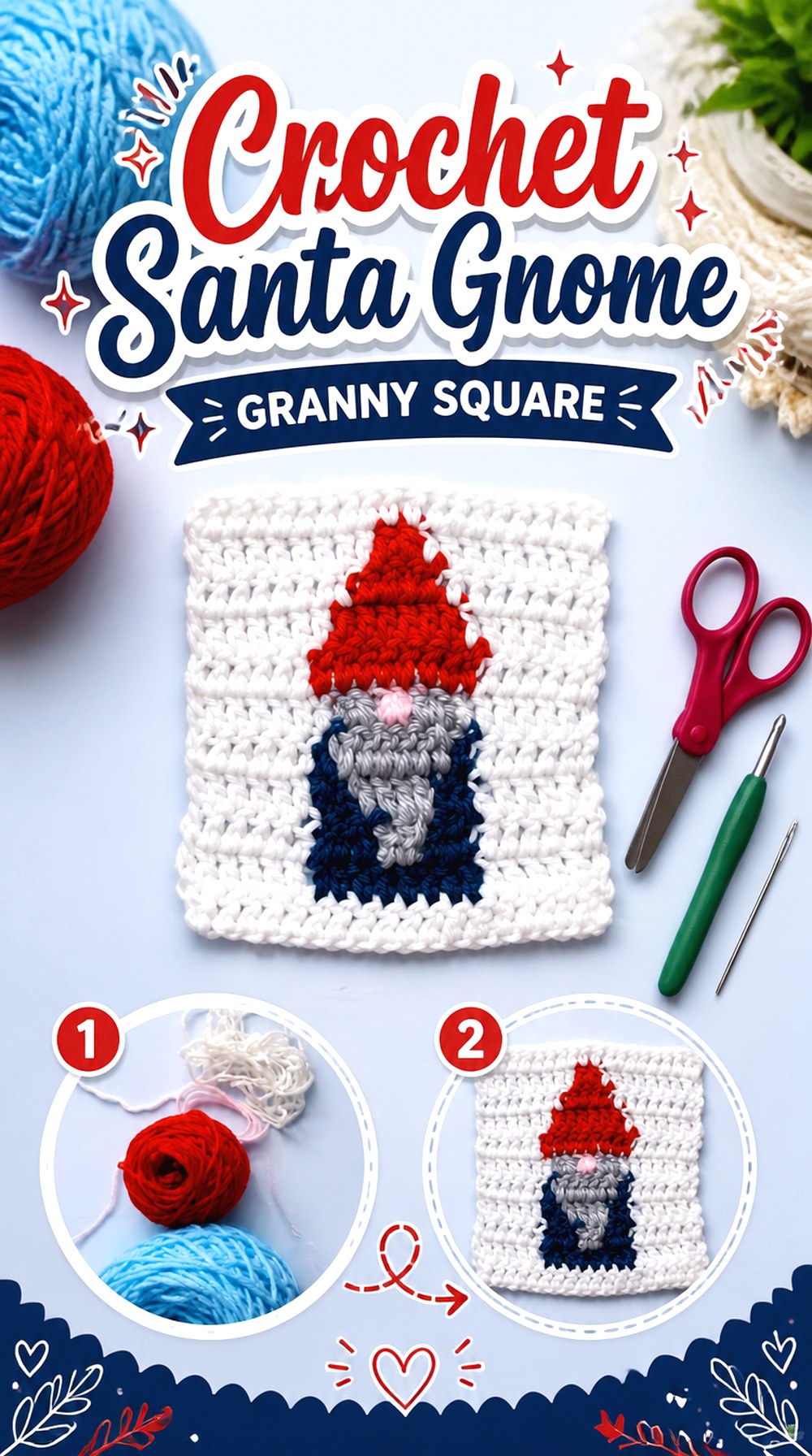
SAVEA Santa gnome brings a graphic character block into the collection. The finished square has a stronger illustration-like quality than a classic cluster-based granny, making it an effective focal design for a blanket, wall hanging, pillow, or Christmas panel. Jayda InStitches presents the design as a Santa Gnome granny and demonstrates the graph-based square in a full tutorial.
This concept suits readers who want recognizable holiday imagery while keeping the finished piece square and easy to position in a grid. Its strong character silhouette also gives you a useful contrast against flowers, snowflakes, or abstract peppermint designs.
Graph-Like Color Areas Change the Look
A pictorial square relies on clean boundaries between color areas. When selecting substitutes, prioritize colors that separate clearly rather than matching every yarn to a particular traditional shade. If the beard, hat, face, and background merge visually, the character loses definition. Make a small color card or place the skeins together before starting so the major sections can be distinguished at a glance.
Check the Border Against Other Motifs
The outer border determines whether a graphic gnome can sit comfortably beside round-centered or appliqué-based squares. Complete the border before deciding where it belongs in a sampler. A square may appear compatible while the central picture is being worked but finish at a noticeably different measurement once all edging is added.
Use the Gnome as a Statement Square
One Santa gnome can provide enough character for an otherwise motif-driven blanket. Repeating it is an option, but a single central or corner placement can keep a large project from becoming too visually literal. Arrange paper labels for all planned motifs first and decide where character blocks will sit before making several identical gnomes.
Original Tutorial and Creator Credit
Creator: Jayda InStitches
5. Crochet Wrapped Gift Box Granny Square
 SAVE
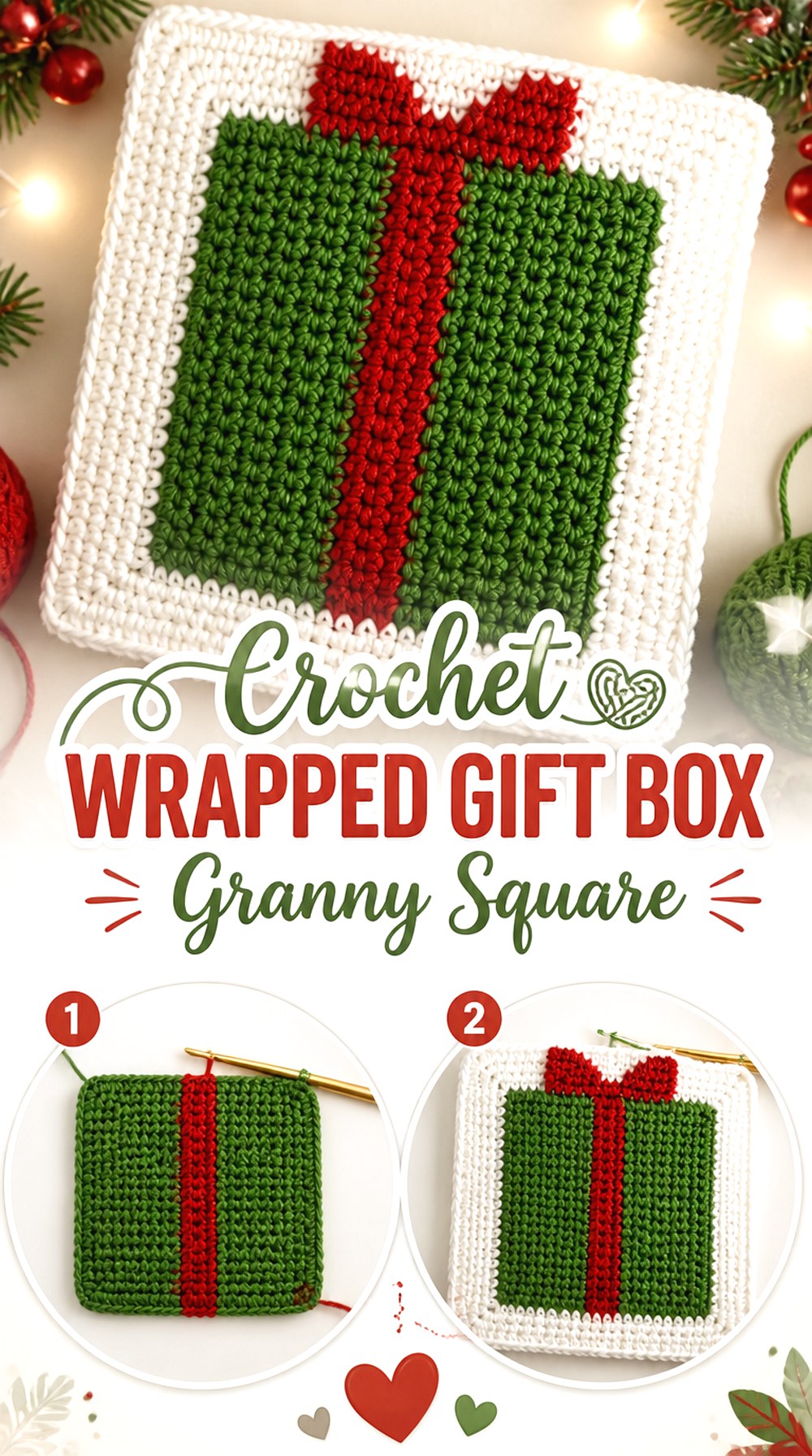
SAVEThe gift-box square uses simple geometry to create an immediately recognizable Christmas present. RepeatCrafterMe’s tutorial shows a granny square designed to look like a wrapped gift, making it a natural option for Christmas blankets but also one that can move easily into birthday or celebration projects through color changes.
Unlike character squares, the design is driven by straight lines and ribbon placement. That makes it a helpful visual reset within a busy sampler. It can also be repeated in different gift colors without changing the underlying concept, creating variety while keeping the construction family consistent.
The Ribbon Lines Need Visual Alignment
The vertical and horizontal ribbon elements are what transform a plain square into a parcel. When several gift squares are used together, inconsistent ribbon placement will be more noticeable than slight color differences. Compare the center lines on completed blocks before joining and rotate each square so the gift orientation remains intentional.
A Flat Bow Packs Better Than a Bulky One
If you plan to use gift-box squares in a frequently folded blanket, consider how far any bow detail projects from the surface. A flatter presentation is easier to stack and store, while a raised bow can be a stronger decorative feature on a pillow or wall piece. Follow the tutorial for the actual construction, then choose the final project according to how much surface depth it creates.
Original Tutorial and Creator Credit
Creator: RepeatCrafterMe
6. Crochet Penguin Holiday Granny Square
 SAVE
SAVEA penguin square introduces a winter character without repeating the Santa-and-elf theme. Kerri’s Crochet shows a finished penguin granny square with separate character components assembled into the design, giving the block more illustration and surface detail than a simple color-change square.
This concept can work well in a Christmas sampler that also includes snowmen, snowflakes, or polar winter colors. Because the face, body, feet, and other recognizable details influence the final expression, it rewards careful assembly. It is better treated as a feature motif than as a block to rush through in a large production line.
Attached Features Add Assembly Work
A motif made from multiple components creates more finishing points than a square whose picture is formed entirely during the main crochet. Before committing to several penguins, complete one through the final attachment stage. That sample will show whether you enjoy the assembly and whether the finished surface suits the blanket, pillow, or display you have planned.
Match the Face Scale Across a Sampler
If a penguin will sit beside Santa, a snowman, or a reindeer, compare the visual scale of the faces rather than looking only at outside square dimensions. A very large character next to several tiny faces can make the layout feel unbalanced. Moving larger character squares toward the center or corners can make that contrast look deliberate.
Choose a Firm Background for Appliqué
Attached character pieces are easier to position neatly when the square underneath holds its shape. If substituting yarn, avoid making the background so loose and drapey that the appliqué pulls it out of line. Finish and flatten the base square first, then evaluate the character placement on the actual fabric rather than on an unstabilized work-in-progress.
Original Tutorial and Creator Credit
Creator: Kerri’s Crochet
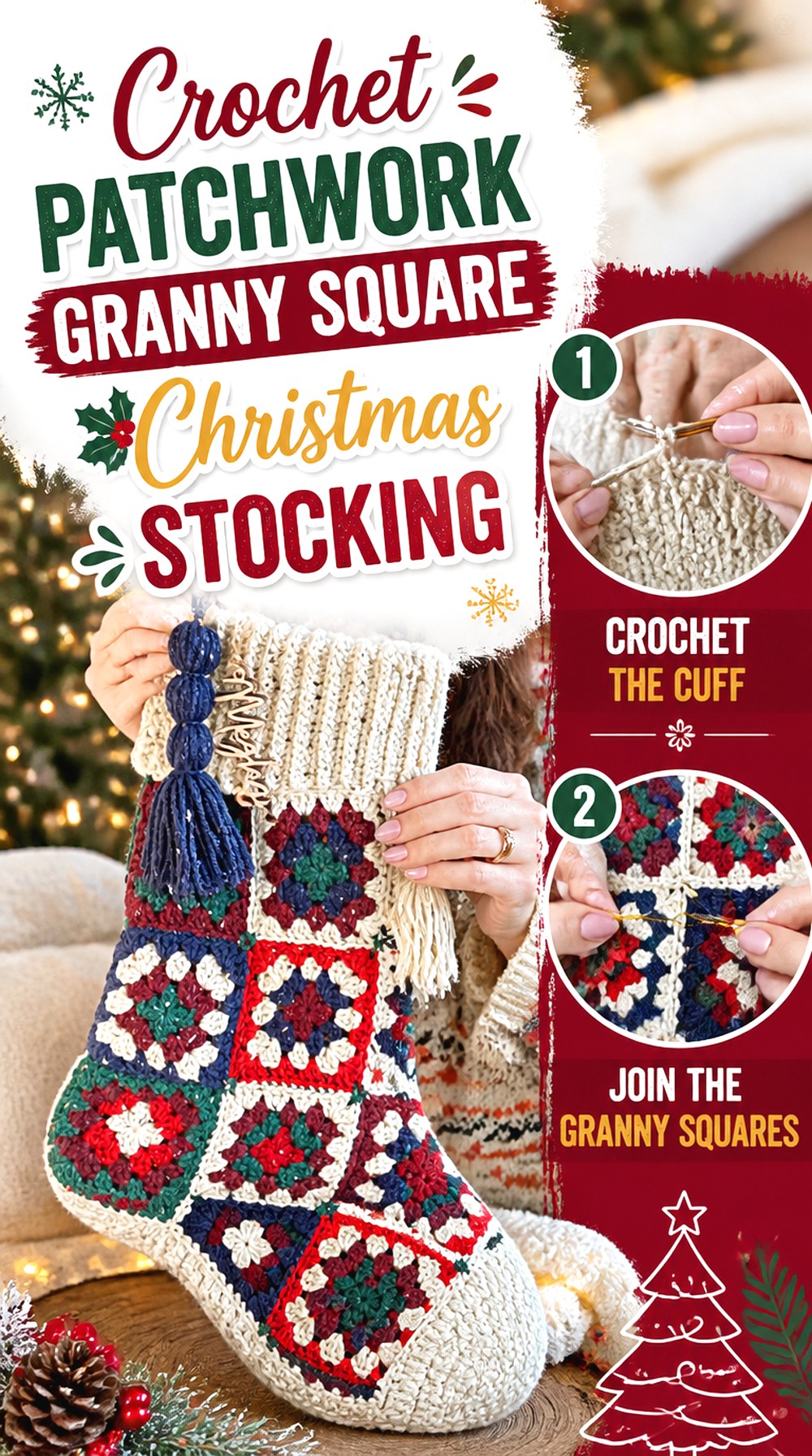
7. Crochet Patchwork Granny Square Christmas Stocking
 SAVE
SAVEThis idea changes the role of the granny square completely. Instead of making one pictorial block, the project uses a collection of traditional granny squares as construction units for a full Christmas stocking. MJ’s Off The Hook Designs demonstrates a stocking made from multiple squares, along with the assembly and finishing stages.
It is a strong choice for readers who enjoy repeated motifs but want an object rather than another blanket. Color placement can be changed from square to square, yet the repeated module keeps the design cohesive. The important planning decisions are scale, seam strength, stocking shape, and how the cuff and hanging area interact with the joined fabric.
Square Size Controls the Whole Stocking
When a project is assembled from multiple motifs, a small difference in each square compounds across the finished shape. Measure a completed, finished sample before making the full set. If you change yarn weight, hook, or tension, do not assume the stocking will retain the same proportions shown in the source tutorial.
Seams Become Structural, Not Decorative
A blanket join mainly needs to keep neighboring blocks connected, but a stocking seam also helps maintain a three-dimensional container shape. Inspect every join for gaps or overly stretched sections, especially around direction changes. If you plan to place anything inside the stocking, remember that the tutorial—not an assumed load capacity—should guide how the item is intended to function.
Plan the Cuff and Hanging Point Together
The upper edge is both a visual finish and a practical part of a stocking. Before adding embellishment, decide which side will face forward and where the hanging point belongs so the stocking hangs in the intended direction. Reinforcing or altering that area without considering the overall construction can twist the finished piece.
Original Tutorial and Creator Credit
Creator: MJ’s Off The Hook Designs
8. Crochet Santa Face Granny Square
 SAVE
SAVEA Santa face square puts one of the clearest Christmas characters directly at the center of the block. The Crochet Bits tutorial is specifically devoted to a Santa granny square, making it a direct match for a holiday sampler, pillow front, decorative wall panel, or character blanket.
Compared with a full gnome or elf scene, the face-focused format keeps attention concentrated near the middle of the square. That makes background and border choices especially important: they need to frame Santa rather than compete with the hat, beard, and facial details.
Face Placement Determines the Expression
Small placement differences can noticeably change a character square. Before securing any separate facial details, place the completed square on a flat surface and check it from normal viewing distance. Look for centered eyes, balanced beard or trim, and enough space between the face and outer border. Pinning components temporarily is safer than discovering an alignment problem after permanent attachment.
White Trim Can Add Visual Bulk
Santa designs often contain substantial light-colored areas around the beard or hat. Against a very pale background, those edges may visually disappear; against an extremely dark background, they can dominate the whole square. Test the main colors together first and choose a border that separates the character while still fitting the broader palette of your project.
Original Tutorial and Creator Credit
Creator: Crochet Bits
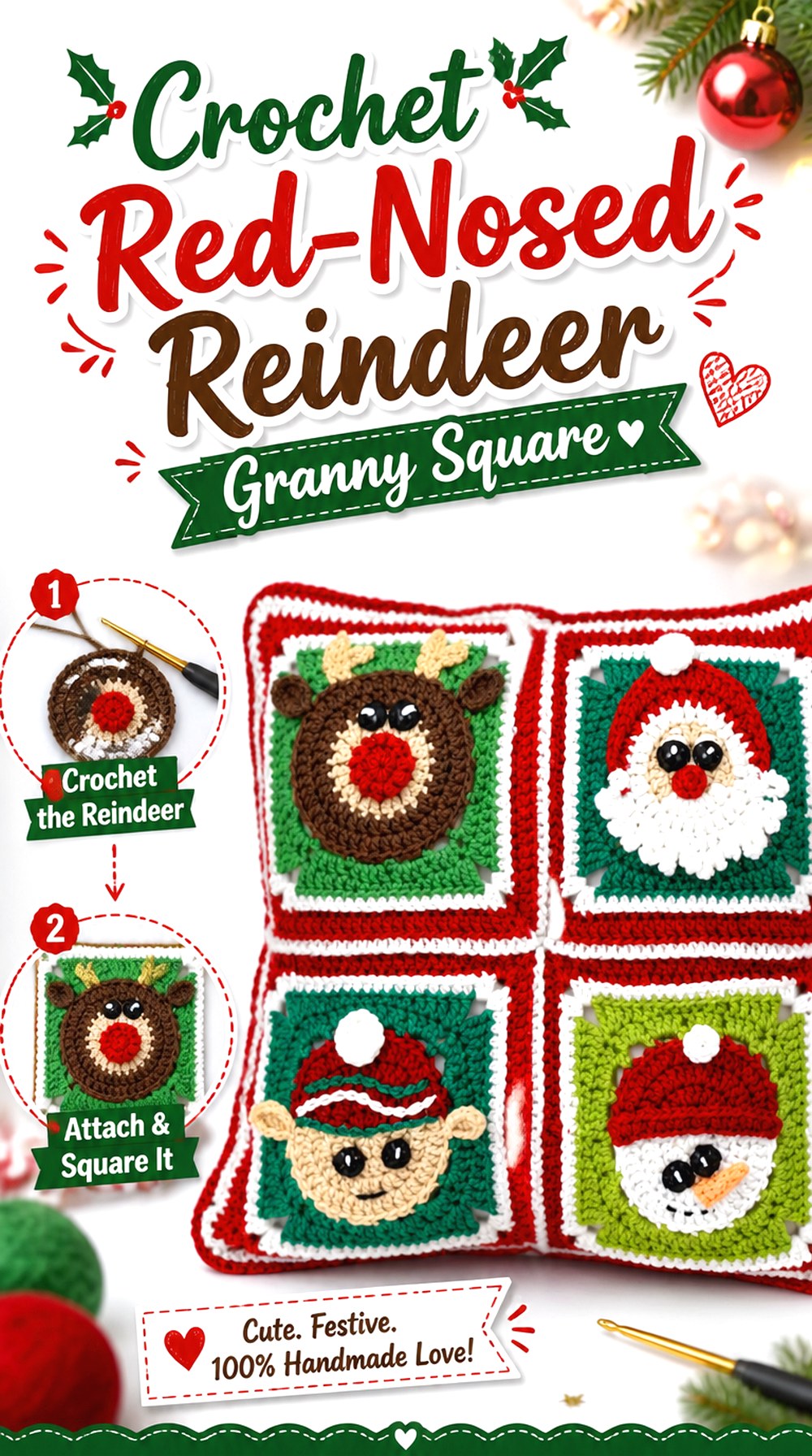
9. Crochet Red Nosed Reindeer Granny Square
 SAVE
SAVEA reindeer block gives a Christmas sampler a second recognizable character while introducing a different silhouette from round-faced Santa and snowman designs. The Passionate Crafter tutorial demonstrates a Christmas reindeer granny square and provides a direct visual reference for the finished motif.
Antlers and ears push the visual interest toward the upper half of the block, while a contrasting nose can create a small central accent. That distribution makes the square useful between more symmetrical motifs such as stars or peppermint pinwheels. It also means the upper edge needs enough space for the character to remain readable after joining.
Antlers Need Clear Edge Space
Antlers can lose definition when they sit too close to a heavy seam or neighboring raised motif. Before joining the reindeer square into a sampler, place the actual adjacent squares around it and check whether the upper silhouette remains visible. If the area feels crowded, change the layout rather than trying to compress or reposition finished character details.
A Red Nose Works Best as a Controlled Accent
A bright nose can be the focal point even when it occupies very little space. Repeating the same strong red throughout every background and border may weaken that effect. If you want the nose to stand out, reserve your most saturated accent color for a few strategic details elsewhere rather than using it equally across every part of the blanket.
Keep Ear Placement Symmetrical
The ears and antlers influence the apparent balance of the whole face. Before securing any separately made components, align the square’s center with a ruler or folded paper guide and compare left and right positions. Perfect mathematical symmetry is not required for character, but noticeable accidental tilt becomes more obvious once the block is placed in a straight grid.
Original Tutorial and Creator Credit
Creator: Passionate Crafter
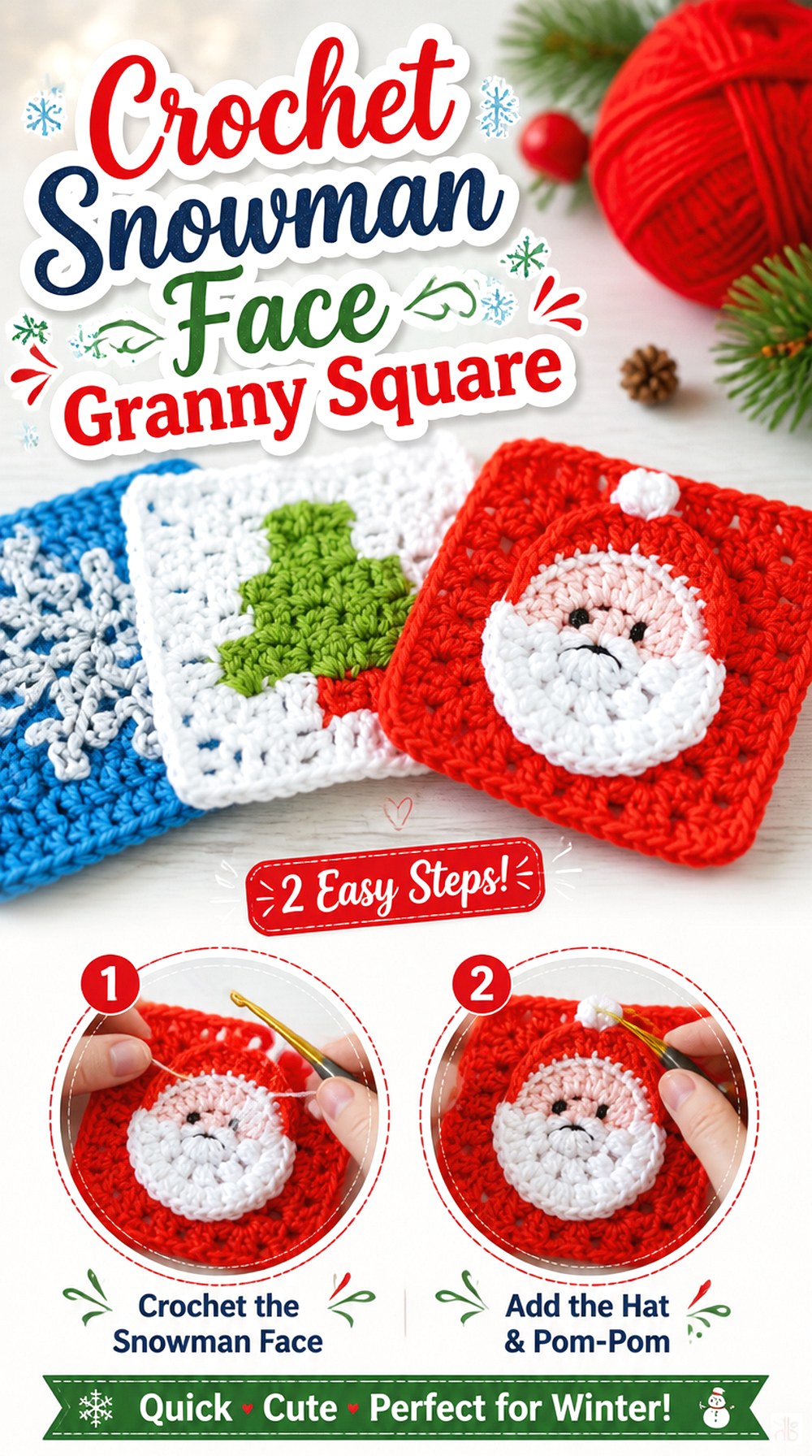
10. Crochet Snowman Face Granny Square
 SAVE
SAVEA snowman square offers a softer winter motif that can bridge explicitly Christmas designs and general seasonal crochet. HappyBerry Crochet’s tutorial focuses on a snowman granny square, giving the design a clear finished-square reference rather than presenting only a separate snowman appliqué.
The mostly rounded face contrasts nicely with pointed trees, stars, antlers, and holly leaves. Because a snowman’s identity depends on a few high-impact details, this is also a good design for a restrained color palette. You can let the background provide most of the color while keeping the face visually clean.
Facial Details Benefit From a Calm Background
When eyes, a nose, mouth, and headwear all occupy a relatively small area, a highly variegated or strongly striped background may make those details harder to read. Place your intended face colors over a sample swatch before committing to the full square. If the features disappear, simplify the background or increase contrast rather than adding more embellishment.
Avoid Overbuilding the Center
A snowman face already creates a strong round focal area. Adding several extra raised decorations around it can make the middle stiff or visually crowded, particularly in a blanket meant to fold. Let the tutorial’s main features do the work, then use the outer border or neighboring squares to add additional Christmas color.
Original Tutorial and Creator Credit
Creator: HappyBerry Crochet
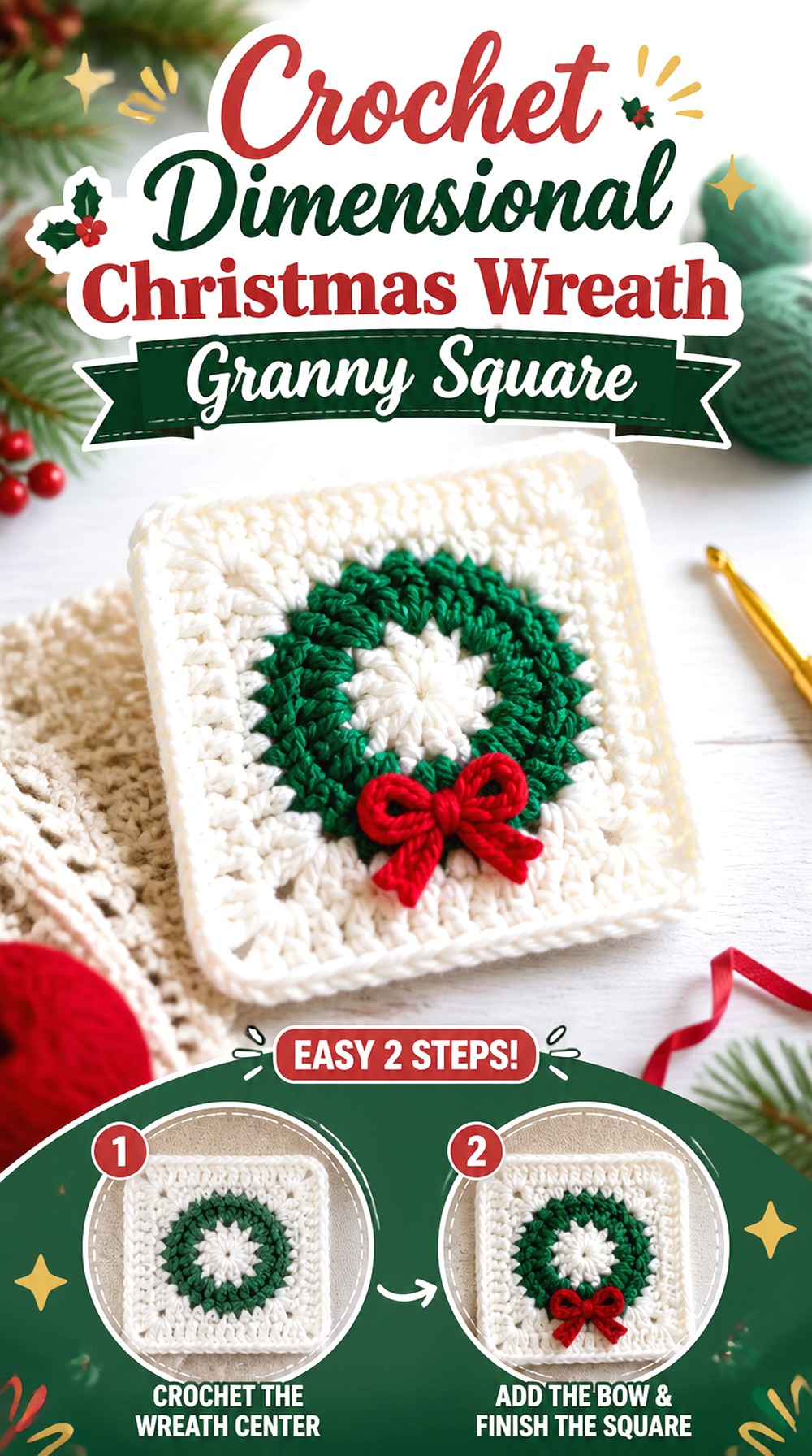
11. Crochet Dimensional Christmas Wreath Granny Square
 SAVE
SAVEThe wreath square creates a circular focal motif inside the square boundary, giving a sampler a strong geometric contrast. Kirsten Redfield Crafts’ tutorial presents a dedicated Christmas wreath granny square, making it suitable for readers who want greenery and seasonal decor imagery without adding another character face.
A wreath can also carry more surface texture than a flat color-change motif. That makes it effective as a single pillow center, wall piece, or highlighted blanket block. The main planning issue is preserving the round wreath shape while keeping its raised elements away from joins.
Raised Leaves Can Catch on Joining Seams
If leaves or other wreath details extend toward the outer portion of the block, test the intended joining method on a sample edge first. A bulky seam placed too close to dimensional foliage can flatten or obscure those details. A different block position may solve the problem without changing the source design.
Center the Wreath Before Final Border Decisions
Circular motifs make off-center placement easy to notice. Lay the square flat and compare the visible background space on all four sides. If you are adapting border colors or adding a compatible outer round for sizing, keep that addition visually even so the wreath still appears centered when viewed from across the room.
Use Repetition to Build Rhythm
Several wreath blocks can create a strong repeated-circle pattern, but they do not need to fill every position. Alternating wreaths with stars, snowflakes, or gift boxes produces a useful round-versus-angular rhythm. Sketch the grid before making multiples to determine whether the wreath is functioning as a repeated motif or a limited accent.
Original Tutorial and Creator Credit
Creator: Kirsten Redfield Crafts
12. Crochet 3D Holly Leaf Granny Square
 SAVE
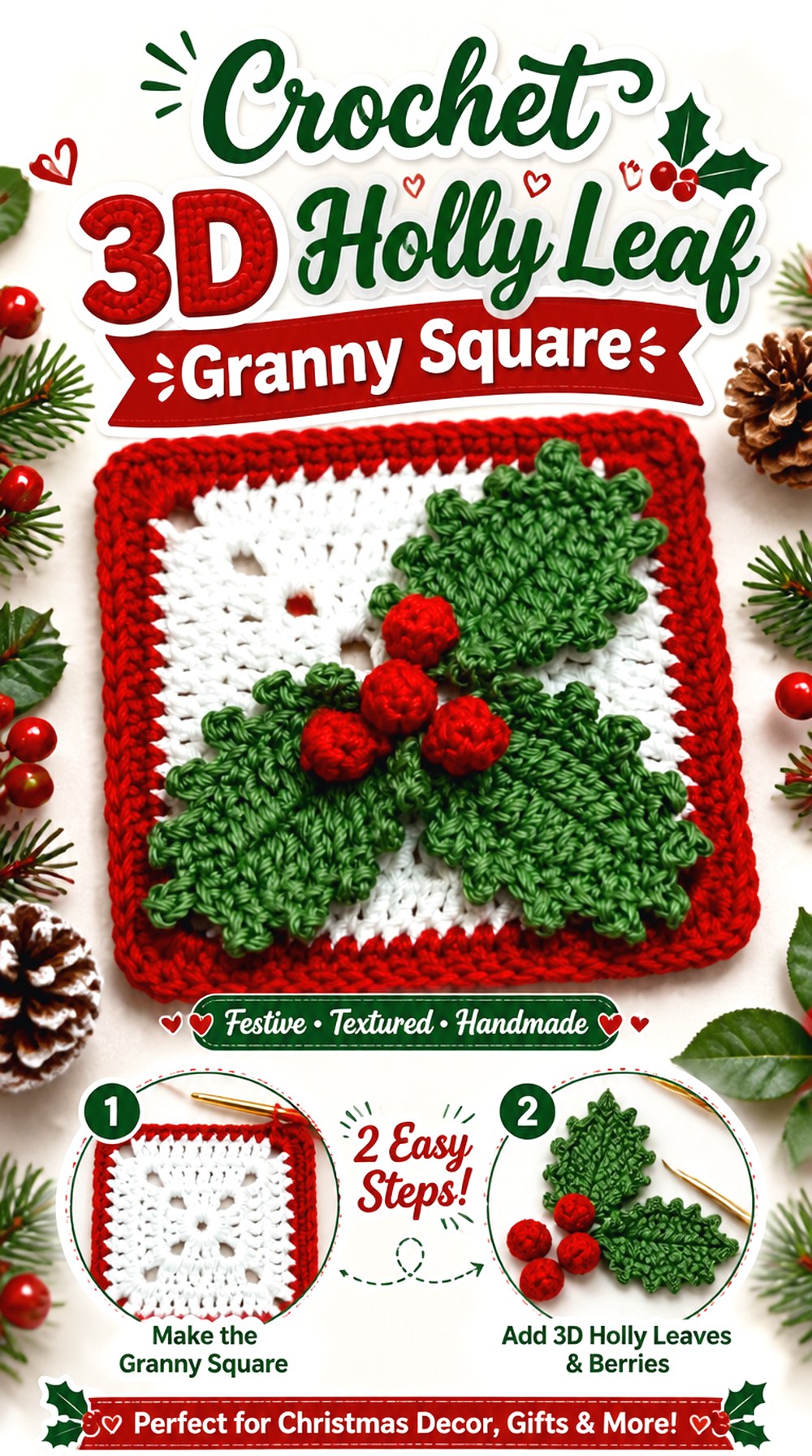
SAVEThis holly design uses dimensional leaves to turn a familiar Christmas plant into a tactile motif. The Tiny Elefant video is specifically titled as a 3D holly-leaf granny square, so it is a strong match for readers seeking more relief than a flat embroidered or color-blocked holly design.
The combination of pointed leaves and small berry accents can work particularly well as a feature block among simpler geometric squares. It also offers a useful way to introduce green without making another Christmas tree. The trade-off is that dimensional leaves need more consideration during storage and frequent handling.
Three-Dimensional Leaves Need Storage Care
Raised leaf tips may bend when the finished item is packed tightly with heavy decorations. If you use the square on a seasonal cushion or wall piece, store it flat or with enough room that the leaves are not crushed for months. For a blanket, examine how the motif behaves when folded and decide whether its relief suits the way the blanket will actually be used.
Balance Berries Against the Background
Small berry details need enough contrast to remain visible without becoming the only thing you see. A red berry on a red border, for example, may disappear at the edge of the composition. Lay all three major colors—leaf, berry, and background—together before beginning so each part retains a distinct role.
Original Tutorial and Creator Credit
Creator: Tiny Elefant
13. Crochet Christmas Lights Granny Square
 SAVE
SAVEChristmas lights bring a playful, graphic element that can connect multiple colors without making the square feel like a character portrait. Brunaticality’s tutorial focuses specifically on a Christmas-lights granny square, providing a clear seasonal project match.
This motif can be especially effective in blankets because several different bulb colors can appear across repeated squares while the underlying design remains consistent. You can also use a few light blocks as transitional pieces between character motifs. The main visual decisions are bulb orientation, the relationship between the lights and any dark cord detail, and how repeated colors travel across the larger layout.
Bulb Orientation Can Create Movement
If every light points in precisely the same direction, the blanket may feel very orderly. Rotating compatible finished squares can create more movement—but only if the motif still looks intentional after rotation. Test the idea on the floor first rather than deciding during joining, particularly if the square has a clearly defined upper edge.
Join Lines Can Become Part of the Composition
Dark connecting lines associated with holiday lights can visually interact with seams between squares. Before choosing a contrasting join, place two light motifs side by side and see whether the seam looks like an intentional extension of the design or an unrelated stripe. A quieter join may be better when the light motif already contains strong line work.
Vary Bulb Colors, Not Square Dimensions
Color variation is an easy way to make repeated lights feel less mechanical without creating compatibility problems. Keep the same outer-square construction and finished dimensions while changing selected bulb colors. This maintains a predictable grid and puts the visual variation where it belongs: inside the motif rather than along the joining edges.
Original Tutorial and Creator Credit
Creator: Brunaticality
14. Crochet Elf Face Granny Square
 SAVE
SAVEAn elf square gives a sampler another unmistakably Christmas character without duplicating Santa’s beard-heavy silhouette. Maria’s Blue Crayon provides a dedicated elf granny square tutorial created for a Christmas afghan project, so the square already sits naturally within a multi-motif holiday context.
The face, hat, and surrounding background can introduce several colors in a relatively small area. That makes this block most effective when neighboring squares are not equally complicated. In a large sampler, the elf can act as one of a limited number of character squares rather than another repeating background motif.
Skin-Tone and Hat Areas Need Clean Color Separation
Character details become muddy quickly when neighboring yarn colors are too similar in value. Put the face color beside the hat, hair, border, and background before starting. If two large areas blend together, adjust one of them while the palette is still flexible rather than depending on outlines or extra embellishments to rescue the finished image.
Pair the Elf With Simpler Neighbor Squares
A face motif already asks the viewer to process eyes, headwear, color changes, and expression. Placing it beside a poinsettia, wreath, and reindeer on all four sides can overload one section of a sampler. Snowflakes, stars, peppermint squares, or restrained tree motifs can give the elf enough surrounding space to remain readable.
Original Tutorial and Creator Credit
Creator: Maria’s Blue Crayon
15. Crochet Peppermint Pinwheel Granny Square
 SAVE
SAVEThe peppermint square delivers Christmas color through geometry rather than an attached seasonal object. ThimbleHooks Easy Crochet demonstrates a pinwheel granny square styled like peppermint candy, producing a strong spiral effect that can be repeated across a blanket without introducing separate appliqués.
Its advantage in a mixed collection is visual energy: the curved movement contrasts with boxy presents, upright trees, and character faces. It can also function as the primary repeating square while more detailed designs are used sparingly. Because the spiral is regular, however, tension and color placement become more noticeable than they might be in an irregular character motif.
Spiral Symmetry Shows Tension Quickly
A pinwheel depends on balanced segments. If one area pulls tighter than another, the spiral can look uneven even when the outside edge is close to square. Complete and flatten a sample before beginning a large batch. If the center twists or a corner consistently pulls, resolve the tension issue at the sample stage instead of expecting joining to correct it later.
Repeat Two Colors Consistently
The familiar peppermint effect comes from clear alternation. Introducing several similar reds or whites within one square may weaken the spiral unless a deliberate gradient is the goal. For a large project, consider keeping the pinwheel itself consistent and using surrounding borders or neighboring motifs for additional palette variation.
Pinwheel Squares Can Carry the Whole Blanket
Unlike a character motif that may feel repetitive when multiplied many times, an abstract spiral can become the main visual repeat. One practical layout is to use peppermint squares as the majority and distribute Santa, reindeer, wreath, or tree blocks as accents. Arrange the entire grid before joining so the character motifs remain balanced across the field.
Original Tutorial and Creator Credit
Creator: ThimbleHooks Easy Crochet
16. Crochet 3D Christmas Star Granny Square
 SAVE
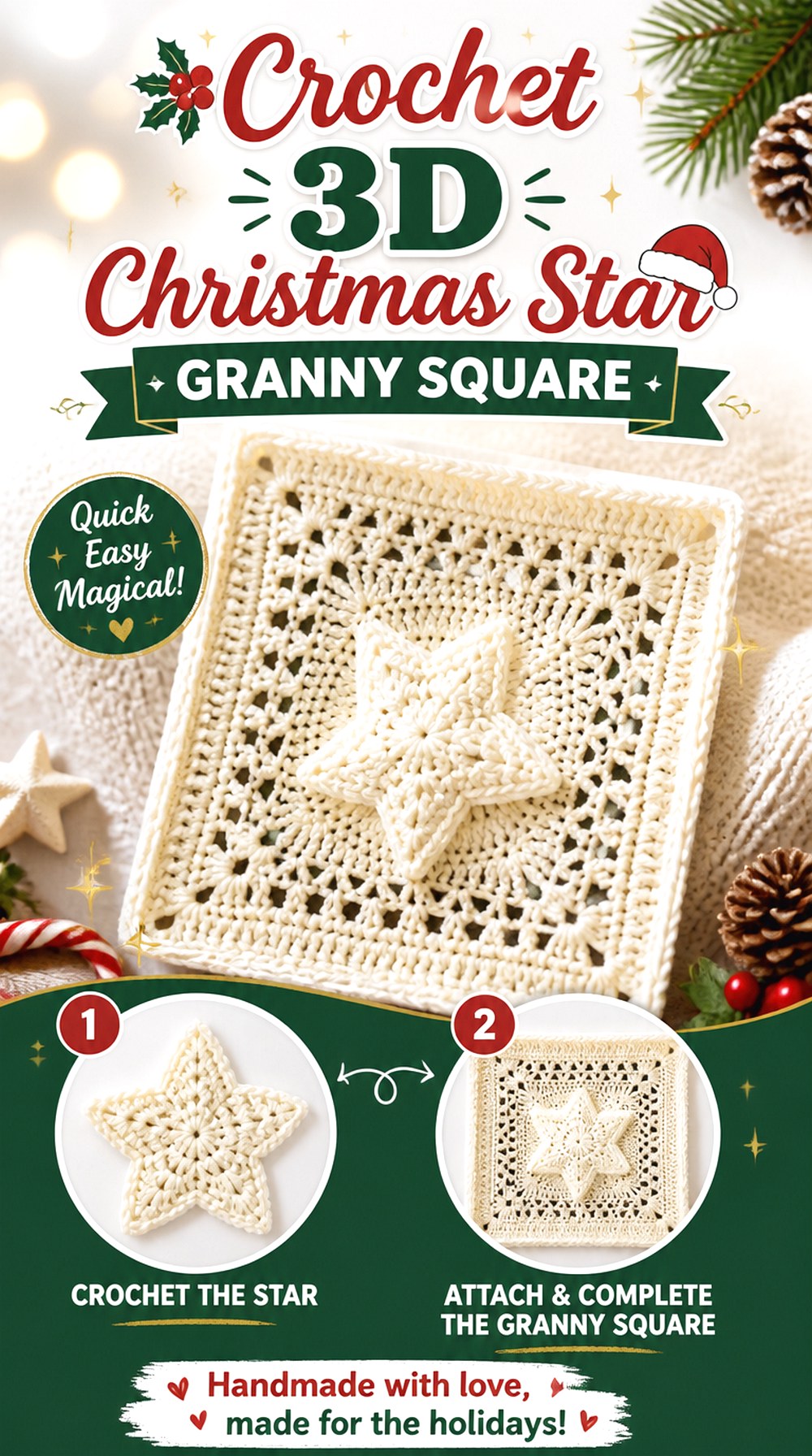
SAVEA star square introduces a strong central shape with points radiating toward the surrounding field. Captain Crochet (Jeremy) presents the project as a 3D Christmas star granny square and divides the full construction across tutorial parts, making it a more dimensional choice than a simple surface-stitched star.
The design can work as a centerpiece for a pillow or blanket, especially when the surrounding blocks are less raised. A star also bridges Christmas-specific imagery and broader winter decor, so palette changes can make the finished square feel traditional, metallic-inspired, snowy, or more modern without changing its basic identity.
Raised Star Points Need Crisp Definition
A dimensional star depends on clearly separated points. Fuzzy novelty yarn may soften that geometry, while a smoother yarn can make the edges easier to read. If you want sparkle, consider whether the decorative yarn still allows the stitch structure to remain visible before using it for the entire motif.
Use One Star as a Centerpiece
A single large-looking star can anchor the middle of a sampler even when every block has the same outside dimensions. Place the star in the proposed grid and view it from a distance before deciding to repeat it. If it already dominates the composition, use quieter snowflakes, gift boxes, lights, or plain coordinating squares around it.
Original Tutorial and Creator Credit
Creator: Captain Crochet (Jeremy)
17. Crochet Granny Square Bauble Ornament
 SAVE
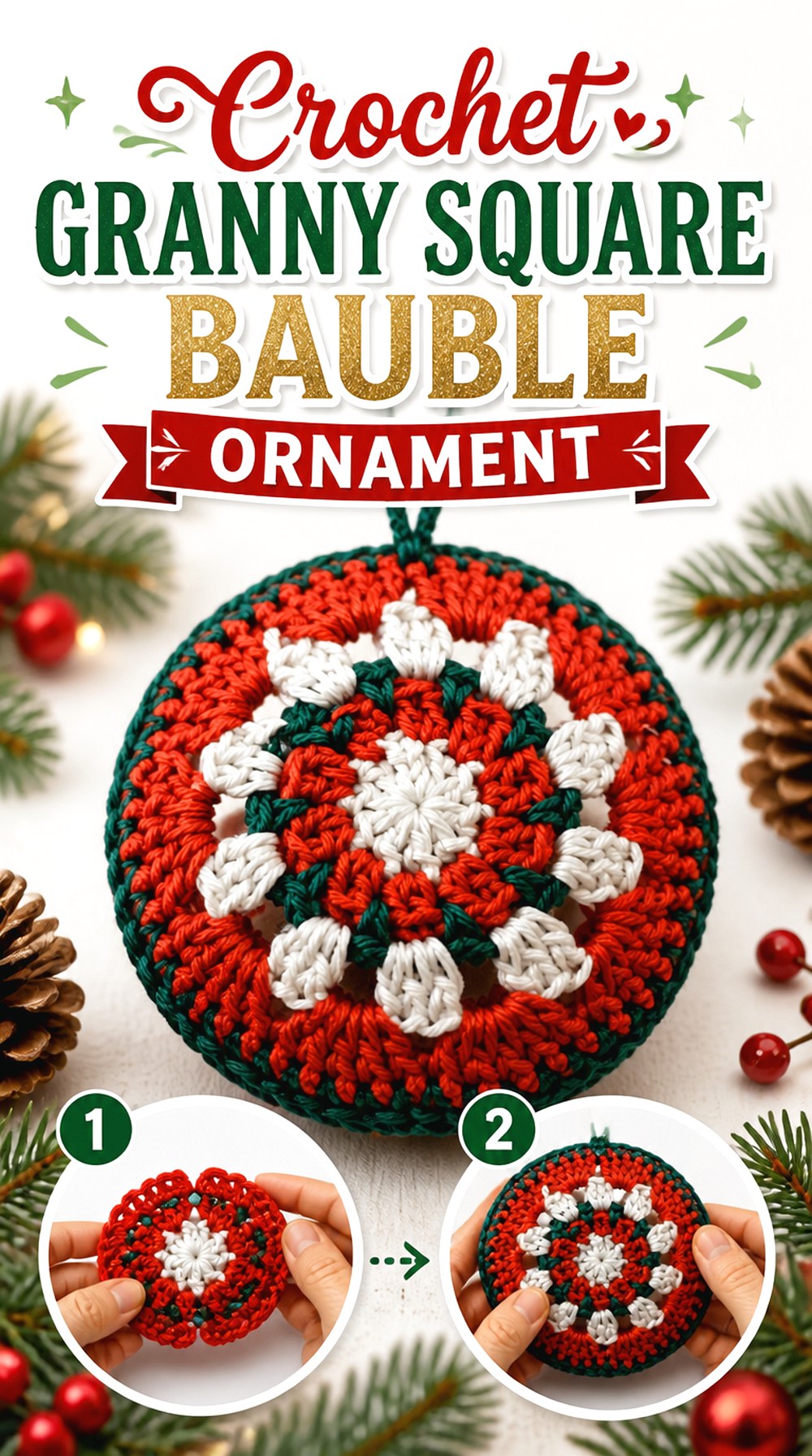
SAVEThis project takes granny-square styling off the flat grid and wraps it around a Christmas bauble. Crochets4U’s video specifically demonstrates a Christmas bauble with a granny-square motif, making it one of the clearest ways in this collection to turn granny crochet into tree decor.
The result is fundamentally different from an afghan block: fit around the ornament matters, the fabric must conform to a curved form, and the hanging hardware has to remain accessible. It is a useful choice when you want a small standalone project rather than dozens of squares for a blanket.
This Is a Three-Dimensional Granny Project
A flat granny motif can tolerate small size differences that disappear during blocking. An ornament cover cannot: excess fabric may bunch, while insufficient fabric may distort the stitches around the bauble. Treat the tutorial’s fit relationship as part of the design and verify your own materials against the object you intend to cover.
Check Ornament Size Before Committing
Do not assume every commercial bauble has the same diameter. Make one cover for the exact ornament style you plan to use before producing a coordinated set. If you switch yarn or hook size, recheck the fit rather than relying on the first sample. Changing the crochet fabric and changing the underlying ornament simultaneously makes troubleshooting much harder.
Hanging Loops Need Practical Clearance
The crocheted covering should not obstruct the area required to hang the ornament securely. Before finishing, check that the existing cap, loop, or other hanging point remains accessible and stable. If the bauble will be displayed where children or pets can reach it, remember that it is seasonal decor, not a toy, and position it accordingly.
Original Tutorial and Creator Credit
Creator: Crochets4U
18. Crochet Christmas Tree Granny Square Gift Bag
 SAVE
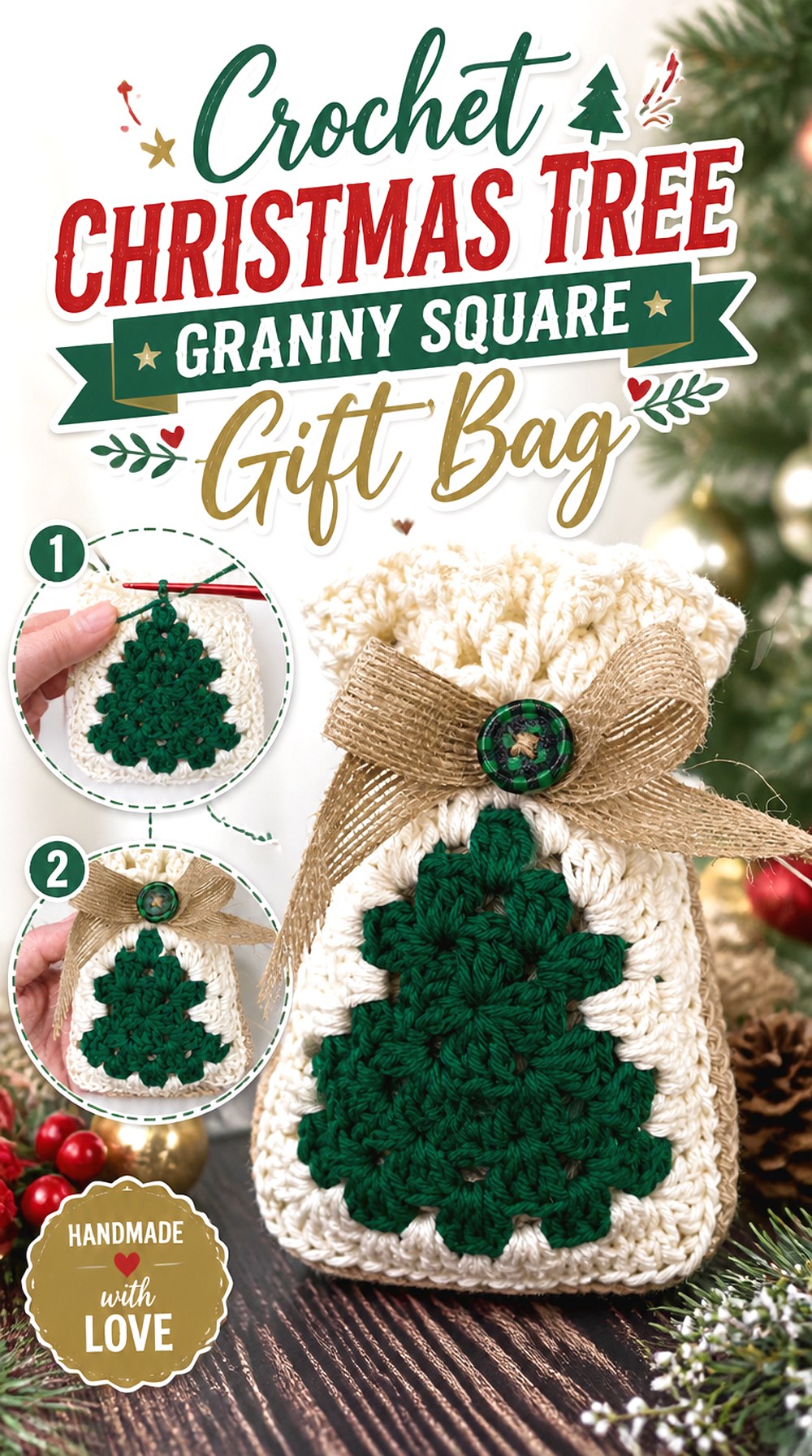
SAVEA gift bag turns a Christmas tree granny square into functional packaging rather than leaving the motif as an isolated block. Lullaby Lodge’s tutorial specifically shows a festive gift bag constructed from Christmas tree granny-square motifs, providing a clear example of how one square design can become a finished object.
This option is particularly useful if you like modular crochet but do not want to commit to a full blanket. It also makes the motif visible on an upright surface, where the tree orientation can be appreciated easily. Structure, opening shape, seams, and what you intend to place inside matter more here than they do in a decorative square.
Motif Placement Must Still Form a Usable Bag
The tree should face the intended direction after all panels are assembled. Before joining, label the top of each motif and mock up the bag shape on a table. This prevents a perfectly crocheted tree from ending upside down or on an unintended side once the panels become three-dimensional.
Reinforce the Opening Before Filling
A bag opening receives repeated handling in a way a blanket edge does not. Follow the tutorial’s finishing approach carefully and inspect the upper edge after assembly. If you substitute a very stretchy yarn, test how the empty bag holds its shape before adding a gift. Decorative crochet should not be assumed to support weight beyond what its construction reasonably allows.
Treat It as Gift Wrap, Not Heavy Storage
A small granny-square gift bag can be practical for light seasonal presents while still functioning primarily as decorative packaging. If you want to use the concept for heavier objects, do not infer capacity from appearance. A lining, altered seam, or different yarn may change performance, but those changes should be evaluated separately rather than treated as guaranteed reinforcement.
Original Tutorial and Creator Credit
Creator: Lullaby Lodge
19. Crochet Glitzy Christmas Granny Square Blanket
 SAVE
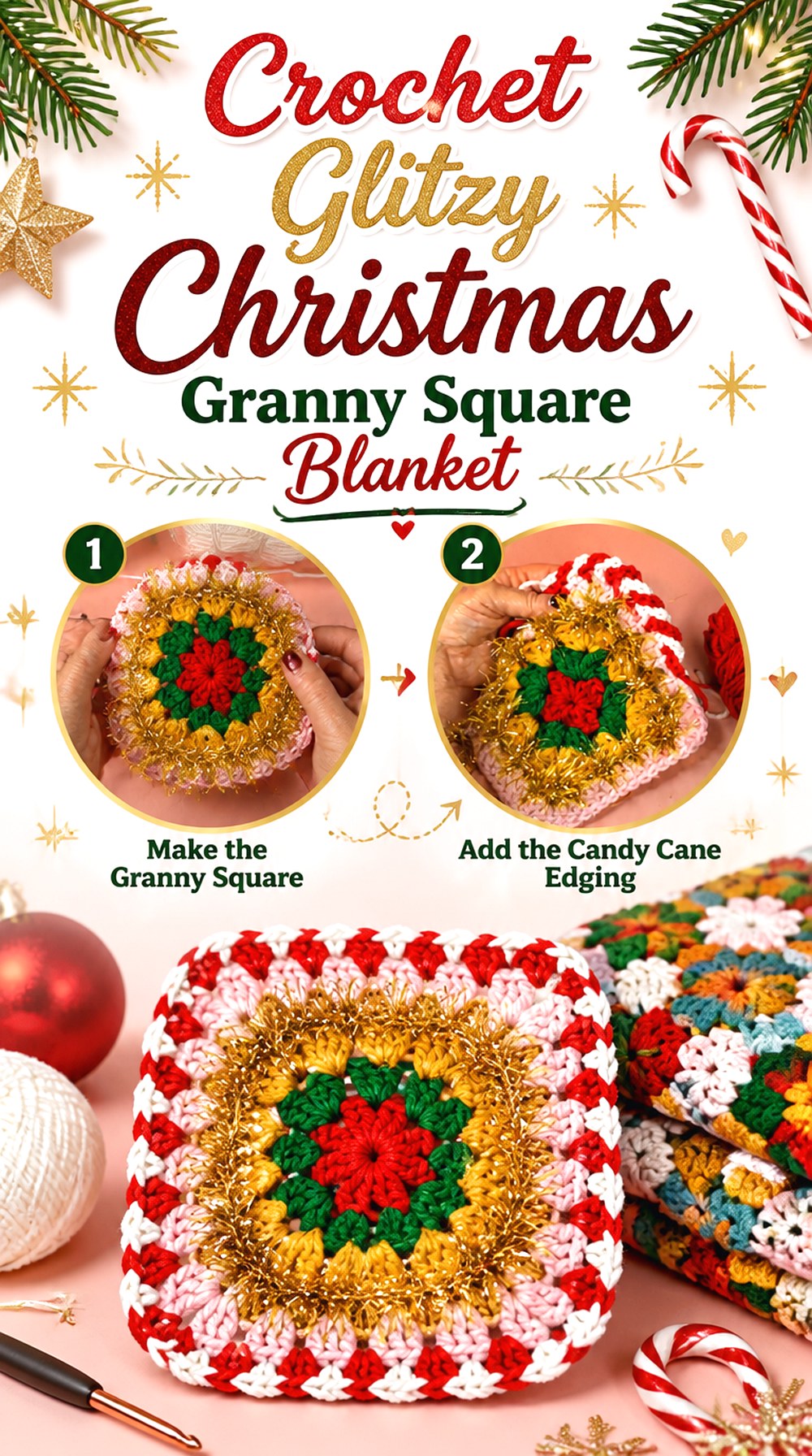
SAVEThe final idea simplifies construction by letting the granny square itself become the blanket. LoveCrafts’ festive tutorial works an expanding granny-square blanket and adds Christmas character through yarn choices and a candy-cane-style border rather than through separate character blocks.
This is the useful counterpoint to the 18 motif-heavy ideas above. There are no dozens of differently sized blocks to reconcile, and the visual focus shifts toward color, texture, scale, and edging. It suits readers who like the Christmas palette and granny-square look but would rather avoid a long joining and appliqué stage.
A Single Expanding Square Avoids Seaming
Continuous expansion removes the challenge of matching nineteen independently made square edges. It does not remove planning entirely: each added round increases the amount of yarn required and changes the overall color balance. Decide early whether the blanket will use repeating stripes, occasional novelty-texture rounds, or larger color sections so later choices still feel connected.
Novelty Yarn Changes Texture and Care
The LoveCrafts example incorporates decorative yarns for a glitzy effect. If you substitute other textured or sparkly yarn, check its care instructions alongside the main yarn before combining them. The finished blanket can only be cared for according to the most restrictive material in the mix, so appearance should not be the only deciding factor.
Border Choice Can Set the Christmas Tone
A red-and-white or other strongly contrasting edge can make an otherwise general granny blanket feel intentionally seasonal. Before committing, hold the proposed border colors against every major color already used in the blanket. A high-contrast edge acts almost like a frame; if it clashes, that conflict will surround the entire finished piece rather than appearing in only one small section.
How to Choose Between These Christmas Granny Square Styles
For a mixed blanket, flatter or strongly geometric designs such as the snowflake, tree, gift box, peppermint, star, and Christmas lights provide useful repetition between more detailed character blocks. Santa, the elf, penguin, reindeer, snowman, gnome, wreath, poinsettia, and holly can then function as focal motifs rather than competing for attention in every position.
For decorative display pieces, dimensional flowers, leaves, wreaths, and character faces give more surface interest because they are viewed rather than constantly folded. If you want a finished object instead of a block collection, the patchwork stocking, bauble, and tree-motif gift bag demonstrate three very different ways to move granny squares into three dimensions. The continuous LoveCrafts blanket is the simplest route when you want the seasonal granny aesthetic without planning a sampler grid.
Conclusion
The most useful way to choose among these 19 crochet Christmas granny square ideas is to start with the finished object. For a frequently used blanket, flatter snowflakes, peppermint spirals, lights, stars, and gift boxes can keep the surface manageable. For pillows or seasonal displays, poinsettias, wreaths, holly, Santa, reindeer, and other dimensional characters provide stronger focal detail. The stocking, bauble, gift bag, and continuous blanket show how granny crochet can also move beyond individual afghan blocks.
Whichever direction you choose, make one sample before producing multiples and compare finished measurements when mixing designers. Use the original tutorials linked with each project for the creators’ exact construction and finishing details.
Frequently Asked Questions
Can I combine Christmas granny squares from different YouTube tutorials in one blanket?
Yes, but compatibility needs to be checked rather than assumed. Different designers may use different yarn weights, hooks, stitch counts, border structures, or intended finished dimensions. Complete and finish one sample of every motif, then compare its outside measurement and available joining points. When two squares differ, determine whether a compatible border adjustment can solve the difference without distorting the central design before making a full batch.
Should all my Christmas granny squares use the same yarn?
Using the same yarn family can simplify thickness, care, and visual consistency, but it is not an absolute requirement. If you combine different yarns, compare their weight, fiber behavior, texture, and care instructions first. Two yarns labeled in the same broad weight category can still produce noticeably different fabric. Make test squares and judge the finished results together rather than relying only on the labels.
Are dimensional granny squares practical for a Christmas blanket?
They can be, but the intended use matters. Raised flowers, holly leaves, wreath components, antlers, or other attached details create more texture and may experience more rubbing and compression than flat motifs. If the blanket will be decorative, that may be perfectly suitable. For a heavily used throw, mix dimensional feature blocks with flatter squares and inspect every attachment before joining.
How do I stop different granny squares from looking random together?
Create repetition outside the individual motif. One shared background color, consistent final borders, a limited accent palette, or a planned sequence can connect designs that otherwise have completely different centers. Lay all completed samples on the floor before joining and distribute strong character or dimensional squares evenly. Moving one block in the layout is far easier than remaking several squares after the blanket has been assembled.
Should Christmas granny squares be blocked before joining?
For a mixed-source project, blocking or otherwise finishing each square in the manner appropriate to its yarn is particularly useful because you need realistic final measurements before joining. It can also reveal whether corners pull, openwork stretches, or dimensional motifs change the apparent shape. Follow suitable care guidance for the specific fiber and avoid forcing an undersized motif outward merely to match another design.
Can I turn one Christmas granny square into an ornament instead of a blanket block?
Often, yes, but the adaptation depends on the particular square. A small flat motif could become hanging decor if its structure and finishing suit that purpose, while the bauble tutorial above is already designed as a three-dimensional ornament. Do not assume a large blanket square will automatically hang neatly when scaled down. Make a sample and check weight, shape, hanging orientation, and any loose embellishments before using it as seasonal decor.