
Pine green and butter yellow give a crochet granny cardigan a clear dark-and-light relationship while keeping the palette warm and wearable. Pine green can anchor square frames, joins, cuffs, front bands, and larger body panels, while butter yellow can brighten motif centers, floral details, outer rounds, sleeves, and selected edging.
The main challenge is judging color across the entire garment rather than one granny square at a time. Several pine green corners can meet and create a large dark block across the back, while repeated butter yellow outer rounds can merge into broad pale bands. Testing several completed squares together before joining is one of the simplest ways to catch those imbalances.
The credited tutorials support classic granny cardigans, floral motifs, cropped layouts, large-square constructions, patchwork designs, ribbed finishes, ties, and longer layers. The pine green and butter yellow schemes below are independent editorial adaptations rather than claims about colors used by the original creators.
Quick List
- Pine Green-Center and Butter Yellow-Frame Crochet Granny Cardigan
- Butter Yellow-Center and Pine Green-Frame Crochet Granny Cardigan
- Pine Green Sunflower Crochet Granny Cardigan with Butter Yellow Petals
- Butter Yellow Daisy Crochet Granny Cardigan with Pine Green Frames
- Pine Green Cropped Crochet Granny Cardigan with Butter Yellow Cuffs
- Butter Yellow Patchwork Crochet Granny Cardigan with Pine Green Joins
- Pine Green Tie-Front Crochet Granny Cardigan with Butter Yellow Edging
- Butter Yellow Diamond-Layout Crochet Granny Cardigan with Pine Green Ribbing
- Pine Green Retro Daisy Crochet Granny Cardigan with Butter Yellow Centers
- Butter Yellow Buttoned Crochet Granny Cardigan with Pine Green Borders
- Butter Yellow Crochet Granny Cardigan with Pine Green Front Band
- Pine Green Long Crochet Granny Cardigan with Butter Yellow Lower Motifs
- Butter Yellow Long Crochet Granny Cardigan with Pine Green Square Frames
- Pine Green Cropped Crochet Granny Cardigan with Butter Yellow Outer Rounds
- Pine Green and Butter Yellow Floral Crochet Granny Cardigan
Decide Whether Pine Green or Butter Yellow Should Lead the Cardigan
One color should usually occupy the larger visual share. Pine green works well as the dominant shade when you want the cardigan to have darker square frames, joins, sleeves, or ribbing. Butter yellow can then appear inside motifs or around selected edges where a small amount of light color remains highly visible.
Reversing the hierarchy gives the cardigan a lighter appearance. Butter yellow can dominate the motifs while pine green creates the framework around them. This approach is especially useful when you want the joins, front opening, cuffs, and neckline to feel connected without making the entire cardigan dark.
Check Pine Green and Butter Yellow Across Several Granny Squares
A single square can hide layout problems that become obvious once the cardigan is assembled. If every motif has pine green corners, four corners may meet and create a dark block at each intersection. If butter yellow occupies every outer round, the individual motifs may visually merge into larger pale areas.
Lay several squares together in the same orientation planned for the back, fronts, or sleeves. Check the layout from a distance as well as close up. A grayscale photo can also help reveal whether your specific green and yellow yarns maintain enough light-and-dark separation.
Connect Pine Green and Butter Yellow Through the Cardigan Finishing
Cuffs, front bands, necklines, and hems provide continuous lines around a garment made from separate motifs. Repeating a motif color in these areas can make the whole cardigan feel more connected.
For example, pine green outer rounds can flow naturally into green cuffs and a green front border. If pine green already dominates the motifs, butter yellow edging can instead lighten the garment perimeter and stop the darker color from surrounding every section.
1. Pine Green-Center and Butter Yellow-Frame Crochet Granny Cardigan
 SAVE
Place pine green in the center of each granny square and expand into butter yellow through the outer rounds. This makes the dark green appear as repeated focal points while the yellow creates more space between neighboring centers.
Pine Green Centers Should Repeat Evenly Across Butter Yellow Squares
Keep the pine green center similar in scale throughout the cardigan. When one motif has a much larger green center than the others, it can appear disproportionately heavy once placed beside several butter yellow-framed squares.
Butter Yellow Frames Need Enough Width Around Pine Green Centers
Give butter yellow enough visual area to keep adjacent pine green centers separate. If the green almost reaches the edge of each square, the assembled cardigan can develop large connected dark patches.
Pine Green Cuffs Can Repeat the Butter Yellow Cardigan Centers
If you want the dark centers to connect to the finishing, pine green cuffs provide a useful second location for the dominant accent. Keep the front border butter yellow if you want the cardigan opening to remain lighter.
Creator Credit: HayHay Crochet
2. Butter Yellow-Center and Pine Green-Frame Crochet Granny Cardigan
 SAVE
Reverse the motif hierarchy by placing butter yellow at the center and pine green around the outside. Once assembled, the pine green outer rounds can form a dark grid throughout the cardigan.
Butter Yellow Centers Brighten Pine Green Granny Square Frames
Make the butter yellow center large enough to remain visible from normal viewing distance. Very small yellow centers can disappear visually when surrounded by several rounds of deep pine green.
Pine Green Frames Can Organize Butter Yellow Granny Squares
Using pine green consistently on the final motif round gives the cardigan a connected framework. The green can continue naturally into joins, cuffs, and front edging without introducing a new color role.
Creator Credit: Chenda DIY
3. Pine Green Sunflower Crochet Granny Cardigan with Butter Yellow Petals
 SAVE
A sunflower-inspired granny cardigan gives the two colors obvious motif roles. Pine green can occupy the square background and outer rounds while butter yellow defines the flower area. This keeps the floral theme readable without requiring several yellows or browns.
Butter Yellow Petals Should Stay Clear Against Pine Green Squares
Give the butter yellow floral area enough contrast and space to remain recognizable after joining. If the petals extend too close to similarly light joining yarn, some of the floral outline can become less distinct.
Pine Green Frames Can Connect Butter Yellow Sunflower Motifs
Use pine green consistently around each floral square so the finished cardigan develops one continuous green framework. This prevents every butter yellow flower from looking like a separate appliqué floating on the garment.
Pine Green Cuffs Can Ground Butter Yellow Floral Sleeves
If flowers continue onto the sleeves, green cuffs provide a darker endpoint below the repeating yellow motifs. Keep the cuff color simple rather than adding additional stripes to an already detailed floral sleeve.
Creator Credit: by Kristine
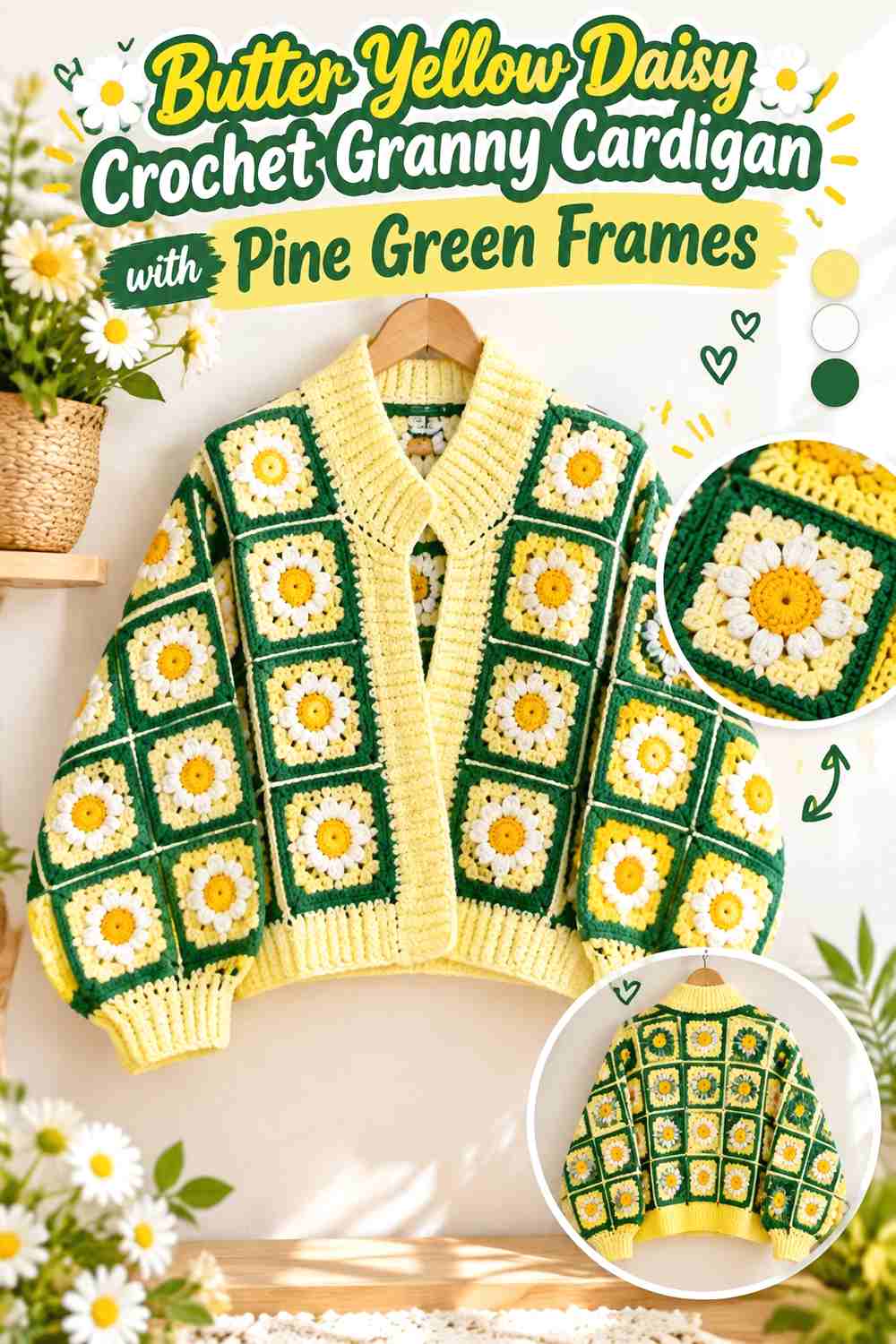
4. Butter Yellow Daisy Crochet Granny Cardigan with Pine Green Frames
 SAVE
Let butter yellow carry the daisy-inspired motifs while pine green forms the outer square frame. The result makes the flowers the lighter focal points and uses green to separate repeated motifs across the body and sleeves.
Butter Yellow Daisy Motifs Need Consistent Placement Inside Pine Green
Keep the yellow floral shape in the same relative position from square to square. Consistency matters because several daisies viewed together create a stronger visual rhythm than one motif viewed alone.
Pine Green Outer Rounds Should Separate Butter Yellow Flowers
Give pine green enough width around each daisy that adjoining butter yellow motifs do not merge visually. The green frame can also make the grid of the cardigan easier to read.
Pine Green Ribbing Can Continue the Butter Yellow Cardigan Framework
Using green around the cuffs, neckline, or lower edge extends the motif frames into the garment finishing. If that creates too much dark edging, keep the hem butter yellow and reserve green for the cuffs and front opening.
Creator Credit: Dreamcrochets
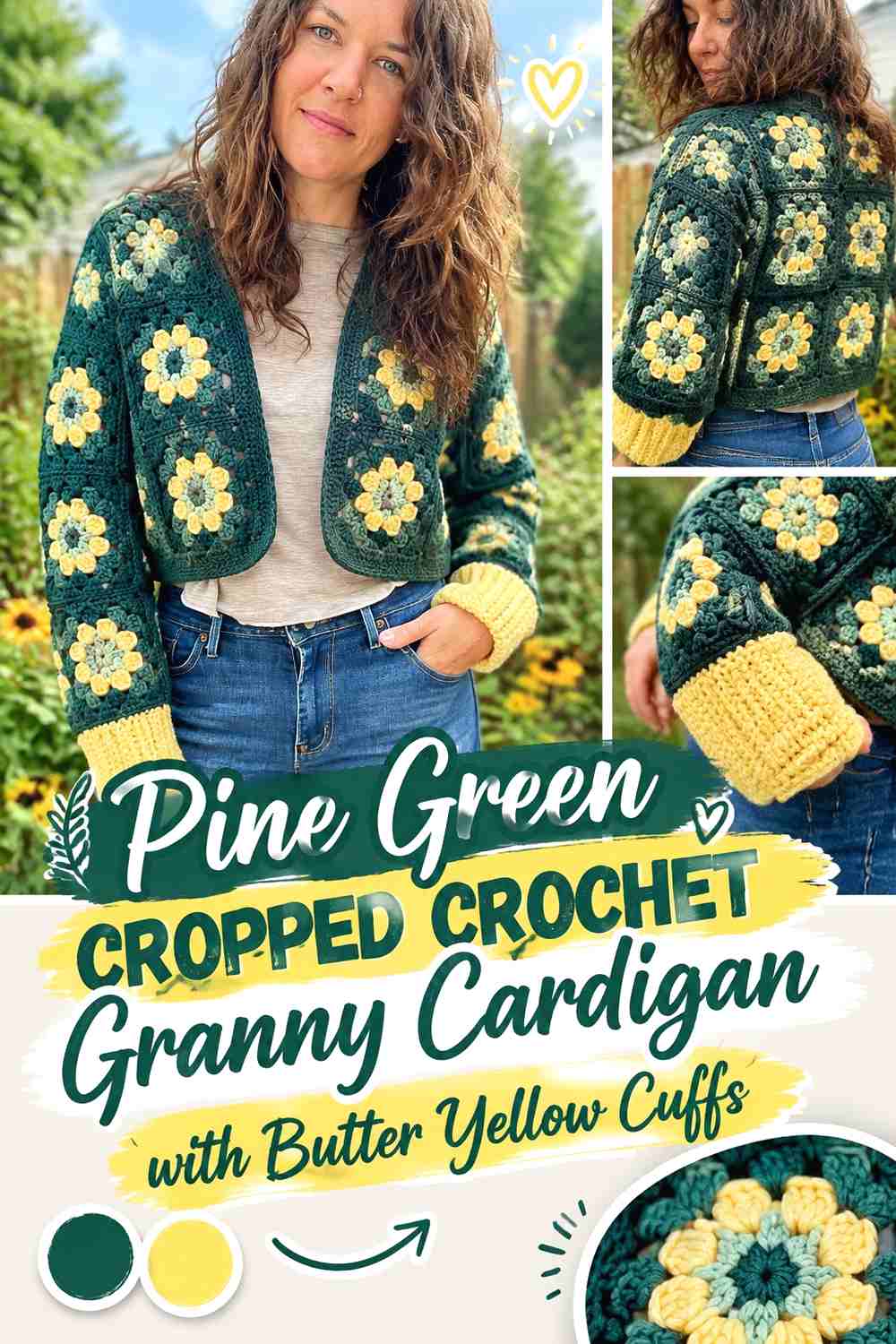
5. Pine Green Cropped Crochet Granny Cardigan with Butter Yellow Cuffs
 SAVE
Make pine green the primary square color and place butter yellow at the sleeves and lower finishing areas. A cropped cardigan gives cuffs and hems more visual importance, so even a modest amount of yellow can noticeably lighten the garment.
Pine Green Should Keep the Cropped Crochet Granny Cardigan Unified
Use pine green across most body motifs when you want the short cardigan to read as one strong dark layer. Frequent yellow changes inside every square can make a compact silhouette more visually crowded.
Butter Yellow Cuffs Give Pine Green Sleeves a Lighter Endpoint
Butter yellow at the wrists creates contrast without interrupting the granny-square sleeve itself. Repeat a small amount at the hem if the cuffs otherwise feel disconnected from the body.
Creator Credit: Off the Beaten Hook
6. Butter Yellow Patchwork Crochet Granny Cardigan with Pine Green Joins
 SAVE
Use butter yellow as the recurring color throughout varied granny squares and pine green as the consistent joining shade. The green seams provide structure even when the yellow distribution changes slightly between motifs.
Butter Yellow Should Travel Across the Entire Patchwork Cardigan
Repeat butter yellow across the back, both fronts, and sleeves rather than concentrating it in one panel. This helps a patchwork layout feel balanced even when individual squares are not identical.
Pine Green Joins Can Control a Butter Yellow Patchwork Layout
A consistent pine green join creates a visible network between motifs. Check the intersections where several seams meet, because concentrated green at those points can become darker than the rest of the joining grid.
Pine Green Cuffs Can Repeat the Butter Yellow Cardigan Join Color
Green cuffs and a green front edge connect the seams to the garment perimeter. Keep the lower hem yellow if you want to prevent the dark framework from surrounding every edge.
Creator Credit: Brunaticality
7. Pine Green Tie-Front Crochet Granny Cardigan with Butter Yellow Edging
 SAVE
Keep the granny-square field mainly pine green and use butter yellow along the open front and ties. This puts the lighter shade at the center of the outfit without dividing every motif into two colors.
Pine Green Should Dominate the Crochet Granny Cardigan Body
Use pine green consistently across the back and front motifs so the tie-front construction remains visually simple. The open center already creates a natural break in the garment.
Butter Yellow Ties Can Highlight the Pine Green Cardigan Opening
Butter yellow ties create a visible focal point where the two fronts meet. Extending the same yellow into a narrow front border makes the ties feel connected to the garment rather than added separately.
Butter Yellow Front Edging Should Stay Narrow Against Pine Green
Because yellow is much lighter, a narrow strip can still be visually strong. Avoid making the edging so wide that it competes with the entire pine green square field.
Creator Credit: Danielle Villanueva
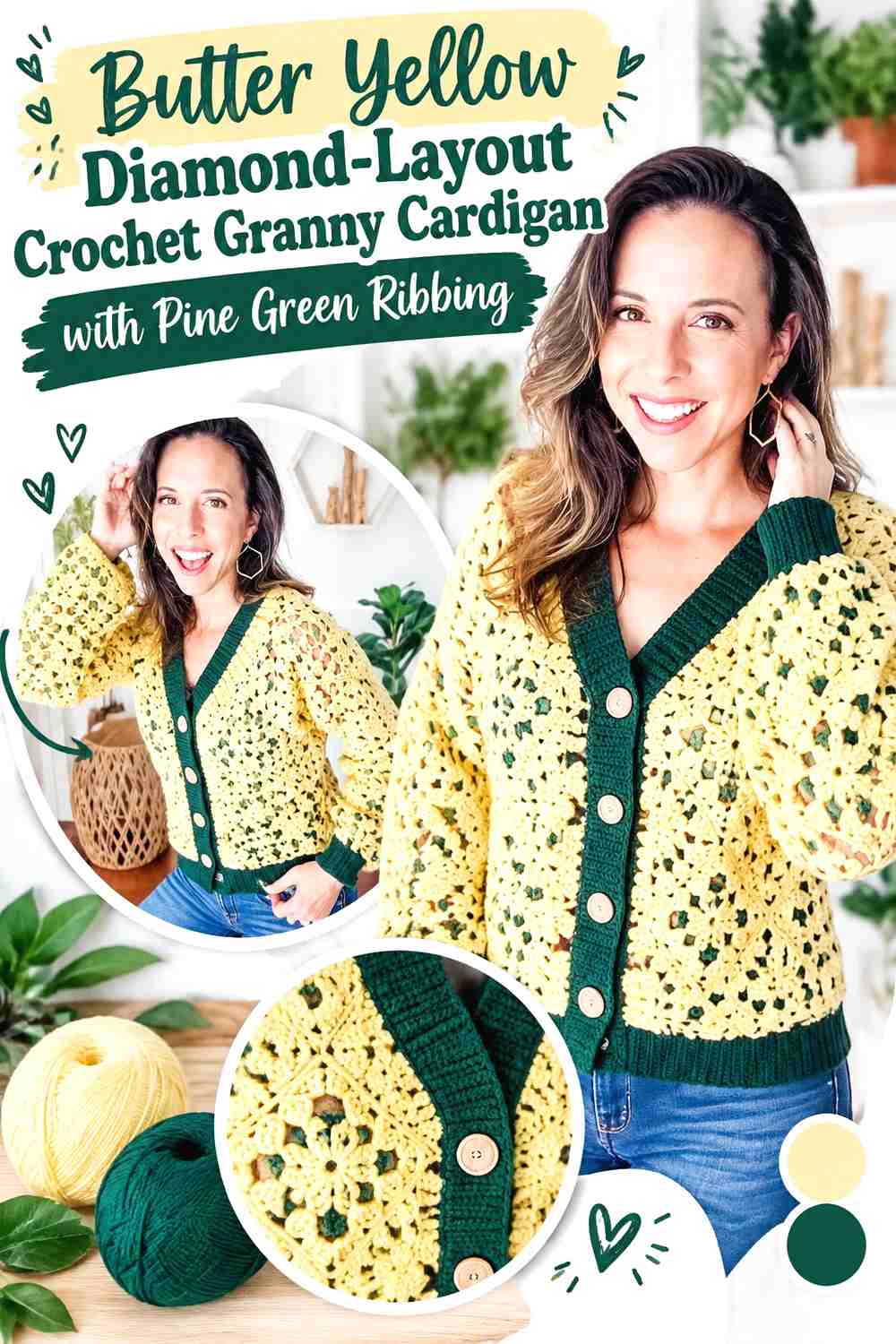
8. Butter Yellow Diamond-Layout Crochet Granny Cardigan with Pine Green Ribbing
 SAVE
A diamond-oriented granny layout gives square corners and joining lines extra prominence. Use butter yellow through the principal motif surface and pine green around the denser finishing areas.
Butter Yellow Keeps the Diamond Crochet Granny Layout Visually Open
A lighter motif field helps the diagonal square arrangement remain easy to follow. Avoid placing heavy pine green blocks inside every diamond if the orientation itself is already providing strong geometry.
Pine Green Ribbing Can Contain the Butter Yellow Diamond Layout
Use green at the cuffs, hem, and neckline when you want a defined perimeter around the lighter body. Since ribbing appears denser than granny-square fabric, check whether the pine green looks substantially darker there before making every finishing section wide.
Pine Green Neckline Ribbing Can Link Butter Yellow Front Diamonds
Continuing green around the neckline provides a continuous boundary between the two front sections. Keep the body motifs yellow-led so the neckline does not compete with multiple dark blocks nearby.
Creator Credit: Briana K
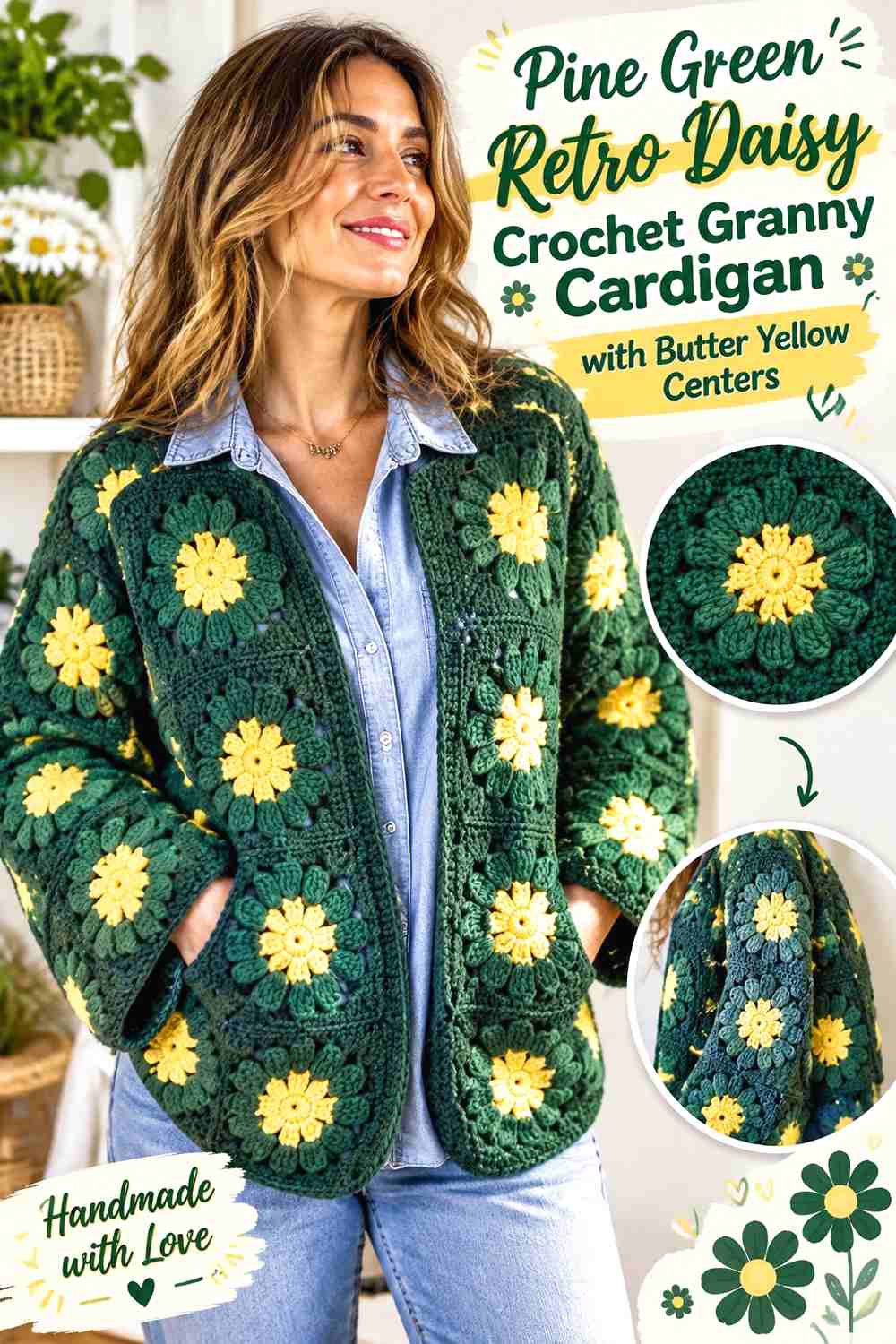
9. Pine Green Retro Daisy Crochet Granny Cardigan with Butter Yellow Centers
 SAVE
Use pine green through the larger daisy motif and outer square while butter yellow marks the floral centers. This makes yellow a repeated point rather than a large surface color.
Butter Yellow Centers Should Repeat Clearly Inside Pine Green Daisies
Keep each yellow center comparable in size so the eye follows an even pattern across the cardigan. An oversized center can dominate its square because the surrounding pine green is much darker.
Pine Green Should Connect the Butter Yellow Retro Floral Squares
Use green consistently through the surrounding motif and final rounds so the yellow centers remain isolated highlights. This keeps the floral surface organized even when many motifs cover the sleeves and torso.
Creator Credit: Frisian Knitting tutorials
10. Butter Yellow Buttoned Crochet Granny Cardigan with Pine Green Borders
 SAVE
Let butter yellow dominate the granny squares while pine green frames the front opening, neckline, cuffs, and button area. This gives the lighter cardigan a strong structured perimeter.
Butter Yellow Should Remain Broad Across the Crochet Granny Cardigan
Keep large motif areas yellow so the body remains clearly lighter than the green finishing. If green appears heavily inside the squares as well, the borders may stop feeling like a distinct structural feature.
Pine Green Front Borders Can Define the Butter Yellow Button Area
A dark front band makes the center opening easy to read and gives button placement a clear background. Repeat the same green around the neckline for continuity.
Pine Green Cuffs Can Balance the Butter Yellow Cardigan Front
Adding green at the wrists distributes the dark shade away from the center opening. Keep the hem yellow if the jacket begins to feel overly framed by green.
Creator Credit: MJ’s Off The Hook Designs
11. Butter Yellow Crochet Granny Cardigan with Pine Green Front Band
 SAVE
For a simpler two-color arrangement, let butter yellow cover nearly the entire granny-square body and reserve pine green for one strong continuous front border. This keeps motif color changes minimal.
Butter Yellow Can Keep the Crochet Granny Cardigan Surface Consistent
Use butter yellow across the body and sleeves when the granny construction itself provides enough texture. A single dominant shade allows square boundaries and open spaces to remain visible without additional striping.
Pine Green Gives the Butter Yellow Cardigan a Strong Vertical Frame
Run pine green up both fronts and around the neckline. These continuous dark lines can make the cardigan opening more defined while leaving most of the garment pale.
Creator Credit: Simply Angel Tiah
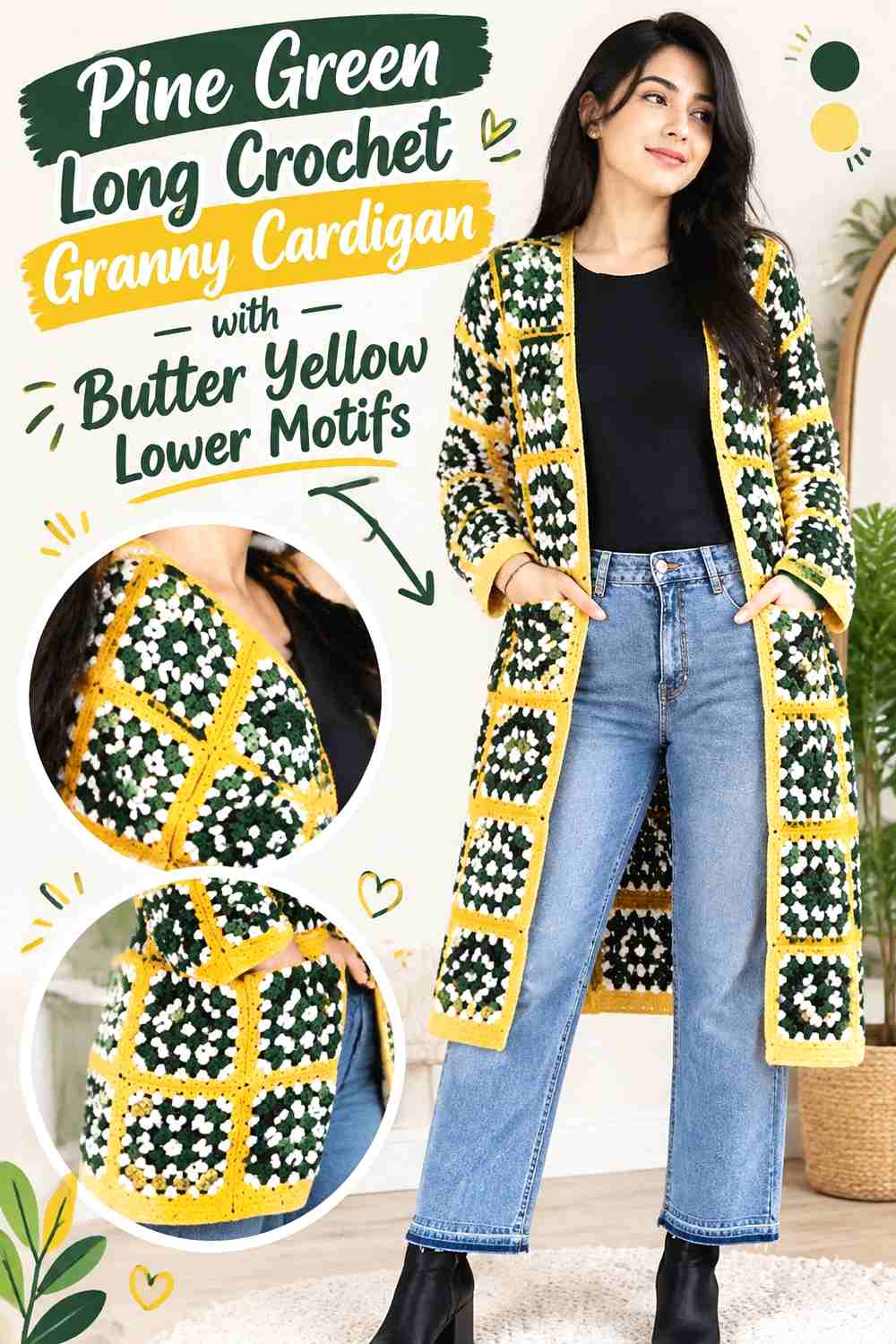
12. Pine Green Long Crochet Granny Cardigan with Butter Yellow Lower Motifs
 SAVE
A longer cardigan gives the dominant color more surface area, so introduce butter yellow toward the lower body to stop pine green from running uninterrupted from shoulders to hem.
Pine Green Should Keep the Upper Long Granny Cardigan Connected
Use green through the shoulders, upper back, and front sections when you want a strong upper anchor. Avoid alternating broad horizontal bands too early because that can visually divide the cardigan’s length.
Butter Yellow Lower Motifs Can Lighten the Pine Green Hem Area
Increase the amount of butter yellow in the lower rows of squares rather than inserting one isolated pale motif. Repetition makes the transition look intentional and spreads the light color across the width of the cardigan.
Butter Yellow Cuffs Can Echo the Pine Green Cardigan Hem
Repeating yellow at the wrists helps the lower-body accent connect to the sleeves. Keep the shoulder area green so the lighter details remain concentrated toward the outer ends of the garment.
Creator Credit: StellaM
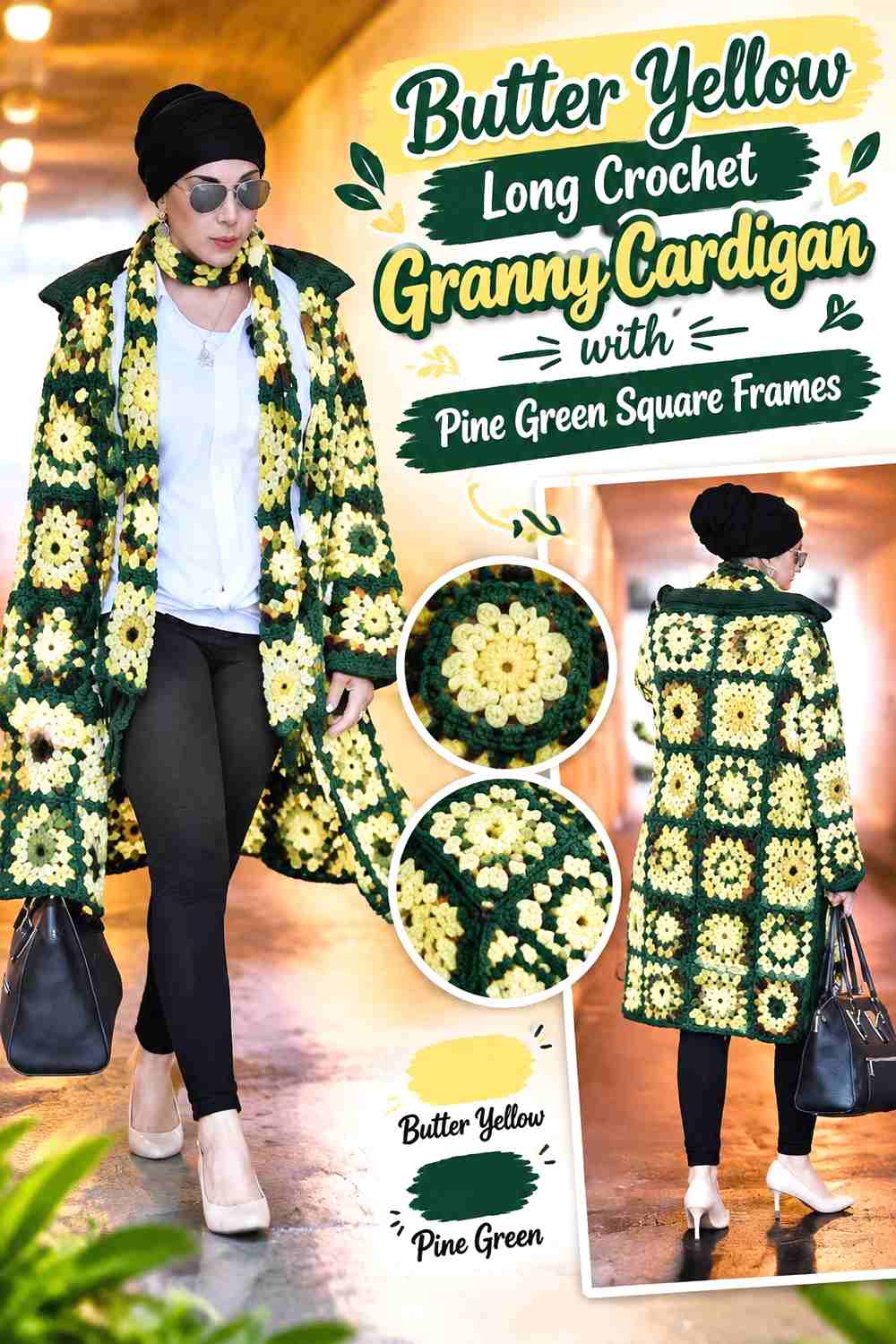
13. Butter Yellow Long Crochet Granny Cardigan with Pine Green Square Frames
 SAVE
For a lighter long cardigan, keep the motif interiors butter yellow and use pine green on the final round of each square. The repeated green framework prevents a large amount of yellow from becoming visually flat.
Butter Yellow Centers Keep the Long Crochet Granny Cardigan Light
Use broad yellow motif interiors so the cardigan remains clearly butter-yellow-dominant despite the repeated dark grid. On a longer silhouette, this prevents pine green from occupying too much total surface.
Pine Green Frames Separate Butter Yellow Squares Down the Cardigan
A consistent green outer round helps each square remain distinct from shoulder to hem. This becomes particularly useful on long front panels where many motifs appear in a vertical sequence.
Pine Green Cuffs Should Relate to the Butter Yellow Square Frames
Use green at the sleeves when you want the motif framework to continue into the finishing. If that makes the lower part too dark, keep the hem butter yellow.
Creator Credit: YARNutopia
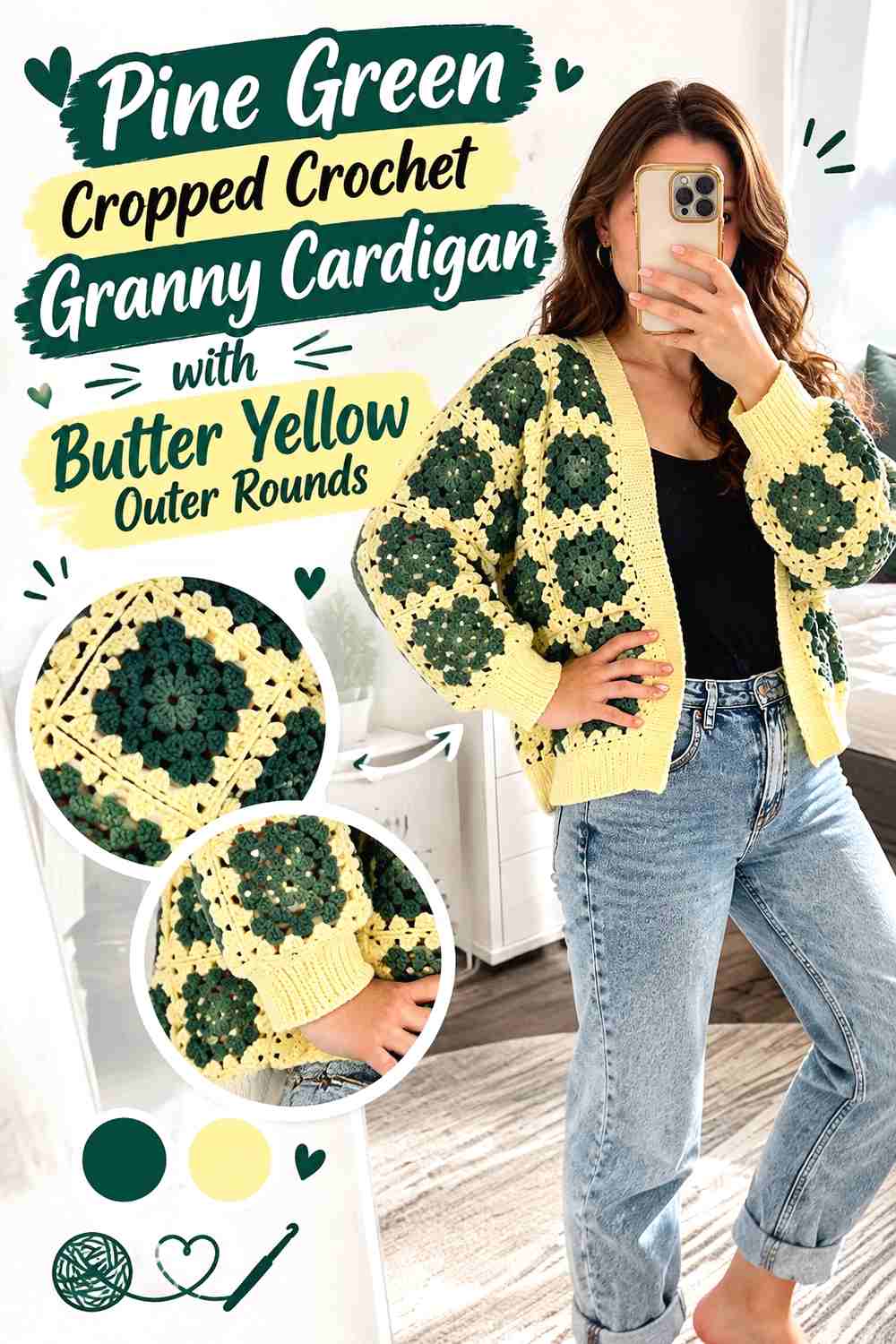
14. Pine Green Cropped Crochet Granny Cardigan with Butter Yellow Outer Rounds
 SAVE
Make pine green the central motif color and gradually introduce butter yellow toward the edge of each square. A cropped shape gives those outer rounds a large influence because fewer motif rows make up the body.
Pine Green Centers Should Give the Cropped Granny Cardigan a Dark Base
Keep pine green concentrated inside the motifs rather than distributing it randomly across outer rounds. This creates repeated dark focal points without making the cardigan perimeter equally heavy.
Butter Yellow Outer Rounds Can Connect Pine Green Motifs
When yellow forms the edge of each square, neighboring motifs create larger connected pale areas after joining. Check the layout before assembly so these yellow bands remain balanced around the front and back.
Butter Yellow Hem Edging Can Extend the Pine Green Cardigan Frames
A narrow yellow hem can continue the motif-edge color without adding another dark boundary. Keep the cuffs pine green if you want the sleeves to retain more visual weight.
Creator Credit: TobyBear
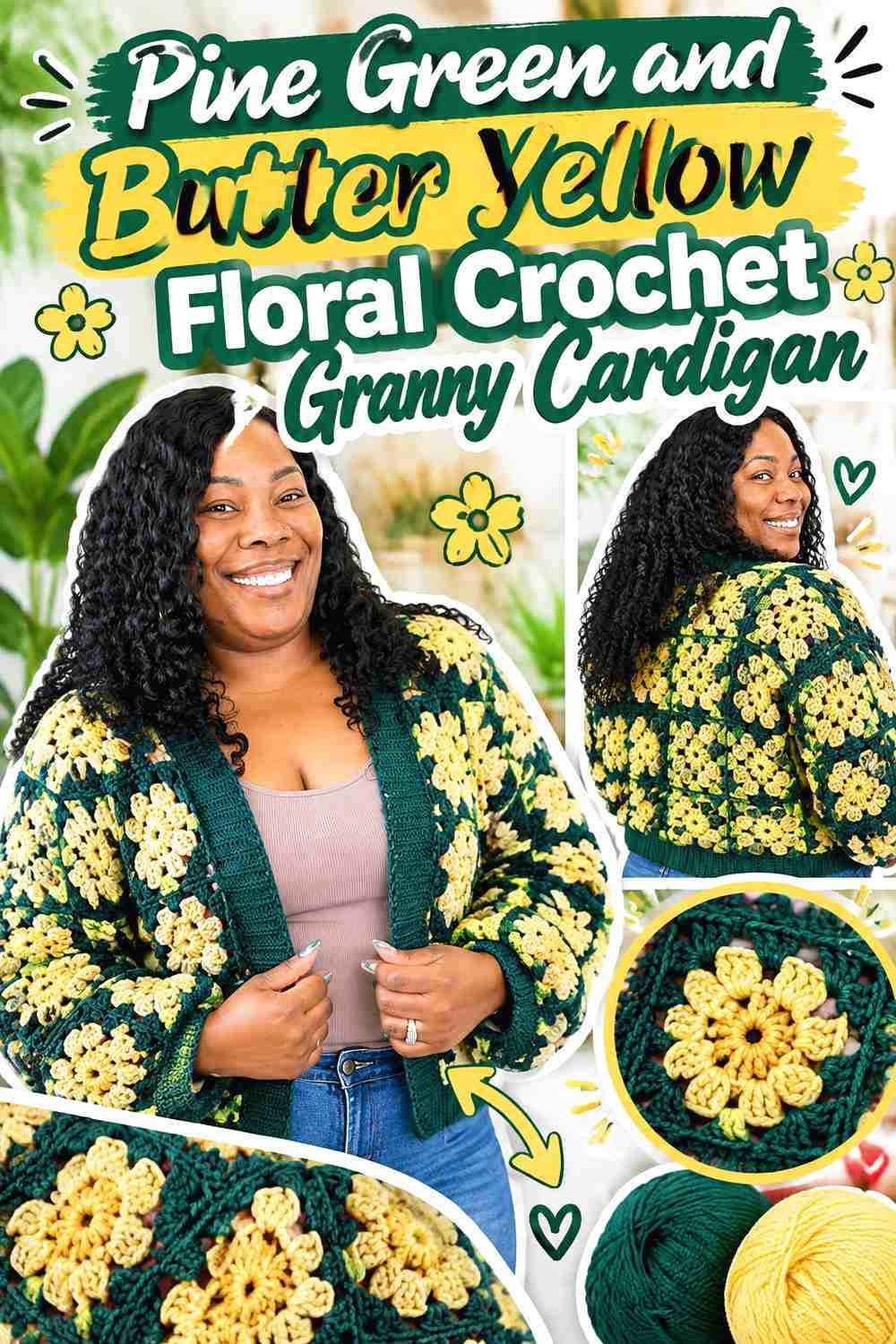
15. Pine Green and Butter Yellow Floral Crochet Granny Cardigan
 SAVE
For a floral granny cardigan, use pine green and butter yellow repeatedly inside the flowers while keeping each color’s role consistent. Butter yellow can define petals or centers, while pine green handles the surrounding square, joining round, or ribbed finish.
Butter Yellow Petals Need Pine Green Separation Across the Cardigan
If yellow occupies the petals, use enough pine green around each flower to stop neighboring motifs from merging into one broad yellow field. The darker green gives individual floral units clearer boundaries.
Pine Green Should Repeat Beyond Butter Yellow Floral Motifs
Carry pine green into the joins, cuffs, or front border so the darker shade is not limited to tiny motif details. This creates continuity between the granny squares and the finished cardigan structure.
Butter Yellow Edging Can Lighten Pine Green Floral Frames
When pine green already surrounds every motif, a narrow butter yellow hem or cuff edge can prevent the garment perimeter from becoming another heavy dark frame. Keep the accent narrow so the flowers remain the primary source of yellow.
Creator Credit: TL Yarn Crafts
Comparing Pine-Green-Dominant and Butter-Yellow-Dominant Granny Cardigans
Choose a pine-green-dominant direction when you want a darker cardigan with butter yellow acting as a repeated highlight. Ideas 3, 5, 7, 9, 11, 13, and 15 keep substantial pine green across motif fields, bodies, or large-square sections.
For a lighter garment, Ideas 2, 4, 6, 8, 10, 12, and 14 give butter yellow more surface area and let pine green organize the cardigan through frames, joins, ribbing, armholes, or front bands.
Ideas 1 and 16 distribute the colors more evenly through repeated motifs. These need especially careful layout planning because even small differences in center and outer-round proportions become more noticeable when dozens of granny squares are viewed together.
Conclusion
Pine green and butter yellow can produce very different granny cardigans even when the underlying square stays the same. Pine green centers surrounded by butter yellow create repeated dark focal points, while butter yellow centers framed in green create a stronger visible grid.
For floral motifs, give each shade a consistent job such as yellow petals with green frames or yellow centers inside green flowers. For classic granny squares, decide whether the darkest color belongs inside the motif, at the edge, or in the joining system before making the full set.
The cuffs, neckline, hem, and front borders should then reinforce that decision. A pine green joining grid can flow naturally into green ribbing, while a green-heavy cardigan may benefit from butter yellow at the outer edges instead.
Before final assembly, arrange the body and sleeve squares together and check for large pine green clusters or areas where butter yellow dominates unexpectedly. Use the credited tutorials for exact construction and finishing guidance, then apply the pine-green-and-butter-yellow balance that suits the cardigan shape you want.
Frequently Asked Questions
Should pine green or butter yellow dominate a crochet granny cardigan?
Either can dominate. Pine green creates a darker framework and works particularly well on square frames, joins, cuffs, and front borders. Butter yellow produces a lighter garment and can fill centers, petals, outer rounds, or complete squares.
Where should butter yellow go in a mostly pine green granny cardigan?
Motif centers, floral petals, selected outer rounds, cuffs, hems, or front edging are useful locations. Repeat the yellow in more than one related area so it feels connected to the garment.
Should pine green be used for granny square joins?
It can work very well when the motifs are butter-yellow-dominant because the green creates a dark grid between them. If the motifs already contain large amounts of pine green, butter yellow joining may give the squares better visual separation.
How can I keep a pine green granny cardigan from looking too dark?
Increase the proportion of butter yellow rather than automatically introducing another color. Larger yellow centers, broader outer rounds, lighter cuffs, or selected yellow-dominant squares can reduce the visual weight while preserving the two-color palette.
How should I arrange pine green and butter yellow squares before joining?
Lay out the complete back first and look for places where multiple green corners meet. Then check the two fronts and sleeves. Redistribute motifs if one area looks much darker or lighter than the rest.
Can pine green and butter yellow work for sunflower or daisy granny cardigans?
Yes. Butter yellow can handle petals or centers while pine green frames the floral motif and connects the squares. Keeping the same color hierarchy throughout the cardigan helps the flowers remain easy to read.
Should the cardigan cuffs match the joining color?
They can, and this often creates a strong connection between the motifs and finishing. Pine green joins with pine green cuffs create a consistent framework, while butter yellow cuffs can lighten a cardigan whose joins and square frames are already dark.
How can I substitute a different yellow while keeping pine green?
Choose another soft light yellow that remains clearly lighter than the pine green. Preserving the contrast relationship and the yellow’s role in the palette matters more than matching an exact commercial shade.