17 Crochet Acorn Basket Ideas for Woodland Storage and Fall Decor
A crochet acorn basket can be anything from a sturdy cord organizer large enough to make a statement on a shelf to a palm-sized box for stitch markers or treats. The projects here also explore different ways of creating the familiar nut-and-cap silhouette: removable lids, soft yarn bodies, rigid internal supports, textured stitches, drawstrings, and carryable acorn-inspired bags.
That range matters because the prettiest version is not automatically the most practical one. Cord and T-shirt yarn tend to favor stronger structure, while ordinary or bulky yarn can create a softer container. A glass jar or printed core changes the stability completely. Toward the end, several basket-adjacent pouch and satchel ideas show how the same woodland shape can become portable storage rather than tabletop decor. Each project links back to an original tutorial for the exact construction details.
Quick List
- Crochet Braided-Cord Acorn Storage Basket
- Crochet Glass-Jar Acorn Basket
- Crochet Waistcoat-Stitch Acorn Basket
- Crochet Melange-Roving Acorn Box
- Crochet Two-Size Cord Acorn Basket Set
- Crochet Treat-Filled Acorn Gift Basket
- Crochet Mini Acorn Craft-Supply Box
- Crochet Super-Bulky Acorn Keepsake Box
- Crochet Braided-Rope “Manne” Acorn Basket
- Crochet Three-Size Acorn Treasure Basket Set
- Crochet 3D-Core Magnetic Acorn Container
- Crochet Drawstring Acorn Basket Satchel
- Crochet Mini Acorn Trinket Pouch
- Crochet Bobble-Texture Acorn Shoulder Bag
- Crochet Bridge-Yarn Acorn Pouch Bag
- Crochet Whimsical Acorn Crossbody Satchel
- Crochet Two-Size Cotton Acorn Bag
Choose Structure Before Choosing Color
Material choice changes an acorn basket more dramatically than color does. Several tutorials use braided cord or similarly substantial yarn because a dense, heavy fabric can help the rounded body stay upright. Other designs use T-shirt yarn, super-bulky yarn, roving-style yarn, or standard cotton, producing different levels of firmness. Some projects solve the structure question another way by crocheting around a glass jar or a rigid printed core.
As general crochet guidance, consider both the empty and loaded basket. A soft container that looks shapely when empty may spread when filled with heavier objects. A very rigid cord can hold a sharper silhouette but may also be more tiring to crochet. If you substitute yarn, do not assume the tutorial’s original dimensions, lid fit, or hook relationship will remain unchanged.
Treat Lid Fit as a Real Construction Decision
The cap is what makes many of these projects immediately recognizable as acorns, but it is also where small tension differences become obvious. Make Your Own specifically identifies getting the top to fit the basket as one of the challenging parts of its “Manne” design and provides adjustment guidance within the original instructions.
For any lidded version, compare the cap against the actual basket while you work rather than relying only on an expected finished size. A replacement yarn, tighter tension, or denser textured stitch can change the two pieces differently. The lid should be usable without requiring aggressive stretching, yet it should not sit so loosely that it immediately slides away. When modifying a source design, preserve the designer’s construction logic first and make sizing decisions from the physical pieces you are producing.
Decide What Your Acorn Basket Needs to Hold
These projects cover very different jobs. One tutorial turns a recycled glass jar into a small acorn container, while DIY-100 Ideas specifically presents its box for little craft supplies such as buttons, beads, stitch markers, and scrap yarn. Craft with Jess shows an acorn that can hide goodies, and larger cord versions move closer to household storage.
Plan around the contents before choosing a design. Lightweight notions place less stress on a soft crocheted base than dense or heavy objects. A carryable version also introduces strap, drawstring, and opening considerations that a shelf basket does not have. For jars, magnets, or other hard components, think about breakage, detachable pieces, and the intended user rather than treating the crochet covering as a safety barrier.
1. Crochet Braided Cord Acorn Storage Basket

This substantial acorn basket from TLC Crochet Designs uses braided cord to create a recognizable rounded body, removable cap, and stem. The video teaches the basket as functional fall storage rather than merely a stuffed decoration, making this one of the strongest choices when you want an acorn that reads as both decor and an organizer. The tutorial specifies 5 mm braided cord and works the body and lid as separate components.
Its larger visual scale makes it especially suitable for a shelf, entryway, craft area, or woodland-themed room where a tiny keepsake box would disappear.
Where the Cord Adds Useful Rigidity
Braided cord generally produces a denser, more self-supporting fabric than ordinary soft yarn, which helps a rounded basket keep an intentional silhouette. That advantage comes with a trade-off: thick cord and tight stitches can require more hand effort. Avoid deliberately tightening every stitch simply because you want a firm basket. Consistent tension is more useful than excessive tension, particularly where the lid must coordinate with the body.
Check the Cap Before Loading the Basket
A large lid has to do more than look proportional in a photograph. Test how comfortably it lifts, replaces, and rests on your actual basket before deciding the container is finished. If you substitute cord, remember that a small circumference change can become noticeable around the entire opening. Save heavy contents for after you are satisfied that the body remains stable and the opening has not been distorted.
Original Tutorial and Creator Credit
Creator: TLC Crochet Designs
2. Crochet Glass Jar Acorn Basket

Kangumi Crochet takes a distinctly different approach by using a recycled glass jar inside the crocheted acorn basket. Instead of relying entirely on yarn stiffness to establish the form, the jar supplies a rigid interior while crochet creates the woodland exterior, cap, and stem. The tutorial is specifically built around transforming the jar into an acorn-shaped storage piece.
This construction is appealing for small objects that benefit from a firm interior and a container that will not collapse when nearly empty. It also makes yarn substitution less responsible for the basket’s overall stability, although the crochet covering still needs to fit its underlying jar accurately.
Let the Jar Carry the Structural Work
A rigid insert can give you cleaner sides without requiring unusually stiff crochet fabric. The important checkpoint changes from “Will my yarn stand up?” to “Does my crochet covering fit the jar cleanly?” Too much looseness can hide the intended shape, while overly tight fabric may be difficult to position. If using a different jar from the tutorial, treat its actual circumference and profile as your reference rather than assuming another container will behave identically.
Treat Glass as Part of the Safety Plan
The crocheted exterior does not make glass unbreakable. Place a jar-supported basket where it is unlikely to be knocked from a shelf or carried roughly, and consider a fully crocheted alternative when breakage would be a concern. This is particularly relevant around young children or pets. Also confirm that the jar is clean and suitable for whatever you intend to store; a decorative crochet cover does not change its original material properties.
Original Tutorial and Creator Credit
Creator: Kangumi Crochet
3. Crochet Waistcoat Stitch Acorn Basket
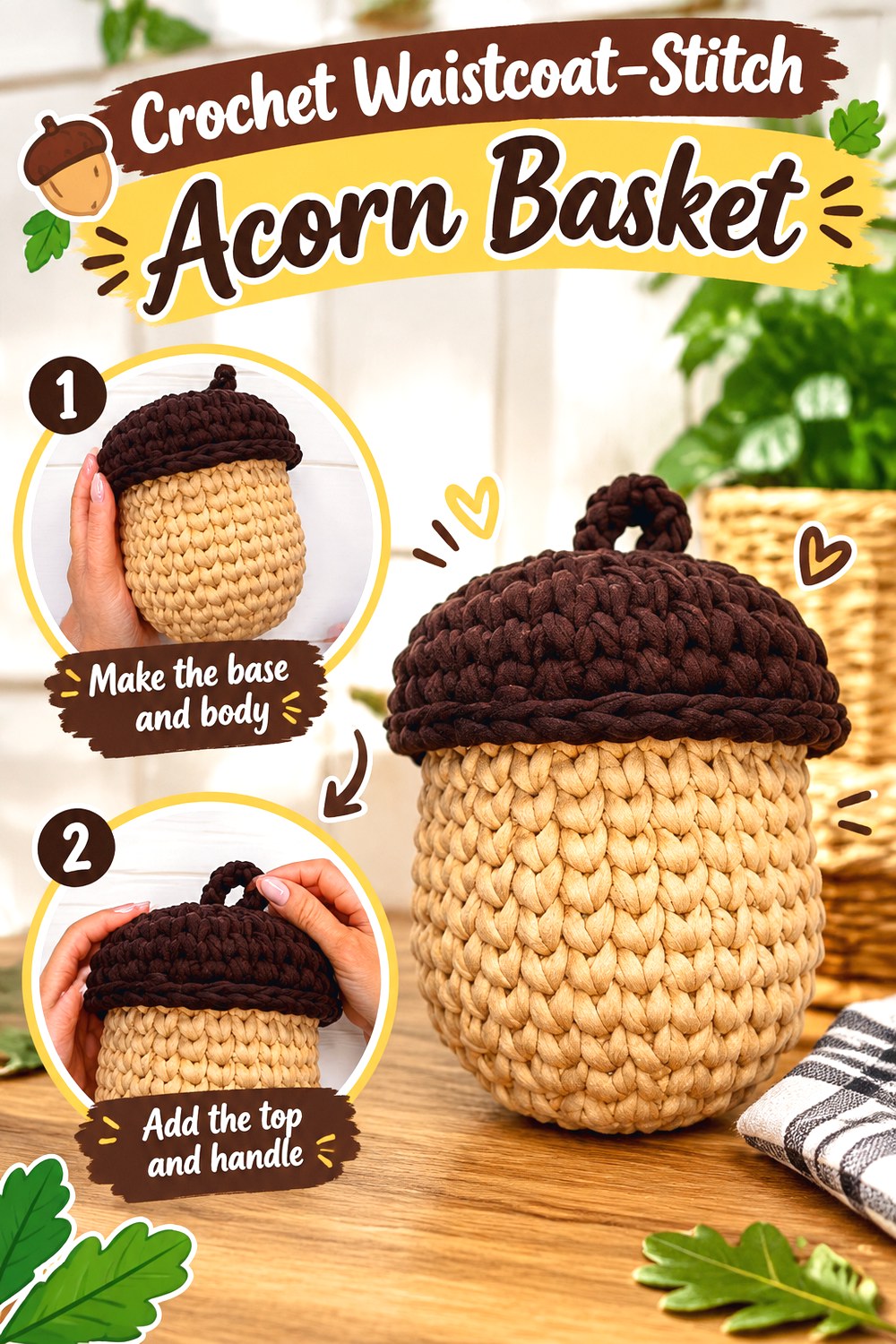
Crochet Cabin’s version emphasizes a dense, knit-like surface created with the waistcoat stitch. The tutorial shows an acorn basket with a separate fitted top and uses substantial T-shirt-style yarn for the basket, giving the finished piece a chunky, strongly defined appearance.
This option suits readers who care as much about surface texture as the basic silhouette. The centered stitches make the body look different from a conventional single-crochet basket, while the thick yarn makes the cap, stem, and rounded lower portion visually prominent. It can work particularly well as a standalone fall organizer where the stitch pattern will be seen at close range.
Why the Knit-Look Texture Suits Storage
A centered stitch can create a compact-looking surface that visually reinforces the idea of a substantial basket. With thick yarn, however, every irregularity in tension may also become easier to see. Focus on keeping stitch height and spacing consistent rather than forcing the fabric tight. If your yarn differs from the tutorial’s, make a small practice section first so you can judge whether the centered stitch remains comfortable to work.
Watch for Tension Creep
Basket projects can become gradually tighter as the fabric grows, especially when working a stitch that requires inserting the hook into a dense part of the previous stitch. Periodically check whether your hook still moves comfortably and whether the wall remains even. A noticeably tighter upper section could affect both the silhouette and lid relationship. Taking short breaks can also be sensible when bulky yarn and dense stitches require more hand effort.
Original Tutorial and Creator Credit
Creator: Crochet Cabin
4. Crochet Melange Roving Acorn Box
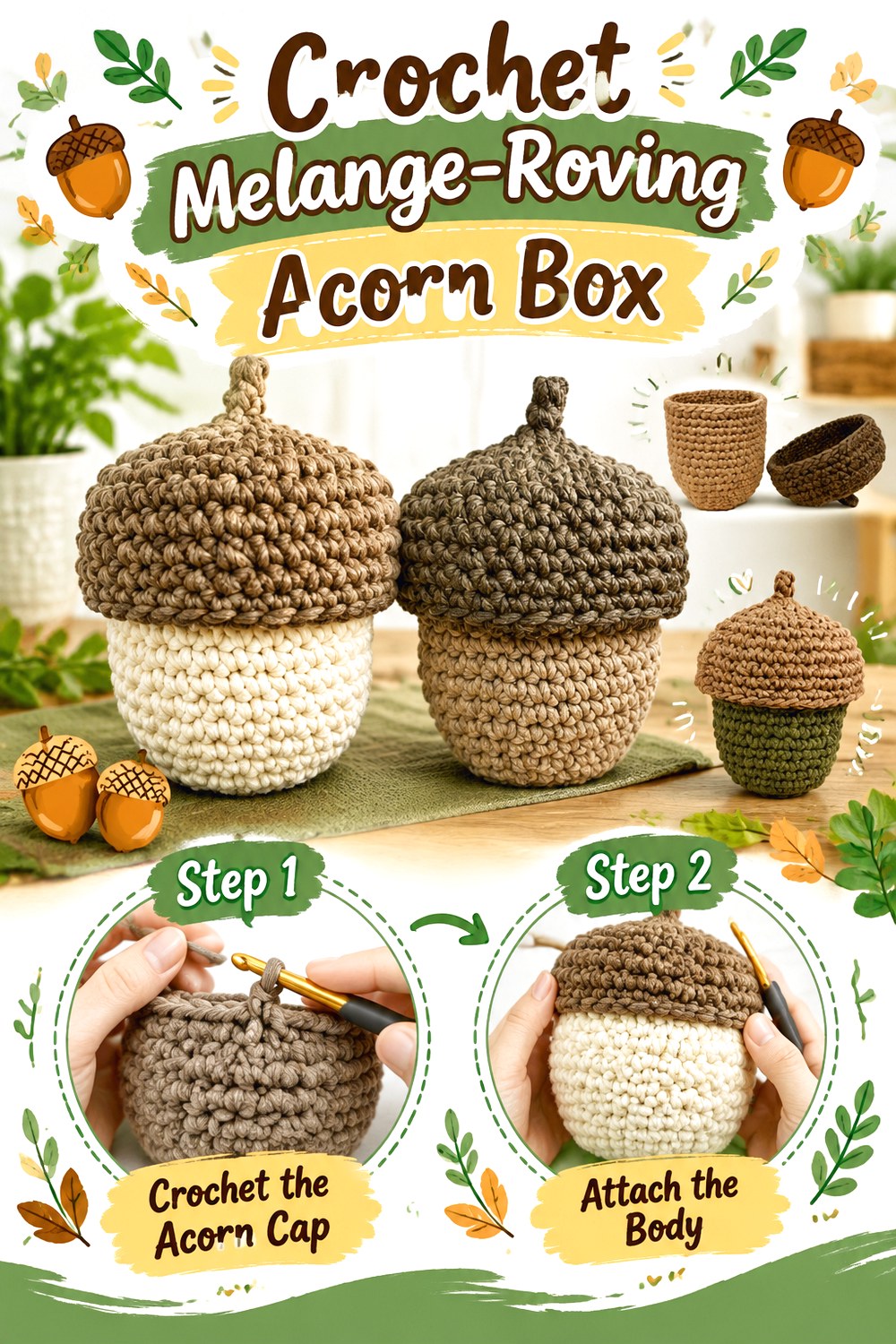
This acorn container from あむあむチャンネル uses a softer melange-roving look rather than the heavy basket cord seen in several other projects. The finished piece still has the key acorn vocabulary—a rounded lower container and contrasting cap—but the yarn gives it a more textile-focused, softly blended appearance.
Choose this direction when your priority is a cozy tabletop box or decorative small-item holder rather than maximum basket rigidity. The softer fiber character also makes color transitions within the yarn part of the finished design, which can reduce the need for elaborate embellishment.
Softer Yarn Changes the Silhouette
A softer yarn does not necessarily produce the same crisp profile as braided cord, even when the underlying construction is similar. That can be an advantage if you prefer a less architectural container. For adaptations, judge whether the sides remain sufficiently upright for your intended use. If the fabric feels flexible, reserve the basket for light items instead of trying to force cord-like performance from a yarn chosen for softness.
Use the Yarn Texture as the Decoration
Melange or subtly changing yarn already adds visual movement. Adding many extra leaves, beads, bows, or appliqués can compete with that effect and may make a small lid cumbersome to handle. A restrained finish lets the cap-and-nut contrast remain clear. If you substitute another yarn, compare not only its thickness but also how fuzzy, smooth, or loosely spun it is, since those characteristics affect stitch definition.
Original Tutorial and Creator Credit
Creator: あむあむチャンネル
5. Crochet Two Size Cord Acorn Basket Set
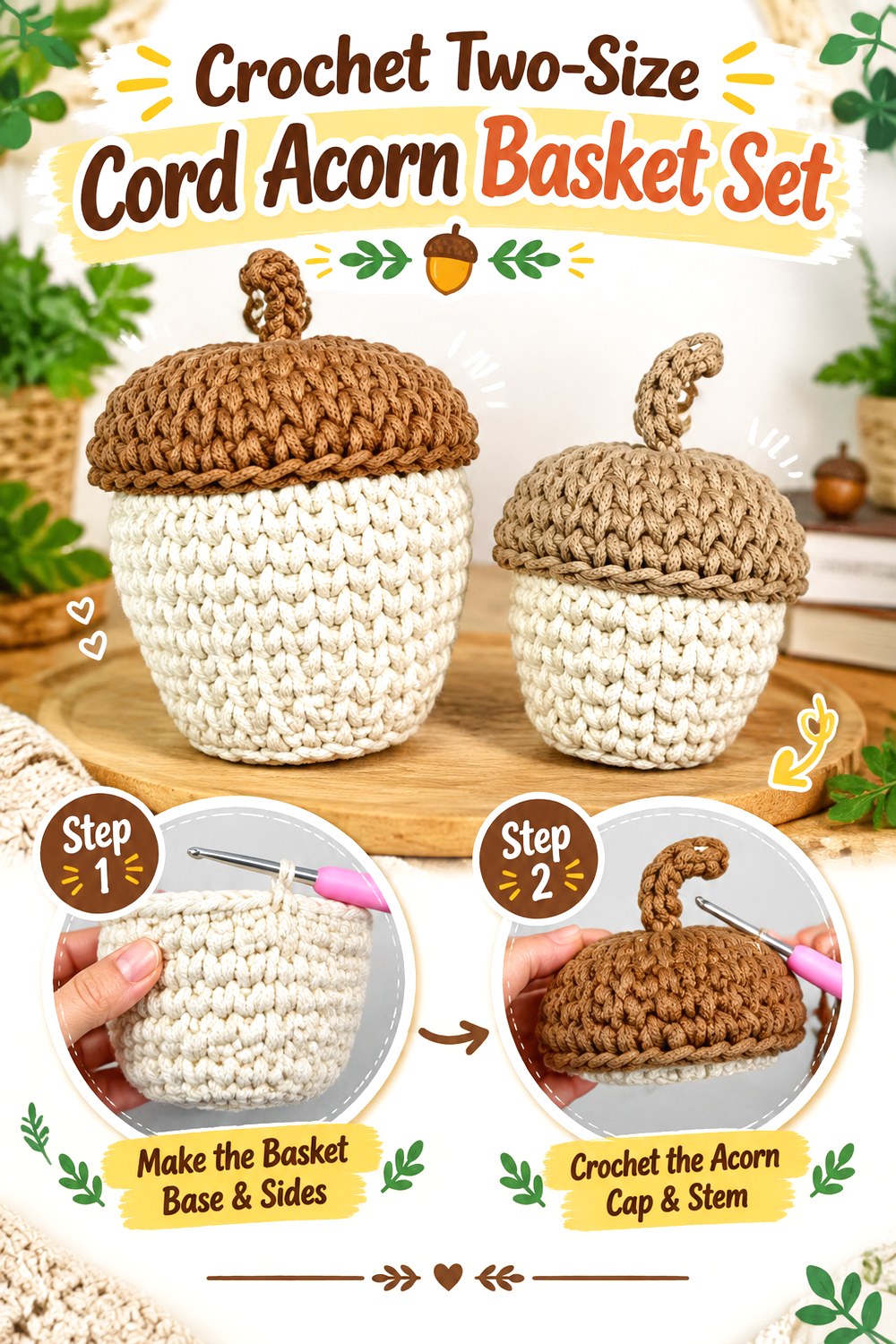
Häkeln mit Irina demonstrates acorn baskets in two different sizes using 5 mm Bobbiny cord. Both versions retain the same core concept—a structured lower basket topped with a contrasting acorn lid—so displaying them together creates a coordinated woodland set without relying on color changes alone.
The size pairing is useful when you want multiple containers for different categories of small items or a grouped seasonal arrangement. Because the material remains consistent, the difference in scale is easier to read as an intentional set instead of an assortment of unrelated baskets.
Two Sizes Create a Better Display
A pair with visibly different heights or capacities often looks more deliberate than several containers made at nearly identical scale. Use the larger basket where access and capacity matter, and let the smaller one handle lighter objects or decorative placement. If arranging them together, leave enough physical space around each cap so the acorn outlines remain readable instead of forming one crowded brown mass.
Keep Scale Changes Consistent
Changing the finished size of a basket involves more than enlarging one isolated part. The body, cap, stem, and opening need to remain visually compatible. The tutorial already supplies two intended sizes, so use its guidance rather than inventing a percentage enlargement from the smaller version. If you go beyond those source sizes, continuously compare the lid and body so one component does not outgrow the other.
Original Tutorial and Creator Credit
Creator: Häkeln mit Irina
6. Crochet Treat Filled Acorn Gift Basket
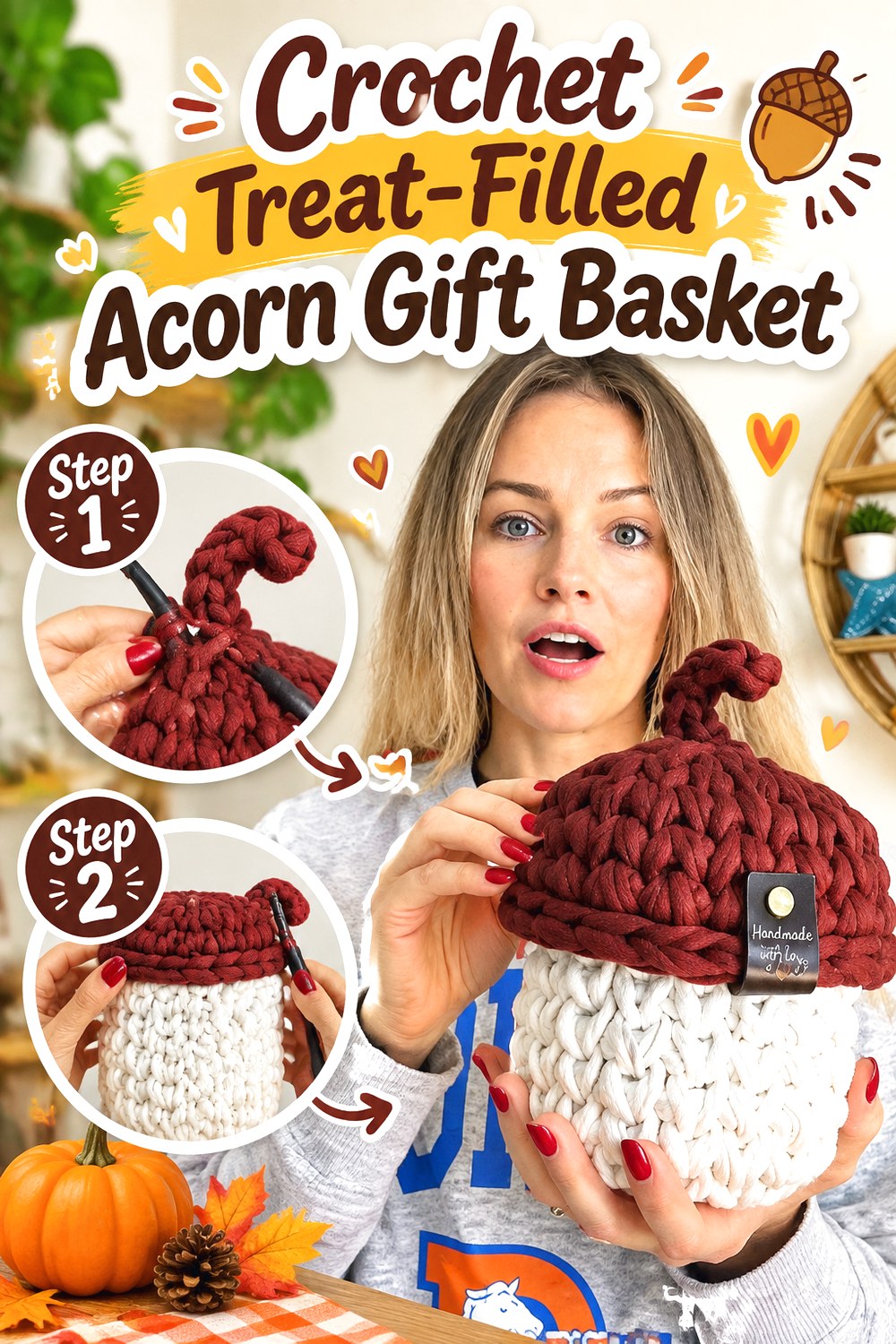
Craft with Jess turns the acorn shape into a small surprise container intended to hide goodies inside. The video covers the acorn, its top, size variation, and later accessorizing, so this project naturally moves from household organization toward seasonal gifting.
That makes it useful for wrapped sweets, small favors, or another lightweight surprise that fits comfortably inside the finished piece. Rather than enlarging the container first and deciding what to put inside afterward, this version works best when the gift and basket are planned together. The acorn itself becomes part of the presentation instead of disposable wrapping.
Plan the Gift Before Choosing the Size
A small container feels intentional when its contents fit without distorting the sides or preventing the top from closing properly. Decide whether you are holding individually wrapped candy, a note, a small accessory, or another lightweight item before settling on size. Avoid forcing an oversized gift into a crocheted opening, since stretching can permanently change the rim and make the cap fit differently afterward.
Keep Accessories Secondary to the Opening
Leaves, ties, tags, or other fall details can personalize a gift basket, but embellishments near the cap should not make the container awkward to open. Attach decoration where it will not bear the force of repeated handling. If the gift is for a young child, avoid loose beads, buttons, or detachable decorations that could become small-part hazards; embroidery or simpler yarn details may be more suitable.
Original Tutorial and Creator Credit
Creator: Craft with Jess
7. Crochet Mini Acorn Craft Supply Box
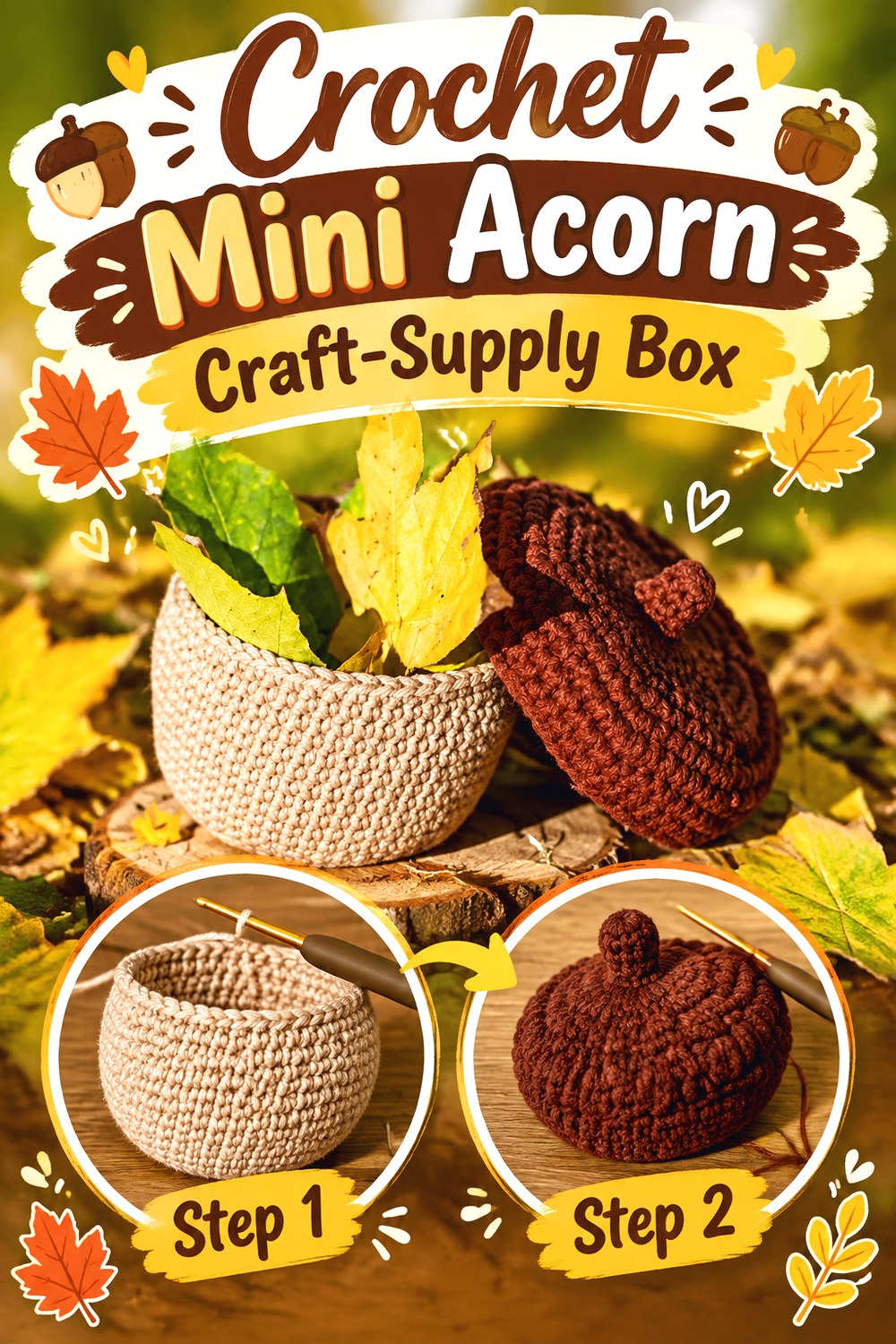
DIY 100 Ideas presents its acorn box specifically as storage for little things and names buttons, beads, stitch markers, and scrap yarn among the possible contents. The original tutorial page provides the project instructions and shows a compact acorn container with separate contrasting sections.
This is a good alternative to oversized fall baskets when you actually need a desktop notions box. Its scale suits craft-room organization, a sewing table, or a small shelf where a heavy cord basket might be disproportionate. The acorn theme remains obvious without the project needing to become a major storage piece.
Match the Box to the Notions You Store
Small crochet containers are useful only when their opening works with the objects inside. Stitch markers or buttons need far less access space than a ball of yarn or a bulky tape measure. Before adapting the size, gather the items you want to store and judge their volume together. Keeping similar lightweight notions in the same acorn also reduces unnecessary pulling and stretching at the opening.
A Small Lid Needs Clean Edge Control
At compact scale, a slight mismatch between lid and body can look proportionally larger than the same error on a big basket. Keep an eye on the edge rather than focusing solely on overall height. If you substitute a much thicker yarn, you may change the character of the project considerably, so refer back to the original tutorial rather than assuming the small-box proportions will automatically transfer.
Original Tutorial and Creator Credit
Creator/Site: DIY 100 Ideas / Iris F
8. Crochet Super Bulky Acorn Keepsake Box
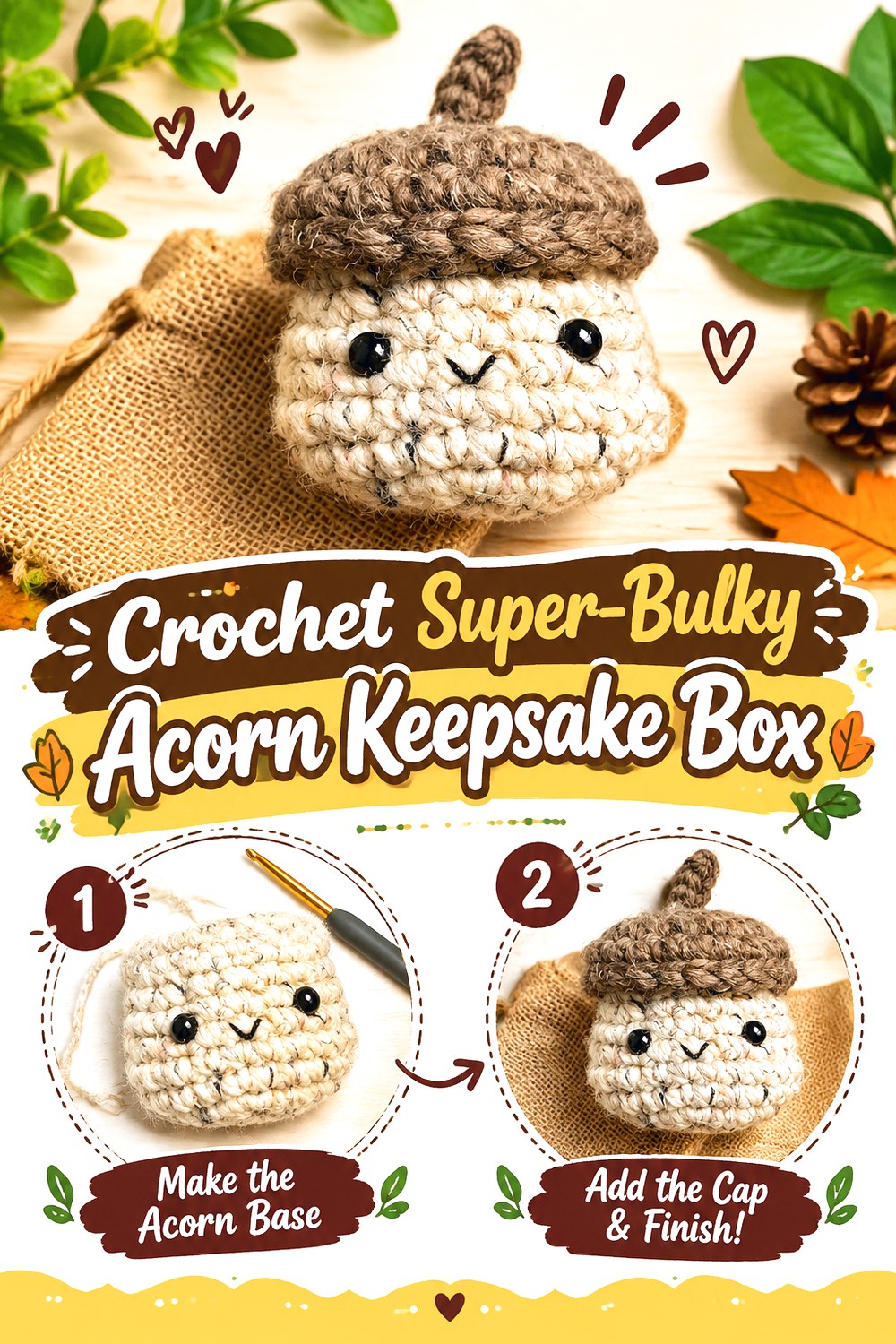
Sweet Softies’ Acorn Box is a small woodland container made with super-bulky yarn and a removable top. The original pattern presents it as functional storage for little treasures and even shows an optional face treatment, allowing the same basic box to lean either toward understated decor or a character-style keepsake.
Compared with rope baskets, this project has a softer, more amigurumi-adjacent personality. Its compact size and thick stitches make the acorn visually substantial without requiring it to become a large household organizer. It works especially well for jewelry, tiny craft supplies, or a small woodland display.
Bulky Yarn Makes the Form Read Quickly
Thick yarn enlarges every stitch, so the basic shape can make a strong visual impact without elaborate surface texture. It also means finishing deserves attention: uneven joins or bulky sewn areas may be easier to notice. When substituting another super-bulky yarn, compare its loft and firmness. Two yarns carrying the same weight category can still create noticeably different levels of stiffness and stitch definition.
Decide Whether to Add a Face
The original design offers optional facial details, which changes the box from woodland decor into a more character-driven object. For an adult desk or minimal fall shelf, leaving the surface plain may keep the acorn silhouette stronger. For children’s decor, consider embroidered facial features rather than detachable plastic components when small-part safety is relevant. Follow the intended recipient, not simply the sample styling.
Original Tutorial and Creator Credit
Creator/Site: Sweet Softies
9. Crochet Braided Rope “Manne” Acorn Basket
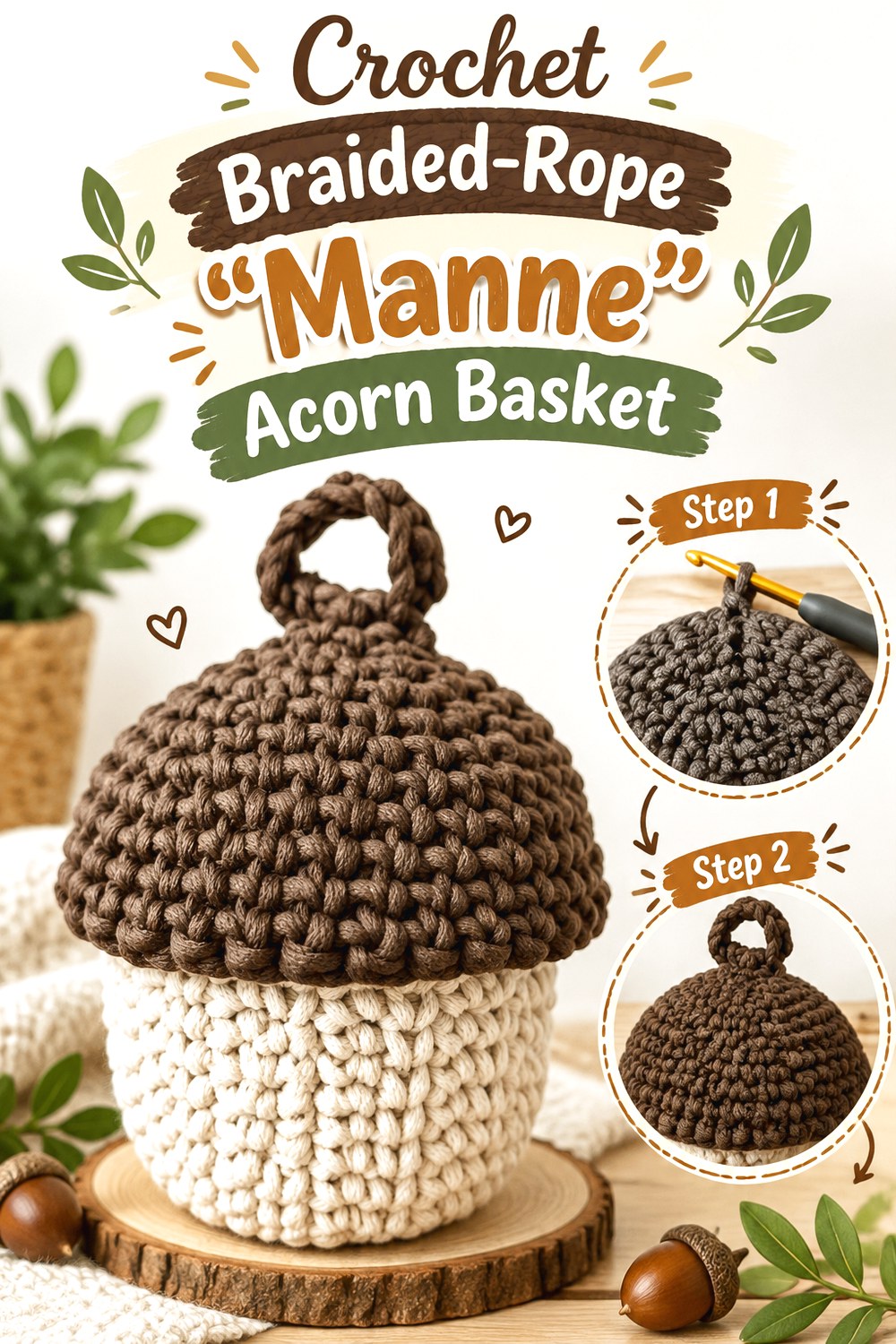
Make Your Own’s “Manne” basket uses braided rope and combines more than one visible stitch treatment across the acorn components. The original Swedish tutorial identifies lid fit as a key area to watch and gives guidance for adjusting when personal tension changes the relationship between the top and lower basket.
That makes this project especially valuable for readers who want to understand why following the same general design does not always produce an automatically perfect cap. The strong rope construction also gives the acorn enough visual weight to function as a decorative organizer rather than a miniature keepsake.
Mixed Texture Gives the Body Definition
Alternating surface treatments can make a neutral basket more interesting without introducing extra colors or sewn decorations. The trade-off is that different stitches may not have identical tension or width. Pay attention to whether the fabric begins pulling inward or spreading as the texture changes. If you are unfamiliar with the techniques used by the source, practice them separately before committing expensive basket rope to the full project.
Lid Fit Is the Main Checkpoint
The creator explicitly discusses variation in lid fit because crocheters may work different techniques with different tension. Treat that as useful permission to assess the physical basket instead of chasing a theoretical result. Try the cap on periodically and follow the source’s adjustment guidance. Avoid improvising a dramatically larger edge all at once; small corrections are easier to evaluate while the lid is still in progress.
Original Tutorial and Creator Credit
Creator/Site: MYO Make Your Own
10. Crochet Three Size Acorn Treasure Basket Set
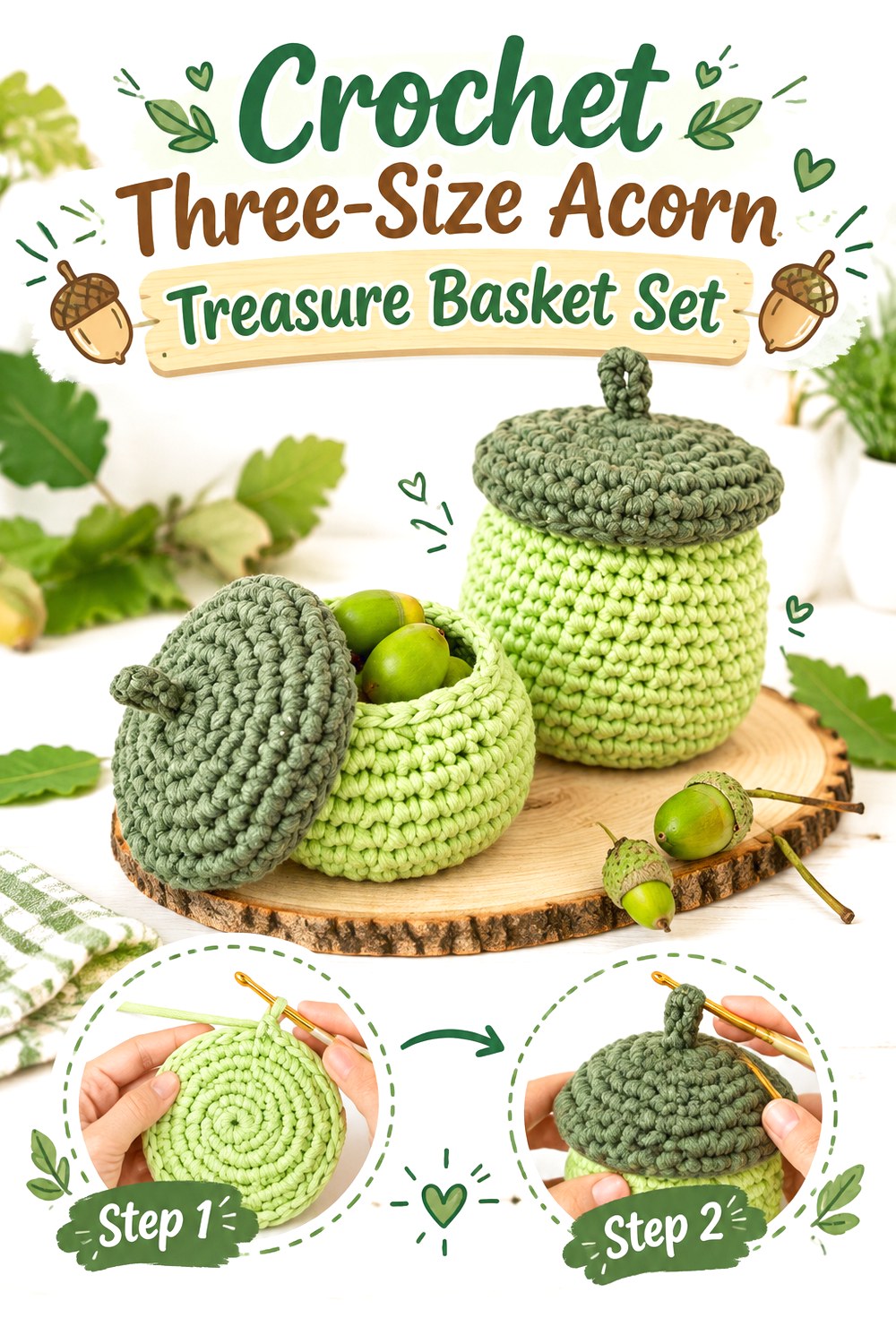
Zuckersüße Äpfel provides an original tutorial for little lidded acorn baskets intended for seasonal treasures and small gifts. The page describes larger and smaller versions and also suggests an especially tiny variation made with finer yarn and a smaller hook.
This set differs from the heavy cord options because it emphasizes small-scale seasonal storage and display. Several sizes can be spread across an autumn table, used for found nature treasures that are clean and suitable for indoor storage, or assigned to different tiny gift items. The variation in scale creates interest even when the color palette remains closely coordinated.
Three Scales Change the Function
The largest version can serve as the visual anchor, while smaller acorns can hold individual little objects or simply complete the arrangement. Think about access as you decrease the size. A container may still look attractive after significant downsizing but become too small to retrieve certain contents comfortably. Choose the tiniest version for appropriately tiny objects rather than treating it as a direct substitute for the larger basket.
Tiny Versions Need Finer Finishing
Every yarn tail, join, and stem occupies a larger percentage of a miniature project. Take extra care securing and hiding ends so they do not overwhelm the small form. If you reduce scale using finer yarn, the fabric behavior may also become softer. For decorative pieces that need an upright appearance, shape them gently and avoid filling them with objects heavy enough to stretch the sides.
Original Tutorial and Creator Credit
Creator/Site: Zuckersüße Äpfel
11. Crochet D Core Magnetic Acorn Container
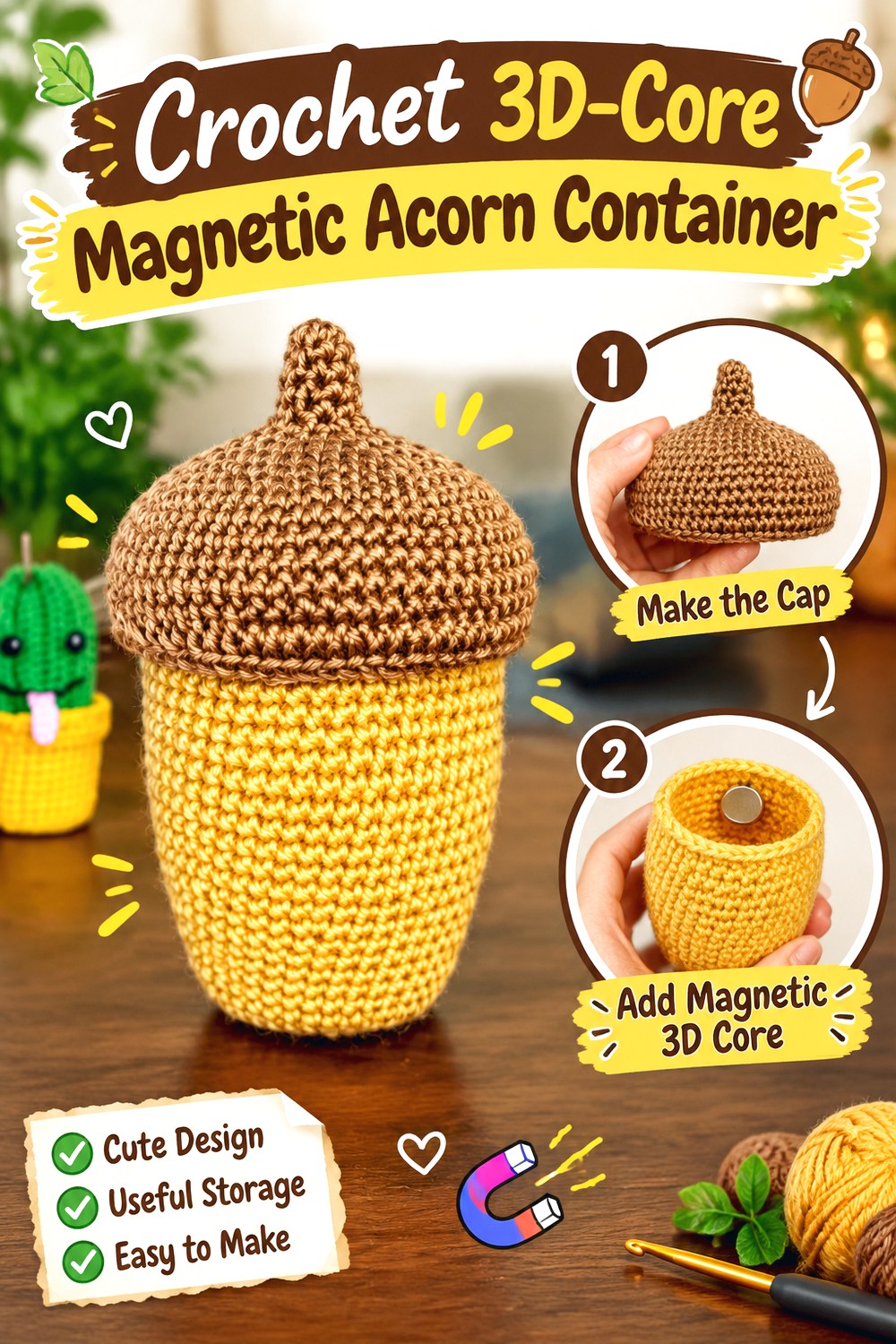
The Lost Marble takes the hybrid-container idea much further by fitting crochet over a 3D-printed acorn container. The tutorial covers crocheted coverings for the rigid base and lid and includes an optional magnetic closure system.
Because the printed object establishes the exact geometry, this version can achieve a cleaner, more mechanically defined container than a completely soft basket. It is a compelling option for makers who already have access to 3D printing or an appropriate printing service and enjoy mixed-media projects. The crochet contributes surface warmth while the rigid core handles the structural job.
The Printed Core Controls the Final Accuracy
The crocheted fabric has to cooperate with a fixed object rather than establishing its own final dimensions. Check fit frequently so the cover does not become baggy or too tight to attach as intended. Yarn substitution therefore becomes a compatibility decision: a thicker yarn may cover the core with fewer visible stitches but can also add bulk around attachment areas. Follow the source closely where crochet meets the printed component.
Magnets Require Extra Caution
Small strong magnets can be hazardous if swallowed and should not be treated as harmless decorative hardware. If you use the optional magnetic feature, secure components according to the source and keep the finished container away from young children or pets if there is any possibility a magnet could come loose. For a child-accessible project, consider omitting the magnetic feature and choosing a simpler fully crocheted closure.
Original Tutorial and Creator Credit
Creator: The Lost Marble
12. Crochet Drawstring Acorn Basket Satchel
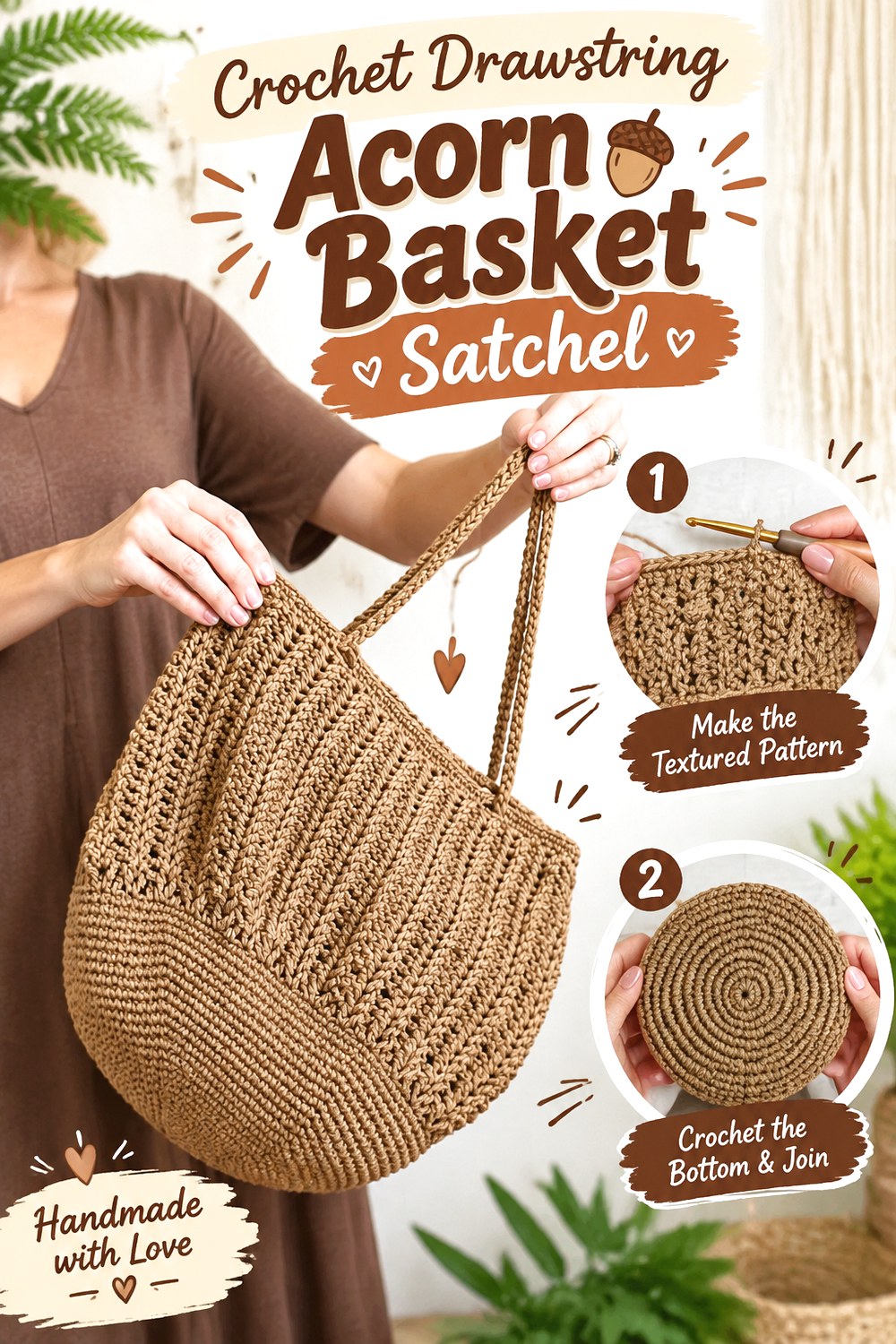
Life + Yarn’s Acorn Basket Satchel shifts the idea from lidded shelf storage to a full carryable basket bag. The design uses a solid base, a textured body intended to evoke a woven basket, and a wide drawstring-style opening. The original pattern specifies cotton yarn and presents the finished project as a practical purse rather than an acorn-shaped box.
This makes it the strongest choice for readers attracted to the words “acorn basket” but wanting an everyday accessory. The open-and-close mechanism is faster to access than a separate lid, while the flexible body offers far more carrying capacity than the miniature containers above.
The Drawstring Changes the Storage Experience
A drawstring opening compresses rather than lifting away, so there is no cap to misplace. The trade-off is that the upper edge and cord channel experience repeated movement. Make sure the closure slides freely instead of requiring force. If you change yarn, check whether the resulting fabric becomes too stiff to gather smoothly; a basket bag needs enough structure to hold belongings but enough flexibility for the closure to work.
Reinforce the Parts That Take Load
A carry bag experiences stresses that tabletop baskets do not. Pay particular attention to strap attachment, the base, and any points where the drawstring repeatedly rubs. Do not assume a decorative yarn substitution will withstand the same load as the original cotton. If you plan to carry heavier objects, inspect the fabric and joins regularly and consider an appropriate lining only if it does not interfere with the source construction or closure.
Original Tutorial and Creator Credit
Creator/Site: Life + Yarn / Brianna Iaropoli
13. Crochet Mini Acorn Trinket Pouch
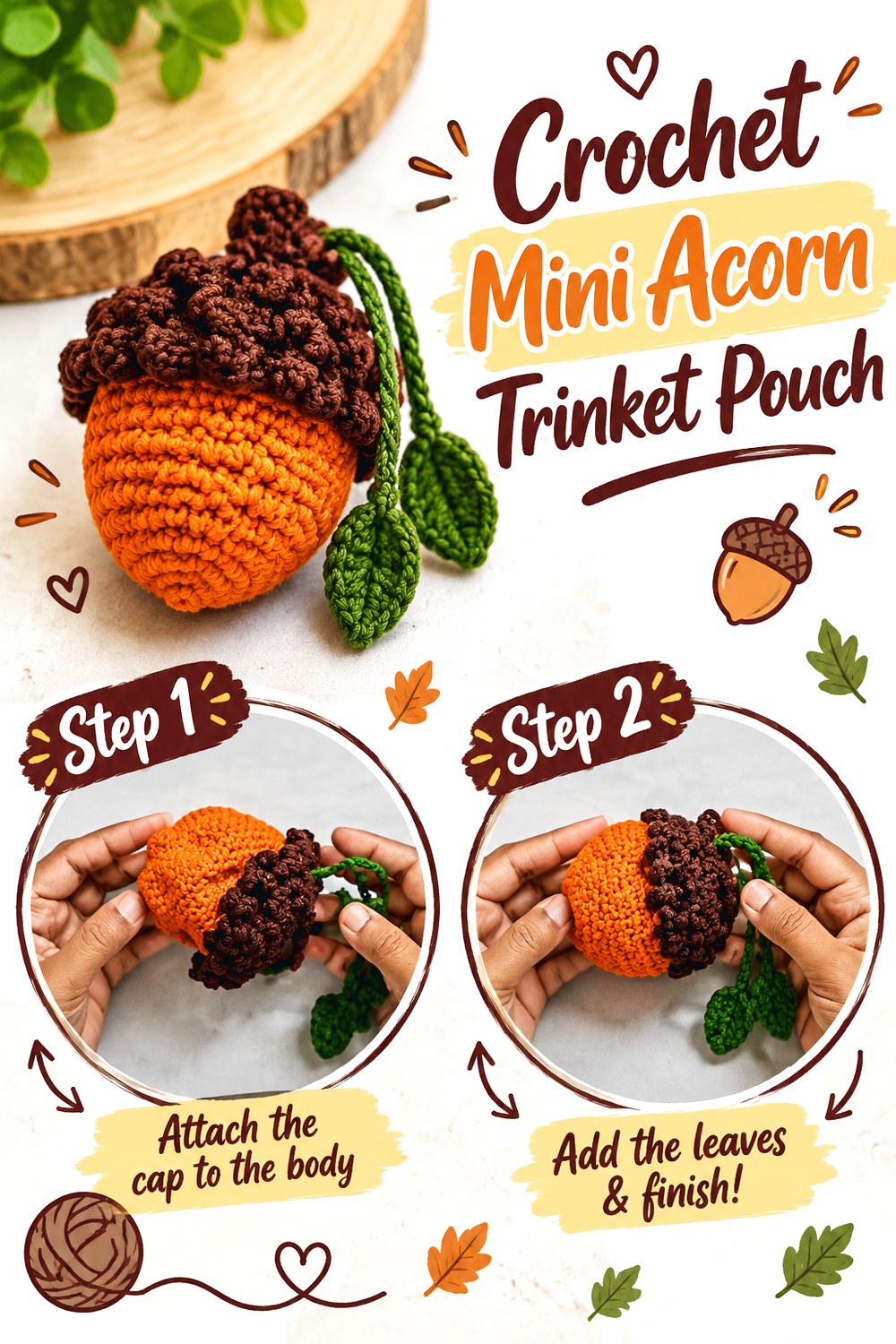
Club Crafteria’s mini acorn pouch is a much smaller portable container. The tutorial divides the finished design into body, top, and leaf components and presents it as a small giftable pouch made with basic crochet techniques.
Its scale makes it better suited to tiny trinkets or presentation than to household organization. The added leaf also separates it visually from the plain-stem basket lids earlier in the list. Consider it when you want the acorn concept to feel like a miniature woodland accessory that can be tucked into a larger gift rather than left permanently on a shelf.
Small Scale Makes the Opening More Important
The smaller the pouch, the more its usable opening limits what it can hold. Test candidate contents before completing decorative details. A small object should enter and leave without forcing the crochet out of shape. This is particularly important for rigid trinkets with corners or clasps. If the opening is already snug, enlarging the contents is usually less successful than choosing a different container size.
Leaf Detail Adds Character Without Bulk
A leaf introduces a second botanical cue without requiring a large applique across the pouch body. Keep its attachment tidy so it does not obstruct the opening or become the point people instinctively pull to access the contents. If the pouch will be handled frequently, check the leaf attachment periodically. For a cleaner woodland look, use closely related natural colors rather than relying on numerous decorative additions.
Original Tutorial and Creator Credit
Creator: Club Crafteria
14. Crochet Bobble Texture Acorn Shoulder Bag
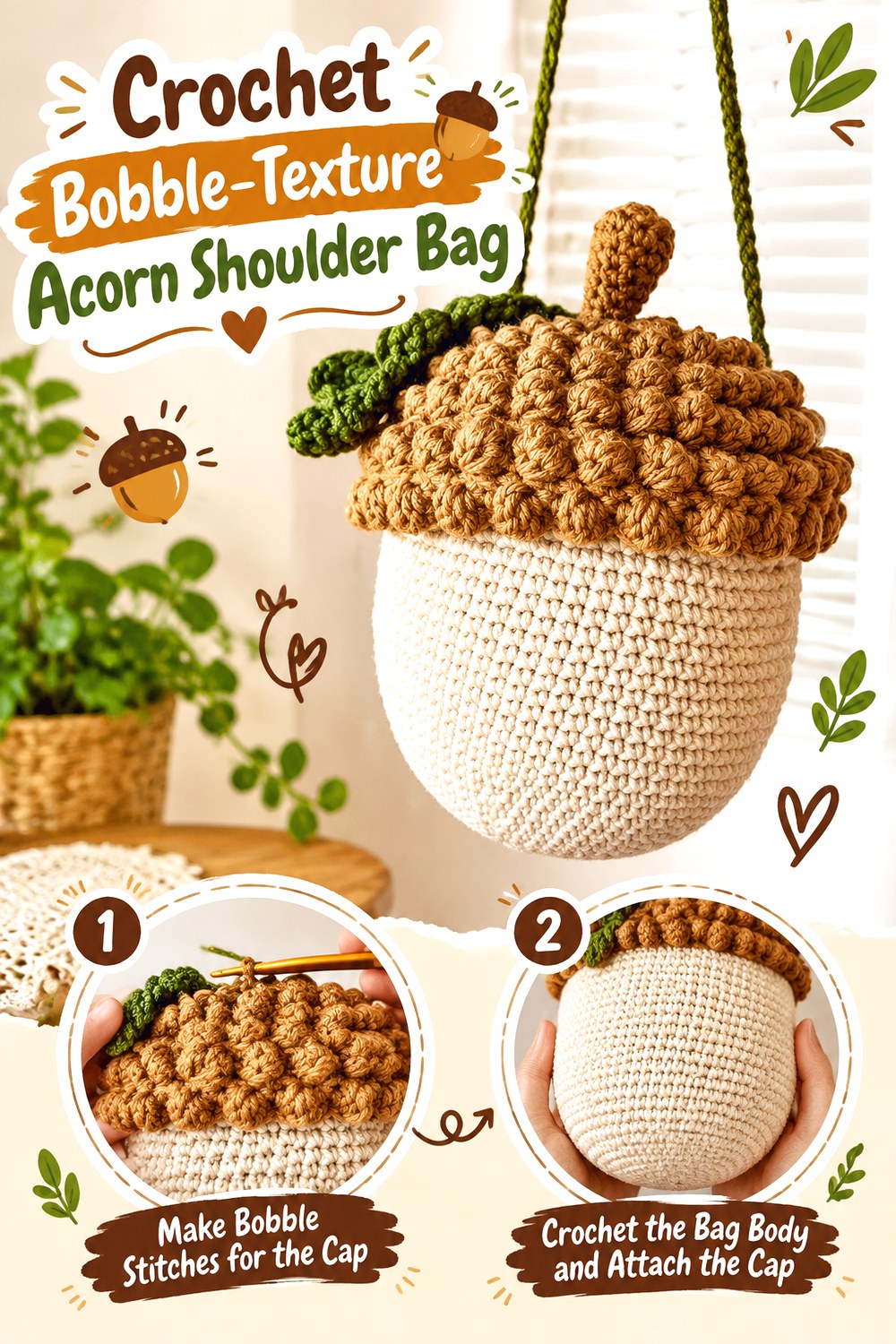
The Caffeinated Snail’s original Acorn Bag Pattern expands the nut silhouette into a wearable bag. The project is worked as a genuinely acorn-shaped accessory rather than a conventional tote with an acorn applique, and the design incorporates texture to strengthen its whimsical woodland character.
This version is useful when the recognizable outline matters more than rigid basket structure. Unlike a shelf container, it has to move with the wearer, so controlled flexibility becomes an advantage. The textured upper portion helps distinguish the “cap” visually while the rounded lower section provides the main carrying space.
Let Texture Mark the Cap
A strong textural change can separate the nut and cap even when the colors are fairly subtle. That approach is often more effective than adding multiple loose decorations to a wearable. If you substitute yarn, first make sure the texture remains visible; very fuzzy fibers can hide bobbles or other raised stitches, while extremely stiff yarn can make the upper section bulky against the body.
Shape Matters More Once the Bag Is Filled
An empty acorn-shaped bag may look perfectly rounded, but contents can create flat spots or pull the lower point downward. Carry ordinary lightweight essentials while evaluating the finished form before trusting it with heavier objects. If sagging becomes pronounced, an appropriate lining may help distribute contents, but it must be planned around the opening and straps rather than added so tightly that it distorts the crochet.
Original Tutorial and Creator Credit
Creator/Site: The Caffeinated Snail / Kimberly Arenas
15. Crochet Bridge Yarn Acorn Pouch Bag
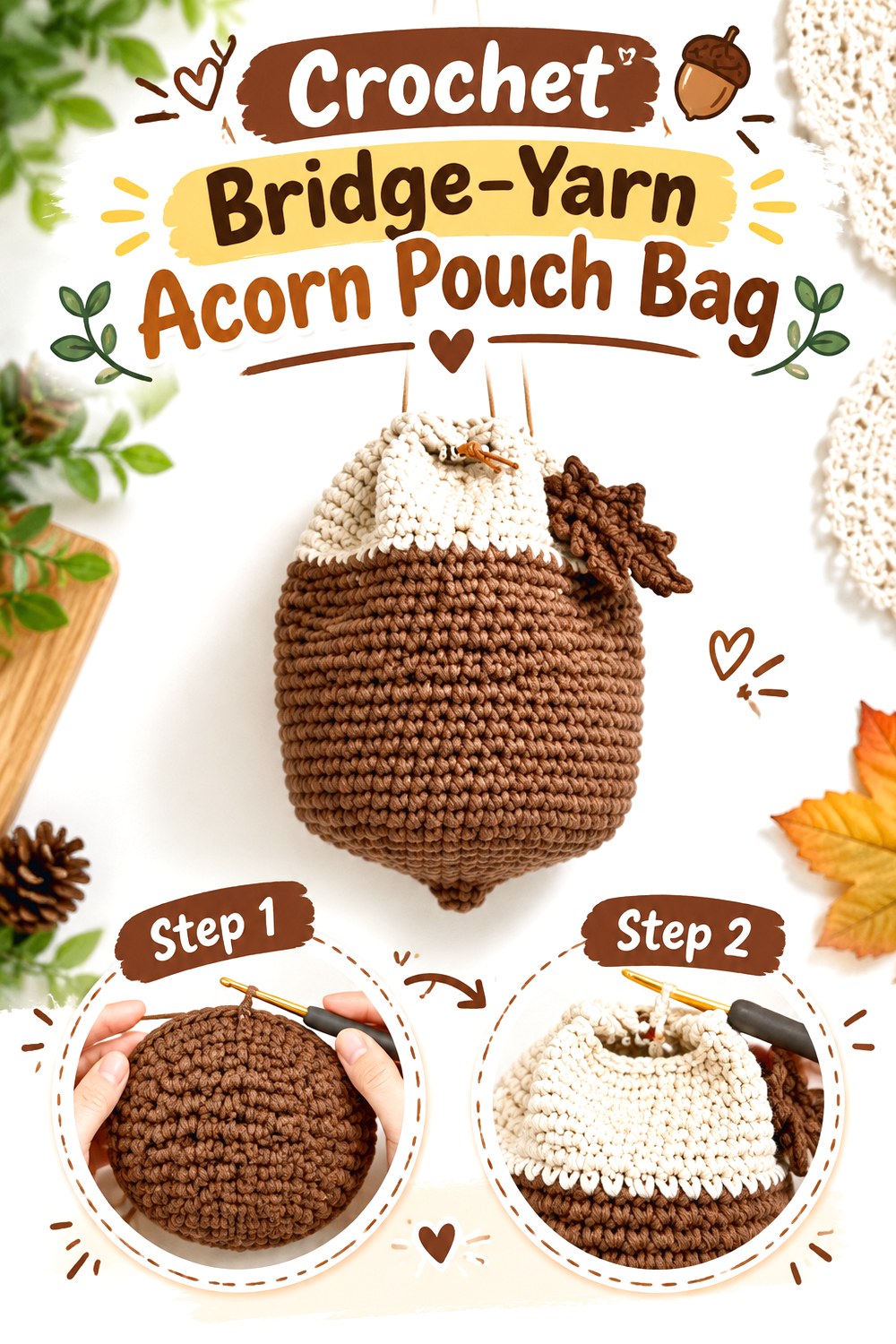
Shasha Friend Factory’s video approaches the theme as an acorn pouch or bag made with bridge yarn. The creator specifically emphasizes capturing the acorn form in the lower portion, resulting in a portable project that looks more like an enlarged nut than a standard rectangular pouch.
This version occupies a useful middle ground between a tiny trinket pouch and a full shoulder bag. It can function as whimsical personal storage while still relying primarily on silhouette rather than extra appliqués. The unusual yarn choice also gives the project a different visual density from the fine-yarn mini pouch above.
Keep the Rounded Bottom Intentional
A bag with a curved or tapered lower shape may not stand on a table like a flat-bottom basket, and that is not necessarily a flaw. Decide whether the finished object is primarily meant to hang, be carried, or sit upright. If you need freestanding storage, choose one of the earlier basket constructions. For a wearable pouch, prioritize an attractive hanging silhouette and comfortable handling instead.
Check How the Yarn Behaves at the Opening
A substantial yarn may create excellent body but can also make an opening bulky if too much fabric gathers in one place. Before finishing, open and close the pouch repeatedly and make sure the edge does not fold into an awkward hard ridge. Any substitution should preserve enough flexibility for access. Decorative firmness is useful only until it starts interfering with the bag’s actual function.
Original Tutorial and Creator Credit
Creator: shsahschingu
16. Crochet Whimsical Acorn Crossbody Satchel
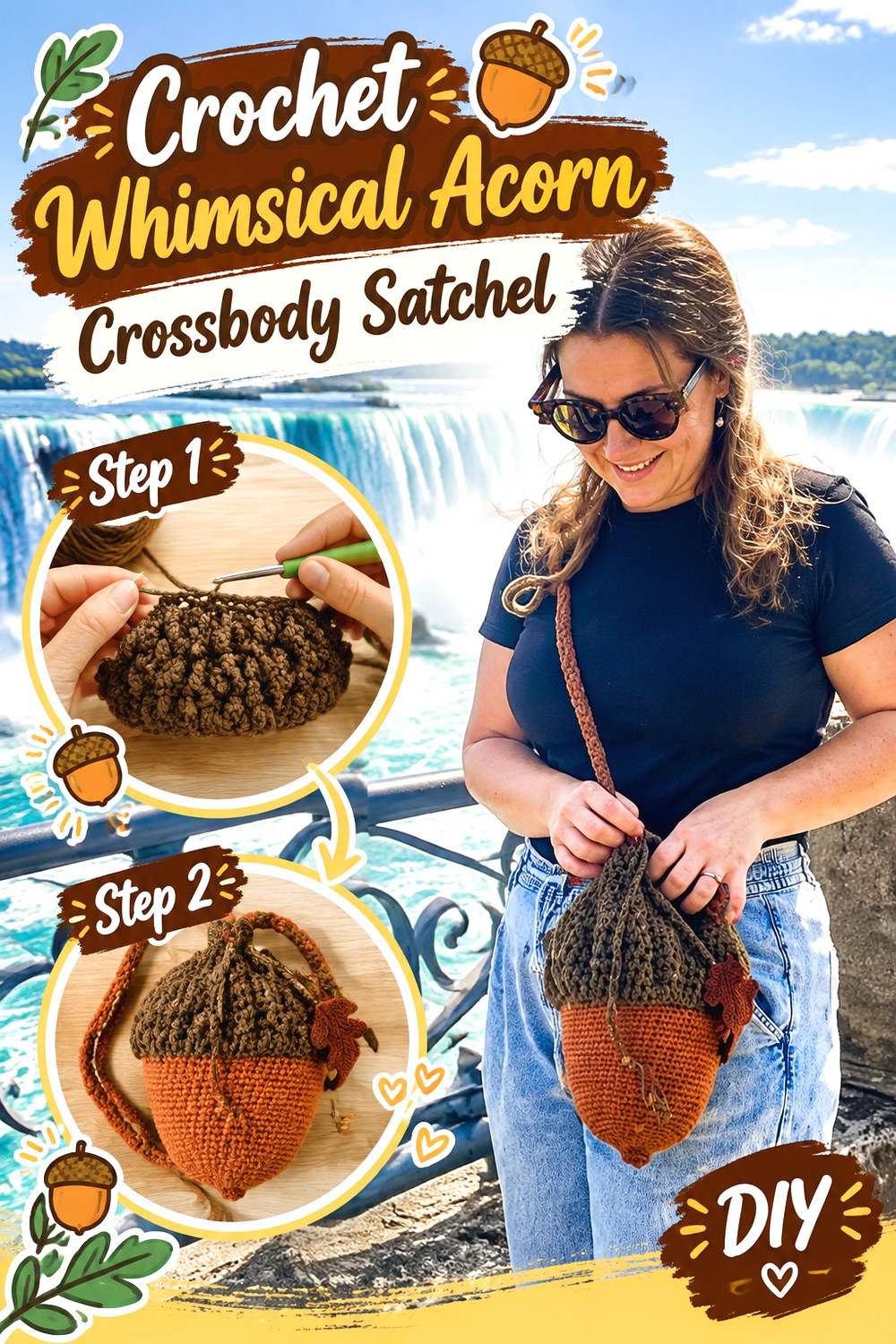
Last Minute Laura’s tutorial turns the acorn into a whimsical crossbody satchel. The finished project uses a rounded lower body, differentiated upper section, drawstring-style access, and a long carrying strap, making it clearly different from both lidded baskets and miniature pouches.
This is a strong option for costume styling, woodland outfits, festivals, or anyone who wants the acorn itself to be the accessory rather than a motif added later. Because the bag hangs vertically, the familiar nut profile stays visible while the strap allows it to function as real portable storage.
Balance the Strap Against the Bag
A whimsical body still needs a practical strap. Before committing to final strap length, consider where the widest part of the acorn will sit against the wearer. An extremely long strap may cause the bag to swing more, while a short one can make the rounded body uncomfortable under the arm. Check the source construction first, then make only adaptations that preserve secure attachment at both sides.
Protect the Drawstring From Decorative Overload
A drawstring closure already adds lines and movement near the cap. Additional leaves, ties, charms, or tassels should not make it difficult to identify which cord actually opens the bag. Keep functional cords easy to grasp and prevent decorative elements from tangling around them. For frequent use, inspect knots and attachment points because these moving parts experience more wear than decorations on a stationary basket.
Original Tutorial and Creator Credit
Creator: Last Minute Laura
17. Crochet Two Size Cotton Acorn Bag
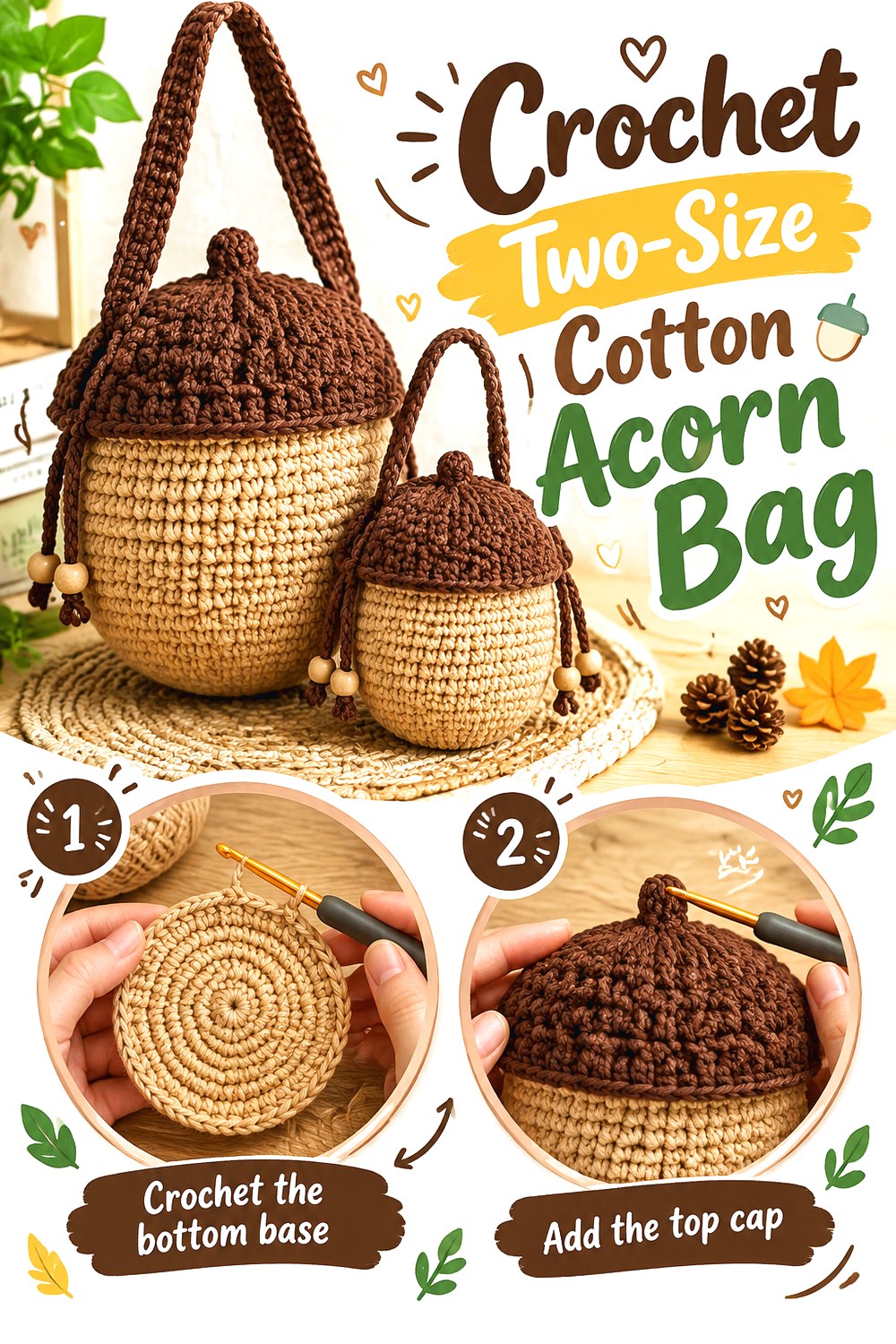
FabCroc’s original tutorial by Fabiana Canu presents an acorn-shaped crochet bag in two size variations and includes both Italian and English pattern information. The design uses cotton yarn, a contrasting upper section, a corded opening, and a shoulder strap, so it combines the recognizable acorn silhouette with a straightforward functional bag format.
The availability of two intended scales makes this particularly useful for readers deciding whether they want a compact novelty bag or something with more carrying room. It is also an interesting contrast to the heavy braided-cord baskets: cotton provides structure through crochet fabric without turning the project into a rigid household container.
Choose the Size by Contents, Not Appearance Alone
Before selecting the smaller or larger variation, list the objects you genuinely expect to carry. A phone, keys, wallet, and small personal items create different space requirements from a purely decorative festival pouch. Leave enough room for retrieval rather than filling the bag to its maximum visual capacity. A rounded acorn body can become awkward if rigid objects are packed tightly against its curved sides.
Let the Cord and Strap Do Separate Jobs
The tutorial includes both an opening cord and a carrying strap. Keep those functions distinct when modifying the design: the closure should gather the top without becoming the primary load-bearing component, while the strap should be securely attached to support the bag. If you substitute a stretchy yarn, monitor the strap length after use because a comfortable starting length can change under repeated load.
Original Tutorial and Creator Credit
Creator/Site: FabCroc / Fabiana Canu
Which Crochet Acorn Basket Style Should You Choose?
The most useful dividing line is not simply large versus small. It is how much structure and access your finished project needs.
| Style | Strongest Use | Main Trade-Off |
|---|---|---|
| Braided-cord basket | Upright household storage | More hand effort and careful lid fitting |
| T-shirt-yarn basket | Chunky decorative organization | Yarn thickness can change size quickly |
| Soft or bulky-yarn box | Keepsakes, gifts, tabletop decor | Less rigid under heavier contents |
| Jar-supported container | Small objects needing firm sides | Breakable internal component |
| 3D-core container | Precise hybrid storage | Requires extra materials and safety planning |
| Drawstring pouch or satchel | Portable storage | Closure, strap stretch, and load become important |
If you mainly want a recognizable fall organizer, start with a cord or T-shirt-yarn basket. For tiny gifts, the compact boxes and pouches make more sense. If the acorn needs to travel with you, choose a purpose-designed satchel rather than trying to attach a strap to a tabletop basket after the fact.
Conclusion
These 17 crochet acorn basket ideas show how much the same woodland shape can change when material, scale, structure, and opening are treated differently. Braided cord creates some of the strongest freestanding organizers; super-bulky and softer yarns suit keepsake boxes; rigid jar and printed cores solve structure in completely different ways; and the drawstring bags turn the idea into portable storage.
Choose by function first. A basket for craft notions does not need the same construction as a crossbody satchel, while a purely decorative fall piece does not need to tolerate heavy contents. Once you have chosen the right format, use the linked original tutorials for the designer’s exact construction, sizing, stitch details, and finishing guidance.
Frequently Asked Questions
What yarn is best for a crochet acorn basket that needs to stand up?
For a freestanding basket, a substantial cord, T-shirt-style yarn, or another yarn that creates a dense fabric is generally more suitable than a very drapey yarn. Several tutorials above deliberately use braided cord or thick yarn for that reason. The exact result still depends on stitch choice and tension. Before substituting materials, compare the yarn’s thickness, firmness, and stretch with what the original designer used.
Can I resize an acorn basket by changing only the hook size?
Changing the hook can alter gauge and therefore size, but it may also alter fabric density and lid fit. A larger hook may create a softer basket rather than simply a proportionally larger one. When a source already supplies multiple sizes, use those instructions instead of relying on hook changes alone. For an unsupported custom size, keep checking the body and cap together so the two pieces remain compatible.
How can I keep an acorn basket lid from becoming too tight?
Check it against the actual basket repeatedly instead of waiting until the lid is finished. Different stitches, yarns, and personal tension can cause the cap and body to grow at different rates. Make Your Own’s “Manne” tutorial specifically discusses this issue. When using another pattern, follow that designer’s adjustment guidance rather than adding arbitrary stitches or aggressively stretching the completed lid.
Should I line a crochet acorn basket?
A stationary cord basket may not need lining if its fabric is already dense and the intended contents cannot slip through. A soft bag may benefit more from lining when carrying small or irregular objects, but lining also changes flexibility and can interfere with drawstrings or unusual rounded shapes. Treat it as a functional addition rather than an automatic upgrade, and check whether the original designer provides any guidance before modifying the construction.
Are glass jars or magnets suitable for children’s acorn baskets?
Use extra caution. A crochet covering does not eliminate the breakage risk of glass, and small strong magnets can be dangerous if they detach and are swallowed. For young children, a completely soft crocheted container with embroidered decoration is generally the simpler choice. If using mixed materials for adult decor, inspect attachments periodically and place the finished piece where it is unlikely to be dropped or accessed by children or pets.
How should I clean a crochet acorn basket?
There is no single safe washing method for all of these projects because the materials vary substantially. Follow the care information supplied for the actual yarn and any guidance from the tutorial creator. A basket containing glass, magnets, a printed core, embellishments, or other mixed materials may require different handling from a fully crocheted cotton piece. Avoid assuming that a finished basket can be machine washed simply because its yarn alone is washable.