Crochet poinsettias can be much more than a single red flower sewn onto Christmas decor. The shape works as a flat motif, a dimensional bloom, a granny square center, a tabletop piece, wearable jewelry, a bag feature, or part of a larger holiday display. That range matters because the yarn, construction, finishing, and amount of structure you need change considerably from one project to another.
These 15 crochet poinsettia ideas focus on genuinely different finished objects rather than repeating the same flower in different colors. You’ll find small projects such as earrings and keychains, functional pieces such as coasters and napkin rings, and larger decor including a garland, wreath, runner, and bag. Each idea also includes an original YouTube tutorial so you can check the creator’s exact construction before starting.
Quick List
- Layered Crochet Poinsettia Flower
- Crochet Poinsettia Granny Square
- Crochet Poinsettia Table Coaster
- Filet Crochet Poinsettia Table Runner
- Crochet Poinsettia Garland
- Crochet Poinsettia Bauble Ornament
- Crochet Poinsettia Flower Bag
- Lace Crochet Poinsettia Doily
- Crochet Poinsettia Tree Ornament
- Crochet Poinsettia Brooch
- Crochet Poinsettia Napkin Ring
- Crochet Poinsettia Christmas Wreath
- Crochet Poinsettia Keychain
- Micro Crochet Poinsettia Earrings
- Crochet Poinsettia Gift Topper and Appliqué
Choose the Finished Use Before Choosing the Flower Style
A dimensional poinsettia that looks striking on a wreath may be inconvenient on a coaster, while a flatter motif suited to a table surface can disappear visually when placed on a large wall display. Start by deciding whether your poinsettia must hang, lie flat, bend around another object, support repeated handling, or remain purely decorative.
For table linens and coasters, relatively controlled thickness and a stable finished shape usually matter more than dramatic petal lift. Ornaments, wreaths, and gift toppers can accommodate greater dimension because nothing needs to sit evenly on top of them. Jewelry and keychains create another challenge: reducing scale also makes finishing details, attachment points, and loose ends more noticeable. Matching construction to use saves more trouble than choosing purely by appearance.
Yarn Choice Changes Scale, Weight, and Petal Definition
Poinsettias depend heavily on recognizable pointed bracts, so the same design can look quite different when the yarn changes. A smooth yarn generally makes individual stitch shapes easier to see, while fuzzy or heavily textured yarn can soften the edges. Thicker yarn also increases both the scale and weight of a layered flower.
Think about the entire finished object rather than the flower alone. A heavier motif may pull on a bag, scarf, garland cord, or ornament hanger. A small ornament made with finer yarn can feel visually delicate, but finer work also demands more attention to finishing. For projects that must be cleaned regularly, such as coasters or table decor, check the yarn manufacturer’s care information instead of assuming a fiber is washable or heat suitable.
Plan Attachment and Storage Before Final Finishing
Many poinsettia projects become easier when you decide how they will be attached before hiding every yarn tail. A flower used as a brooch needs a secure backing. A wreath flower needs a stable connection that keeps it facing outward. A gift topper may benefit from a removable attachment so the flower can be reused instead of discarded with the wrapping.
Seasonal storage deserves consideration too. Highly dimensional petals can flatten when packed tightly, while garlands and fine-thread pieces can tangle. Before making a whole matching set, finish one sample and see how it hangs, folds, or sits on its intended surface. For embellishments containing beads, jewelry findings, clips, or other small components, also consider whether the final item will be accessible to young children or pets.
1. Layered Crochet Poinsettia Flower
 SAVE
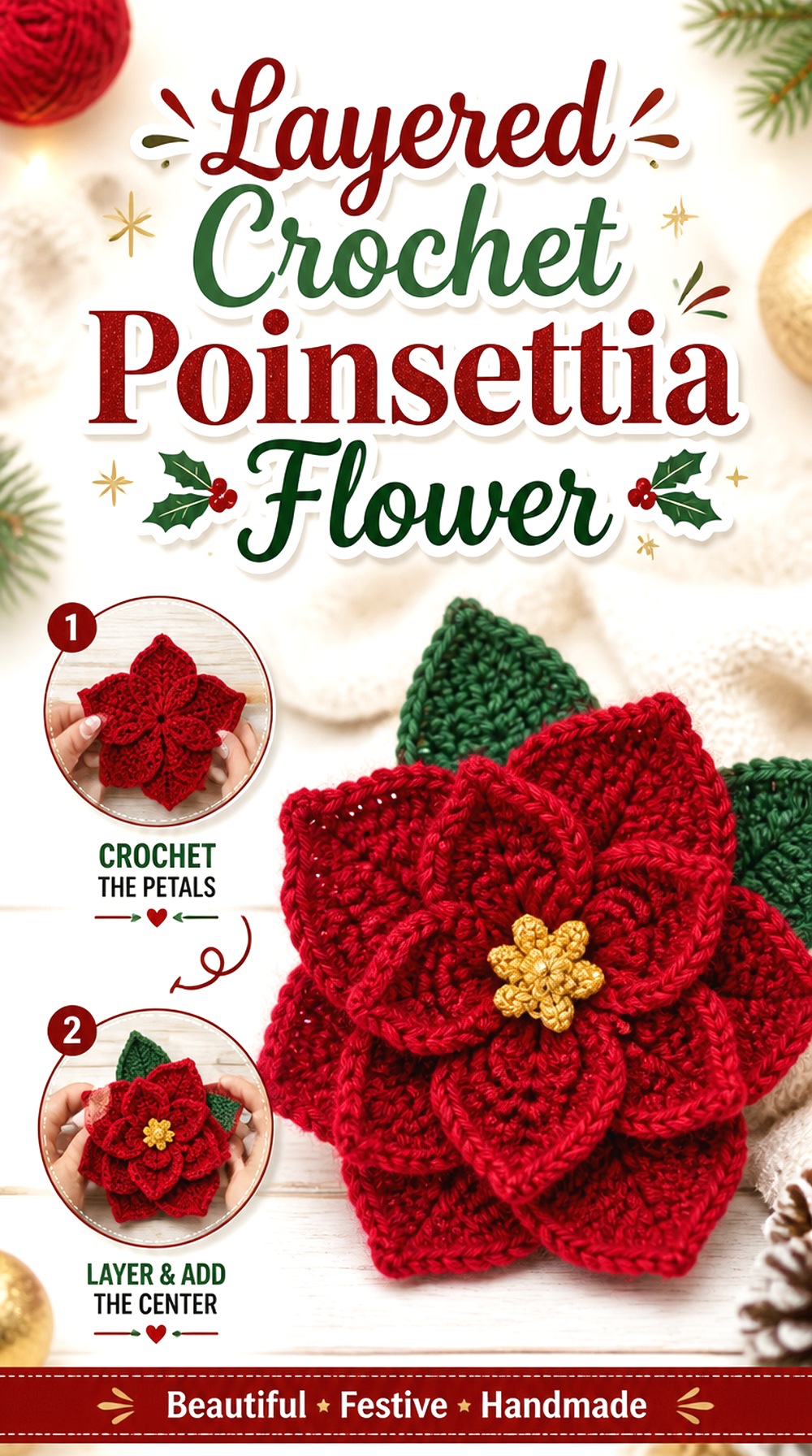
SAVEThis layered crochet poinsettia is a good starting point when you want the flower itself to be the feature rather than merely a printed-looking motif. Multiple petal or bract layers create visible depth, and the green elements underneath help the red flower read clearly from several angles. It suits mantel arrangements, wreath additions, package decorations, or other places where a flatter appliqué might look undersized.
The main planning question is how much dimension your final use can handle. A flower intended for display can keep its layered profile, while one destined for a wearable or bag may need to sit closer to the surface so the petals are less likely to catch.
Layer Spacing Controls the Finished Depth
When several petal sizes are stacked, their rotation matters visually. If every point falls directly above another, much of the lower layer can disappear. A staggered arrangement exposes more of the flower and distributes its visual weight.
Before securing the layers permanently, arrange them loosely and check the bloom from straight ahead and from an angle. That simple checkpoint is particularly useful if you are changing yarn weight because a thicker yarn may increase overlap.
Keep the Green Leaves Visible Without Competing With the Bloom
Leaves can make the flower easier to recognize, but they do not need equal visual space with the red layers. Check the flower against its intended background before final assembly. A green wreath, for example, may already provide plenty of green around the bloom.
On a neutral gift box or wall decoration, showing more leaf area may create stronger contrast. The useful decision is not simply whether to add leaves, but how much of them should remain visible.
Decide How the Back Will Be Used
A decorative flower can look finished from the front while still having a bulky back. That may be perfectly acceptable on a fixed arrangement but less useful on a brooch, ornament, or accessory.
Before weaving away every tail, decide whether the back needs a hanger, pin base, stitching point, or another attachment. Planning this early can reduce the temptation to force a fixing through finished petal layers later.
Original Tutorial and Creator Credit
Creator: Moara Crochet
2. Crochet Poinsettia Granny Square
 SAVE
SAVEA crochet poinsettia granny square turns the flower into a modular building block instead of a stand-alone decoration. That opens the door to blankets, cushions, bags, table pieces, and garments, but it also introduces an important requirement: the outer square must cooperate with every neighboring motif.
The raised floral center creates more visual and physical texture than a plain granny square. That makes it a useful accent square when you want poinsettias concentrated in selected areas rather than repeated across an entire project. Before planning a large layout, make and finish one square so you can judge its actual blocked dimensions, density, and how far the flower projects from the background.
Blocked Square Size Comes Before Layout Math
Do not plan a blanket or bag solely from the size you expect the square to be. Crochet tension, yarn, hook choice, and blocking can all change the final dimensions.
Measure the completed motif in the condition in which you intend to join it. As a simple planning example, if a blocked motif were 5 inches wide, four placed side by side would span about 20 inches before accounting for joining, borders, or other construction details. Use your own measured square for real calculations.
Raised Flowers Change the Surface Texture
A dimensional center creates a different surface from a traditional flat granny square. That may be desirable on a decorative cushion front or statement tote but less comfortable in a location that receives pressure or rubbing.
Before repeating dozens of motifs, think about where the flowers will sit in the final object. Selective placement can preserve the poinsettia effect without covering every functional surface in raised texture.
Filler Squares Need Compatible Edges
If you combine poinsettia squares with simpler motifs, the outside dimensions and edge structure matter more than whether the centers use the same stitches. Two squares that look similar while unblocked may still resist clean joining if their finished sides differ.
Make one poinsettia square and one intended filler square first. Block both, compare their edges, and solve any size mismatch before committing to the full project.
Original Tutorial and Creator Credit
Creator: Pora Pora Crochet
3. Crochet Poinsettia Table Coaster
 SAVE
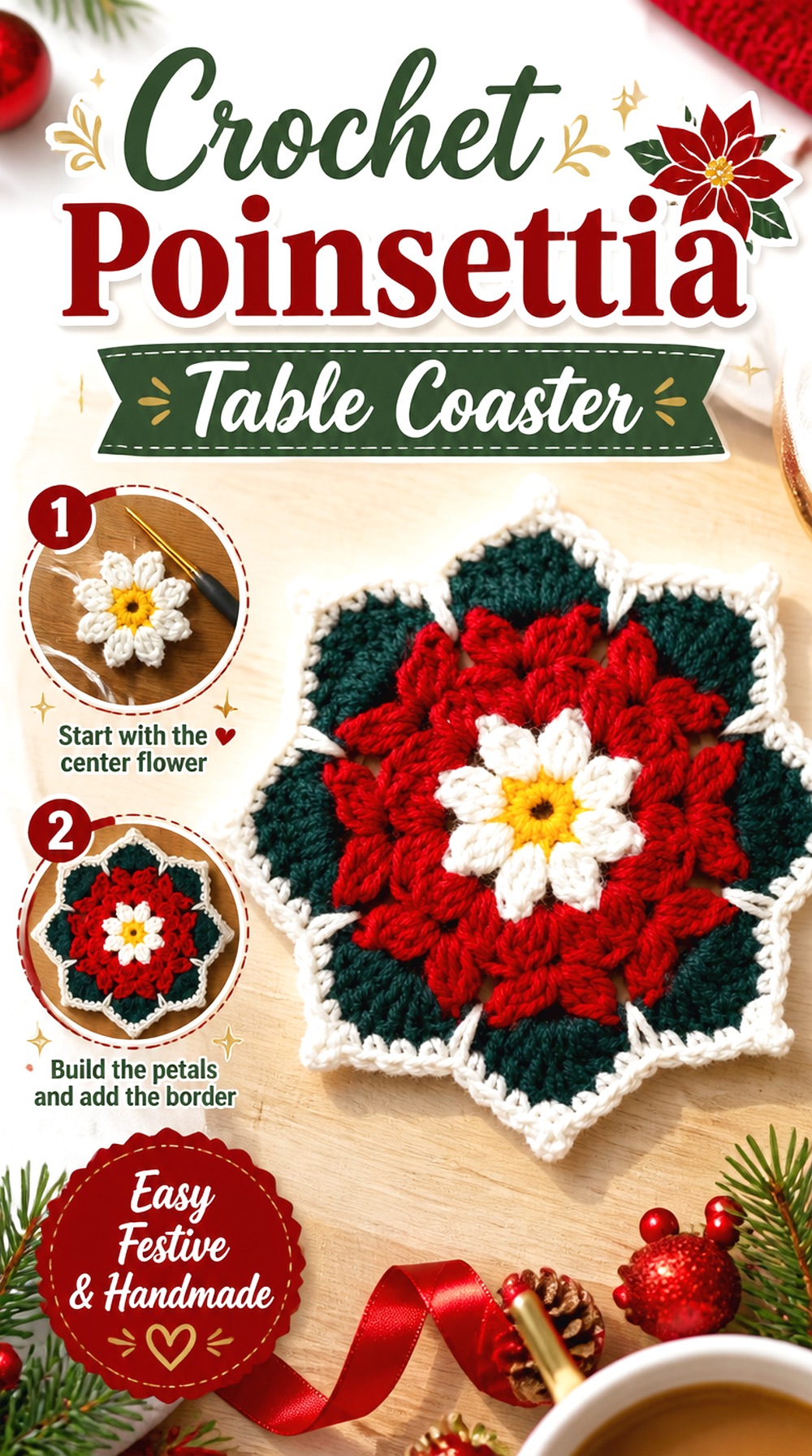
SAVEA flower-shaped crochet poinsettia coaster gives the holiday motif a practical tabletop role. Unlike a decorative appliqué, this version needs to work visually when viewed from above and sit sensibly beneath a cup or glass. That makes flatness and petal arrangement more important than maximum dimension.
A set can provide strong seasonal color without requiring a large table project, and individual coasters are easier to mix with existing linens than a full matching runner. Before making multiples, complete one and place the drinkware you normally use on top. Check whether the base sits securely on the central portion rather than balancing awkwardly over raised edges.
Keep the Center Functional
The prettiest petal shape is not useful if the drinking vessel cannot sit comfortably. Look at how much of the coaster forms a reasonably even central support area and compare it with the base of your mugs or glasses.
If you change yarn weight, repeat that check because the proportions may shift. Avoid assuming that a visually larger flower automatically creates a larger usable surface.
Choose Fiber With the Real Table Use in Mind
A coaster for a cold glass and a coaster regularly used under hot drinks do not face identical conditions. Do not infer heat performance from appearance or from the fact that a yarn is commonly used for crochet.
Check the fiber label and care instructions, and consider moisture, washing, and your intended temperature exposure before choosing materials for functional table use.
Original Tutorial and Creator Credit
Creator: Mumsy Makes Crochet
4. Filet Crochet Poinsettia Table Runner
 SAVE
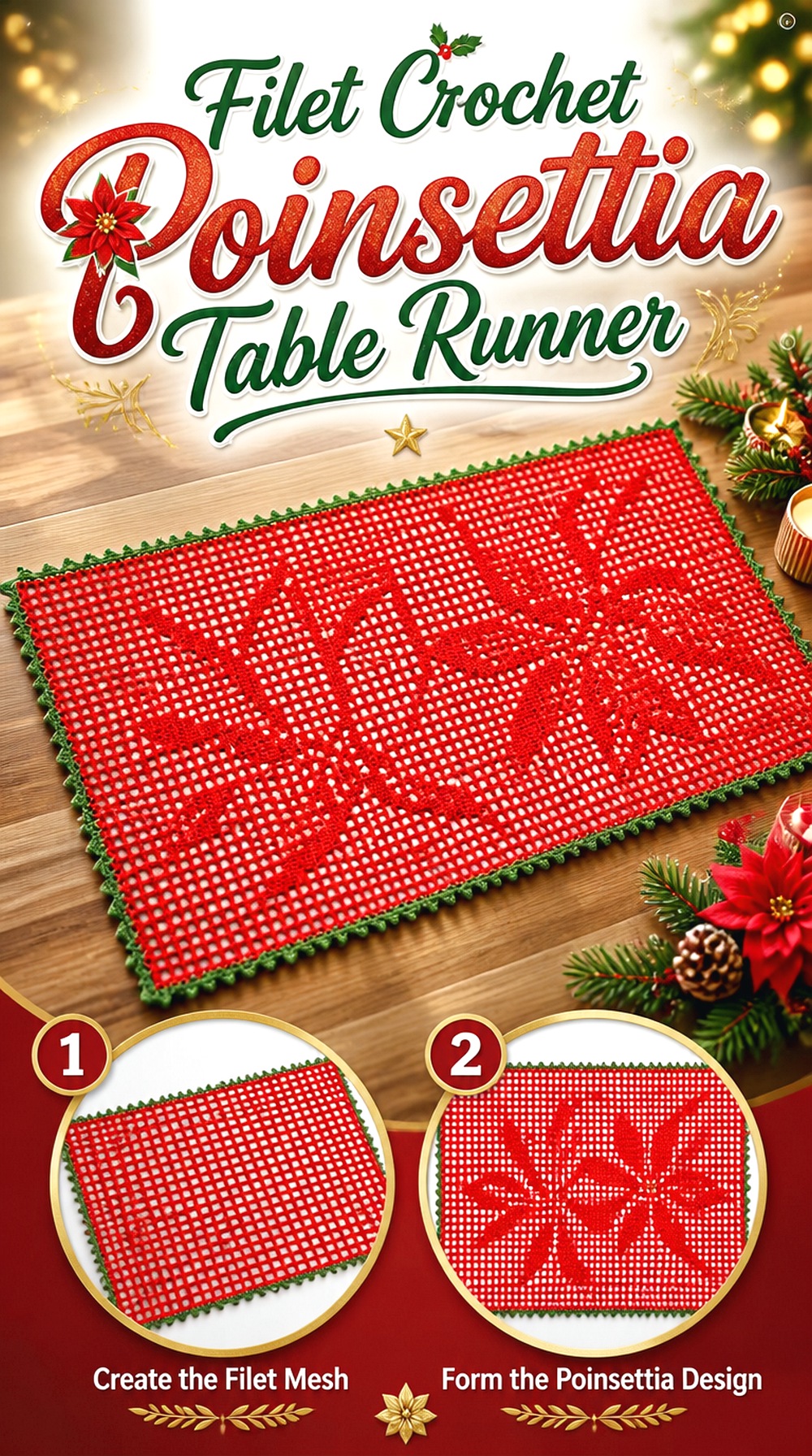
SAVEThis poinsettia table runner takes a completely different approach to the flower. Instead of building raised petals, the design uses filet crochet so the poinsettia appears through contrasting open and filled areas. The result is flatter, more graphic, and easier to place beneath dishes or decorative objects than heavily dimensional floral crochet.
A narrow runner also gives the motif room to repeat along the length of a dining table, console, or sideboard. Because filet work depends on a readable grid, consistency matters: uneven tension can affect the way the image appears. This is a better choice for someone drawn to lace-like holiday decor rather than plush, layered flowers.
Contrast Matters More Than Petal Thickness Here
With filet crochet, the poinsettia is created through the fabric pattern rather than through raised flower layers. That shifts the planning emphasis toward stitch definition, open spaces, and how well the motif can be read against the surface below.
Before choosing a table location, compare the runner against the actual tabletop or cloth you plan to use. A busy background can reduce the visibility of a delicate filet motif.
Measure the Display Area Before Committing to Length
A runner can look balanced on one table and cramped on another. Decide whether you want it contained within the tabletop, extending toward the ends, or used over another tablecloth.
Use the creator’s information for the tutorial version and your own gauge results before altering anything. If you want a different proportion, determine first whether the poinsettia repeat can be changed without interrupting the design.
Blocking Can Affect the Final Presentation
Open crochet often benefits visually from careful finishing because the spaces become easier to read when the fabric lies evenly. Follow appropriate care guidance for the specific fiber rather than applying one blocking method to every yarn or thread.
After finishing, check that the long edges remain straight and that the poinsettia image is not being distorted by uneven tension along one side.
Original Tutorial and Creator Credit
Creator: HandmadebyRaine
5. Crochet Poinsettia Garland
 SAVE
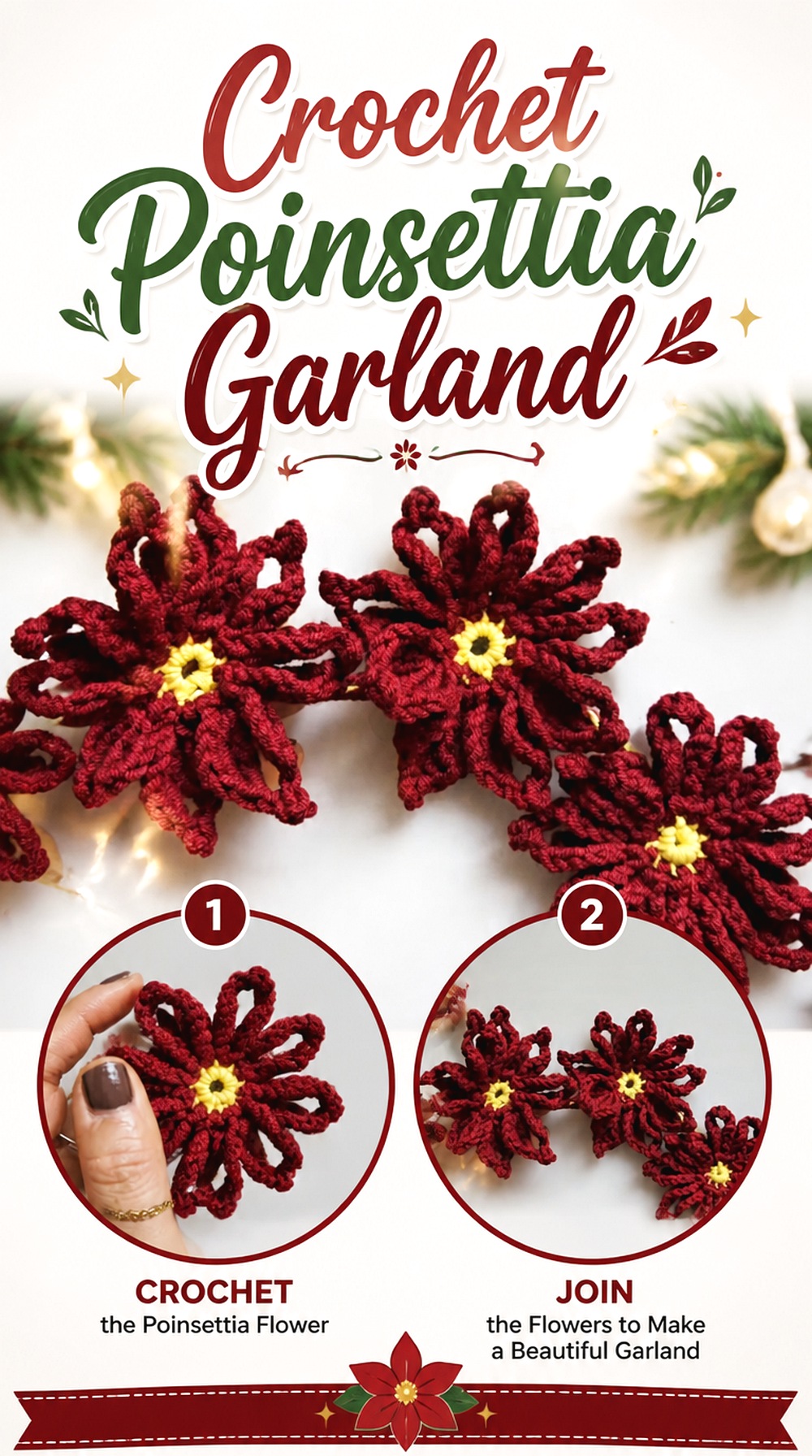
SAVEA crochet poinsettia garland turns repeated flowers into a linear decoration for a mantel, shelf, doorway, or other holiday display. The important difference from scattered appliqués is that the connecting structure becomes part of the design. Flower spacing, orientation, and overall flexibility all affect how the garland hangs.
Rather than automatically making every flower identical, think about the viewing distance. Closely spaced blooms create a fuller visual band, while more space between motifs lets each poinsettia read individually. Make a short sample section before producing the entire length so you can see how the flowers behave when the cord curves or drapes.
Spacing Determines Whether the Garland Feels Full or Light
The same flower can create very different displays depending on how closely the motifs sit together. Tight spacing emphasizes color and volume. Wider intervals highlight each flower and can reduce overall weight.
Test several motifs along a temporary strand before finalizing the arrangement. This is much easier than discovering after assembly that the garland looks too crowded for the mantel or opening you planned to decorate.
Check Flower Direction While the Garland Is Hanging
A motif that faces perfectly upward on a worktable may rotate once suspended. The connection point and weight distribution influence which direction the flower naturally faces.
Hang a short section before making all of your joins permanent. If the flowers twist, correct the attachment strategy early rather than trying to reposition an entire finished garland.
Original Tutorial and Creator Credit
Creator: Jeni Kim Crochet
6. Crochet Poinsettia Bauble Ornament
 SAVE
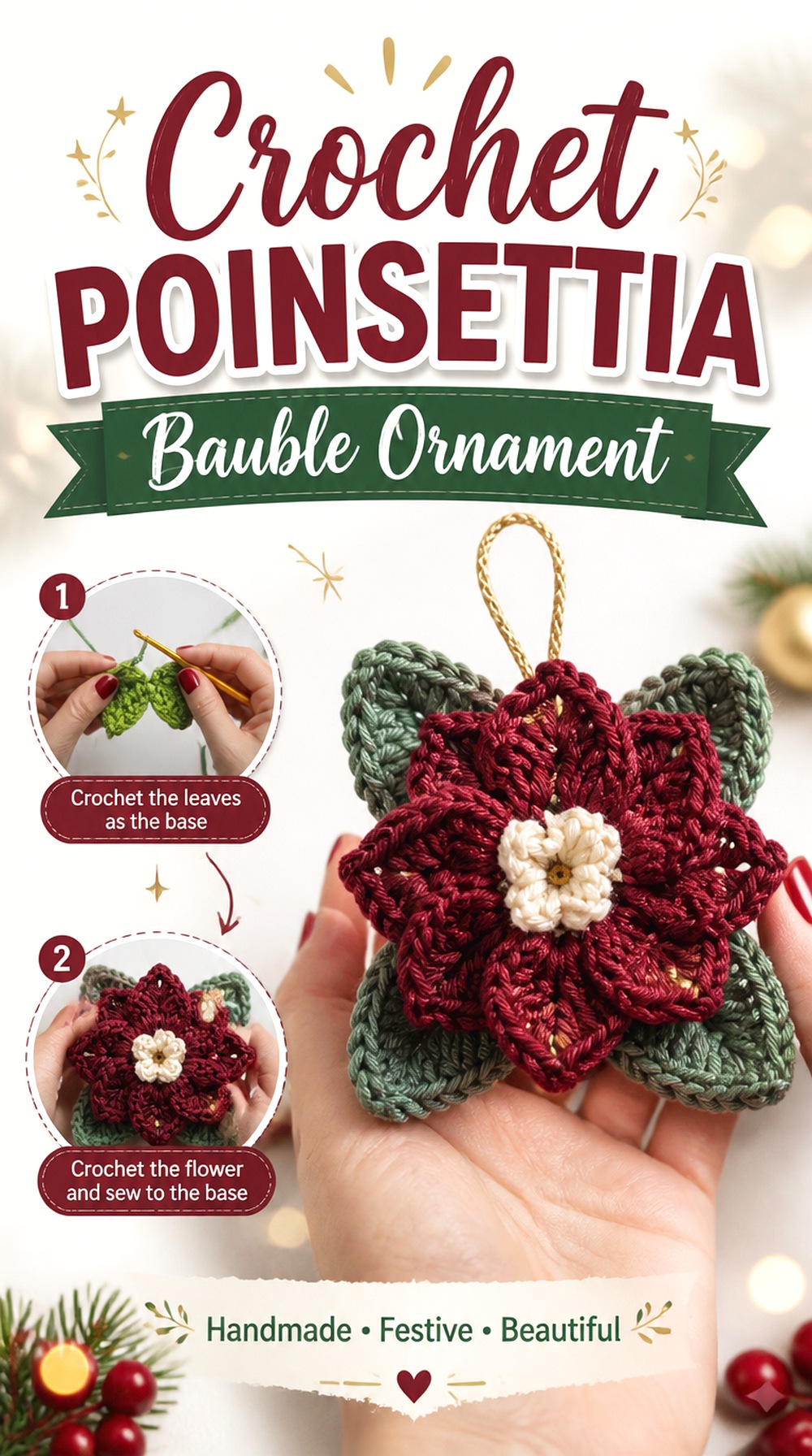
SAVEThis crochet poinsettia bauble creates a rounded tree decoration rather than a flat hanging flower. The poinsettia component wraps the visual interest around a three-dimensional form, so the ornament remains decorative when seen from different directions.
That round structure also changes storage and finishing. You cannot press it flat with ordinary appliqués, and a bulky hanging loop can compete with the flower. It makes sense for a tree where you want handmade ornaments to hold their own among conventional baubles. Before repeating the project for a matching set, check both the ornament diameter and the finished hanging length against your tree branches.
Balance the Flower Against the Round Form
A flower that is too visually dominant can hide the bauble shape, while one that is too small may look like an afterthought. Look at the complete ornament from the side as well as the front.
If you substitute materials, consider how the flower’s scale changes relative to the core. Matching the proportions matters more here than making the poinsettia as large as possible.
Store the Ornament Without Crushing Its Surface
Because the project combines a three-dimensional base with decorative crochet, stacking finished baubles under heavy seasonal items can flatten or distort details.
Plan a storage box with enough space around each ornament. If you make a full set, separate pieces so hooks, ribbons, or petals do not become caught in neighboring crochet.
Original Tutorial and Creator Credit
Creator: SistersInStitch
7. Crochet Poinsettia Flower Bag
 SAVE
SAVEA poinsettia bag moves the flower from seasonal decor into a functional accessory. Here the floral element has to work with a larger object that will bend, hang, and carry weight. That means the bag’s shape and handle construction deserve as much attention as the poinsettia itself.
The large flower gives the design a statement look, so it can work as a holiday accessory without covering the entire bag in Christmas motifs. Before choosing yarn or changing scale, think about whether you want a softer bag that collapses when set down or a more structured silhouette. The flower should complement that choice rather than pulling the fabric out of shape.
Large Flowers Add Weight to the Bag Front
A prominent floral feature can create an uneven pull if it is heavier than the surrounding fabric. Check how the finished bag hangs with the flower attached, particularly if you substitute a thicker yarn.
If the front sags or twists, the issue may come from the relationship between motif weight and bag structure rather than from the flower itself.
Handle Behavior Matters Once the Bag Is Loaded
A beautiful empty bag can behave differently when carrying everyday contents. Crochet straps may stretch depending on yarn, stitch construction, length, and load.
Before relying on the bag for regular use, evaluate the handle and opening under the type of light contents you actually intend to carry. Do not assume a decorative tutorial establishes a specific weight capacity unless the creator states one.
Protect the Dimensional Motif From Snagging
Raised petals look striking on an accessory, but they also create edges that can catch more easily than a flat colorwork design. Consider where you plan to carry the bag and how often it will rub against coats, furniture, or other surfaces.
If you prefer a low-maintenance accessory, compare this construction with the flatter poinsettia granny-square option earlier in the article.
Original Tutorial and Creator Credit
Creator: MIMI Handmade
8. Lace Crochet Poinsettia Doily
 SAVE
SAVEA lace crochet poinsettia doily turns the flower into a larger radial tabletop design. Compared with the compact coaster, this version has more decorative presence and is better suited to a centerpiece setting, side table, or display surface where much of the crochet remains visible.
The radiating petal shapes make symmetry especially noticeable. Small variations in tension can become more obvious as the work expands, so it is worth periodically placing the piece on a flat surface to check its overall shape. If your goal is purely decorative, finer thread can emphasize the lace effect; if you change materials, remember that the finished scale can change substantially.
Keep the Radial Shape Under Observation
Round lace projects can begin looking even and develop rippling or cupping later. Do not wait until the final round to assess the shape.
Lay the work down periodically without stretching it aggressively. If the fabric is behaving differently from the tutorial example, review your tension and instructions before adding many more rounds.
Let the Table Surface Support the Design
A doily is partly defined by the negative space between stitches. The background underneath therefore becomes part of what the viewer sees.
Try the finished piece over the surface where it will actually be displayed. Strong contrast can make the poinsettia geometry easier to appreciate, while a similarly colored or highly patterned surface may hide delicate details.
Original Tutorial and Creator Credit
Creator: Star Crochet
9. Crochet Poinsettia Tree Ornament
 SAVE
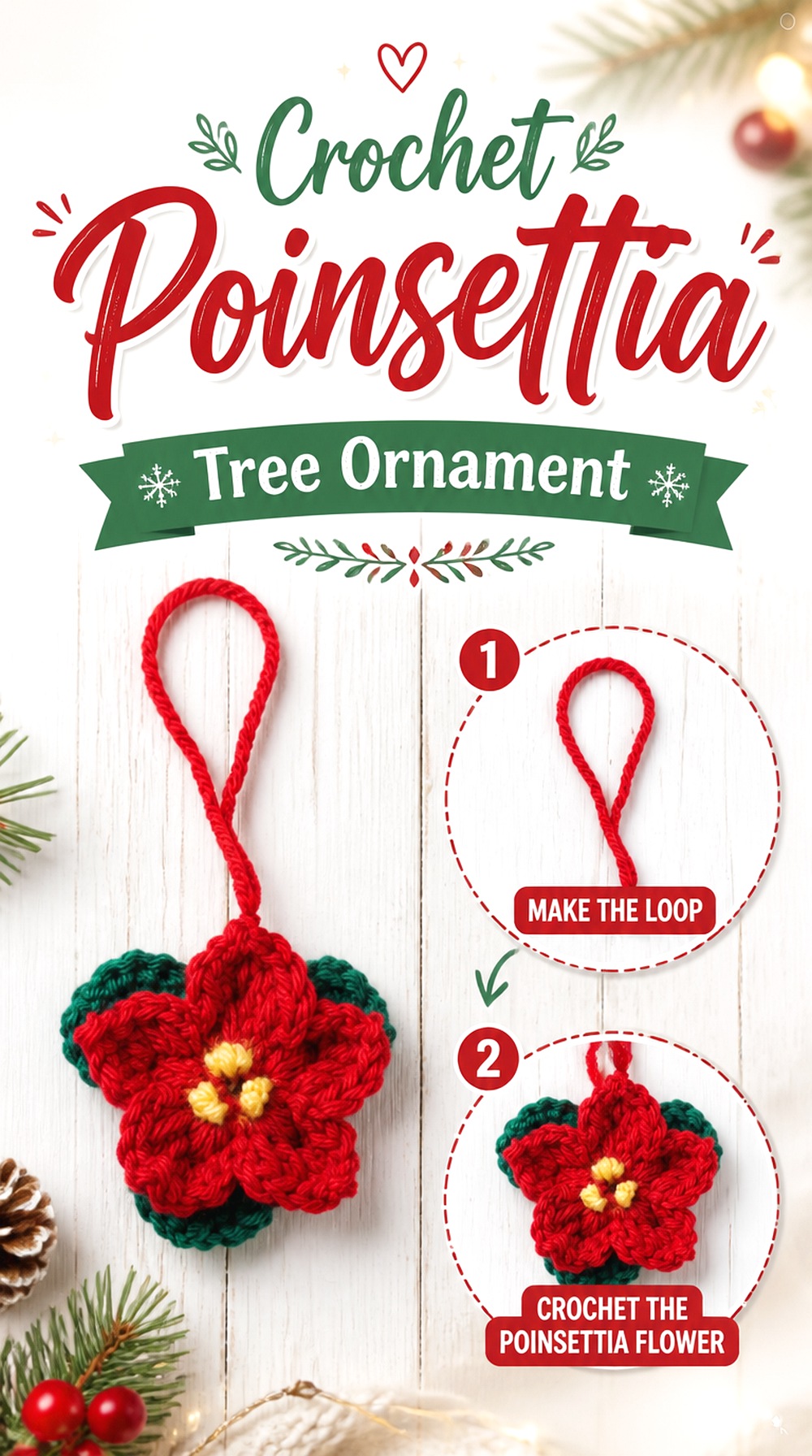
SAVEA dedicated poinsettia ornament is a better choice than simply adding string to any flower. The flower, leaves, center, and hanger need to create a balanced finished object that faces outward once it is placed on a branch.
This project is compact enough to repeat as a coordinated tree set, use on a wreath, or attach to wrapped gifts before the ornament moves to the tree. Because it is handled during decorating and storage, pay attention to loose ends and the security of the hanger. If you change yarn weight, make one complete sample before committing to a set so you can judge whether the new scale suits your tree.
The Hanging Point Changes How the Flower Faces
Where you attach the loop affects the angle of the ornament. A connection that is slightly off center may cause the flower to tilt or rotate instead of presenting its face toward the room.
Test the hanger while the ornament is still easy to adjust. Hang it from an actual branch or hook rather than assessing it only while holding the loop in your hand.
Repeated Ornaments Benefit From Consistent Finishing
Small variations can be charming, but a matched set looks more intentional when the flower scale, hanging loop length, and general petal arrangement remain reasonably consistent.
Finish the first ornament completely and use it as a visual reference for the rest. That is more reliable than comparing partially finished flowers that have not yet been assembled.
Original Tutorial and Creator Credit
Creator: Desert Blossom Crafts
10. Crochet Poinsettia Brooch
 SAVE
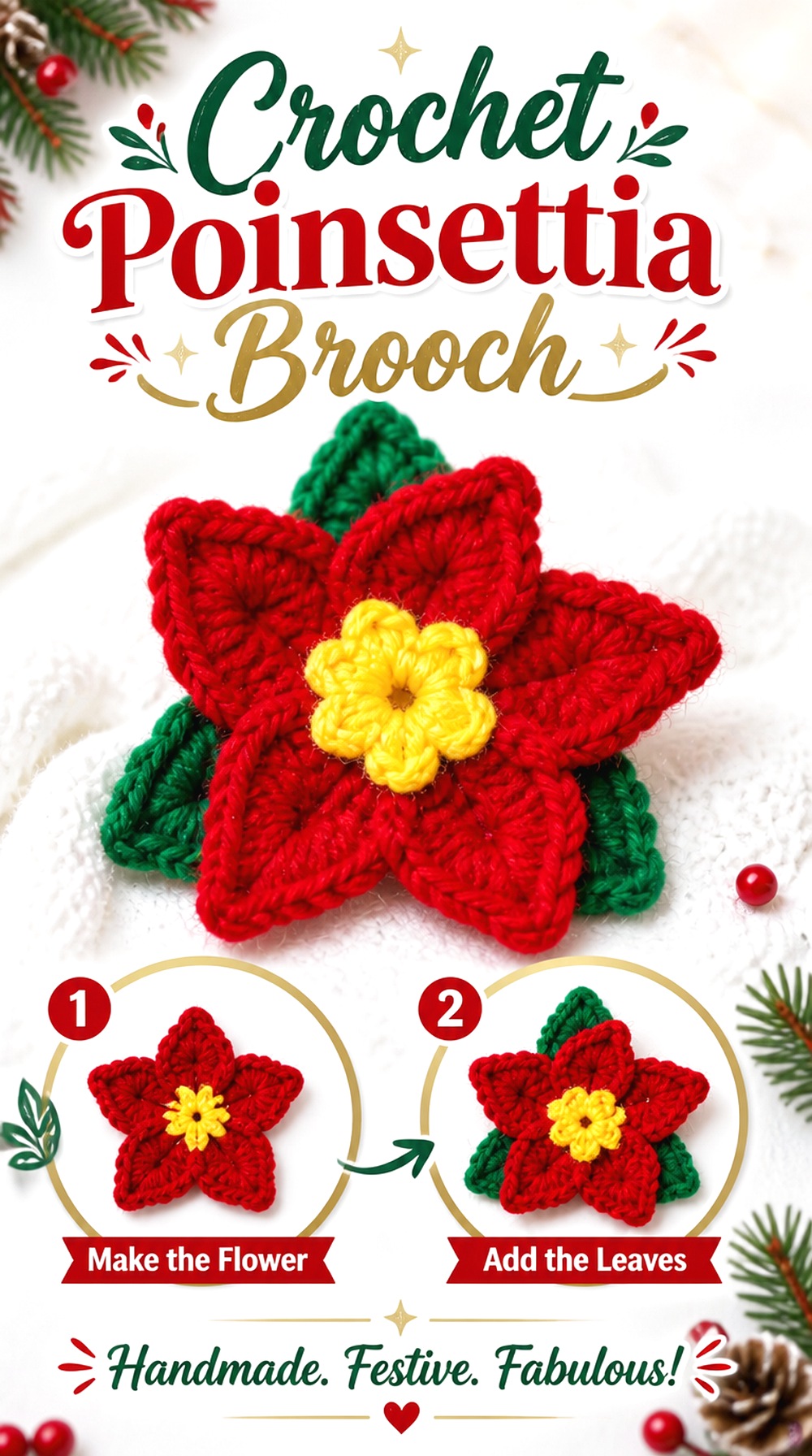
SAVEA crochet poinsettia brooch turns a holiday flower into a removable accessory for a coat, scarf, bag, or seasonal outfit. The removable format is useful because you can add festive detail without permanently sewing a flower to the item underneath.
A brooch needs a flatter, neater back than a centerpiece flower. The attachment should also sit securely enough that the bloom does not droop once worn. Before selecting the final location, compare the weight and diameter of the crochet flower with the fabric it will be pinned to. A heavy bloom may be less suitable for very light or delicate material.
A Neat Back Matters on a Wearable Pin
The front gets most of the visual attention, but the reverse determines how comfortably and securely the flower can be mounted. Bulky knots or uneven layers can prevent the pin base from sitting flat.
Arrange and secure the components before attaching the hardware. If using adhesive or another non-yarn component, follow the product instructions and make sure it is suitable for the materials involved.
Match the Brooch to the Supporting Fabric
A structured coat or tote can tolerate a different accessory weight than a fine knit garment. Test placement before wearing the brooch for an extended period.
Also consider the pin itself: sharp jewelry findings should be handled and stored appropriately, and small detachable components make this a decorative accessory rather than an item intended for unsupervised young children.
Original Tutorial and Creator Credit
Creator: Fiber Flux
11. Crochet Poinsettia Napkin Ring
 SAVE
SAVEA crochet poinsettia napkin ring puts the flower directly into a Christmas table setting without covering the table in a large textile. Each bloom sits on a narrow holder around the napkin, giving you a repeated floral accent that can coordinate with plain dishes and linens.
The project is small, but fit still matters. A ring that is too loose may slide away from the folded napkin, while one that is too tight can compress a thicker fabric awkwardly. Decide how you actually fold or roll your napkins before making a complete set. That way, the finished ring is planned around real table use rather than an abstract circumference.
Test the Holder Around the Actual Napkin
Napkin fabrics vary considerably in thickness, and folding multiplies that bulk. Before repeating the ring construction, put the first finished sample around the napkin style you plan to use.
You are looking for a holder that stays in position without forcing the fabric through. If you frequently change linens, a little flexibility may be more useful than a very precise fit.
Keep the Flower Clear of Food and Flames
A decorative napkin ring belongs close to plates, glasses, and sometimes candles, so placement matters. Keep yarn decorations away from open flames and avoid positioning loose petals where they are likely to fall into food.
For cleaning, follow the yarn’s actual care guidance—especially when napkin rings are reused over multiple holiday meals.
Original Tutorial and Creator Credit
Creator: Natagor Finlayson
12. Crochet Poinsettia Christmas Wreath
 SAVE
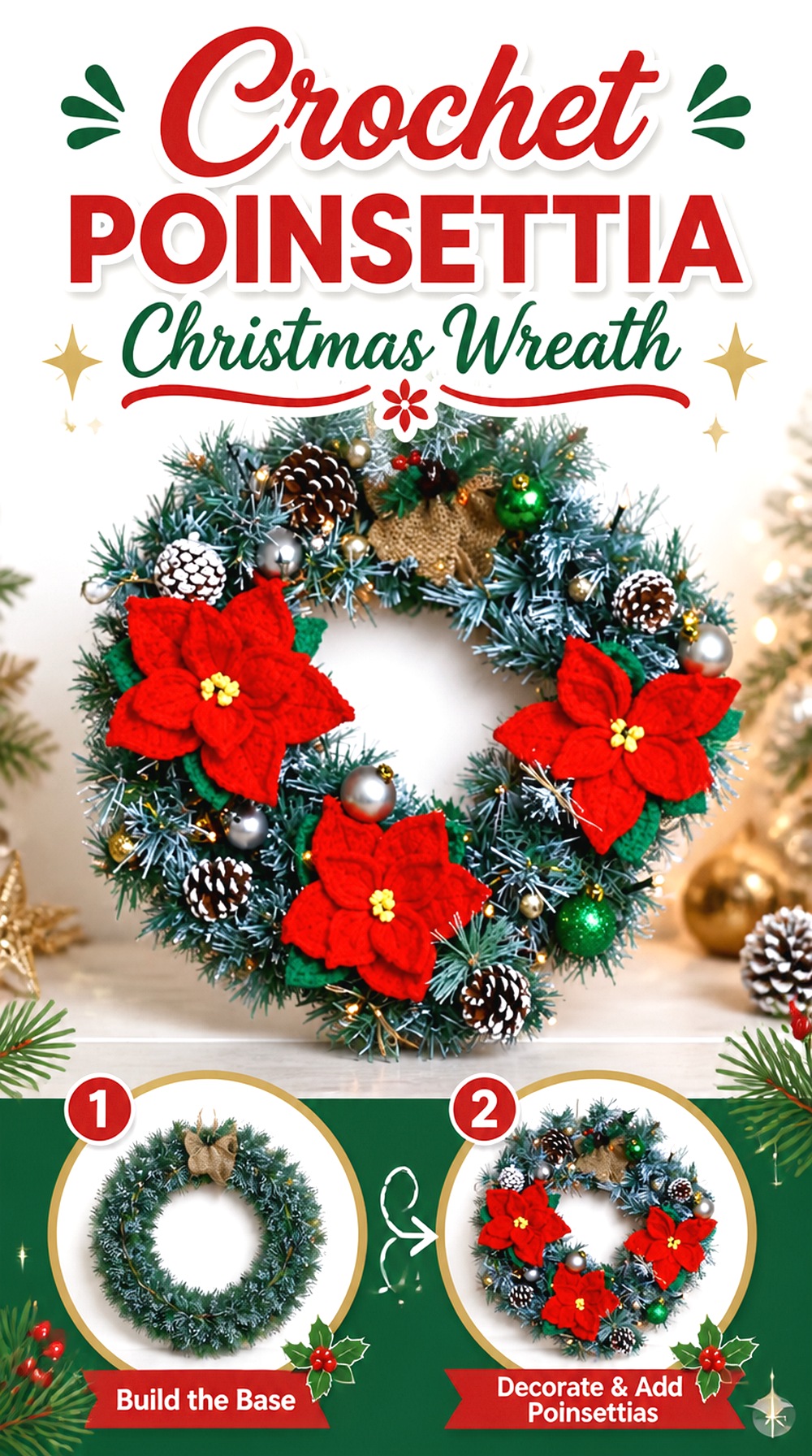
SAVEA crochet poinsettia wreath gives the flower enough scale and visual space to act as a major holiday focal point. Unlike a garland, where repeated motifs share attention along a line, a wreath concentrates the display into one circular composition.
The poinsettias can provide strong color against greenery, ornaments, pinecones, ribbon, or other seasonal elements, but the most successful arrangement depends on balance rather than filling every available gap. Before fixing anything permanently, position the wreath upright. Gravity can change how flowers, bows, and hanging pieces sit compared with their appearance on a table.
Decide Between a Cluster and an Even Floral Ring
A small group of poinsettias creates a strong focal point and leaves more of the wreath base visible. Even spacing creates a more repetitive, formal look.
Try both arrangements temporarily before attaching the flowers. Photographing the wreath from several feet away can help reveal whether one area feels visually heavy or empty.
Secure Flowers for the Display Location
An indoor mantel wreath and an exterior door decoration face different movement and environmental conditions. Do not assume a yarn flower, adhesive, or decorative component is weather resistant unless its materials are specified for that use.
For a reusable indoor wreath, consider attachments that are secure yet allow individual crochet pieces to be removed for storage or replacement.
Let the Wreath Base Provide Structure
The crochet flowers do not need to carry the shape of the entire piece. A supportive wreath form allows the poinsettias to remain decorative rather than being made unnecessarily stiff.
Check that the flowers remain visible once other components are added. Large bows or dense greenery can easily hide crochet petals that looked prominent when the base was empty.
Original Tutorial and Creator Credit
Creator: Brunaticality
13. Crochet Poinsettia Keychain
 SAVE
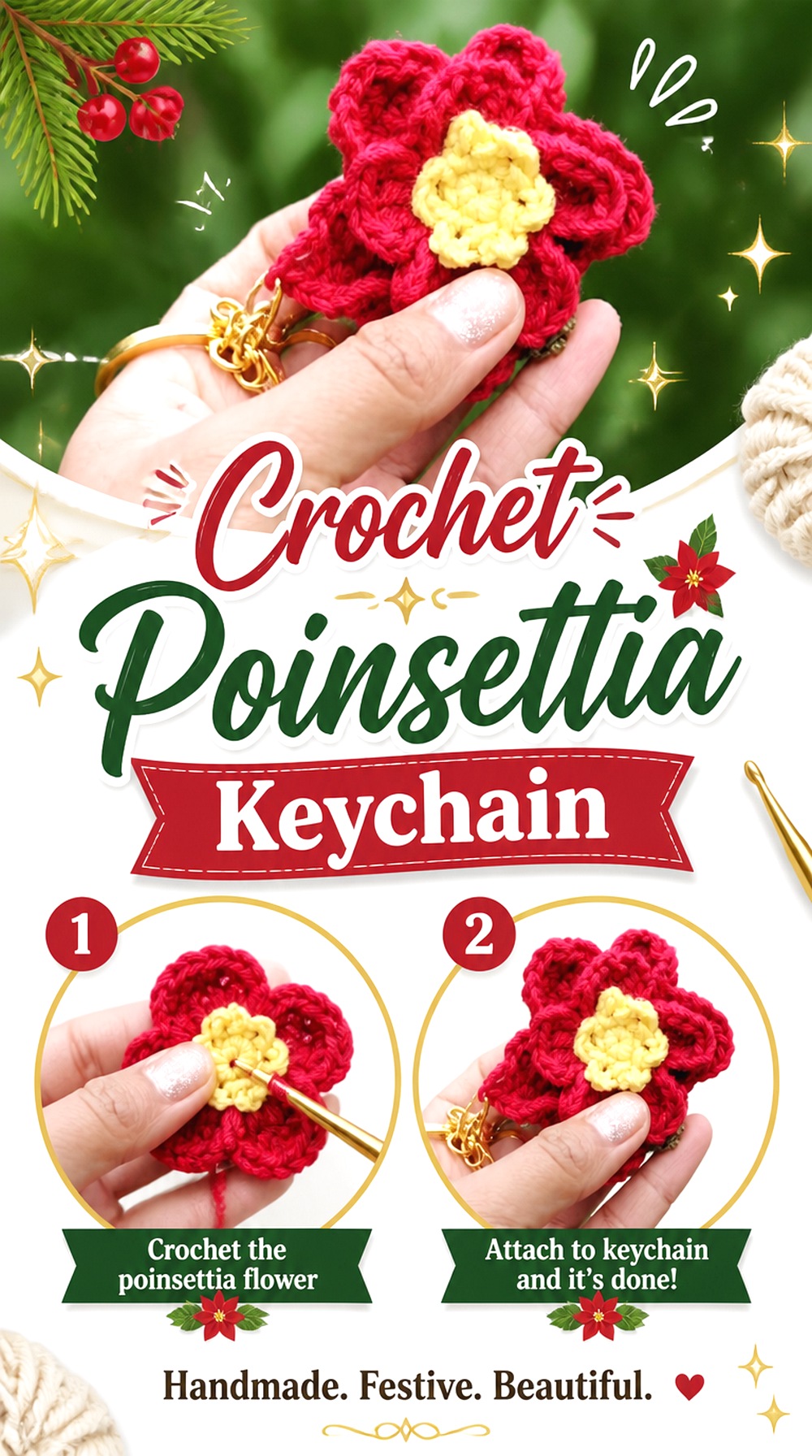
SAVEA crochet poinsettia keychain takes the flower down to a portable scale. That makes it suitable for keys, a zipper pull, a bag charm, or a small seasonal gift, but frequent handling means the attachment point becomes more important than it is on display-only decor.
The finished flower should remain recognizable without becoming so bulky that it interferes with the keyring. Compact projects also magnify finishing quality because there is little space to hide ends or hardware. Make one complete keychain and handle it for a while before producing several; this can reveal whether petals fold excessively or the connection between crochet and metal hardware needs reconsideration.
Reinforce the Point That Takes the Pull
The keyring connection receives repeated movement, so attaching hardware only through a delicate outer petal may put stress in the wrong place.
Follow the tutorial’s construction and examine where the force is transferred into the crochet. If adapting another flower, look for a central or otherwise stable attachment area rather than choosing the most convenient loop.
Small Scale Makes Finishing More Visible
On a large wreath, a slightly uneven tail can disappear behind greenery. On a keychain, the viewer can see the object from every side.
Spend extra time securing and hiding ends neatly. If the design uses any small detachable hardware or embellishments, treat it as an accessory rather than a toy for young children.
Original Tutorial and Creator Credit
Creator: Crochetaure
14. Micro Crochet Poinsettia Earrings
 SAVE
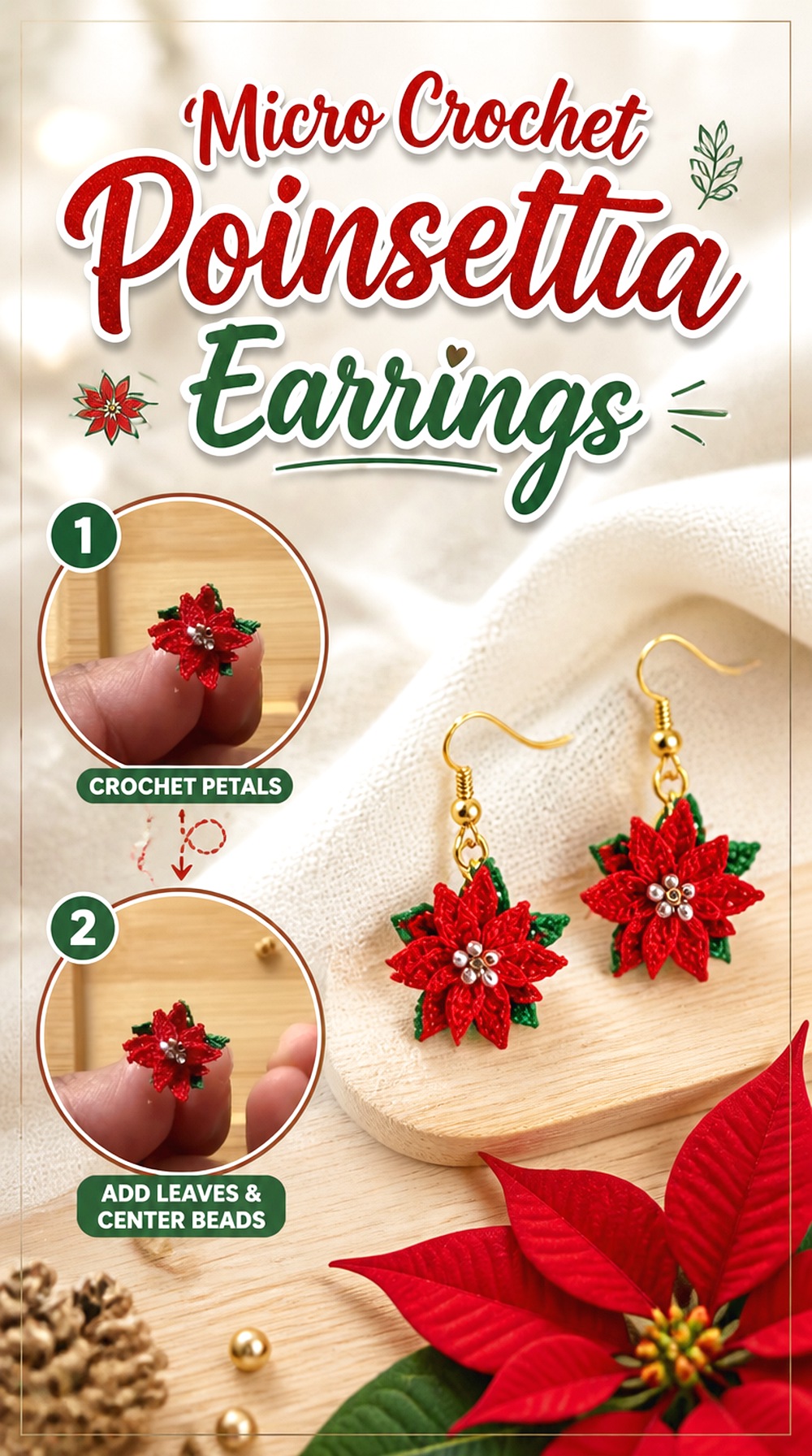
SAVEMicro crochet poinsettia earrings are the smallest-scale idea in this collection. Instead of simply shrinking a regular ornament, the project treats the flower as jewelry, where lightness, symmetry, and neat attachment to the finding are especially important.
Because two earrings are worn together, differences that would be charming in stand-alone flowers may be more obvious here. Complete the first earring and use it as a visual reference for the second, comparing flower diameter, petal arrangement, and how each piece hangs. This project also involves jewelry findings, so the crochet is only one part of the finished object; secure assembly deserves equal attention.
Pair Matching Matters More Than Perfect Flowers
Handmade earrings do not need machine-level identical stitches, but noticeably different scale or petal orientation can make the pair look unbalanced.
Work both pieces with the same yarn, hook, and general tension. Compare them before adding the final findings, when small adjustments may still be easier.
Jewelry Hardware Changes the Safety Considerations
Hooks, studs, glue, and other findings are functional components, not merely decoration. Use materials intended for jewelry and follow the relevant product guidance for assembly.
Because earrings contain small parts and are worn against the body, inspect them periodically for looseness. They are also unsuitable as play items for small children.
Original Tutorial and Creator Credit
Creator: Nurocrochets
15. Crochet Poinsettia Gift Topper and Appliqué
 SAVE
SAVEA multipurpose crochet poinsettia appliqué is useful when you want one flower design that can move among different holiday projects. It can sit on a wrapped gift, decorate a basket, accent a plain stocking, or become a removable ornament depending on how you finish the back.
This option differs from the dedicated bauble or keychain because the flower does not need to commit to one function while you crochet it. That flexibility is valuable for batch making. Produce the flowers first, then decide individually whether each needs a hanging loop, sewing tails, or another attachment. Keeping the backing simple also makes unused flowers easier to store flat.
Removable Gift Toppers Can Have a Second Use
If a flower is permanently glued to disposable wrapping, its life may end with the package. A removable tie or loop can let the recipient reuse it as seasonal decor.
Decide on that second use before attaching it to the gift. A topper destined to become an ornament needs a different finishing plan from one that will later be sewn onto a bag.
Match Attachment Method to the Destination
There is no single ideal backing for every appliqué. Sewing can work well on suitable fabric, while a hanging loop makes more sense for a tree or package ribbon.
Avoid attaching the flower in a way that could damage the underlying item. When decorating finished garments or accessories, consider whether the embellishment needs to be removable for washing.
Original Tutorial and Creator Credit
Creator: Bag-O-Day Crochet
How These Crochet Poinsettia Ideas Compare
| If you want… | Strong options | Main planning issue |
|---|---|---|
| A reusable tree decoration | Bauble, tree ornament, appliqué | Hanger position, storage, finished weight |
| Functional table decor | Coaster, runner, doily, napkin ring | Flatness, fiber care, scale |
| A large seasonal display | Garland, wreath, layered flower | Motif spacing, attachment, petal dimension |
| A project that can expand into something larger | Granny square | Blocked dimensions and motif compatibility |
| A wearable or portable poinsettia | Bag, brooch, keychain, earrings | Weight, snagging, secure hardware |
| A flexible small gift | Ornament, keychain, appliqué, brooch | Finishing method and intended second use |
Conclusion
The right crochet poinsettia project depends less on which flower looks prettiest and more on where the finished piece needs to work. Choose a granny square when modular construction matters, a runner or doily for flatter table decor, and a wreath or layered flower when dimension is an advantage. Small accessories such as the keychain, brooch, and earrings put more pressure on tidy finishing and secure attachment, while the bag adds structure and wear considerations.
For a coordinated holiday collection, you can also combine different scales instead of repeating one design everywhere. Once you choose your format, use the original tutorials above for the creators’ exact construction details and finishing sequence.
Frequently Asked Questions
Can I use one crochet poinsettia flower for all of these projects?
Not necessarily. A dimensional flower suitable for a wreath may be too bulky for a coaster, earring, or flat bag panel. Start with the finished function and compare the tutorial’s flower scale, thickness, and construction with that use. If you adapt one motif into another project, make a sample first rather than assuming the proportions will transfer cleanly.
What yarn is best for crochet poinsettia decorations?
There is no universal best yarn. Smooth yarn can make pointed petals and stitch definition easier to see, while finer yarn can create a more delicate ornament or jewelry piece. Thicker yarn increases scale and can also increase weight. For functional projects such as coasters or table linens, check the actual fiber content, care instructions, and intended exposure instead of selecting yarn only by color.
How can I stop crochet poinsettia petals from looking uneven?
First compare the petals before final assembly. Differences may come from changing tension, inconsistent shaping, or one layer being attached at a different angle. If the design is made from separate components, arrange them loosely before sewing. For granny squares or lace projects, also check the entire motif on a flat surface because distortion elsewhere in the fabric can make the flower appear uneven.
Should crochet poinsettias be blocked before assembly?
It depends on the project and fiber. Granny squares and lace pieces often benefit from checking their finished dimensions before joining or display, while heavily dimensional flowers may need their natural raised shape preserved. Follow appropriate guidance for the yarn you are using. When several motifs must match, finish and measure a sample before producing the full set.
How do I adapt a poinsettia granny square into a blanket or bag?
Start with the blocked dimensions of the actual square you made. Plan the motif grid from that measurement and compare any filler squares before joining. Also consider surface texture: a raised poinsettia may work beautifully on a decorative blanket section or bag front but may not be desirable across every square. The original square tutorial should remain your source for its exact construction.
Which crochet poinsettia ideas are easiest to store after Christmas?
Flatter pieces such as granny squares, table runners, doilies, and appliqués generally require less storage depth than baubles, wreaths, and highly dimensional flowers. Garlands need protection from tangling, while jewelry and keychains benefit from small individual containers. Whatever you choose, avoid crushing raised petals beneath heavier decorations if you want the shape to remain defined from one season to the next.