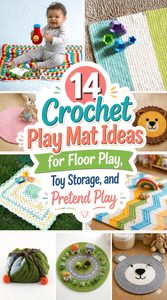
A crochet play mat can be much more than a flat rectangle on the floor. Depending on the design, it might provide a soft place for supervised floor play, transform into toy storage, become a pretend farm or island, double as a blanket, or function as a playful nursery rug. That range makes construction and intended use more important than color alone.
The 14 ideas below include round and rectangular mats, animal silhouettes, textured rugs, convertible designs, graphic blankets, and interactive play sets. Some put cushioning first; others make the mat part of the game itself. Along the way, you’ll find practical guidance on floor size, fabric density, cords, separate toy pieces, bulky yarn, edge stability, and other details worth considering before choosing a tutorial.
Quick List
- Crochet Drawstring Toy-Storage Play Mat
- Crochet Concentric Rainbow Floor Play Mat
- Crochet Scallop-Edged Baby Play Mat
- Crochet Double-Layer Leaf Play Mat
- Crochet Fold-Up Ice Dragon Play Mat
- Crochet Faux-Fur Bear Play Rug
- Crochet Round Farmyard Activity Mat
- Crochet Island-and-Ocean Play Set
- Crochet Basketweave Cushion Play Mat
- Crochet Striped Tummy-Time Play Mat
- Crochet Double-Strand Blanket Play Mat
- Crochet Oval Racetrack Play Rug
- Crochet Dump-Truck C2C Play Mat
- Crochet Picnic Activity Play Mat
Choose Yarn for Cushion, Structure, and Real Floor Use
Play mats ask more from yarn than many decorative crochet projects. A thicker yarn can build a substantial surface quickly, but added bulk also increases finished weight and may make a large mat harder to wash, move, or store. A firm stitch pattern can create structure, while a looser or taller stitch pattern may feel more flexible. Neither is automatically better; the intended use should lead the choice.
Texture deserves attention too. Plush and faux-fur yarns can make inviting floor pieces, but stitch definition may be harder to see. Smooth yarn makes shaping, colorwork, and repairs easier to inspect. If substituting yarn, compare the new fabric with the tutorial sample before committing to the full mat. Check whether it lies flat, feels appropriate against the floor, and still produces the intended dimensions. Care should follow the yarn label and any creator-specific guidance rather than assumptions based only on fiber type.
Plan Size, Shape, and Storage Before You Crochet
A play mat needs to fit the place where it will actually be opened. Measure the available floor area rather than assuming a larger mat is automatically more useful. Round mats work well as defined activity zones, rectangles can sit neatly beside furniture, and irregular animal or leaf shapes make stronger decorative statements but may use floor space differently.
Storage is another useful dividing line. A flat blanket-style mat can usually be folded, while thick rugs may be better rolled. Convertible drawstring designs can contain toys as well as the mat itself, but the cords change how the finished item should be used around young children. Larger scene mats also need room for toys to move beyond their edges. Before resizing any tutorial, consider how the adjustment could affect motif proportions, folding behavior, edge shaping, or the placement of interactive components.
Finish Children’s Play Mats With Extra Attention
Anything intended for children deserves a careful final inspection. Weave in and secure ends thoroughly, check seams and attached motifs, and look for loops or decorative parts that could catch during active play. Separate amigurumi figures, buttons, safety eyes, toggles, cords, bells, and other small or hard components require particular judgment based on the intended user.
Drawstrings deserve special caution. One of the original tutorials below specifically warns that cords can create a hazard and that babies should not be left unattended with the mat. For rug-style projects on smooth flooring, also consider whether a suitable nonslip layer is needed underneath; the Life + Yarn rug tutorial likewise notes that rugs can slide. Crochet floor mats should be treated as supervised play surfaces according to their intended use, not substituted for a designated infant sleep surface.
1. Crochet Drawstring Toy Storage Play Mat
 SAVE
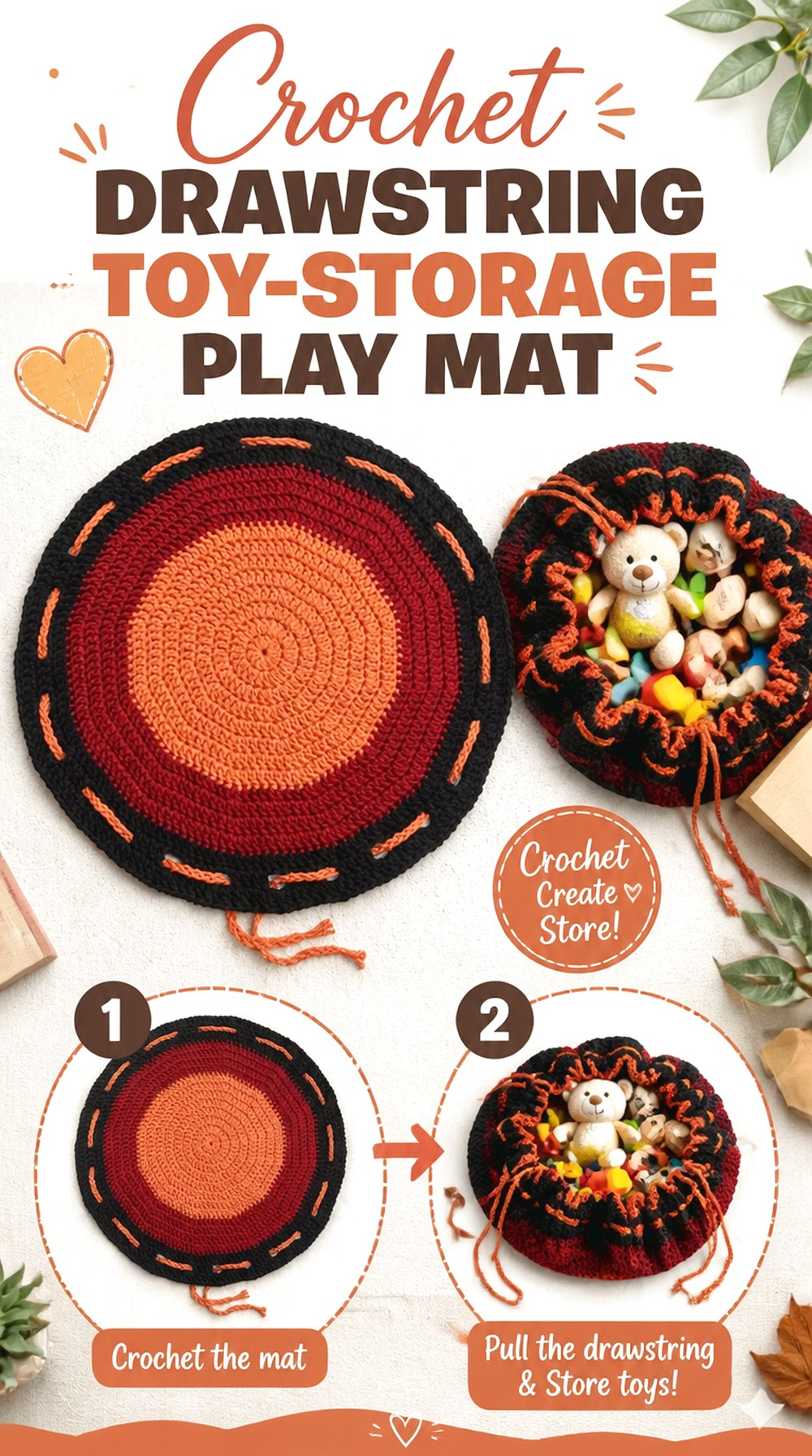
SAVEThis round crochet mat combines a cushioned floor surface with a cleanup function. Lisa Brown’s I Crochet So Hard tutorial presents a plush circular play mat that can be finished either flat or with a drawstring that gathers the perimeter into a toy-carrying bag. The design is worked in super-bulky plush yarn, so its visual character comes from scale and softness rather than complicated motifs.
It is especially relevant for a living room or play space where toys need to be collected regularly. The storage version is the standout feature, but makers who do not want cords around the intended user can follow the source’s flat-mat option instead.
Decide Whether Storage Is Worth the Cord
The drawstring changes the project from a simple floor circle into a convertible storage piece. That is useful when toys need to move between rooms, but it also introduces a long flexible component. If the mat is intended for a baby or young child, consider whether the flat version better suits the way it will actually be used. The creator explicitly warns against leaving a baby unattended with the corded mat.
Watch the Circle Before It Cups
Large crochet circles can begin to ripple or cup when tension, yarn thickness, hook choice, and increase spacing no longer work together. The source itself includes troubleshooting for noticeable curling. Treat flatness as an ongoing checkpoint rather than something to fix only at the end. Lay the work down periodically without stretching it and correct significant distortion before adding many more rounds.
Plan for Floor Use, Not Sleep
Plushness can make a mat look pillow-like, but that does not change its intended role. Use it as a supervised floor-play or toy-storage surface and keep infant sleep separate from play-mat use. If you substitute a denser plush yarn, also check whether the finished fabric becomes unexpectedly heavy or warm compared with the tutorial sample.
Original Tutorial and Creator Credit
Creator/Site: Lisa Brown / I Crochet So Hard
2. Crochet Concentric Rainbow Floor Play Mat
 SAVE
SAVEFor a mat that relies on bold geometry rather than appliqués or separate toys, this large rainbow circle is a strong option. Cecilia of Oh La Lana! teaches a round play mat built outward in broad concentric color sections, creating a clear visual target in the center and strong bands around the edge. The tutorial uses bulky yarn and explains how the circle expands as it grows.
Because nothing has to be attached afterward to create the main design, the finished surface stays visually clean. It can suit a classroom corner, reading area, playroom, or nursery where the mat itself needs to define a distinct zone without introducing loose components.
Use Color Bands to Control Visual Energy
The original uses a rainbow progression, but the construction also lends itself to quieter palettes. Fewer colors can emphasize the shape, while multiple contrasting bands make the mat more graphic. Before changing the palette, decide whether you want the floor piece to blend with surrounding decor or act as a visual play-zone marker. Keep enough contrast between neighboring bands if maintaining the concentric effect matters.
Keep a Large Circle Flat
Circular mats become less forgiving as their diameter increases because small tension differences accumulate over many rounds. The source specifically adjusts the hook for its finishing round to avoid a tight border pulling the edge out of plane. If substituting yarn, repeatedly check the outer edge for cupping or ruffling rather than assuming the original hook relationship will transfer unchanged.
Original Tutorial and Creator Credit
Creator/Site: Cecilia / Oh La Lana!
3. Crochet Scallop Edged Baby Play Mat
 SAVE
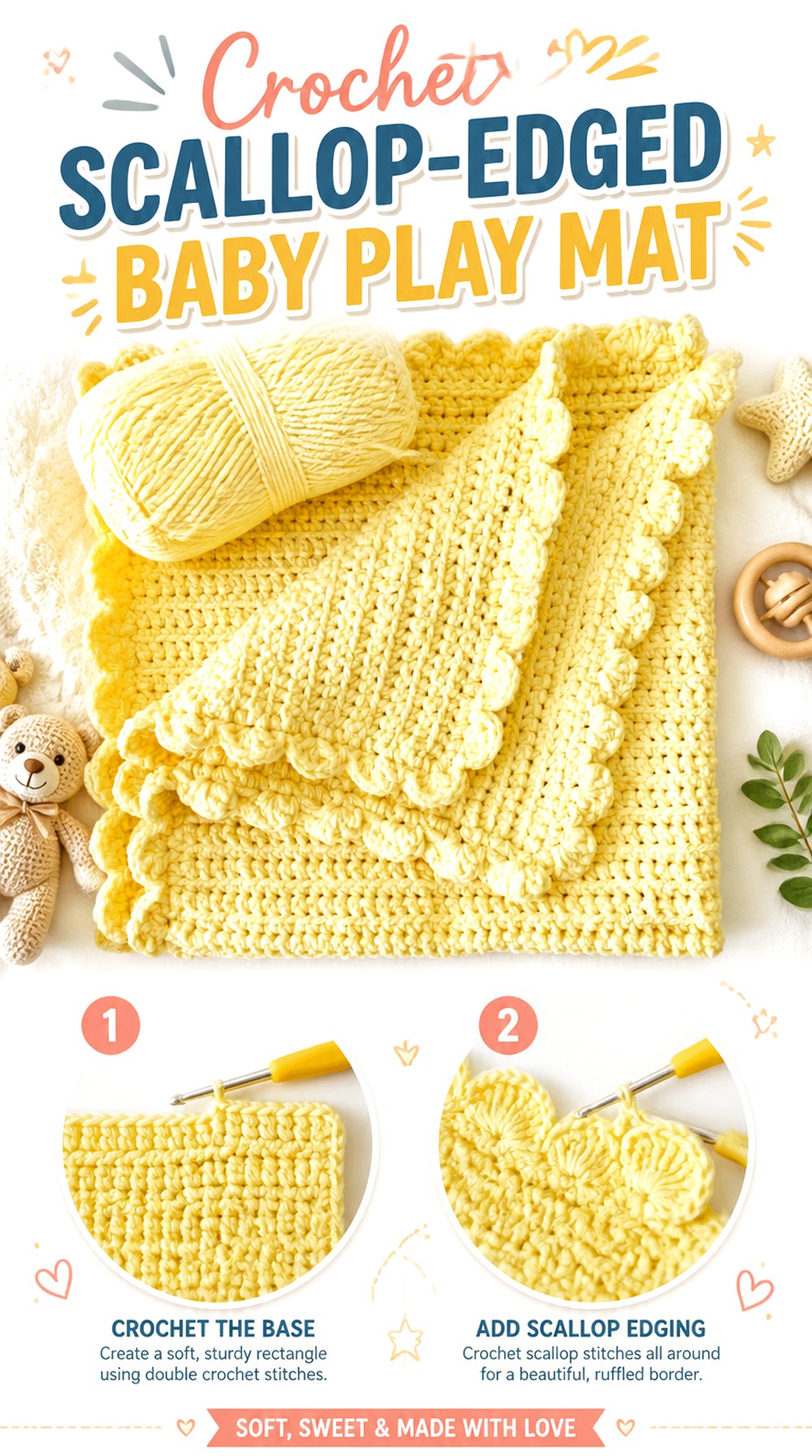
SAVEThis design moves away from round rugs and uses a square, plush surface finished with a noticeably decorative scalloped edge. Daisy Farm Crafts’ tutorial by Hannah uses front-loop single crochet for the main body and a thick blanket yarn, with the scallop treatment providing most of the visual detail.
The relatively simple center makes this a useful direction when you want a floor mat that reads more like a substantial baby blanket than a themed toy. Its square shape can also be easier to position beside a sofa, play gym, or nursery furniture. The key design decision is whether the decorative border remains practical for the floor space you have in mind.
Let the Scallops Stay Decorative
Scallops create a softer outline than a plain straight border, but they are not the part of the mat that should provide structure. When adapting the dimensions, keep an eye on how the edging distributes around corners and sides. A crowded or stretched border can draw the eye away from the intentionally simple center and may stop the mat from lying as cleanly as the tutorial sample.
Check Bulk at the Border
A thick yarn becomes even more dimensional where several stitches gather into decorative edge shapes. Before committing to a heavier substitute, make a small sample that includes the proposed edging. What feels pleasantly plush in the body can become bulky at the perimeter. The source’s original combination of simple center fabric and pronounced scallops is a useful balance to preserve.
Original Tutorial and Creator Credit
Creator/Site: Daisy Farm Crafts
4. Crochet Double Layer Leaf Play Mat
 SAVE
SAVEYarnspirations’ Bernat Leafy Time design changes both the outline and the construction. Instead of a standard circle or rectangle, the finished mat has a broad leaf-like silhouette. The official description explains that the two sides use the same stitch family with different stripe treatments, while surface slip stitches through the center add vein-like detail.
That makes this option particularly interesting for a botanical, woodland, or nature-inspired space. The mat gets its identity from shape, layered construction, and surface detailing rather than attached toys. It also illustrates an important design principle: when the perimeter itself carries the theme, careless resizing can change much more than overall floor coverage.
Two Layers Change the Feel
A layered mat can feel more substantial than a single sheet of crochet, but it also means extra yarn, extra weight, and more finishing. If changing the yarn, make a sample that represents both layers rather than judging only one thickness. A substitution that seems flexible as a single piece may become quite firm once the finished construction is assembled.
Preserve the Leaf Silhouette
The recognizable shape depends on its changing width and pointed ends. Simply adding equal amounts everywhere may make the project larger without preserving those proportions. If you need a different finished size, first check whether the original pattern gives adjustment guidance. Otherwise, treat major resizing as a redesign rather than a casual extension of the final rows.
Surface Details Need Secure Finishing
The central surface crochet contributes to the leaf effect, so it should sit evenly without pulling the two layers into puckers. After finishing, inspect the center line from both sides and make sure all ends are secure. For a floor-use project, raised decorative lines should look intentional without creating loose loops that can snag during play.
Original Tutorial and Creator Credit
Creator/Site: Yarnspirations
5. Crochet Fold Up Ice Dragon Play Mat
 SAVE
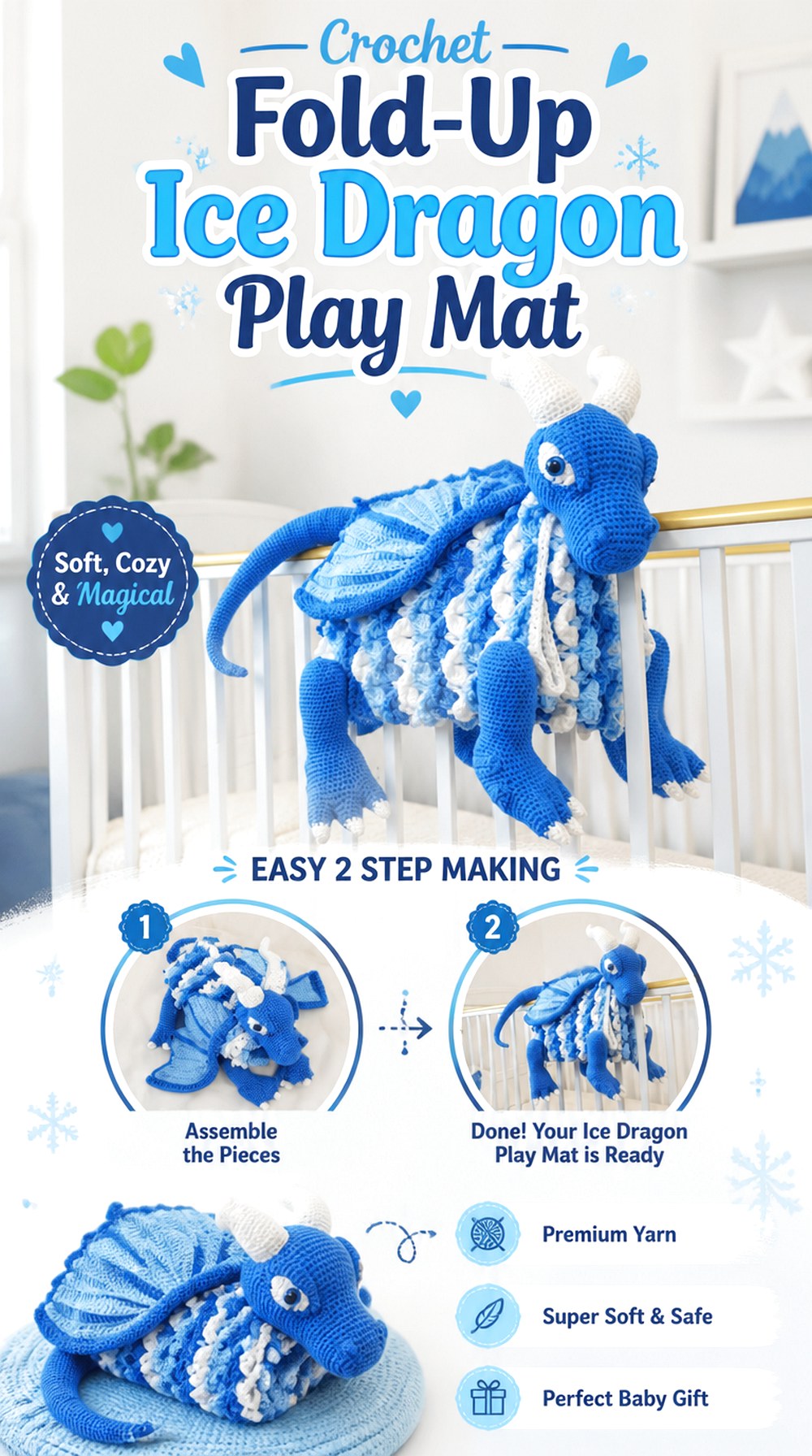
SAVEThis fantasy-themed option is built around transformation. Ariana Wimsett’s Crafting Happiness design functions as a blanket or play mat when opened and folds into a three-dimensional dragon form when stored or displayed. The blanket portion uses pointy crocodile-stitch texture, while the attached dragon components allow the flat piece to become a decorative character.
That makes it substantially different from a mat that simply rolls or folds away. The storage state is part of the design itself. It can appeal to a maker who wants a floor piece with strong visual storytelling, but the dimensional attachments and folding proportions mean substitutions deserve more planning than they would on a basic rectangle.
Folding Function Depends on Proportion
With a convertible design, enlarging one section without considering the others can affect how the finished piece folds. The designer notes that changing yarn or blanket dimensions can alter the relationship between the blanket and the dragon components. If you want a larger floor surface, check the original designer’s adjustment notes rather than assuming every component should simply be scaled equally.
Texture Adds Drama and Yarn Weight
Crocodile-style texture creates the scale-like visual effect, but heavily textured crochet generally uses more yarn and creates a thicker fabric than a flat stitch pattern. That can be an advantage for a dramatic fantasy mat, yet it may also affect foldability and storage bulk. Make sure any replacement yarn still lets the blanket fold into its intended shape without becoming excessively stiff.
Reconsider Small Facial Components
The source lists safety eyes among the supplies for its dragon. For a project intended for a very young child, assess whether hard or detachable components suit the recipient and intended use. Embroidered facial details are one possible adaptation when appropriate, but any change should be planned so it does not interfere with the head construction.
Original Tutorial and Creator Credit
Creator/Site: Ariana Wimsett / Crafting Happiness
6. Crochet Faux Fur Bear Play Rug
 SAVE
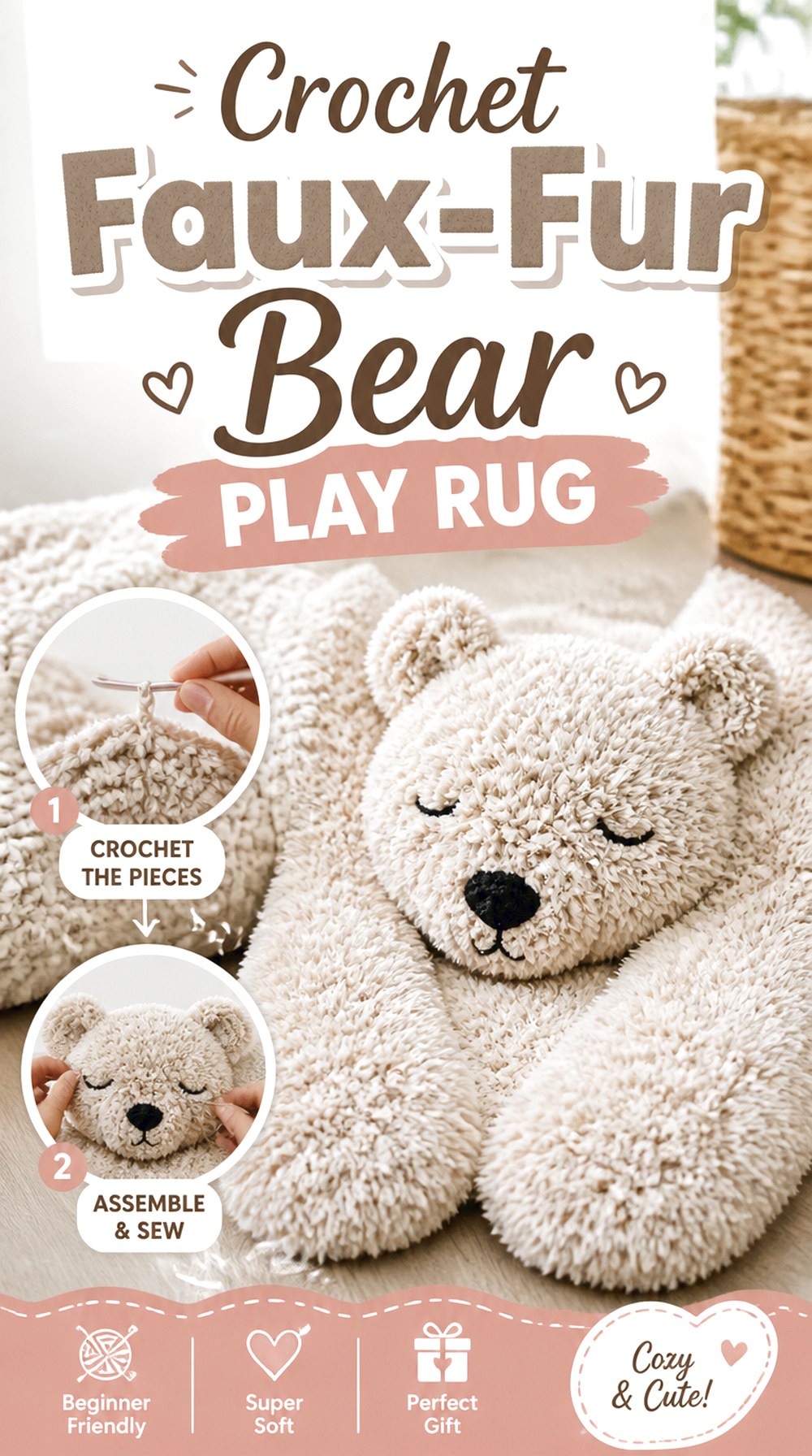
SAVEA bear-shaped rug shifts the focus from geometric floor covering to recognizable silhouette. Jess Coppom’s Make & Do Crew pattern creates a faux-fur crochet bear that can serve as a child’s play mat, nursery rug, or blanket. The designer uses fuzzy yarn for the main body and builds the bear form with a shaped body, limbs, and a dimensional head.
This is a strong choice when the mat should contribute to room decor even when no toys are on it. The furry surface gives the bear a convincing animal-rug appearance, but it also changes how you read stitches and inspect the finished fabric compared with smooth yarn.
Fuzzy Yarn Hides Stitches
The designer specifically discusses finding stitch locations by feel when working with faux-fur yarn. If you are new to high-pile yarn, practice on a sample before starting a large shaped piece. Stitch markers can also help identify important increase, decrease, and joining points that may be difficult to see once the fibers obscure the underlying loops.
A Sculpted Head Changes Floor Use
Unlike a completely flat rug, a dimensional head creates a raised area. That is part of the visual appeal, but it means the mat will not behave like an evenly padded rectangle. Think about where the head will sit in the room and how the intended user will interact with the mat. Placement may matter more than exact symmetry.
Treat It Like a Rug on Hard Flooring
A fuzzy top does not automatically mean the underside grips the floor. On tile, laminate, wood, or another smooth surface, evaluate whether a suitable rug pad or other floor-safe nonslip solution is appropriate. Also check that paws and narrower projections lie flat rather than curling into edges that are easier to catch with a foot.
Original Tutorial and Creator Credit
Creator/Site: Jess Coppom / Make & Do Crew
7. Crochet Round Farmyard Activity Mat
 SAVE
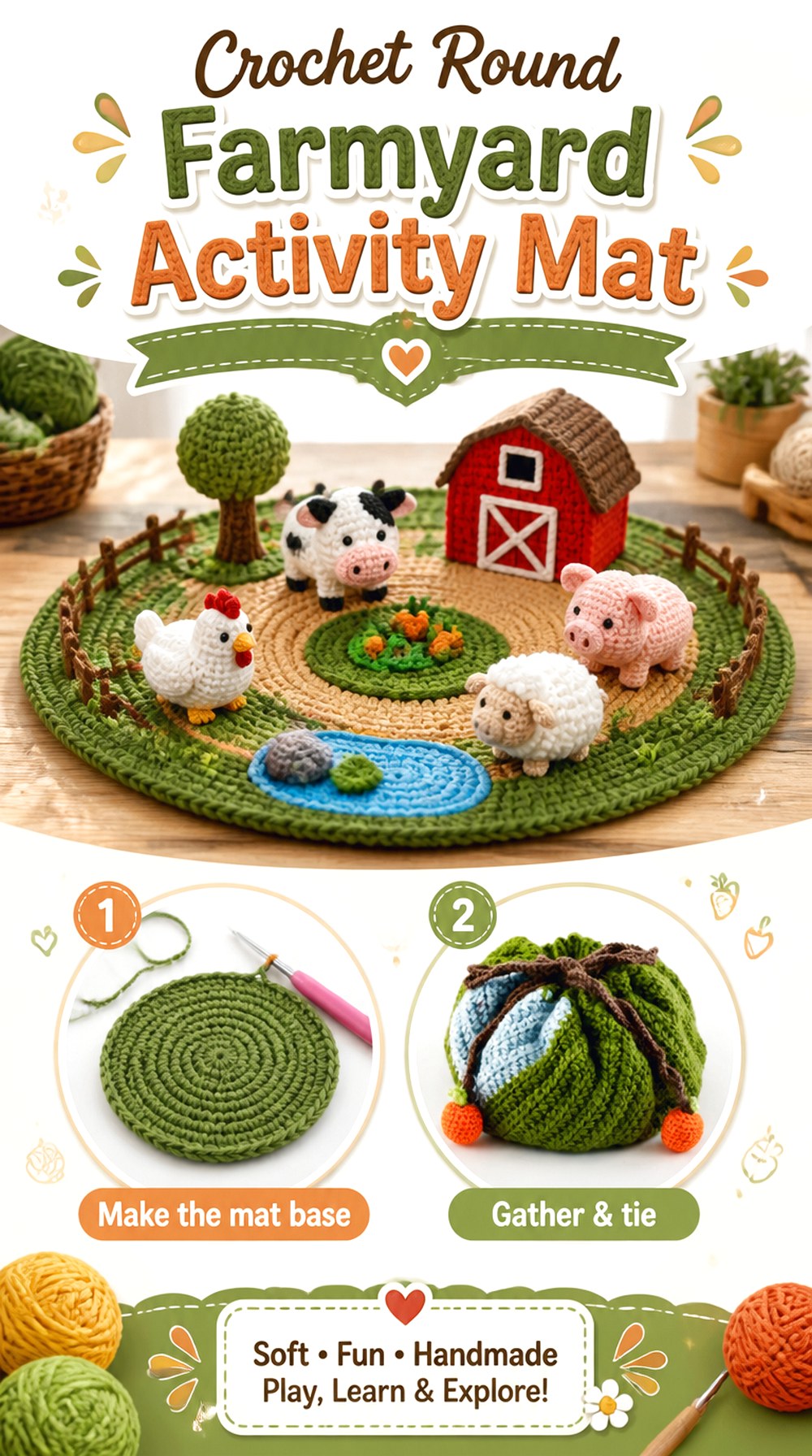
SAVEFor imaginative play rather than simple cushioning, Lion Brand Yarn’s farm-themed project offers a compact round base designed as both a home item and toy. The official pattern page identifies it as the “Down on the Farm Playmat” and presents a circular crochet play surface made for babies using bulky-weight yarn.
Its strength is the clearly defined play theme. Instead of a blank floor surface that waits for any toy, the mat itself establishes a setting. This approach is useful when you want crochet to become part of storytelling, but themed details also require more attention to attachment, scale, and how much visual information fits comfortably into the available base.
Scene Scale Should Match the Toys
A farm mat works best when roads, fields, buildings, animals, or other scene elements feel compatible with whatever objects will actually be used on it. Before changing the mat’s size, think about whether the play pieces will remain proportional. A large expansion can make original details look sparse, while shrinking the base can leave too little room for hands and toys to move comfortably.
Dimensional Farm Pieces Need Inspection
If your version includes raised or attached elements, inspect every join before use. Decorative parts that are secure enough for display may need more careful finishing when children will handle them repeatedly. For very young recipients, consider whether any separate or small components are appropriate at all. The original source should remain the reference for the actual construction and intended pieces.
Keep the Base From Becoming Too Busy
Farm scenes invite extra embellishment, but more detail is not always more usable. Leave enough open surface for actual play. If customizing colors or adding motifs, prioritize a readable landscape and clear paths for toys rather than filling every available section with appliqués.
Original Tutorial and Creator Credit
Creator/Site: Lion Brand Yarn
8. Crochet Island and Ocean Play Set
 SAVE
SAVEJennifer Olivarez’s Squirrel Picnic project turns a round crochet base into an island surrounded by water, then adds a palm tree and a collection of crocheted sea creatures. The base can also be converted into storage with a drawstring, so the play landscape and the container for its pieces are integrated into one project.
This is one of the most story-driven ideas in the roundup. Rather than providing only a surface for existing toys, the tutorial develops a complete miniature play environment. It suits makers who enjoy amigurumi and assembly as much as flat crochet, while the number of separate components makes finishing and recipient suitability especially important.
Storage and Story Play Work Together
The storage function is useful because the project contains multiple small animals. When open, the mat creates a scene; when gathered, it helps keep those pieces together. That is a more integrated use of a drawstring than simply adding storage to an otherwise plain rug. Still, assess whether a long cord is appropriate around the intended user and supervise play accordingly.
Separate Animals Raise a Safety Question
The original set includes several crocheted ocean animals. Separate toys increase play possibilities, but they also need individual inspection. Check seams, stuffing containment, embroidered details, and any accessories. For babies or children who still mouth objects, evaluate the size and construction of each piece rather than treating the mat and toys as a single safety category.
Make the Island Read Clearly at a Glance
The scene depends on a strong visual division between land and water. If changing colors, preserve enough contrast for the island shape to remain obvious. Additional coral, shells, boats, or other motifs can be tempting, but keep open areas for moving the animals. The base should support imaginative play rather than becoming so embellished that toys have nowhere to sit.
Original Tutorial and Creator Credit
Creator/Site: Jennifer Olivarez / Squirrel Picnic
9. Crochet Basketweave Cushion Play Mat
 SAVE
SAVEA play mat does not need a character or landscape to feel substantial. Brianna Iaropoli’s Life + Yarn rug uses basketweave texture and super-bulky yarn, and the designer specifically notes that the squishy rug can double as a play mat.
The strong woven-looking texture makes this a good option when you want the mat to remain useful as home decor after dedicated floor-play days have passed. It is essentially a rug-first construction adapted to play-mat use, so floor grip and placement deserve as much attention as softness. A restrained neutral palette can make it blend into a room, while a brighter version can define the activity area.
Basketweave Gives Cushion Without a Motif
Front- and back-post stitches create raised texture across the entire surface rather than concentrating decoration at an edge or appliqué. That means yarn substitution affects not only size but also the depth and firmness of the texture. Swatch enough repeats to judge whether the fabric feels flexible or board-like before making a larger floor piece.
Add Grip Under a Rug-Style Mat
The designer notes that handmade rugs can be slippery and suggests using an appropriate nonslip solution underneath. This is especially relevant if the mat will sit on smooth hard flooring. Choose a backing or rug pad that is compatible with the floor surface and can be removed when the mat needs washing or storage.
Original Tutorial and Creator Credit
Creator/Site: Brianna Iaropoli / Life + Yarn
10. Crochet Striped Tummy Time Play Mat
 SAVE
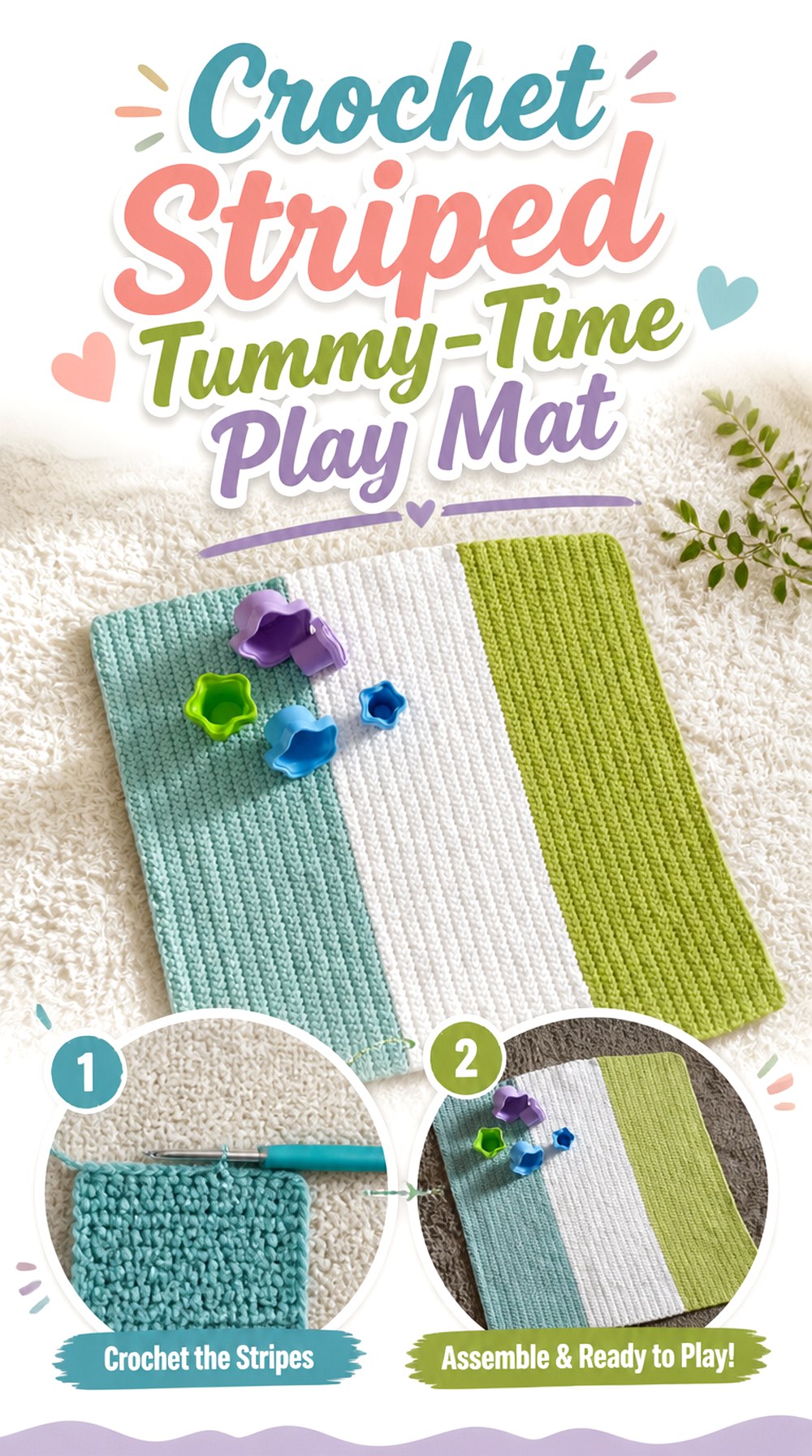
SAVEThe Turtle Trunk’s video tutorial focuses on a straightforward soft and squishy mat intended for baby floor play and tummy time. The example uses blanket yarn in three colors, keeping the emphasis on broad stripes, simple construction, and a substantial fabric rather than attached decoration.
This makes it a useful contrast to the elaborate farm, island, and dragon projects. If you want a mat that can sit under a play gym or provide a defined spot for supervised floor time without introducing extra pieces, a restrained stripe layout is easy to coordinate with a room. The simple visual design also gives yarn texture and color placement more influence over the finished look.
Simple Stripes Put Texture First
With no complicated motif competing for attention, inconsistencies in tension or changes in yarn texture are easier to notice. If substituting another blanket yarn, compare thickness and fabric feel before buying enough for the whole mat. Even yarns carrying a similar weight label can produce noticeably different drape or density.
Match the Mat to the Real Floor Space
Before changing the size, mark the proposed footprint on the floor with removable tape or another temporary reference. A tummy-time mat only needs to be large enough for its intended setup; unnecessary extra width adds yarn, weight, and laundering bulk. Also make sure the completed piece sits fully on a clean, stable surface rather than overlapping an edge or walkway.
Original Tutorial and Creator Credit
Creator: The Turtle Trunk
11. Crochet Double Strand Blanket Play Mat
 SAVE
SAVEBag-O-Day Crochet takes a different route to thickness by holding two different yarn strands together. The tutorial combines a bulky fuzzy yarn with a medium-weight yarn, producing a thicker surface that the creator presents as suitable for either a baby play mat or blanket.
This approach is worth considering if you like the feel or appearance of a novelty yarn but want another strand to change how it works in the fabric. It also creates opportunities for subtle color blending. The trade-off is that double-stranding can substantially affect weight, gauge, yarn consumption, and how easily the finished piece folds.
Holding Two Strands Changes Fabric Behavior
Two strands worked as one do more than create a thicker version of either yarn. They can alter stitch definition, elasticity, surface texture, and color. If substituting, make a meaningful swatch using both yarns together and wash it according to their care requirements. Check that the two fibers remain compatible after cleaning rather than judging the combination only while dry and new.
Check Weight Before You Upsize
A small sample can feel pleasantly substantial while a much larger double-strand mat becomes heavy. Estimate finished weight from your swatch or an early section before deciding to add significant extra width or length. A floor mat still needs to be practical to move, fold, clean, and dry, particularly when it will be used around children.
Original Tutorial and Creator Credit
Creator: Bag-O-Day Crochet
12. Crochet Oval Racetrack Play Rug
 SAVE
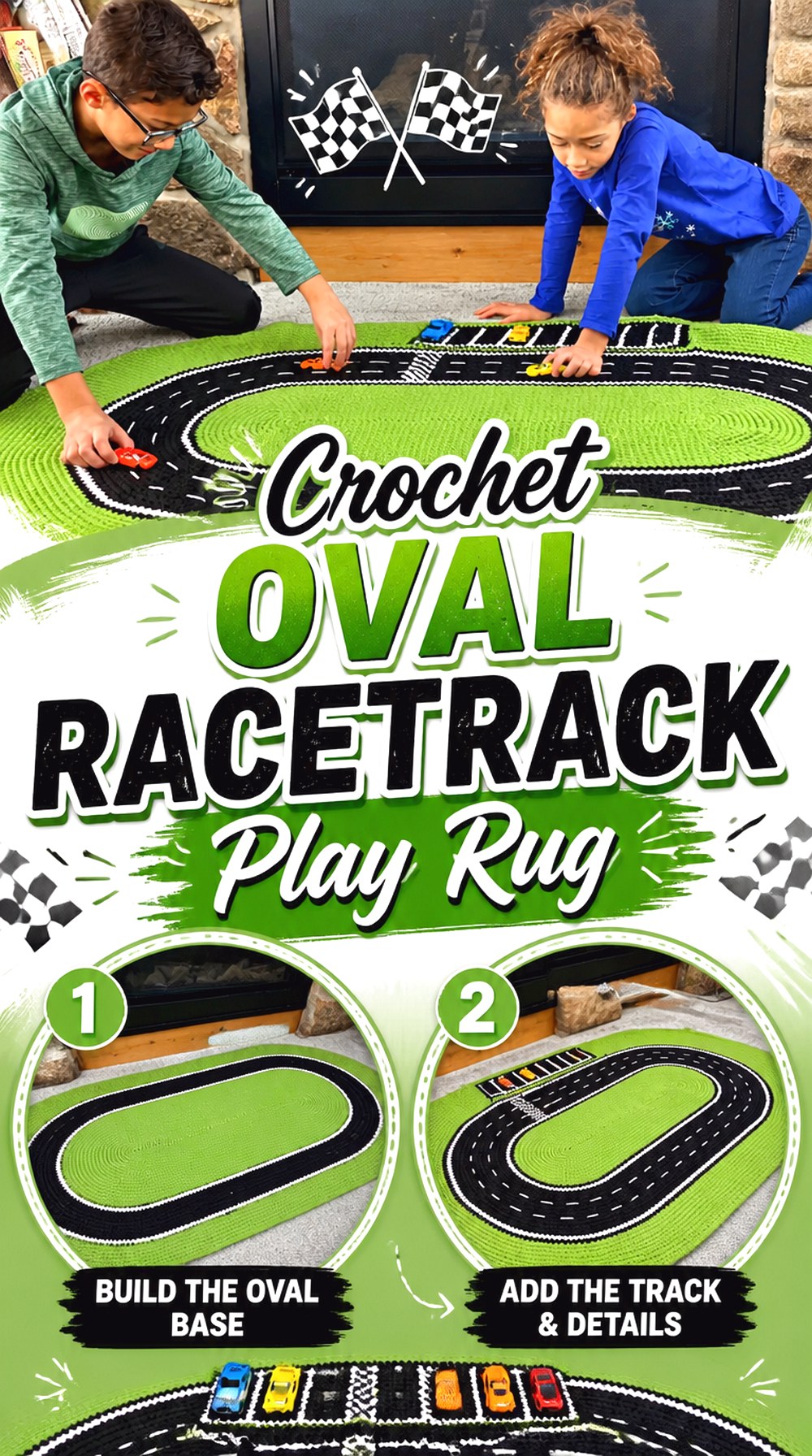
SAVEThe EKayG Crafts racetrack is a large oval floor rug designed specifically for toy-car play. Its road forms a continuous loop around the center, with lane markings turning the crochet surface into a functional track rather than merely a transportation-themed picture. The creator works the rug around both sides of a foundation chain and uses two strands of worsted-weight yarn together.
Compared with the C2C dump-truck mat later in this list, this design is interactive in a different way: toy cars can actually follow the roadway. It is a good choice when you want a substantial permanent or semi-permanent playroom rug with a clear play function.
Oval Shaping Needs Consistent Increases
An elongated oval must expand around curved ends while staying straight through the longer sides. If tension changes dramatically between those areas, the mat may stop lying flat. Check the rug frequently on the floor as it grows. When substituting yarn or hook size, prioritize a stable flat shape over matching a particular measurement at all costs.
Lane Details Should Lie Flat
The creator adds lane markings after the main rug is crocheted and cautions against pulling them so tightly that the surface puckers. That is a useful finishing principle for any surface embroidery on a floor mat: decorative lines should follow the fabric without cinching it. Inspect the underside as well so secured ends do not create uncomfortable lumps.
Think About Parking and Reach
A racetrack needs more than enough room for the crochet itself. Children need space around the perimeter to sit, reach, and move vehicles. Before making a very large version, measure the whole activity zone—not just the rug footprint. If the mat will live in a shared room, a slightly smaller flat rug may be more practical than an impressive version that constantly blocks circulation.
Original Tutorial and Creator Credit
Creator/Site: ekayg crafts
13. Crochet Dump Truck CC Play Mat
 SAVE
SAVESeeLoveShare’s construction-themed project uses corner-to-corner crochet to build a bold dump-truck image into the surface itself. The designer describes the finished piece as suitable for use as a play mat or kids’ throw and provides both a pixel graph and written colorwork guidance.
Unlike the racetrack, this mat is not dependent on raised roads or sewn-on scenery. Its playroom identity comes from the graphic image. That makes it useful when you want a themed floor blanket that can still fold, drape, or transition to throw use. C2C colorwork, however, introduces many color transitions, so the back and all yarn ends deserve careful finishing.
C2C Makes the Picture Part of the Surface
Because the dump truck is created through the crochet fabric rather than added afterward, the front can remain relatively flat. That is helpful on a play mat where bulky appliqués might interfere with toys. If you choose a different palette, preserve enough contrast between the vehicle and background for the pixel image to remain readable from across the room.
Color Changes Need Neat Ends
A graphic C2C project can accumulate more yarn tails and color-management points than a one-color rug. Secure and weave ends carefully rather than relying on a decorative border to hide unfinished work. Inspect the back for loose strands that fingers or toys could catch. If carrying yarn across sections, follow the designer’s method instead of inventing long floats across the reverse.
Decide Whether It Is a Mat or Throw First
Dual-purpose projects work best when one use does not undermine the other. A very stiff version may sit nicely on the floor but feel less comfortable as a throw; a very loose version can drape well yet move around more as a mat. Swatch with the intended yarn and decide which function has priority before making major gauge or yarn substitutions.
Original Tutorial and Creator Credit
Creator/Site: SeeLoveShare
14. Crochet Picnic Activity Play Mat
 SAVE
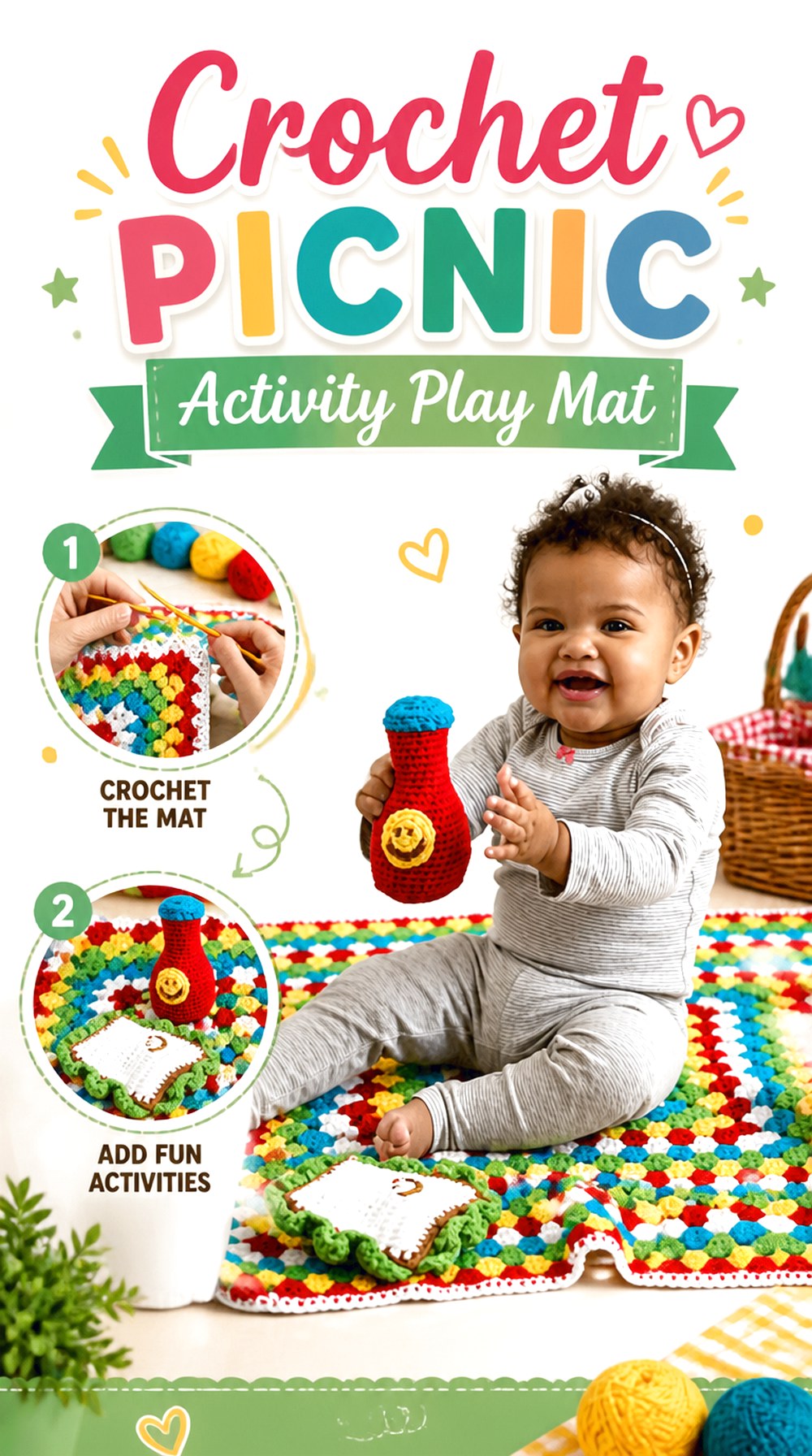
SAVETamara Kelly’s Playtime Picnic Set takes the play-mat idea beyond the floor surface by pairing a square blanket-style mat with crocheted pretend picnic items. The original published project includes a juice-bottle toy with a rattle element and a sandwich toy with a crinkle element, while the mat doubles as a blanket when play is finished.
That combination creates a different kind of interactive project from the farm or ocean scenes: the setting is intentionally simple, while the separate tactile toys carry much of the activity. It can be a useful inspiration for makers who want coordinated play pieces, provided the added inserts and small components are suitable for the intended recipient.
The Activity Pieces Should Earn Their Place
Separate toys add work, so decide whether they will genuinely be used. A picnic set is most compelling when the food and drink pieces support pretend play, not simply because matching accessories look impressive in photos. If making the project for a younger recipient, it can also be reasonable to make only the mat initially and add more complex accessories later.
Sound Inserts Need Extra Judgment
The original design uses special components to create rattle and crinkle effects and specifically calls for child-safe crinkle material. Any enclosed hard, noisy, or plastic component deserves careful containment and inspection. Do not substitute random packaging material or loose noise-making objects simply because they create a similar sound; follow the source guidance and assess recipient suitability.
A Blanket-Mat Can Outlive the Toy Phase
One advantage of the square mat is that it has a useful identity independent of the picnic toys. Once the coordinated activity pieces are no longer interesting, the crochet surface can still function as a small blanket or general floor mat. If longevity is a priority, choose colors you would be happy to use outside the picnic theme rather than making every element dependent on novelty.
Original Tutorial and Creator Credit
Creator/Site: Tamara Kelly / I Like Crochet
How These Crochet Play Mats Compare by Use
For straightforward floor cushioning, the scalloped mat, basketweave mat, striped tummy-time mat, and double-strand blanket mat keep the construction focused on the surface itself. The rainbow and leaf designs add a stronger decorative identity without requiring separate play pieces.
The drawstring mat and island set are the most storage-oriented choices, although both introduce cords that need thoughtful use. The dragon and bear emphasize character and room decor, while the farm, island, racetrack, dump truck, and picnic designs make the mat part of imaginative play. If portability matters, a foldable blanket-style project will generally be easier to manage than a large rug-style piece. If the mat will stay in one playroom, a more structured or oversized design may be worth the additional bulk.
Conclusion
These 14 crochet play mat ideas show how much the category can change once shape, texture, storage, and play style are considered. A simple plush square may be the practical choice for supervised floor time, while a bear rug or leaf mat can become part of the room itself. Racetracks, farms, islands, and picnic sets move further toward imaginative play, and convertible designs add storage or blanket functions.
Before choosing, think about the available floor space, how often the mat needs to move or wash, whether separate pieces are suitable for the intended user, and how much finishing you want to manage. Once you have selected a design, use the linked original tutorials for the creator’s exact construction details, materials, measurements, and adjustment guidance.
Frequently Asked Questions
Can I use a different yarn weight for a crochet play mat?
Often, but changing yarn weight can alter far more than appearance. A heavier yarn may increase thickness, overall dimensions, weight, and stiffness, while a thinner yarn can reduce cushioning and change motif proportions. This matters especially for shaped, layered, or folding mats. Make a substantial swatch first, then compare its gauge and fabric behavior with the original tutorial. For major substitutions, check whether the creator provides specific adjustment guidance.
How large should a crochet play mat be?
There is no single correct play-mat size. Measure the intended floor area and consider what will happen around the mat as well as on it. A supervised tummy-time surface has different space requirements from a racetrack where children need room to sit around the edge. If changing a source pattern’s dimensions, remember that scene layouts, folding systems, drawstrings, shaped outlines, and attached components may not scale cleanly with the base.
How can I stop a round crochet play mat from curling?
First determine whether the edge is cupping inward or ruffling outward. Hook size, tension, yarn substitution, and the rate of increases can all influence flatness. Do not aggressively block a severely distorted mat and assume the problem is solved. Lay the work flat during construction so you can respond early. When following a published tutorial, keep its increase structure intact unless you understand how your gauge change is affecting the circle.
Should I put a nonslip backing under a crochet play mat?
For rug-style mats on smooth flooring, some form of floor-compatible nonslip layer may be useful. Life + Yarn specifically notes the slipping issue in its crochet rug guidance. The appropriate solution depends on the flooring, mat construction, and cleaning routine. A removable rug pad can be easier to separate for washing than a permanent treatment. Whatever you choose, verify that it will not damage the underlying floor.
Are drawstring crochet play mats appropriate for babies?
A drawstring makes storage convenient, but cords require extra caution around babies and young children. The I Crochet So Hard play-mat tutorial explicitly warns that its string or cord can create a hazard and says not to leave a baby unattended with it. If the storage function is unnecessary, a flat version may be the more suitable choice. Always consider the intended user rather than assuming every feature of a crochet design is appropriate for every age.
How should I wash a crochet play mat?
Follow the care information for the exact yarn and any instructions supplied by the project creator. Do not assume all acrylic, cotton, plush, or faux-fur yarns can be cleaned the same way. Embellishments, stuffing, sound inserts, multiple fibers, and nonslip treatments can further change care requirements. Before washing a finished mat, also check that ends, seams, appliqués, and toy components are secure so laundering does not expose a weak attachment.