Burgundy and camel give crochet projects a warm two-color direction without requiring a complicated palette. Burgundy usually carries more visual weight because of its deeper appearance, while camel can provide a lighter, warmer break around borders, ribbing, motifs, and smaller details.
The most useful way to work with this pairing is to decide which shade should lead before you begin. A burgundy-heavy project can feel richer and more defined, while a camel-heavy version gives the same combination a lighter overall surface. Alternating the two creates a more graphic effect, especially on stripes, granny squares, and repeated motifs.
The tutorials credited below support the crochet construction or project concept. The burgundy-and-camel palettes are color adaptations, so you can apply the placement ideas without assuming the original creator used these exact colors.
Quick List
- Burgundy And Camel Granny Stripe Crochet Blanket
- Burgundy And Camel Ribbed Crochet Beanie
- Camel And Burgundy Granny Square Crochet Tote Bag
- Burgundy And Camel Colorwork Crochet Pillow
- Burgundy And Camel C2c Crochet Granny Square
- Burgundy And Camel Crochet Bucket Hat
- Burgundy And Camel Classic Crochet Sweater
- Camel And Burgundy Crochet Shawl
- Burgundy And Camel Crochet Storage Basket
- Camel And Burgundy Textured Crochet Scarf
- Burgundy And Camel Ribbed Crochet Cardigan
- Camel And Burgundy Crochet Cowl
- Burgundy And Camel Crochet Sweater Vest
- Camel And Burgundy Crochet Mug Rug
How to Balance Burgundy and Camel in Crochet
Burgundy does not automatically need to occupy half of a two-color project. Because it is often visually deeper than camel, smaller burgundy sections can still command considerable attention. On a blanket or scarf, for example, broad camel areas separated by narrower burgundy bands can still read clearly as a burgundy-and-camel palette.
For garments, consider using one color for the main panels and the other for structural details such as cuffs, necklines, hems, or edging. This keeps the garment coordinated while avoiding a divided half-and-half appearance unless that stronger contrast is intentional.
Check Burgundy and Camel Contrast Before You Commit
The names “burgundy” and “camel” cover a wide range of actual yarn colors. A very deep burgundy beside a light golden camel may have obvious value separation, while a muted burgundy and darker brownish camel may sit much closer together.
Place your chosen yarns side by side before starting. If motif edges or stitch details need strong visibility, a quick grayscale photo can help reveal whether the two shades are sufficiently different in lightness. If they merge, reserve the stronger contrast for larger blocks rather than tiny details.
Use Burgundy and Camel Where Crochet Structure Can Show Them Clearly
Borders, ribbing, motif centers, joins, cuffs, straps, and repeated stripes are useful places to introduce a second color because they already create natural visual divisions. You do not need to scatter both colors evenly across every part of a project.
Texture matters too. When raised stitches or pronounced ribbing are an important feature, giving the textured area one uninterrupted color can keep the stitch definition from being broken up by frequent color changes.
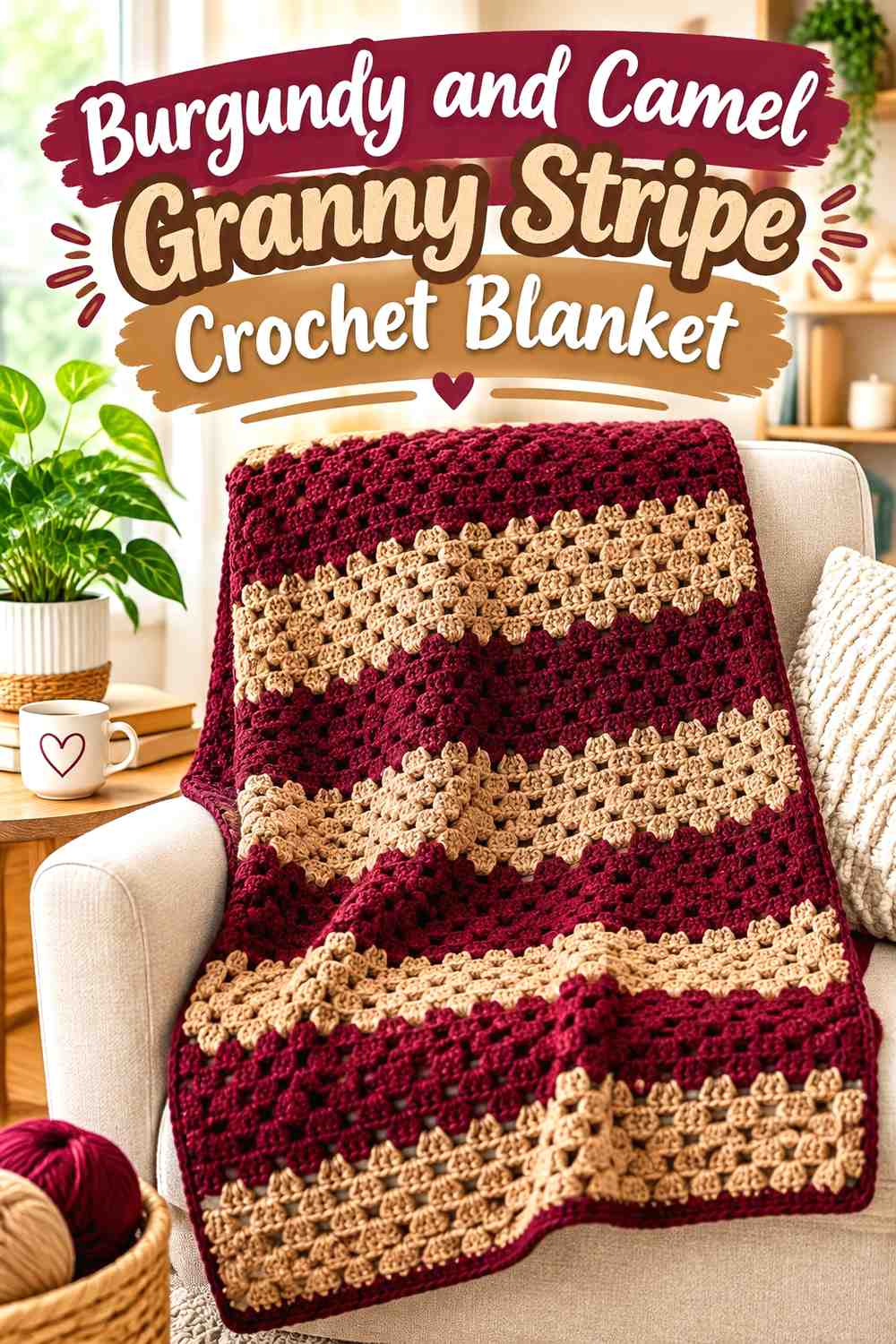
1. Burgundy And Camel Granny Stripe Crochet Blanket
 SAVE
SAVEA granny stripe blanket gives burgundy and camel enough surface area to establish a clear rhythm. Instead of alternating the colors after every narrow section, consider grouping several camel stripes between stronger burgundy repeats. That lets camel lighten the blanket while burgundy acts as a recurring visual anchor.
Burgundy Can Create the Stronger Repeating Blanket Stripe
If burgundy is the color you want noticed first, repeat it at predictable intervals rather than using it once or twice. Repetition helps dark burgundy sections feel intentional across a large blanket surface and prevents one isolated stripe from looking disconnected.
You can also vary the width of the color areas without changing the basic construction concept. More camel between burgundy sections creates a lighter blanket; increasing the burgundy share gives the finished piece a deeper overall appearance.
Camel Can Keep Burgundy Granny Stripes From Becoming Too Heavy
Camel is particularly useful between repeated burgundy areas because it provides visual breathing room without introducing a third color. If your burgundy yarn is very dark, larger camel sections can also make the granny-style openings and repeated stitch groups easier to distinguish from a distance.
Before committing to the full blanket, place a small burgundy-and-camel sample on the sofa or bed where the finished piece may be used. Surrounding neutrals can change how dominant each yarn appears.
Creator Credit: The Loopy Lamb
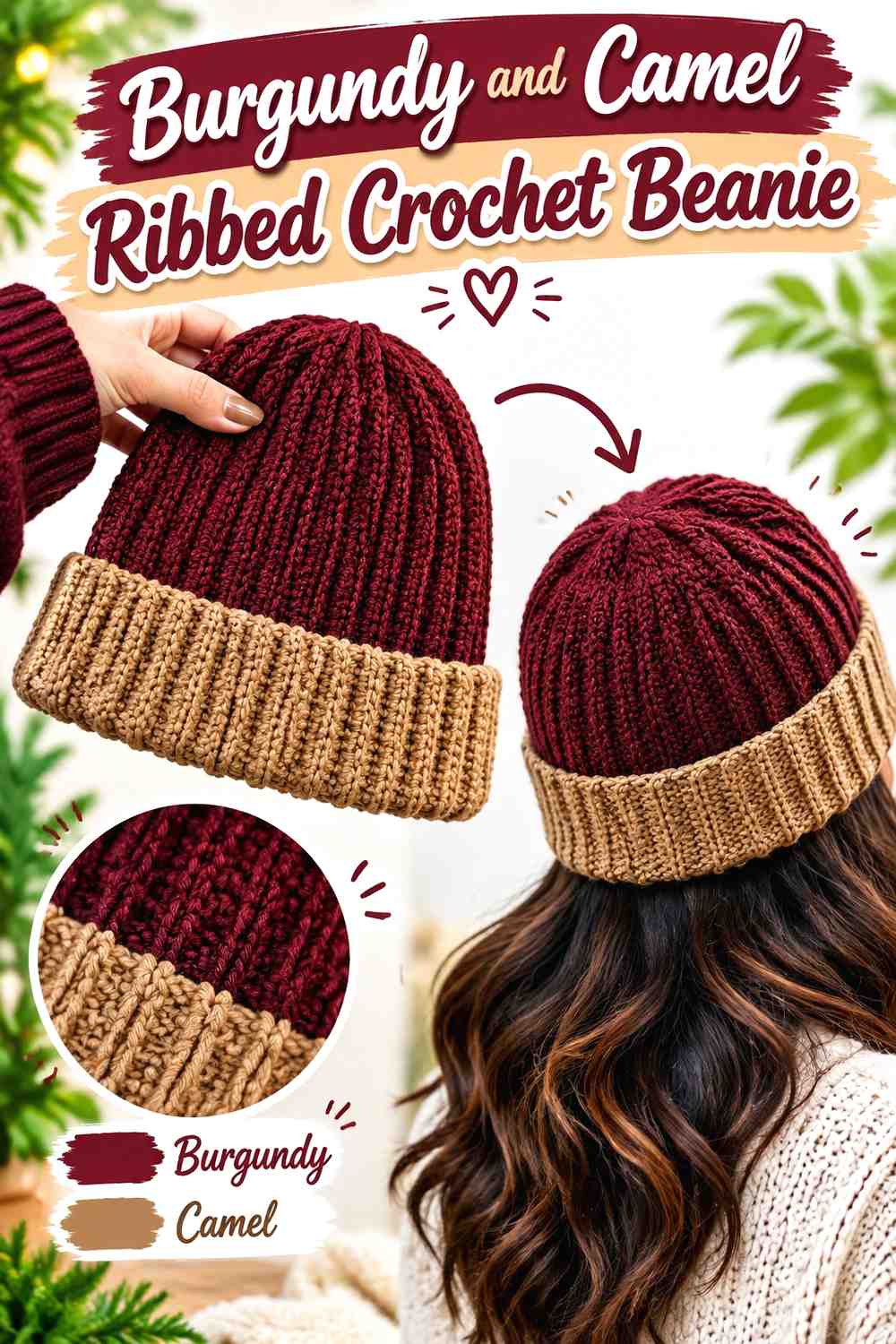
2. Burgundy And Camel Ribbed Crochet Beanie
 SAVE
SAVEFor a ribbed beanie, burgundy can cover the main hat while camel is concentrated around the lower edge. This distribution takes advantage of the beanie’s natural visual divisions rather than interrupting the vertical ribbed surface with many small color changes.
Burgundy Keeps the Crochet Beanie Body Visually Continuous
Using burgundy across most of the crown allows the ribbing to remain one uninterrupted field of color. That can be useful when the main appeal of the hat is the repeated vertical texture.
If your burgundy is especially dark, examine the ribbing under ordinary indoor lighting before deciding whether it needs more camel. Texture that looks distinct in bright light can appear flatter in deeper shades under softer lighting.
Camel Can Define the Burgundy Beanie Edge
A camel lower band can separate the burgundy hat from coats, scarves, or other dark layers while keeping the palette warm. You can make camel a narrow finishing detail or give it more visual space if you want the lower portion of the hat to become a feature.
Keep the transition deliberate. A single camel area at the edge usually reads more clearly than several unrelated camel patches scattered over the burgundy crown.
Creator Credit: VivCrochets
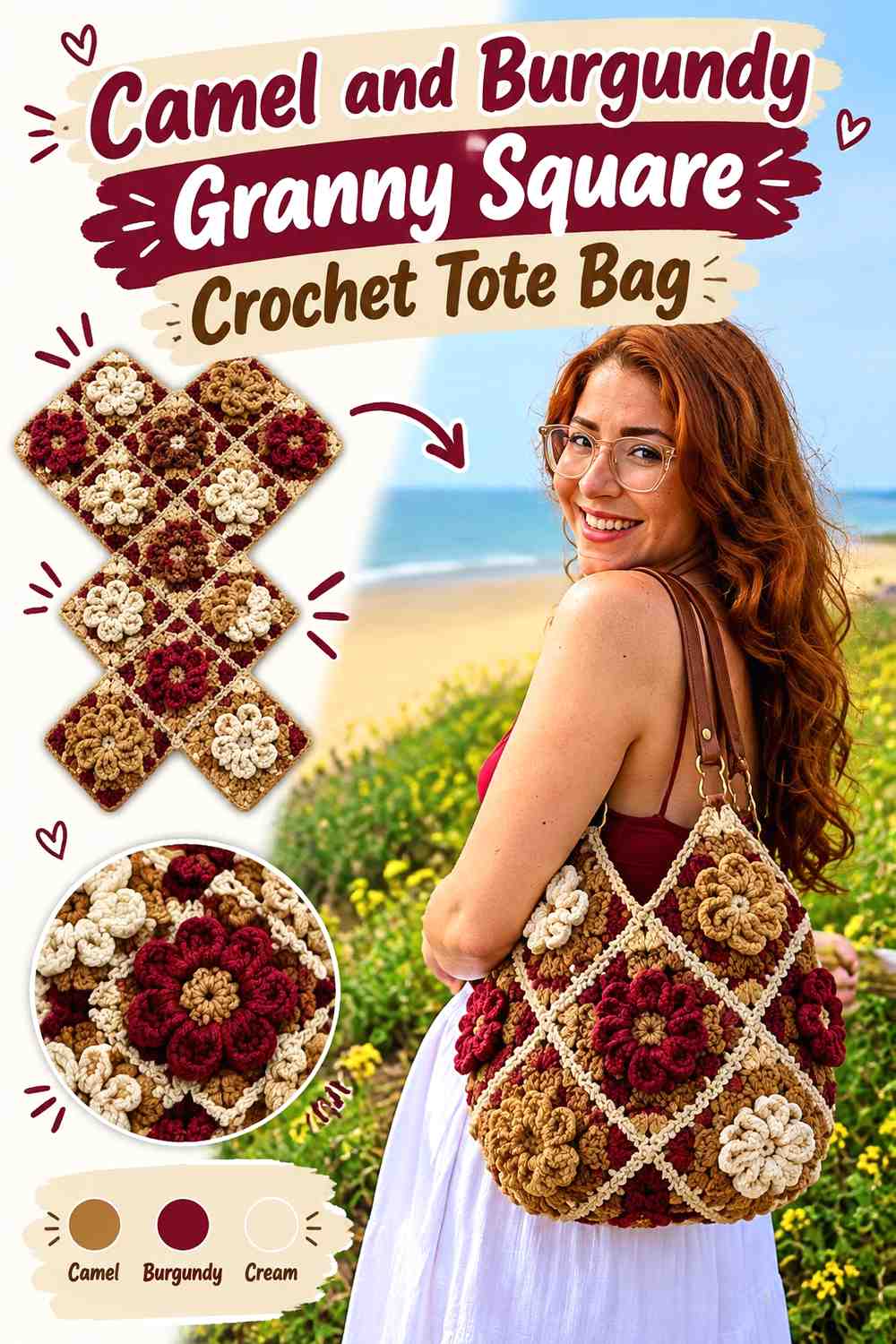
3. Camel And Burgundy Granny Square Crochet Tote Bag
 SAVE
SAVEA granny square tote gives you several places to control the burgundy-and-camel balance: motif centers, outer rounds, joins, sides, and straps. Letting camel cover more of the square surfaces while burgundy defines selected structural areas can make the darker color noticeable without overwhelming the bag.
Camel Can Lead the Crochet Tote Square Surfaces
Using camel across the larger parts of the squares gives the bag a lighter foundation. Burgundy can then be reserved for centers or selected outer sections, making each appearance of the deeper color easier to notice.
If the bag uses many repeated squares, decide on the color order before joining them. Random placement can work, but planned repetition usually makes a two-color layout easier to read across the finished front and back.
Burgundy Can Tie Camel Crochet Squares Together
Burgundy is a useful candidate for visible joins, edging, or strap details when you want a stronger outline around lighter camel motifs. The darker connecting color can visually organize separate squares into one bag.
If you use burgundy for both joining and the strap, repeat at least a little burgundy inside the motifs as well. That keeps the structural burgundy details connected to the body instead of appearing added after the fact.
Creator Credit: Brunaticality
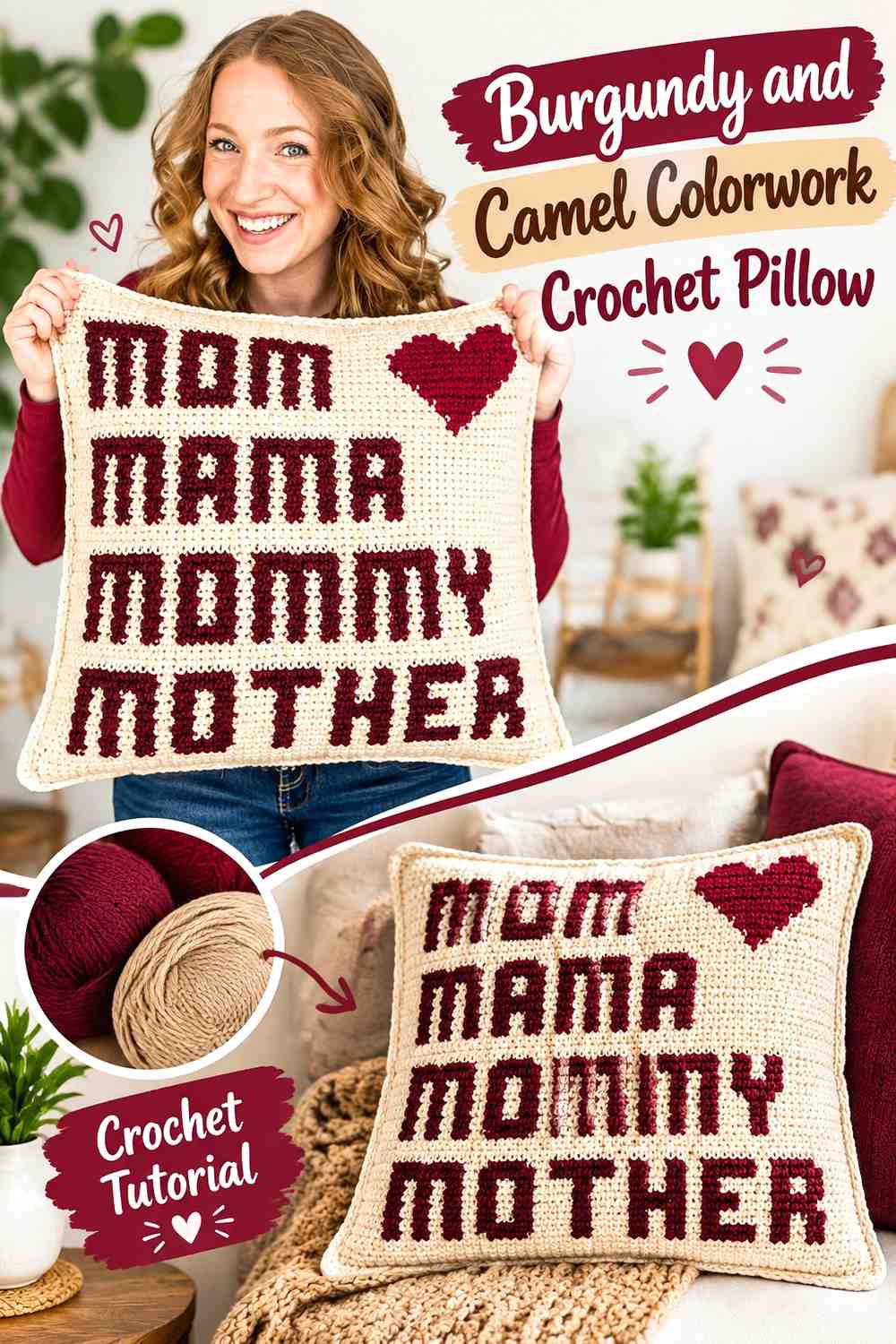
4. Burgundy And Camel Colorwork Crochet Pillow
 SAVE
SAVEA pillow offers one of the clearest ways to make burgundy dominant because its front surface is viewed as a single composition. Use burgundy as the field and camel for lettering, shapes, or another simple colorwork detail when you want the lighter shade to stand apart.
Burgundy Can Provide a Strong Crochet Pillow Background
A broad burgundy background keeps the pillow visually unified and gives camel details plenty of uninterrupted space around them. This approach works especially well when the front includes a recognizable motif that should remain easy to identify.
Check the two yarns from several feet away before committing to intricate colorwork. If burgundy and camel are too similar in value, small camel details may disappear even though the yarns look different when held side by side.
Camel Should Stay Clear Against the Burgundy Pillow Surface
Camel works most effectively when colorwork details are large enough to remain legible against burgundy. Avoid relying on tiny isolated camel stitches to carry an important part of the design when the two yarns have modest value contrast.
Camel can also be repeated around the pillow edge. That small repetition connects the central colorwork with the perimeter and keeps the accent from existing only in the middle.
Creator Credit: The Turtle Trunk
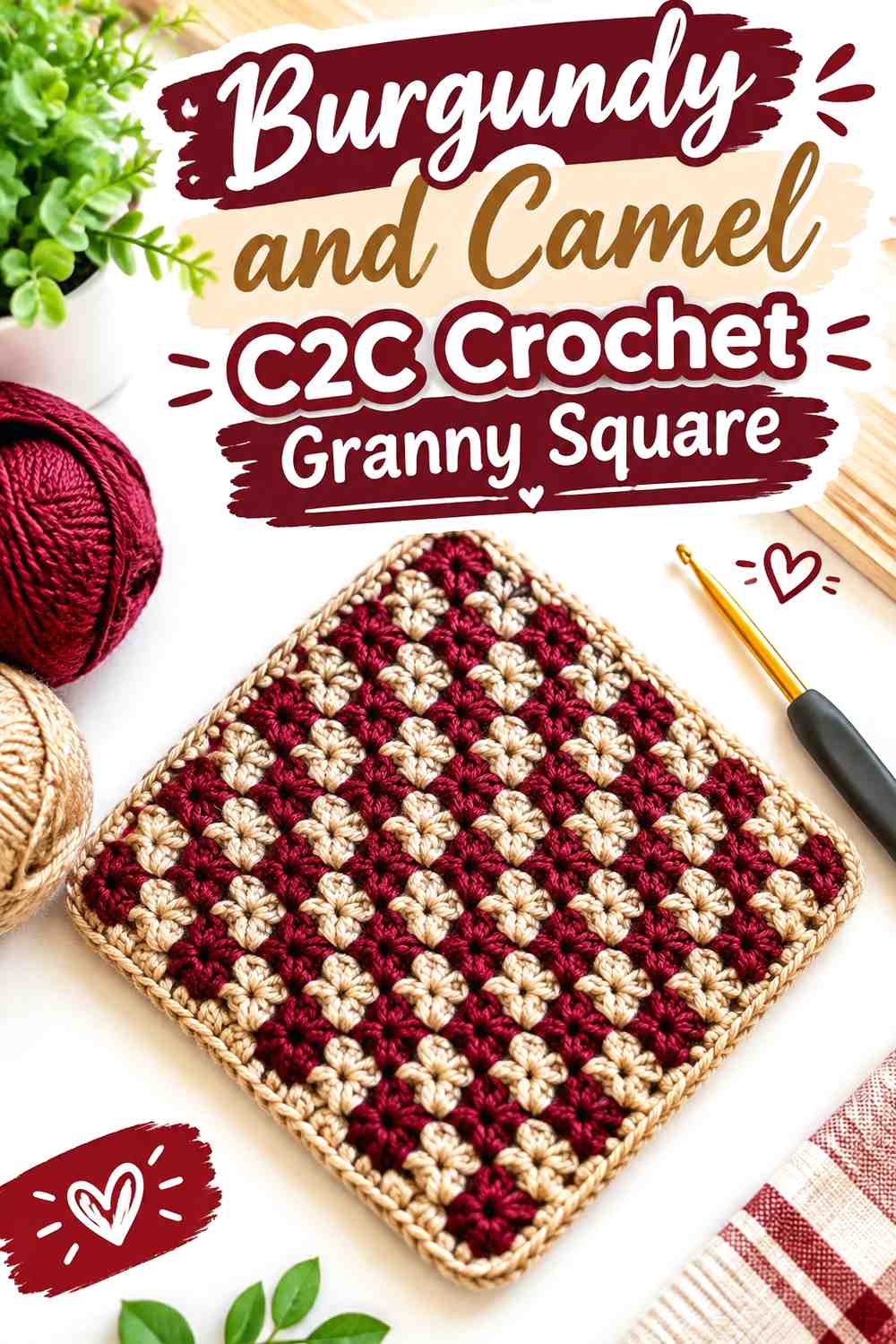
5. Burgundy And Camel C2c Crochet Granny Square
 SAVE
SAVEA corner-to-corner granny square lets burgundy and camel move diagonally across the motif rather than only around concentric rounds. This makes the pairing useful for larger graphic blocks, cushion panels, blankets, or bags assembled from repeated squares.
Burgundy Can Anchor One Side of the Camel C2C Crochet Square
Instead of changing color constantly, allow burgundy to occupy a substantial diagonal section. A larger block gives the deeper shade enough space to establish the color direction without producing excessive visual fragmentation.
When several squares will be joined, rotate some motifs before deciding on the final arrangement. Burgundy sections aligned in the same direction create a stronger diagonal movement than a deliberately alternating layout.
Camel Can Open Up a Burgundy C2C Crochet Layout
Camel can take the larger share when you want the square to feel lighter while still retaining a strong burgundy section. This can be particularly useful when many motifs will be combined and too much dark color would make the overall project heavier than intended.
If camel becomes the background-like color, keep the burgundy placement consistent enough that the repeated motifs still relate to one another.
Creator Credit: Bella Coco
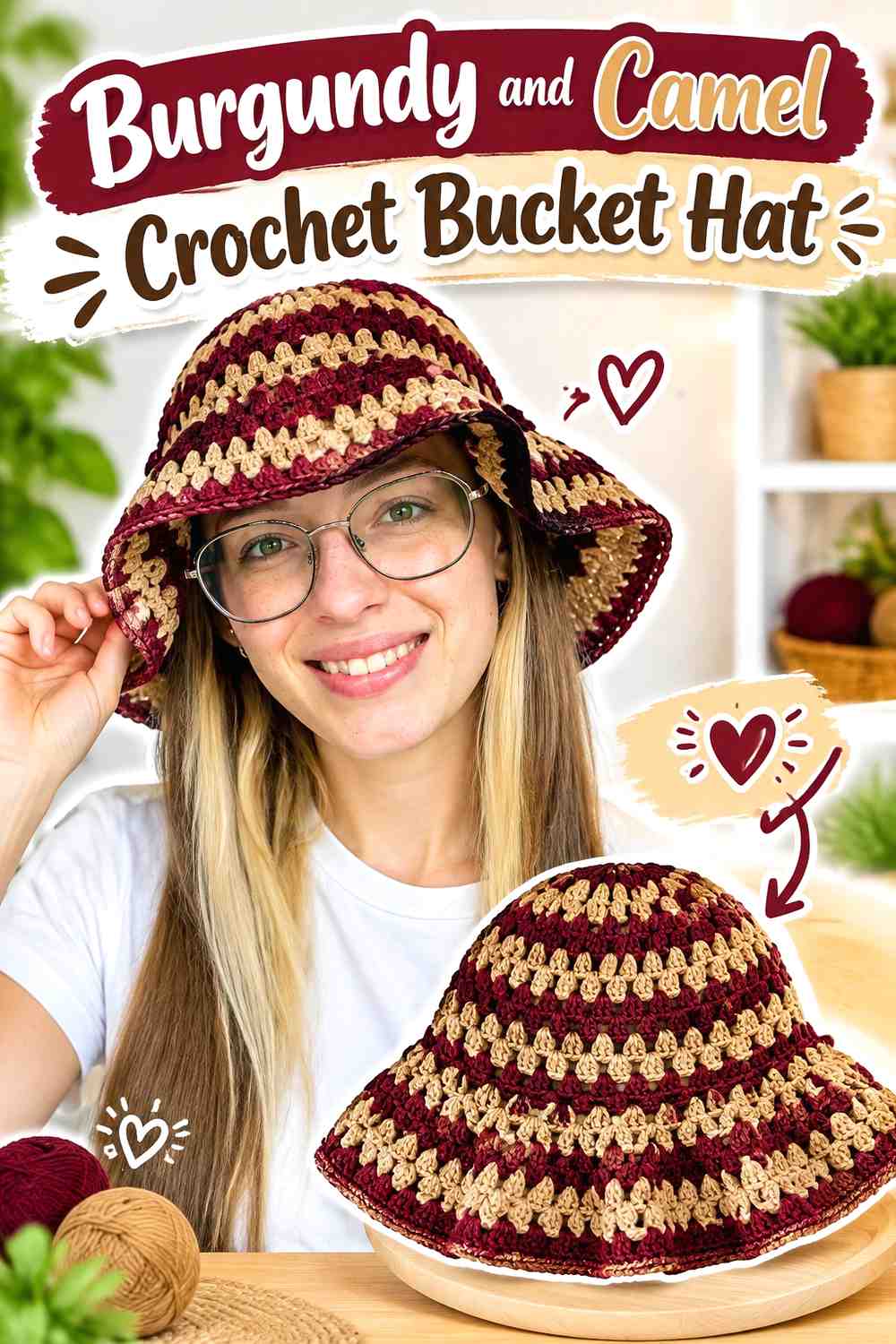
6. Burgundy And Camel Crochet Bucket Hat
 SAVE
SAVEA bucket hat has three obvious color zones: crown, sides, and brim. That makes it easy to use burgundy and camel intentionally without relying on random stripes. One effective direction is burgundy through the upper hat with camel controlling most of the brim.
Burgundy Can Keep the Crochet Bucket Hat Crown Defined
Using burgundy across the crown and upper sides gives the hat one clear main color. Keeping that area uninterrupted also prevents frequent color changes from distracting from the shape.
If you want more camel without dividing the crown, introduce it where the sides transition toward the brim. This maintains the burgundy-dominant upper section while increasing the visibility of the lighter shade lower down.
Camel Can Turn the Burgundy Bucket Hat Brim Into a Feature
A camel brim creates a broad contrast zone around the face of the hat and gives the second color more impact than a very thin edging would. The wider placement also makes sense structurally because the brim is already distinct from the crown.
For a more balanced look, repeat a small amount of camel near the top or use a narrow burgundy detail within the camel brim. The goal is connection, not equal color coverage.
Creator Credit: PassioKnit Kelsie
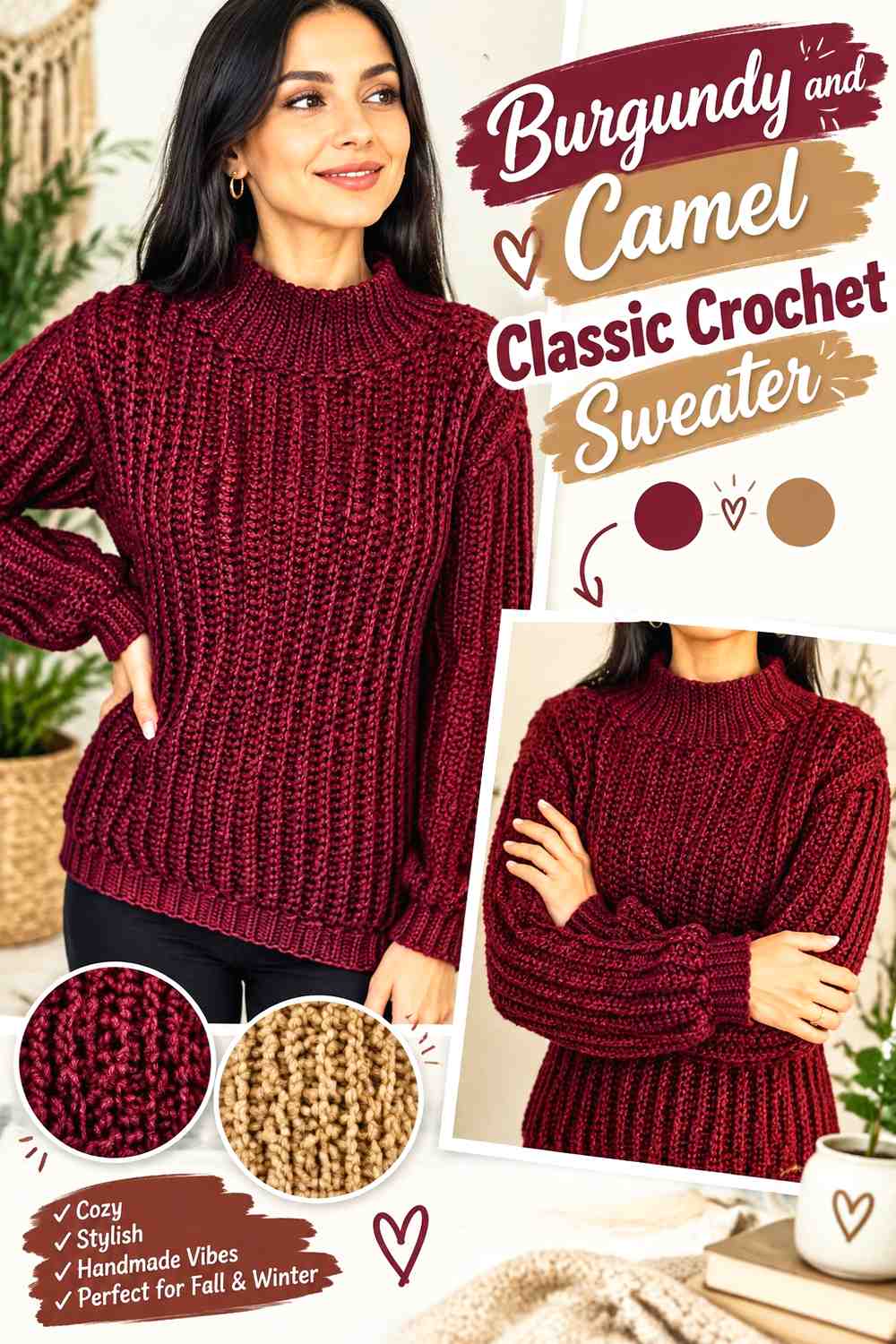
7. Burgundy And Camel Classic Crochet Sweater
 SAVE
SAVEA sweater gives burgundy and camel multiple natural placement points without needing complex colorwork. Burgundy can cover the body and sleeves, while camel is restricted to the collar, cuffs, and lower band for a framed wearable palette.
Burgundy Works Well Across the Main Crochet Sweater Panels
Keeping the front, back, and most of the sleeves burgundy gives the garment a continuous main field. This is useful when you want the sweater silhouette and stitch texture to remain more prominent than the color changes themselves.
Before committing to a very dark burgundy, swatch enough fabric to judge the texture. Deep shades can reduce visible shadow between stitches, particularly from a distance.
Camel Can Connect Burgundy Crochet Sweater Ribbing and Edges
Camel cuffs alone may look isolated, but camel repeated around the neckline and lower edge establishes a clear finishing system. These repeated locations let a relatively small amount of camel influence the whole sweater.
If you want a subtler effect, choose a darker camel that stays closer to burgundy in value. For stronger definition, preserve a clearer light-and-dark difference between the two yarns.
Creator Credit: TCDDIY
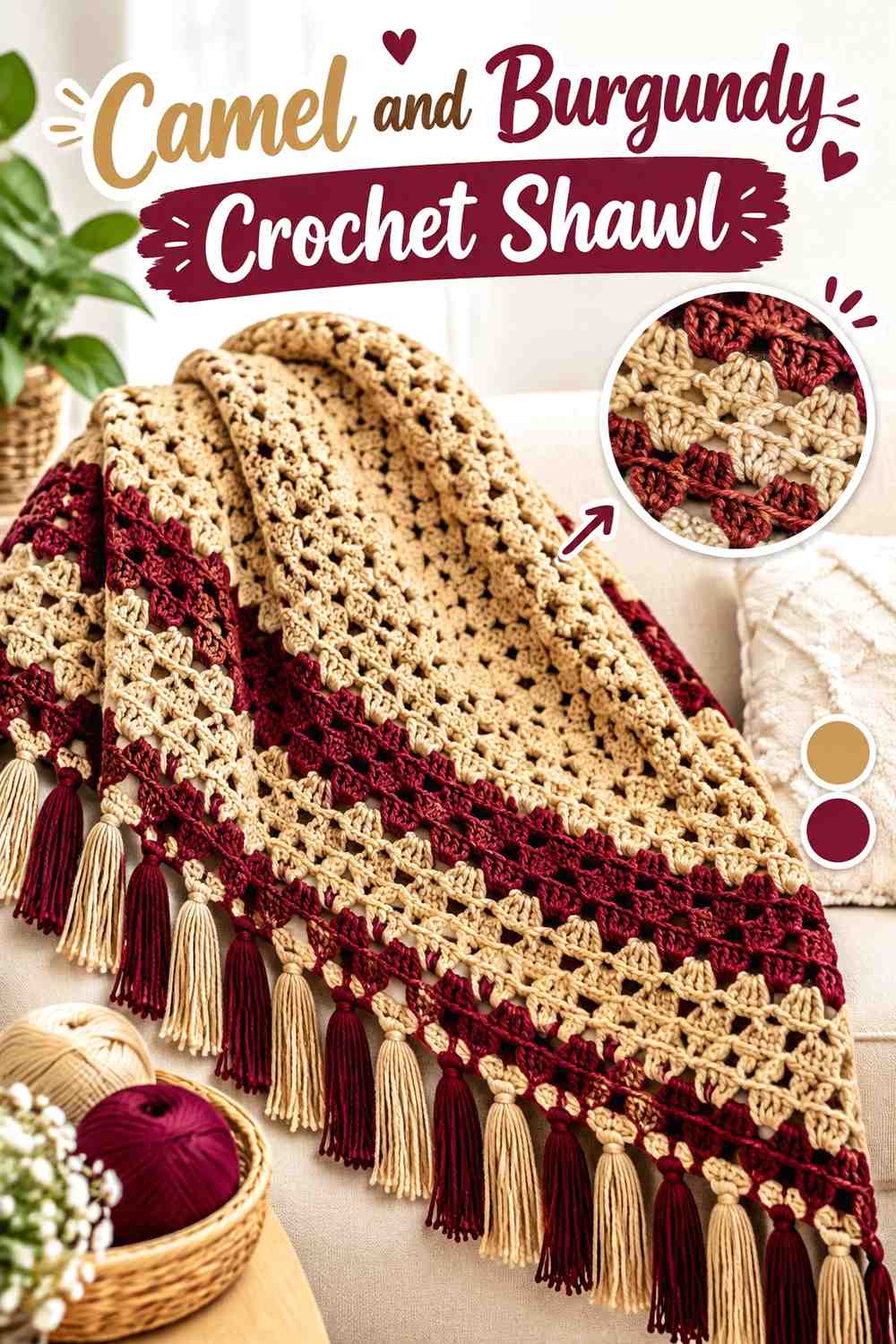
8. Camel And Burgundy Crochet Shawl
 SAVE
SAVEA shawl can reverse the usual hierarchy by making camel dominant and allowing burgundy to appear only at selected intervals or near the outer edge. Because a shawl widens as it grows, burgundy placed later in the project can occupy increasingly noticeable sections.
Camel Can Keep the Crochet Shawl Center Lighter
Starting with camel gives the inner part of the shawl a quieter visual base. As the fabric expands, burgundy can be introduced in larger sections without immediately making the entire piece dark.
Consider where the shawl will fold when worn. A burgundy section that looks narrow while laid flat may become much more prominent once layers overlap.
Burgundy Can Give the Camel Crochet Shawl a Defined Outer Edge
Placing burgundy near the outer portion of a camel shawl creates a darker frame. This can help define the triangular or curved silhouette and gives the final rows stronger visual weight.
If the border contains noticeable texture or openwork, test whether the burgundy is dark enough to obscure some of that detail. A slightly lighter burgundy may preserve more visible stitch definition.
Creator Credit: Fiber Spider
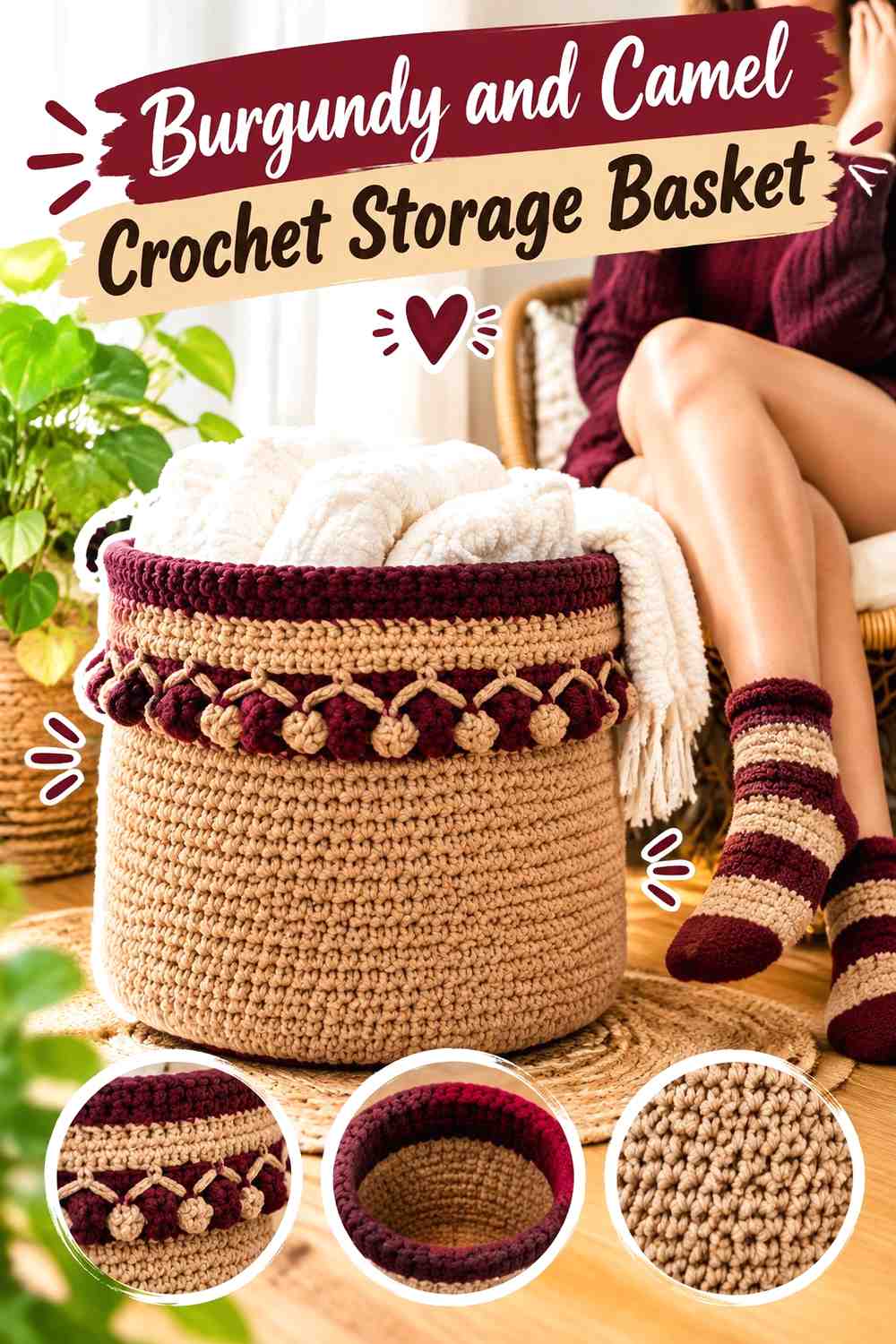
9. Burgundy And Camel Crochet Storage Basket
 SAVE
SAVEA basket benefits from simple, broad color placement because its sides are viewed as one continuous surface. Burgundy can cover most of the basket, while camel marks the upper section, handle area, or another structural detail.
Burgundy Can Ground the Crochet Basket Body
Using burgundy through the lower and middle basket creates a strong base visually. It is also a useful choice when you want the basket to coordinate with other warm, dark home accents rather than disappear into pale surroundings.
Avoid changing color repeatedly around a small basket unless stripes are the main goal. Two larger blocks generally make burgundy and camel easier to read as an intentional pairing.
Camel Can Separate the Burgundy Basket Rim or Handle Area
Camel around the upper edge creates a clear endpoint for the burgundy body. If the basket includes handles or another contrasting structural feature, repeating camel there can connect function with color placement.
For a less divided appearance, move the burgundy-to-camel transition closer to the top. For a more obviously two-color basket, give camel a larger share of the side wall.
Creator Credit: TL Yarn Crafts
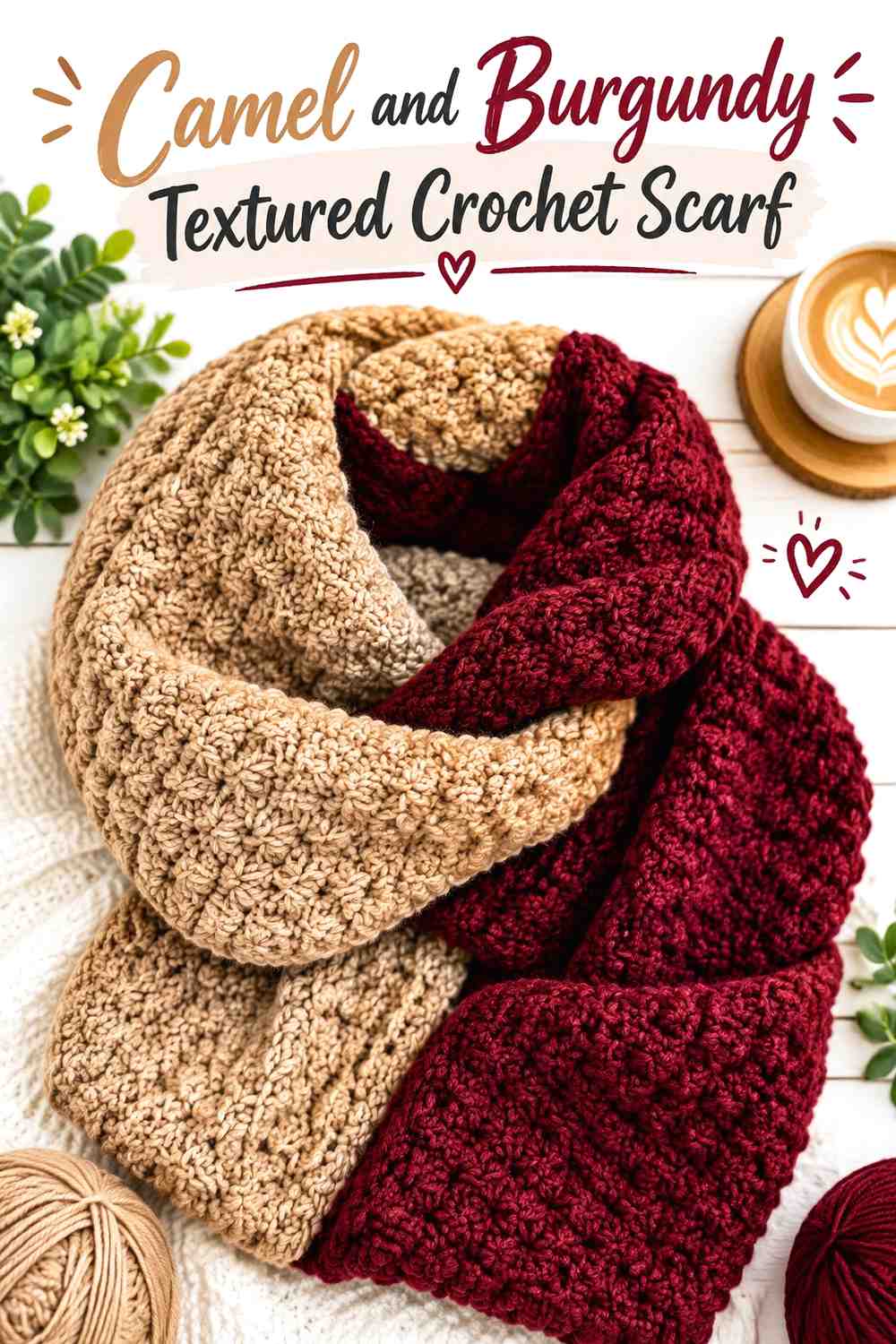
10. Camel And Burgundy Textured Crochet Scarf
 SAVE
SAVEA long scarf gives camel and burgundy enough room for broad sections that do not compete with the stitch texture. Camel can cover most of the length while burgundy appears near both ends, creating color balance when the scarf hangs around the neck.
Camel Can Preserve the Crochet Scarf’s Textured Surface
If the scarf pattern has repeated raised or recessed texture, working a substantial section in camel keeps the stitches easy to follow visually. Frequent color changes may break up that texture, so larger blocks are often more useful here than narrow striping.
A medium or light camel also tends to show shadow between raised stitches more clearly than a very dark yarn, although the actual effect depends on the yarn and lighting.
Burgundy Can Balance Both Ends of the Camel Crochet Scarf
Using burgundy at only one end creates an intentionally asymmetric look. If you prefer visual balance, repeat comparable burgundy sections at both ends of the camel scarf.
Those burgundy blocks do not need to be very large. Because they sit at the ends, they already act as finishing points when the scarf is worn or displayed.
Creator Credit: Rich Textures Crochet
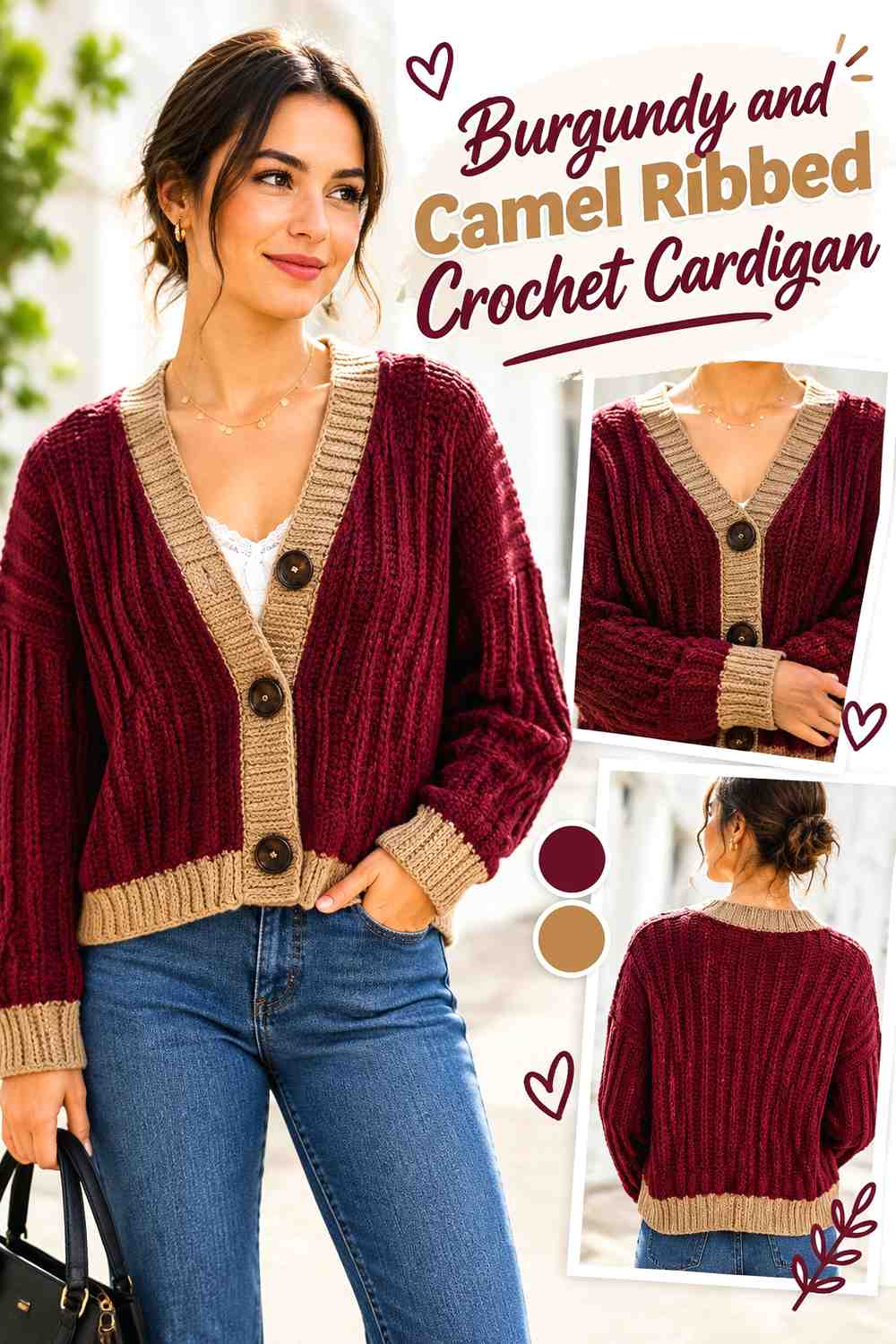
11. Burgundy And Camel Ribbed Crochet Cardigan
 SAVE
SAVEA ribbed cardigan gives camel several useful finishing locations while burgundy remains dominant across the main panels. Camel around the neckline, button band, cuffs, or hem can emphasize the garment structure without dividing the body into competing color blocks.
Burgundy Can Keep the Crochet Cardigan Panels Cohesive
Use burgundy consistently across the back and front panels when you want the ribbed surface to remain the main visual feature. A single dark field also makes the separate cardigan pieces read as one garment after assembly.
If the cardigan has pronounced vertical or horizontal ribs, examine a burgundy swatch from a distance. The darker the shade, the more important directional light becomes for showing the texture.
Camel Can Frame the Burgundy Crochet Cardigan Opening
A camel button band or neckline treatment draws a clean line around the cardigan opening. Repeating camel at the cuffs or hem gives that frame a connection to the rest of the garment.
You can keep the effect restrained by using camel only on the opening and cuffs, or strengthen it by extending camel across all major ribbed finishing areas.
Creator Credit: For The Frills
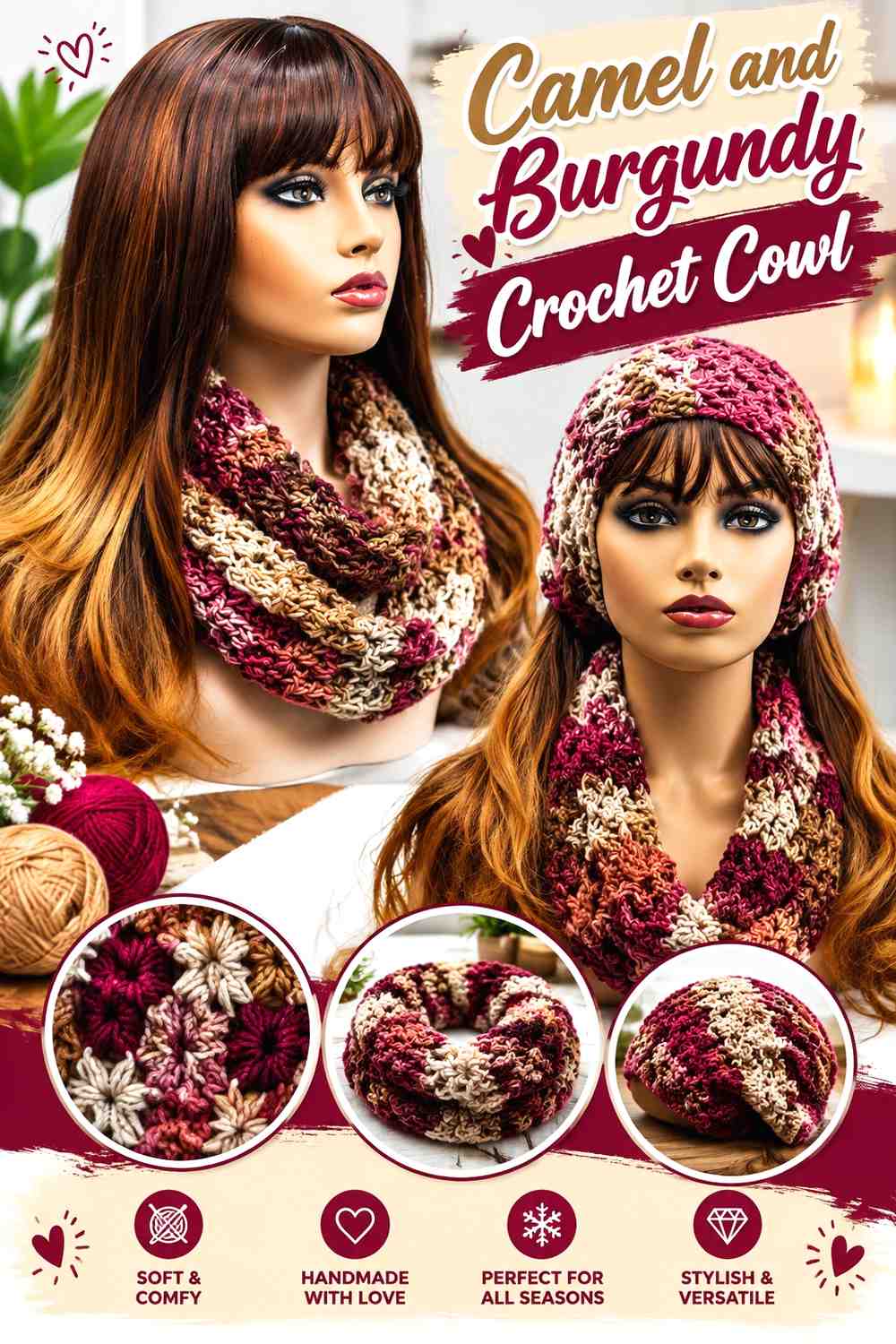
12. Camel And Burgundy Crochet Cowl
 SAVE
SAVEA cowl is compact enough that even a small burgundy section can strongly influence a camel-dominant design. Keep camel across most of the main fabric if you want the stitch pattern to stay light, then use burgundy as an upper or lower framing color.
Camel Can Lead the Crochet Cowl Without Looking Flat
When camel covers most of a cowl, stitch texture becomes important because the palette itself is restrained. Raised stitches, openings, or repeated surface patterns can create variation without adding another color.
If the chosen camel is quite dark, compare it directly with burgundy. Two mid-to-dark shades may create a blended effect rather than obvious contrast, which can be useful if subtlety is the goal.
Burgundy Can Add a Clear Edge to the Camel Crochet Cowl
A burgundy edge gives the cowl a defined boundary and can be more effective than scattering small burgundy sections throughout the texture. Place it where it will remain visible after the cowl folds or bunches around the neck.
For a reversible-looking balance, burgundy can appear at both edges with camel between them. Keep the color placement simple enough that the texture still reads clearly.
Creator Credit: Bag-O-Day Crochet
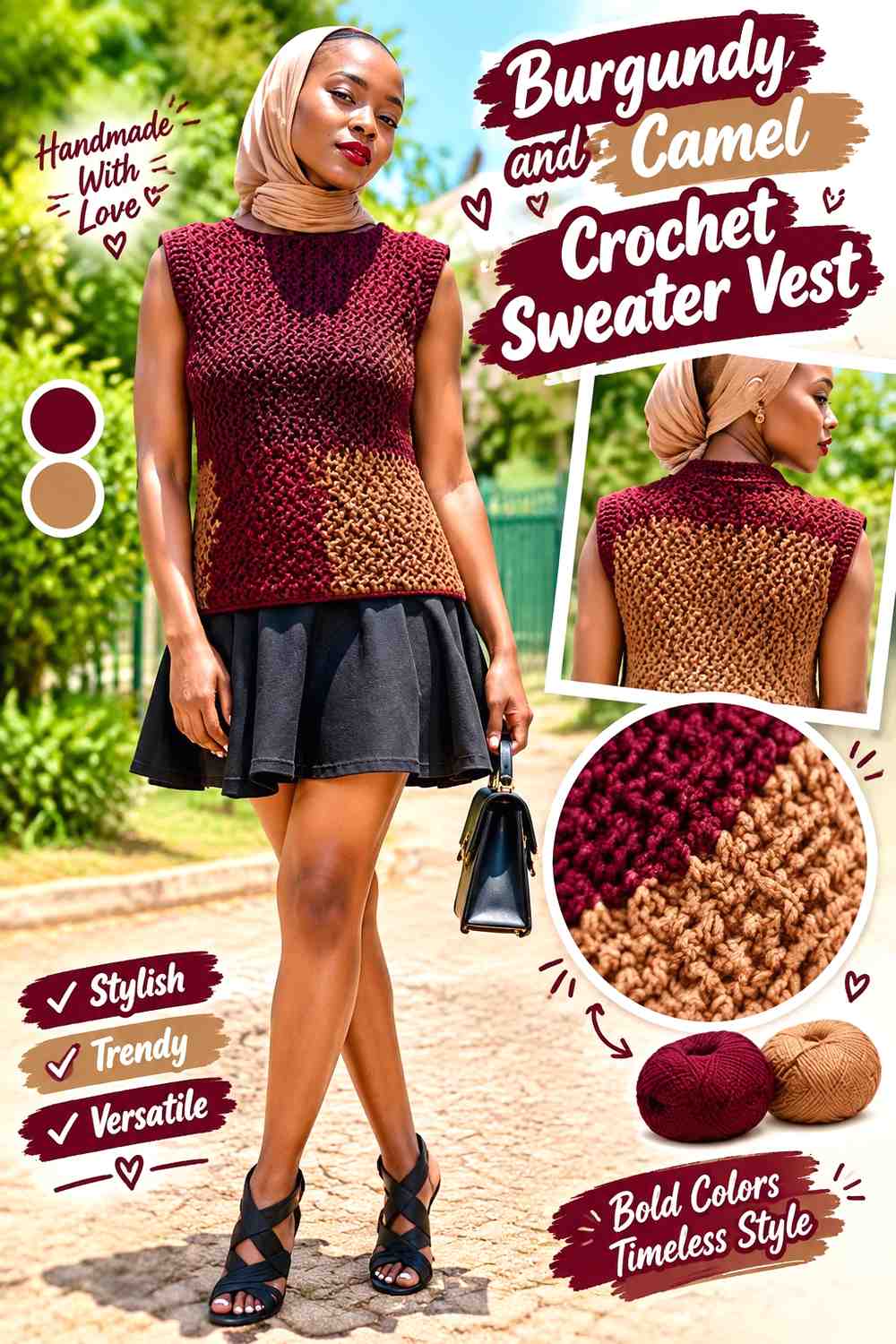
13. Burgundy And Camel Crochet Sweater Vest
 SAVE
SAVEA sweater vest naturally separates the body from the neckline and armhole finishing, giving burgundy and camel useful color zones. Burgundy can dominate both panels while camel outlines the openings and lower edge.
Burgundy Can Carry the Main Crochet Vest Texture
Keeping the main vest panels burgundy creates a continuous background for any pronounced stitch texture. It also avoids breaking the torso into horizontal color blocks unless that is specifically the effect you want.
If the stitch pattern has lots of surface texture, check whether your burgundy is so dark that individual details become difficult to see. Moving toward a slightly lighter burgundy can preserve the color identity while improving definition.
Camel Can Outline Burgundy Crochet Vest Openings
Camel around the neckline and armholes makes those openings visibly distinct from the burgundy body. Repeating camel at the lower edge can complete the frame and stop the accent from appearing only around the upper portion.
When adapting a vest to two colors, decide on the edging plan before assembly so the camel details are distributed intentionally rather than added wherever space remains.
Creator Credit: AC Crochets
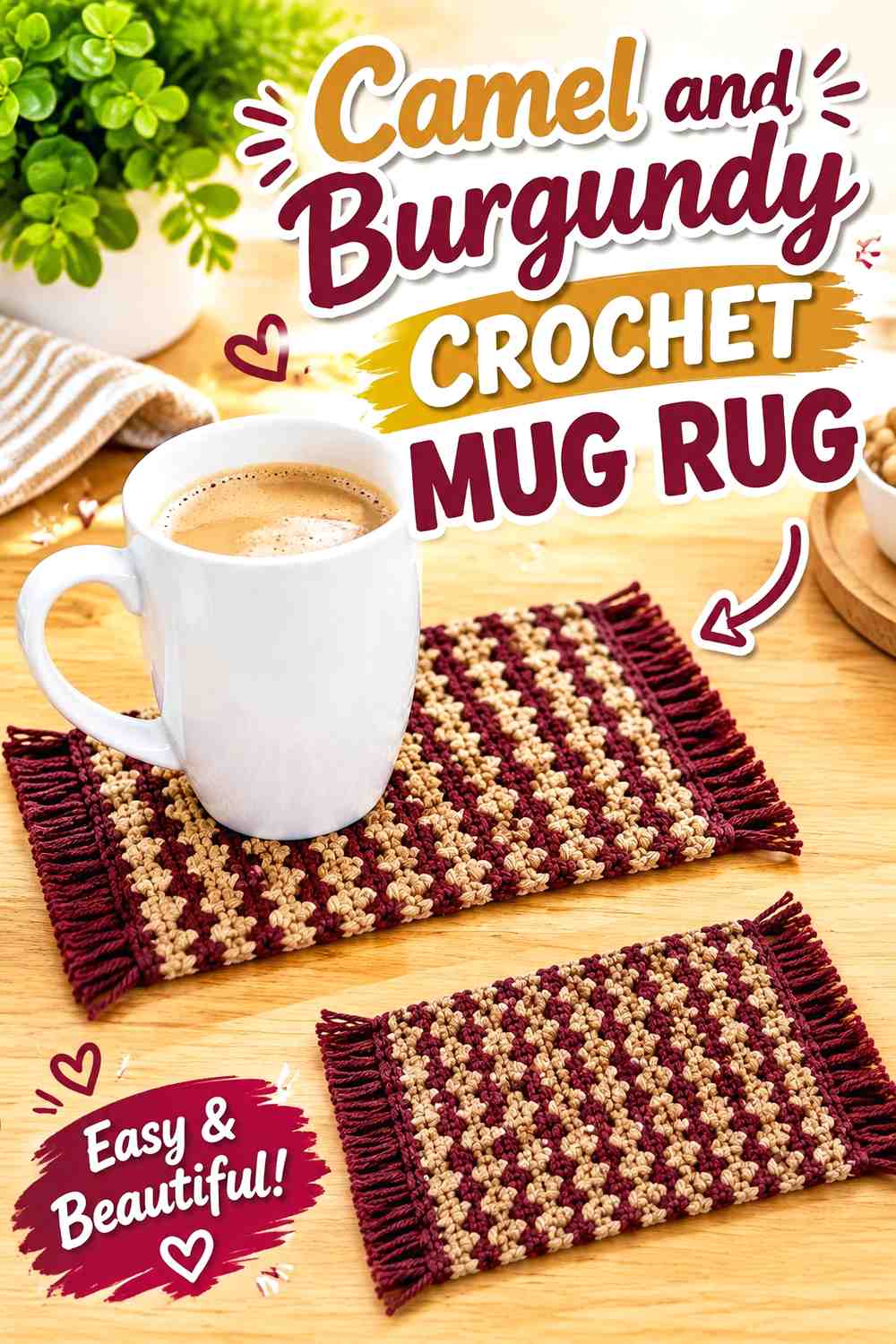
14. Camel And Burgundy Crochet Mug Rug
 SAVE
SAVEA mug rug is small enough to test burgundy and camel before using the combination on a larger project. Camel can form the main rectangle, while burgundy appears as a stripe, border, or fringe detail.
Camel Can Keep the Crochet Mug Rug Surface Open and Simple
Using camel for most of the mug rug leaves plenty of uninterrupted space for the stitch pattern. Because the project is small, one strong burgundy feature is often enough to establish the two-color combination.
Try the yarns together in this scale before using them on a blanket or garment. A small project can reveal whether the colors have the contrast you expected without requiring a large commitment.
Burgundy Can Define the Camel Crochet Mug Rug Fringe or Edge
Burgundy fringe can create a strong finishing detail because the yarn extends beyond the camel fabric rather than competing inside the main stitch pattern. A burgundy border offers a cleaner alternative when you want a more contained edge.
If you add both burgundy stripes and burgundy fringe, watch the proportion. On a small surface, too many dark details can quickly reduce camel from the main color to a narrow background.
Creator Credit: Crochet Jewel
Which Burgundy and Camel Crochet Direction Should You Choose?
Choose a burgundy-dominant layout when you want the finished crochet piece to have greater dark visual weight. The beanie, sweater, cardigan, vest, pillow, and basket all provide natural places to confine camel to edges or structural details.
Choose camel as the larger field when stitch texture or a lighter overall surface matters more. The scarf, cowl, shawl, tote, and mug rug can all use burgundy selectively without losing the identity of the color combination.
For a more graphic result, the blanket, granny square, bucket hat, and motif-based bag allow the two shades to occupy clearly separated blocks. Whatever arrangement you choose, compare the actual yarns rather than relying on the color names alone.
Conclusion
Burgundy and camel can move from understated to highly graphic depending on proportion and placement. A burgundy body with camel ribbing keeps the contrast controlled, while large alternating sections make both colors equally important. Camel-dominant surfaces are useful when you want a lighter appearance, and burgundy works especially well where a darker border, join, cuff, or motif needs definition.
Before starting a larger piece, make a small swatch with the exact yarns you plan to use. Check the colors together in ordinary lighting, look at their light-and-dark separation, and decide which one should lead. That simple decision makes it much easier to place burgundy and camel consistently across the rest of the project.
Frequently Asked Questions
Do burgundy and camel work together in crochet?
Yes. Burgundy provides a deeper red tone while camel contributes a warmer brown or tan direction. The combination can produce either strong or subtle contrast depending on the exact yarn shades you choose.
Should burgundy or camel be the dominant crochet color?
Either can lead. Burgundy is useful when you want more dark visual weight, while camel is useful when you want a lighter main surface. For garments, one practical option is a burgundy body with camel cuffs and edging; reversing those roles creates a noticeably different result.
How can I tell whether burgundy and camel have enough contrast?
Place the yarns together and view them from a distance. You can also photograph them in grayscale to compare their lightness. If they look almost identical in grayscale, small motifs or thin stripes may not separate clearly even though the hues are different.
Where should camel go in a burgundy crochet project?
Camel can work around borders, cuffs, ribbing, joins, handles, brims, motif centers, or other naturally separated sections. These locations allow the lighter color to create definition without breaking up the burgundy main surface unnecessarily.
Can I use equal amounts of burgundy and camel?
Yes, especially for stripes, checkerboard-style layouts, repeated motifs, or two-color granny squares. Equal coverage creates a stronger graphic effect than a dominant-and-accent arrangement, so test the layout first if you prefer a quieter result.
What can I substitute if my burgundy or camel yarn is unavailable?
Preserve the relationship between the colors rather than trying to match a commercial shade name exactly. For burgundy, choose another deep muted red or wine-like color with similar darkness. For camel, look for a warm tan or light brown that maintains the level of contrast you want against the burgundy.
Why does burgundy sometimes hide crochet texture?
Darker yarns can show less visible shadow between stitches in some lighting conditions. If texture is an important feature, work a swatch and inspect it in the lighting where the finished piece will usually be seen. You can also give highly textured areas more camel if that improves definition.