13 Crochet Christmas Wreath Ideas
Crochet Christmas wreaths can take very different forms. Some cover a firm ring and work as noticeable wall or door decor, while others are small enough for a Christmas tree, gift package, garland, or holiday card. There are also flatter designs that rely on decorative edging rather than a thick wreath base, plus spiral constructions that create their circular shape in a completely different way.
The 13 ideas below are organized around those practical differences. You can compare scale, support, embellishment, hanging style, texture, and how much structure each finished wreath needs. Each project is paired with an original YouTube tutorial, but the planning notes here focus on helping you choose and adapt the concept rather than replacing the creator’s construction instructions.
Quick List
- Crochet Leafy Ring Door Wreath
- Crochet Candy Cane Stripe Statement Wreath
- Crochet Bracelet-Ring Loop Wreath
- Crochet Vintage Spiral Wreath Ornament
- One-Round Crochet Christmas Wreath Ornament
- Crochet Wreath Appliqué for Gifts and Ornaments
- Crochet Lace-Edge Christmas Wreath Coaster
- Crochet Garland-Ready Mini Wreath
- Crochet Craft-Ring Wreath with Bow
- Crochet Two-Round Flat Wreath Ornament
- Crochet Mini Wreath Charm
- Crochet Two-Color Curly Wreath Ornament
- Crochet Holly-and-Berry Ring Wreath
Choose a Wreath by Display Scale, Not Just Color
Before comparing red, green, white, or metallic yarn, decide where the finished wreath will actually go. A wreath intended for a wall or door needs enough visual volume to remain noticeable from several feet away. Small tree ornaments have almost the opposite requirement: excessive bulk can hide neighboring ornaments or make a branch sag.
Gift toppers, appliqués, and garland pieces benefit from flatter constructions because they sit closer to another surface. A coaster needs to be flatter still, since stability matters more than creating a deep wreath profile. If you plan to adapt a tutorial, compare the finished project’s construction with your intended display rather than simply enlarging or shrinking it. A technique designed around a tiny rigid ring may behave very differently when scaled toward statement-wreath proportions.
Match Yarn and Structure to the Finished Job
A firm internal ring immediately controls the circular outline, making it useful when a clean wreath shape matters. Fully crocheted or spiral designs depend more heavily on stitch density, yarn behavior, joining, or additional support to maintain the circle.
Texture also changes scale. Leafy loops, ruffles, curlicues, and layered edging occupy more visual space than a smooth ring covering, even when their internal diameter is similar. If you substitute yarn, compare the resulting fabric before adding all the embellishments. A very soft fabric can emphasize drape, while a firmer fabric can make small decorative features read more clearly. For embellished wreaths, consider the combined weight of bows, beads, berries, bells, or appliqués instead of planning the base in isolation.
Plan Hanging, Embellishment, and Storage Together
The hanger is easy to treat as an afterthought, but its position can affect whether a small wreath hangs level. Before permanently attaching a large bow or clustered decorations, hold the piece by its intended hanging point and check the balance.
Seasonal storage matters too. Deep leaves, raised loops, wired curves, and glued embellishments can be crushed more easily than flat wreaths. If your wreath needs to pack into a holiday decoration box each year, removable or low-profile accents may be more convenient than a heavily dimensional arrangement.
For sets of ornaments or garland pieces, consistency also matters. Similar hanger lengths and similarly positioned bows create a more deliberate display even when the wreaths use different colors.
1. Crochet Leafy Ring Door Wreath

This wreath takes the idea beyond a tiny tree ornament by using a supported ring with prominent crochet leaf-like loops around the circumference. The tutorial covers the ring first, builds the dimensional foliage, and finishes with a dedicated hanging element, giving the finished piece the presence of seasonal home decor rather than a flat motif.
This is a strong direction when you want crochet itself to create most of the wreath’s volume. It can also provide a relatively neutral base for additional Christmas accents, since the textured green structure already supplies a recognizable wreath silhouette.
The Ring Support Makes This a Better Statement Piece
A rigid ring gives this style a dependable circle and supports dimensional crochet around the edge. That distinction matters if the wreath will be viewed on a wall or door, where a collapsed or uneven center is much more noticeable than it would be on a tiny ornament.
When adapting the idea, choose the supporting ring before planning decorative density. Increasing the base diameter without considering how much foliage surrounds it can leave the center looking disproportionately empty.
Leafy Loops Need Room to Stay Visible
The raised foliage is one of this wreath’s defining features, so decorations should complement rather than bury it. Large bows, clusters of ornaments, or several separate appliqués could cover enough of the crocheted leaves that the textural effect becomes secondary.
A useful checkpoint is to arrange potential decorations loosely on the finished base before attaching them. Look at the wreath from normal display distance, not only close up on a worktable.
Plan the Hanger Before Adding Extra Decor
Because this design already includes a substantial crocheted ring, the hanging point becomes part of the final balance. Add heavy-looking accents to one side and the wreath may appear visually tilted even when the ring itself hangs correctly.
Determine the top of the wreath first. Then temporarily place bows or other accents while it is hanging. That makes it easier to judge whether the finished arrangement still reads as an intentional circle.
Original Tutorial and Creator Credit
Creator: Secret Yarnery
2. Crochet Candy Cane Stripe Statement Wreath
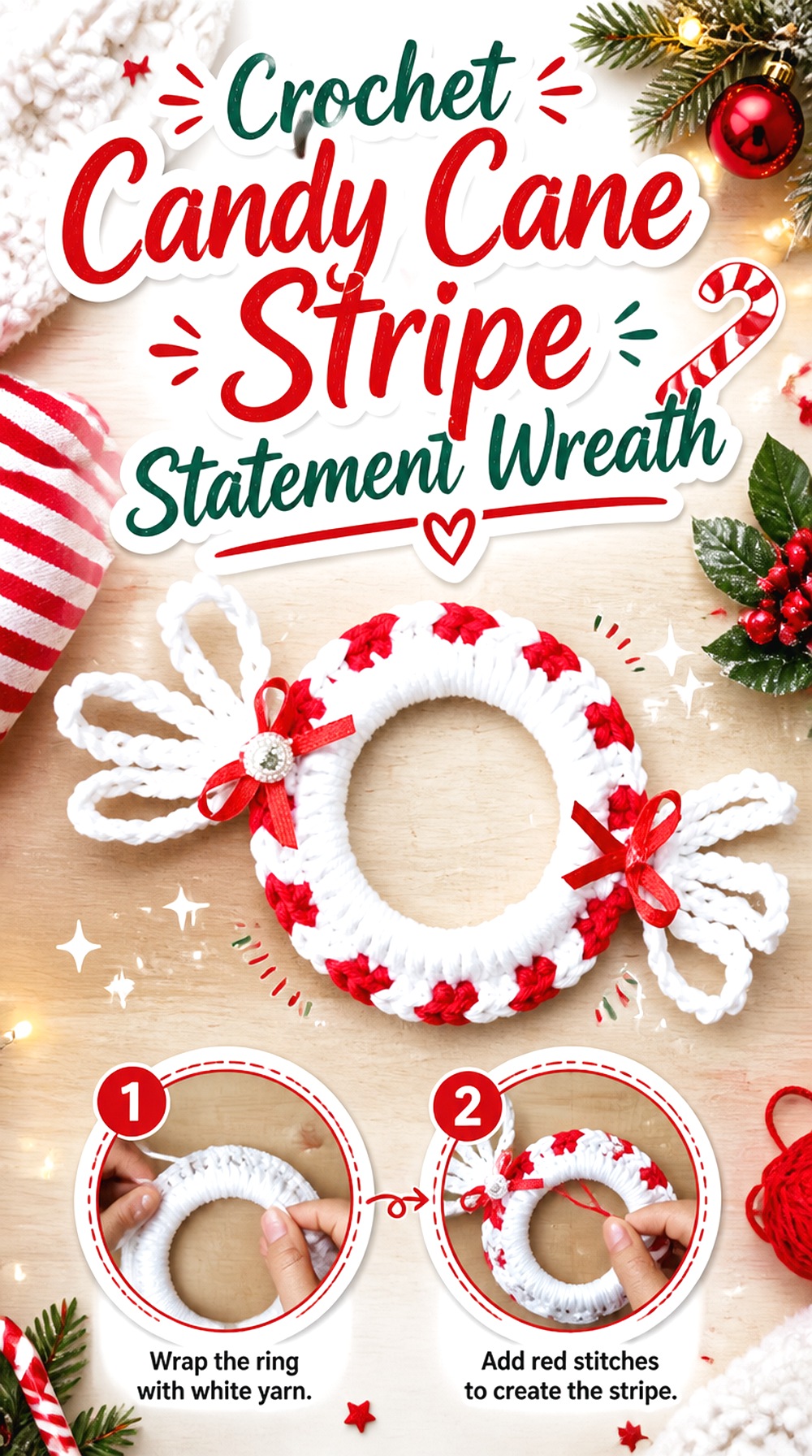
A red-and-white striped wreath moves the Christmas theme into the base itself rather than relying entirely on separate ornaments. Chaveiro Doce’s tutorial centers on a candy-cane-inspired circular wreath with alternating color treatment, added structure, and optional festive appliqués.
That makes this option visually different from a traditional green wreath. It is suited to readers who want the circular body to be the main decorative feature instead of simply becoming a background for greenery, flowers, or berries. The strong stripe pattern also means you can keep secondary embellishment comparatively restrained.
Red-and-White Striping Carries the Theme
With a candy-cane wreath, the color rhythm is doing much of the decorative work. Unevenly distributed stripes or an interruption at the join will be more noticeable than a minor variation in a solid-color wreath.
Before adding decorative pieces, look at the wreath as a complete circle and check whether the stripe pattern reads continuously. If it already has enough movement, one focal bow or small accent group may be more effective than filling every open area.
A Firm Base Helps the Stripe Pattern Read Cleanly
Striping is easiest to appreciate when the circular outline remains controlled. If the underlying wreath bends or becomes oval, the regularity of the red-and-white sections can exaggerate that distortion.
When substituting a support, check its shape before covering it. Also consider where the finished wreath will hang: a more structured base generally makes sense for a statement display, while a lighter support may be enough for a small interior decoration.
Keep Added Appliqués From Overcrowding the Circle
Candy-cane striping already creates high contrast. Adding multiple similarly bold appliqués can make the center and edge compete for attention.
Try arranging additional motifs without fastening them first. Keep enough visible striped area that viewers can still immediately identify the candy-cane concept. This is particularly useful if you want to personalize the wreath with a bow, miniature sweets, or another Christmas motif without losing the graphic base.
Original Tutorial and Creator Credit
Creator: Chaveiro Doce
3. Crochet Bracelet Ring Loop Wreath

Instead of beginning with a traditional wreath form, this version uses a small metal bracelet as its supporting ring. Naztazia also notes other possible ring-shaped substitutes, while the crochet adds a textured chain-loop edge around the covered center.
This construction makes sense for ornament-scale decorating because the hardware establishes the circle before the decorative crochet is added. It also creates a useful contrast within this collection: the ring remains relatively slim while the outer loops produce the visual fullness. That can work well when you want definition without the heavily padded appearance of a thick wreath form.
A Bracelet Gives the Ornament an Instant Frame
Repurposing a ring-shaped object removes much of the guesswork from forming a symmetrical center. That can be especially helpful for small decorations, where even minor irregularities are easy to notice.
The main planning decision is compatibility. A substitute ring needs enough space to crochet around comfortably, and its diameter determines the basic scale before any edging is added. Compare several rings side by side if you are making a coordinated ornament set.
Chain-Loop Edging Adds Volume Without a Thick Cover
The looped outside edge creates texture beyond the rigid circle rather than relying on a bulky wreath body. Visually, this gives the ornament a lighter outline than a thick padded ring.
That makes it a good candidate for tree branches, smaller wall displays, or gift decoration. When changing yarn, watch how firmly those loops hold their shape. Very limp loops may read differently from crisp, well-defined ones even when the underlying ring is unchanged.
Substitute Rings Should Be Checked Before Starting
The tutorial mentions alternatives to a bracelet, but not every circular object will behave identically. Thickness, flexibility, surface texture, and diameter all affect how easily crochet can be worked around the support.
Before committing your preferred yarn, make a short test section on the actual ring. Confirm that stitches stay where you place them and that the ring does not flex more than expected once you begin handling it.
Original Tutorial and Creator Credit
Creator: naztazia
4. Crochet Vintage Spiral Wreath Ornament
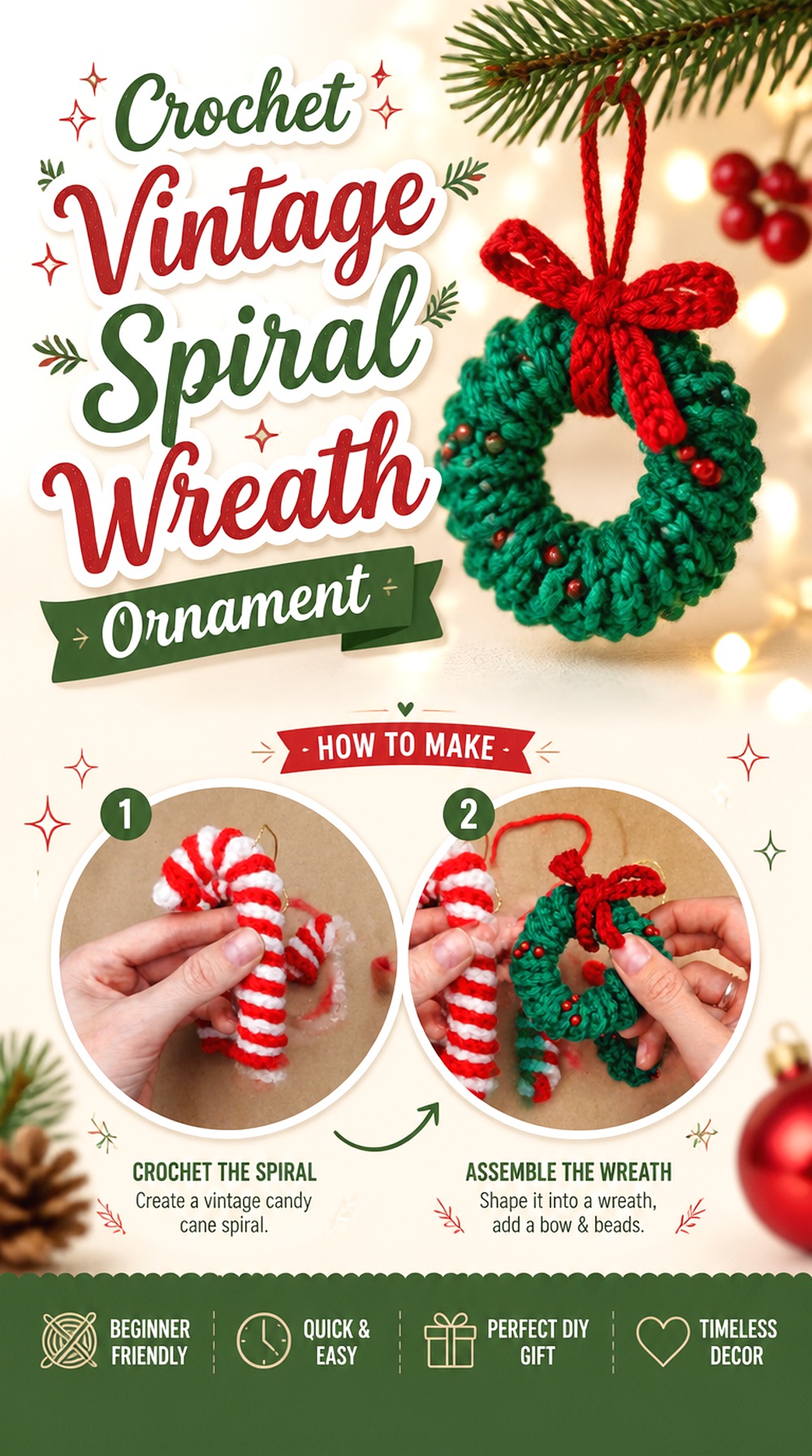
Made by Phia’s tutorial includes both a candy cane and wreath ornament and uses a spiral-based approach with additional craft materials such as pipe cleaners and beads. The finished concept has more of a vintage handmade-ornament character than a thick modern wreath form.
This option is useful if you want the crochet to twist and curve around support rather than simply covering a rigid ring. It also gives embellishments a more integrated role: beads and structural elements are part of the overall ornament language rather than decorations placed on a large green base after construction.
The Spiral Base Creates a Softer Vintage Outline
A spiral construction naturally produces more movement than a uniformly covered ring. That can give the wreath a playful handmade look, especially when contrasting colors or small decorative elements are incorporated.
When shaping the final circle, compare the spacing all the way around before securing everything permanently. One compressed section can make the ornament look heavier on one side, while overly loose spirals may expose more of the support than you intended.
Beads and Internal Support Change the Finish
This tutorial incorporates non-yarn materials, so the final character depends partly on those choices. Beads introduce hard reflective details, while flexible internal support can help maintain curved forms.
If you substitute embellishments, check both weight and attachment. A bead that looks small in the package may become visually dominant on an ornament-scale wreath. Likewise, any structural material should be fully concealed or intentionally incorporated into the finished appearance.
Original Tutorial and Creator Credit
Creator: Made by Phia
5. One Round Crochet Christmas Wreath Ornament

This Vicky Handmade tutorial stands apart because the wreath is presented as a one-round crochet ornament. That keeps the crochet component intentionally compact rather than building outward through many decorative layers.
A design like this makes sense when you need small Christmas pieces that do not dominate a tree, gift package, or small display. It also offers a useful planning lesson: extra rounds are not always necessary for an identifiable wreath. A clear circular opening, festive color, and deliberate hanger or accent can carry the theme with much less visual mass than a padded door-style wreath.
One-Round Construction Keeps the Shape Visually Light
With fewer layers of crochet, the open center remains an important part of the design. That negative space helps the ornament read as a wreath instead of becoming a solid circular motif.
If you adapt the concept with a thicker yarn, watch how quickly that central opening closes visually. A yarn substitution that seems minor can change the proportion between the inner hole and outer edge enough to alter the whole silhouette.
Use It Where a Flat Ornament Makes Sense
A compact wreath does not need the depth of a statement piece to be useful. Its flatter profile makes it more suitable for a crowded Christmas tree, small gift wrapping, or a grouping of several decorations.
Think about viewing distance when choosing colors. Fine stitch detail may disappear from across a room, but a clean contrast between wreath and bow or hanger can keep the small circular form easy to recognize.
Original Tutorial and Creator Credit
Creator: Vicky Handmade
6. Crochet Wreath Appliqué for Gifts and Ornaments
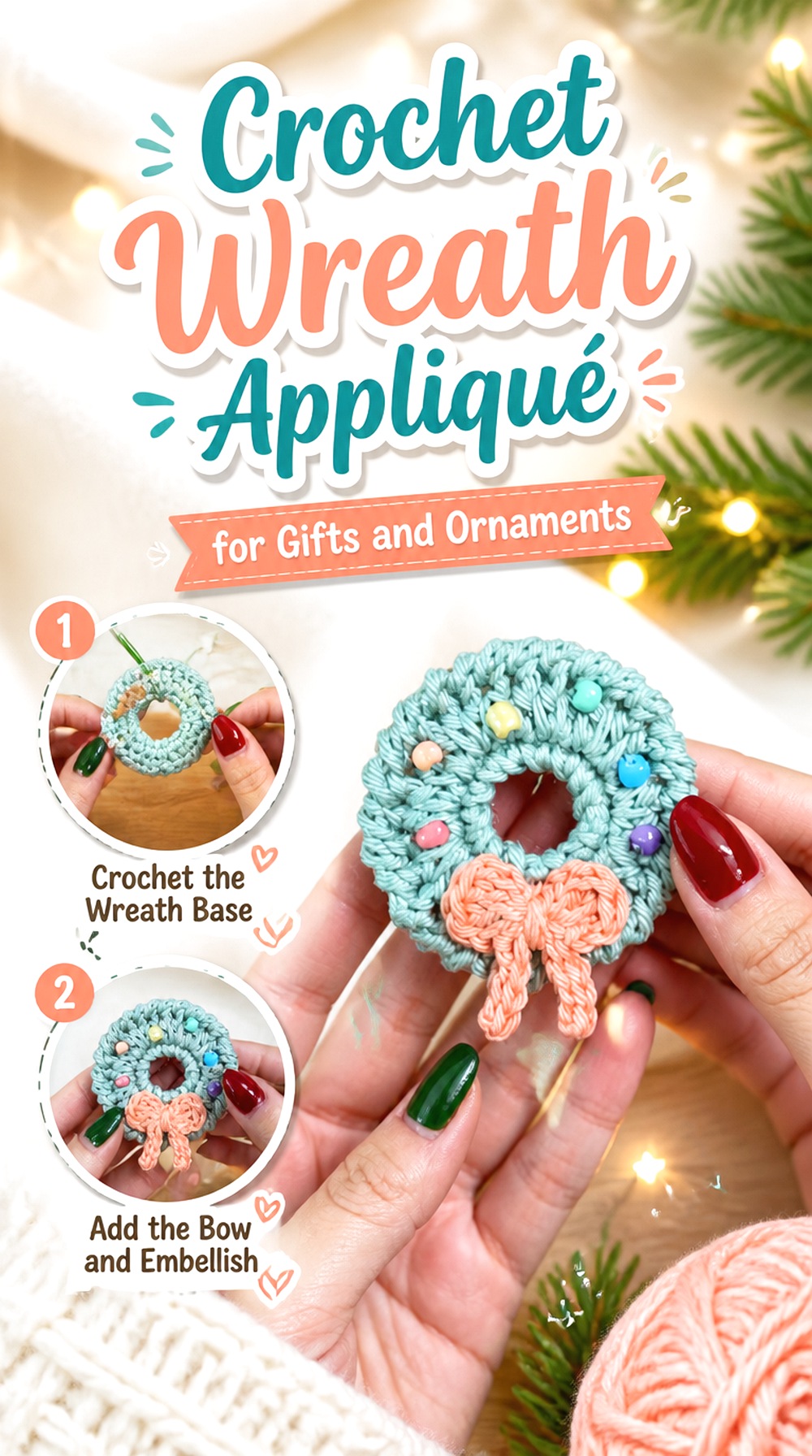
This wreath is deliberately designed as an appliqué, with the tutorial suggesting uses that include ornaments, pins, keychains, gifts, and cards. The project includes a separate bow and decorative finishing, making its flat format much more versatile than a dedicated door wreath.
Choose this direction if you want the wreath motif to become part of another item rather than always hanging independently. Its relatively flat surface can be attached to packaging, incorporated into a larger decoration, or finished with its own hanging method. That flexibility is its main advantage over thicker ring-based constructions.
The Flat Appliqué Format Expands How You Can Use It
A flat wreath can move between projects more easily than a rigid framed one. It can function as a small ornament one day and inspire an embellishment for a bag, gift, card, or holiday display another time.
Before attaching it permanently, decide whether the back will lie against fabric, paper, or another hard surface. The intended destination should influence how much bulk you allow in knots, sewn attachments, and decorative finishing.
Surface Details Matter More at This Small Scale
The tutorial incorporates a bow and additional surface decoration, so small changes can noticeably alter the finished balance. On an appliqué, there is less empty space to absorb oversized accents.
Lay out beads, embroidery, or other small decorations before securing them. If the center opening becomes difficult to distinguish, reduce the embellishment or move it outward. Preserving that open center is what keeps the small motif immediately readable as a wreath.
Finish the Back if It Will Be Seen
A wreath used as an ornament or keychain may rotate, unlike an appliqué permanently attached to a card. That means the reverse side can become part of the presentation.
Before choosing the finishing method, decide whether the back will remain exposed. Neatly managed yarn ends and unobtrusive attachment points matter more for a freely hanging decoration than for a motif that will be fixed permanently to another surface.
Original Tutorial and Creator Credit
Creator: olliehollycrochet
7. Crochet Lace Edge Christmas Wreath Coaster
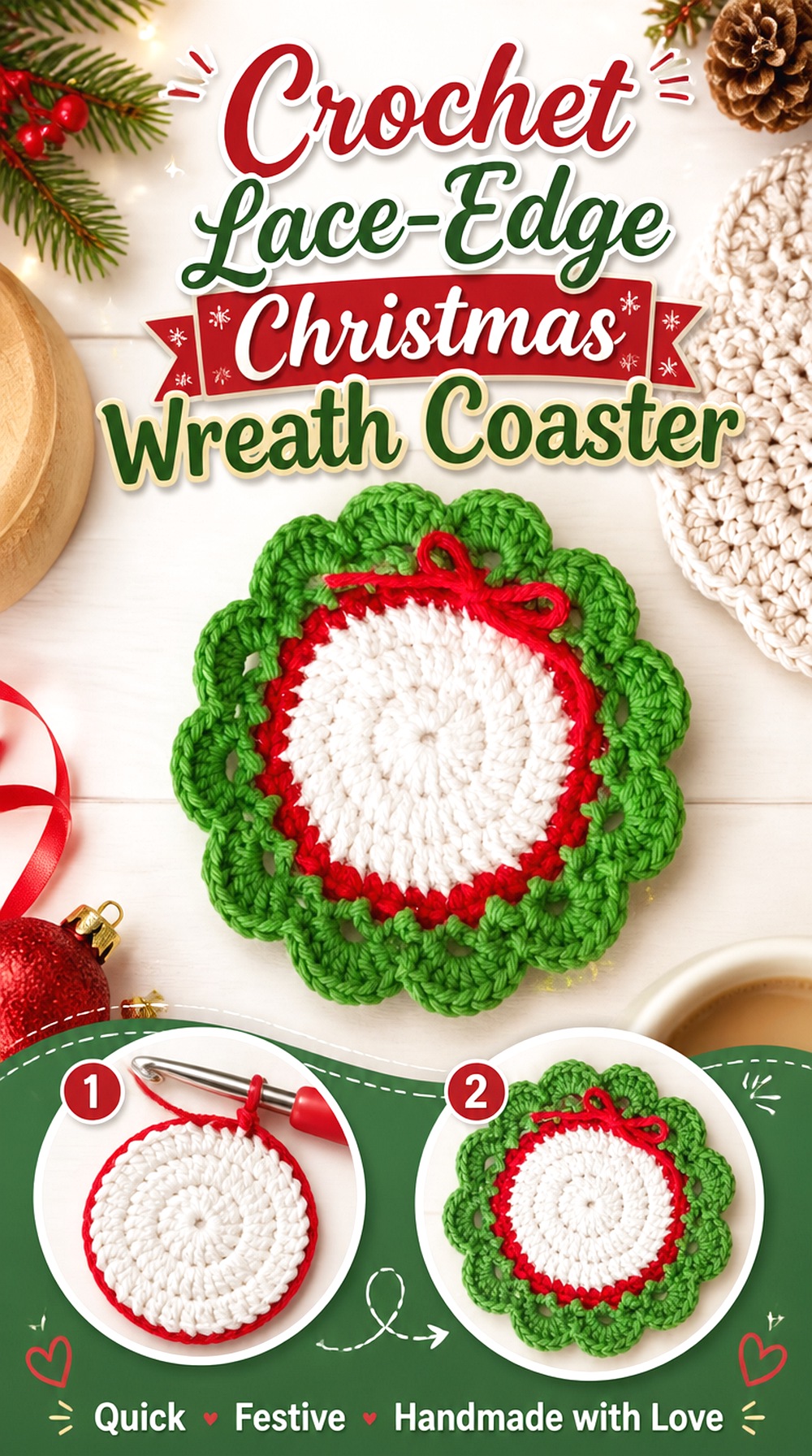
Not every wreath needs to hang. Ichigocrochet turns a lace-style coaster into Christmas wreath decor through festive colors and a ribbon accent, creating a functional tabletop interpretation of the wreath shape.
This is one of the most practical departures from the ornament-heavy ideas in the collection. Instead of working around a physical ring, the crochet itself forms a flat circular surface with a decorative outer edge. It suits holiday tables, drink stations, or small hostess-gift sets where Christmas imagery is useful but dangling ornaments would not be.
A Coaster Needs a Flatter Profile Than a Hanging Wreath
Depth that looks attractive on a wall decoration can make a coaster unstable. For this project type, the central surface needs to remain the functional priority while the wreath identity is carried around the perimeter.
If you adapt the colors or edging, set a cup or glass on the unfinished coaster before adding extra decorations. This simple check can reveal whether an embellishment is creeping too far into the area that needs to remain level.
Lace Edging Changes Both Look and Contact Area
The scalloped or lace-like outer treatment gives the piece its decorative outline, but it also extends the footprint beyond the central circle. That matters when arranging several coasters on a crowded holiday table.
If you make a set, block or shape them consistently so the outer edges read as coordinated pieces. Differences in tension become more visible when identical circular items are placed directly beside one another.
Keep Decorative Add-Ons Away From the Cup Zone
A ribbon helps communicate the wreath theme, but raised decorations should stay clear of the area where drinkware rests. The same principle applies if you add your own beads, tiny bells, or dimensional motifs.
Treat the functional center and decorative border as separate zones. That lets you personalize the wreath appearance while preserving the flat surface that distinguishes this project from purely hanging Christmas decorations.
Original Tutorial and Creator Credit
Creator: Ichigocrochet
8. Crochet Garland Ready Mini Wreath
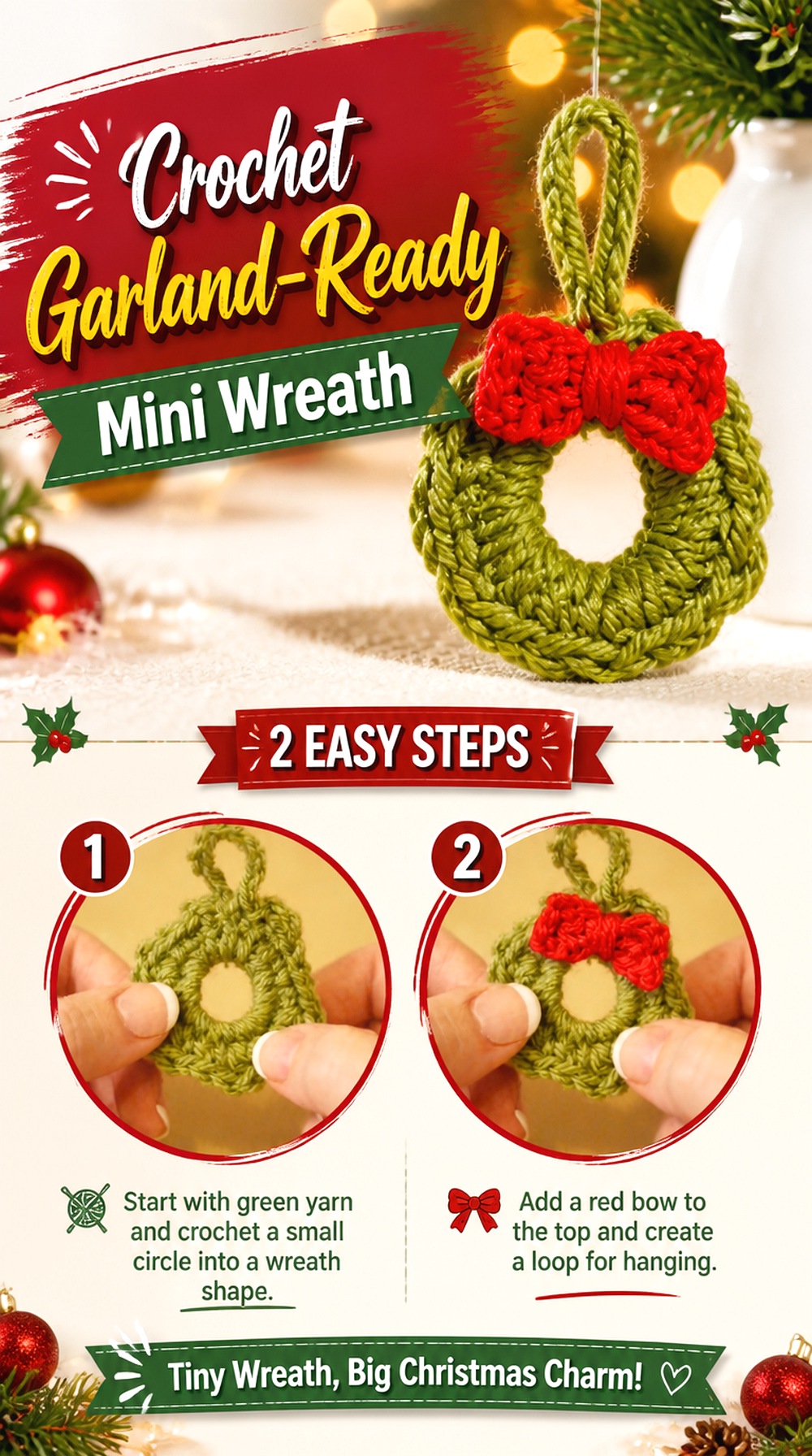
Bella Coco’s small Christmas wreath is specifically shown as a project that can be used on a tree or repeated for a garland. The tutorial also includes the separate crochet bow, making the accent part of the handmade piece rather than relying on purchased ribbon.
That repeated-display potential is what separates this idea from a single focal wreath. A group of matching minis can create rhythm across a mantel, tree, or doorway, while individual pieces still work on their own. It is especially useful when consistency across several small decorations matters more than creating one elaborate statement wreath.
Small Scale Makes Repetition Practical for Garlands
Garlands usually look more intentional when individual motifs are reasonably consistent in size and spacing. With repeated wreaths, differences that might disappear on separate tree branches become more noticeable when everything is lined up.
If you plan a set, finish one complete sample first. Use it as the visual reference for later pieces, checking overall diameter, bow size, and hanger placement rather than relying only on stitch tension.
The Separate Bow Becomes the Main Focal Point
On a small green wreath, a contrasting bow can carry a surprising amount of visual weight. A large bow creates a playful, heavily decorated look, while a smaller one leaves more of the circular body visible.
Before sewing it in place, move the bow around the wreath. Bottom-centered, top-centered, and slightly offset placement can make otherwise identical ornaments feel quite different without changing their crochet construction.
Keep Hangers Consistent Across a Set
If the wreaths will form a garland, you may not need individual tree-style hangers at all. If they will be used separately, inconsistent loops can make them sit at noticeably different heights.
Decide the display method before finishing the whole batch. Matching hanging loops, garland attachment points, or spacing will do more for a coordinated collection than trying to make every individual stitch look perfectly identical.
Original Tutorial and Creator Credit
Creator: Bella Coco
9. Crochet Craft Ring Wreath with Bow
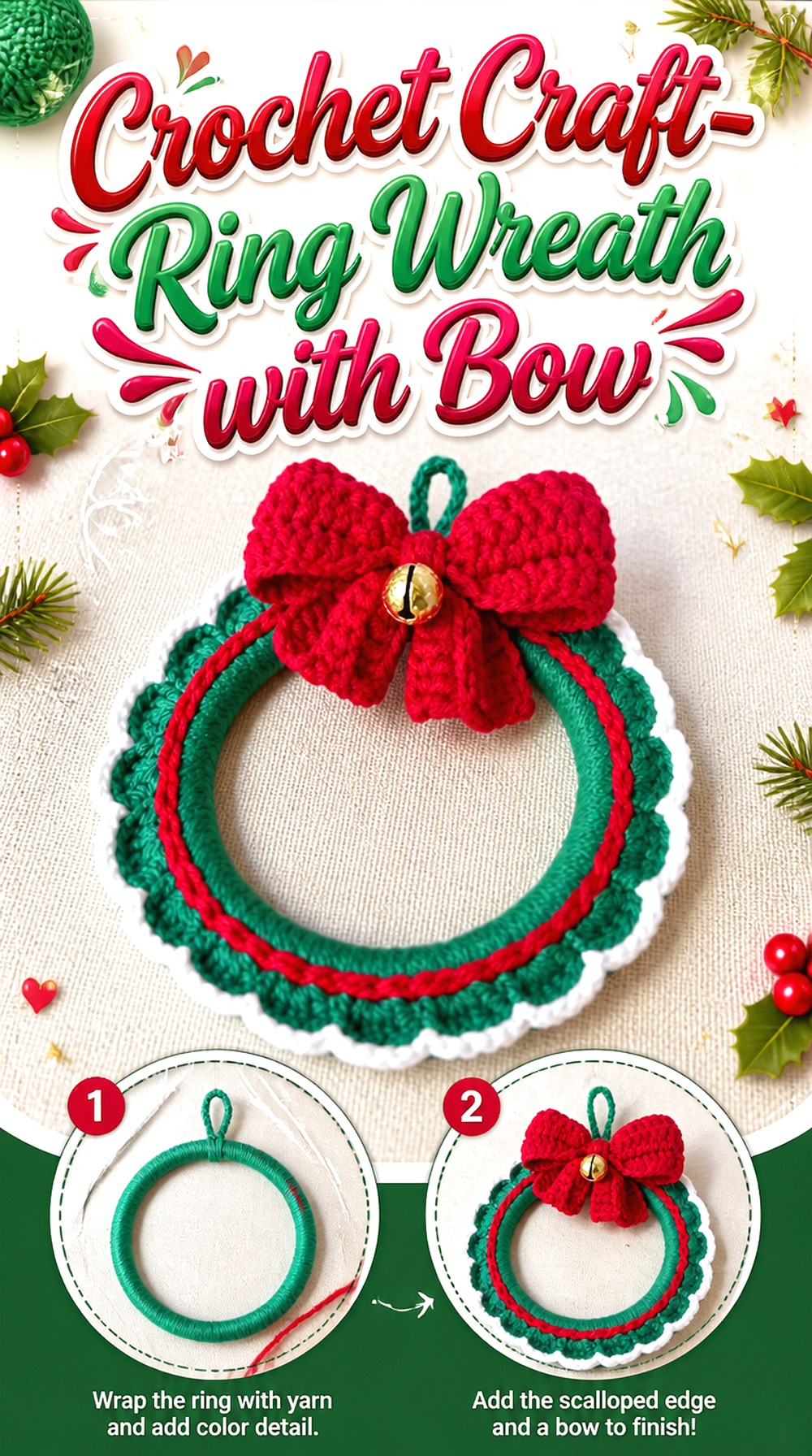
This small wreath from vvw.studio is constructed around a craft ring and includes a contrasting red detail, hanging loop, and separate bow. The firm circular support gives the miniature project a particularly tidy outline.
It works well when you want a polished ornament where the inner circle stays crisp instead of relying entirely on soft crochet to hold its shape. The combination of a ring, layered color, and bow also offers several customization points without needing to redesign the basic silhouette. That makes it useful for coordinated tree ornaments in different holiday palettes.
The Craft Ring Provides a Crisp Circular Silhouette
A rigid center can help a small wreath keep a clean opening, which is particularly noticeable at ornament scale. If you substitute a different ring, however, its diameter and thickness will change the relationship between the open center and crocheted edge.
Place your yarn against the ring before beginning. A very thick yarn around a small support may close the center visually, while a finer yarn can leave more of the underlying structure apparent.
The Contrasting Liner Can Define the Inner Edge
A narrow contrasting color around or near the center creates definition without needing a large external embellishment. It is a useful strategy if you want a multicolor wreath but prefer something more controlled than alternating stripes around the entire circumference.
Choose the accent by contrast rather than tradition alone. Red is seasonal, but the key visual job is separating the inner opening from the green or neutral body surrounding it.
Glue and Sewn Details Have Different Storage Trade-Offs
The tutorial’s materials include glue for assembly, while other wreath projects rely more heavily on sewing. If you adapt the finishing method, think about repeated seasonal handling.
Raised glued accents can be convenient for small decorations but may need protection from crushing in storage. Sewn pieces can be easier to reposition before final fastening. Whichever method you use, check attachment security before putting the ornament into a frequently handled holiday display.
Original Tutorial and Creator Credit
Creator: vvw.studio
10. Crochet Two Round Flat Wreath Ornament
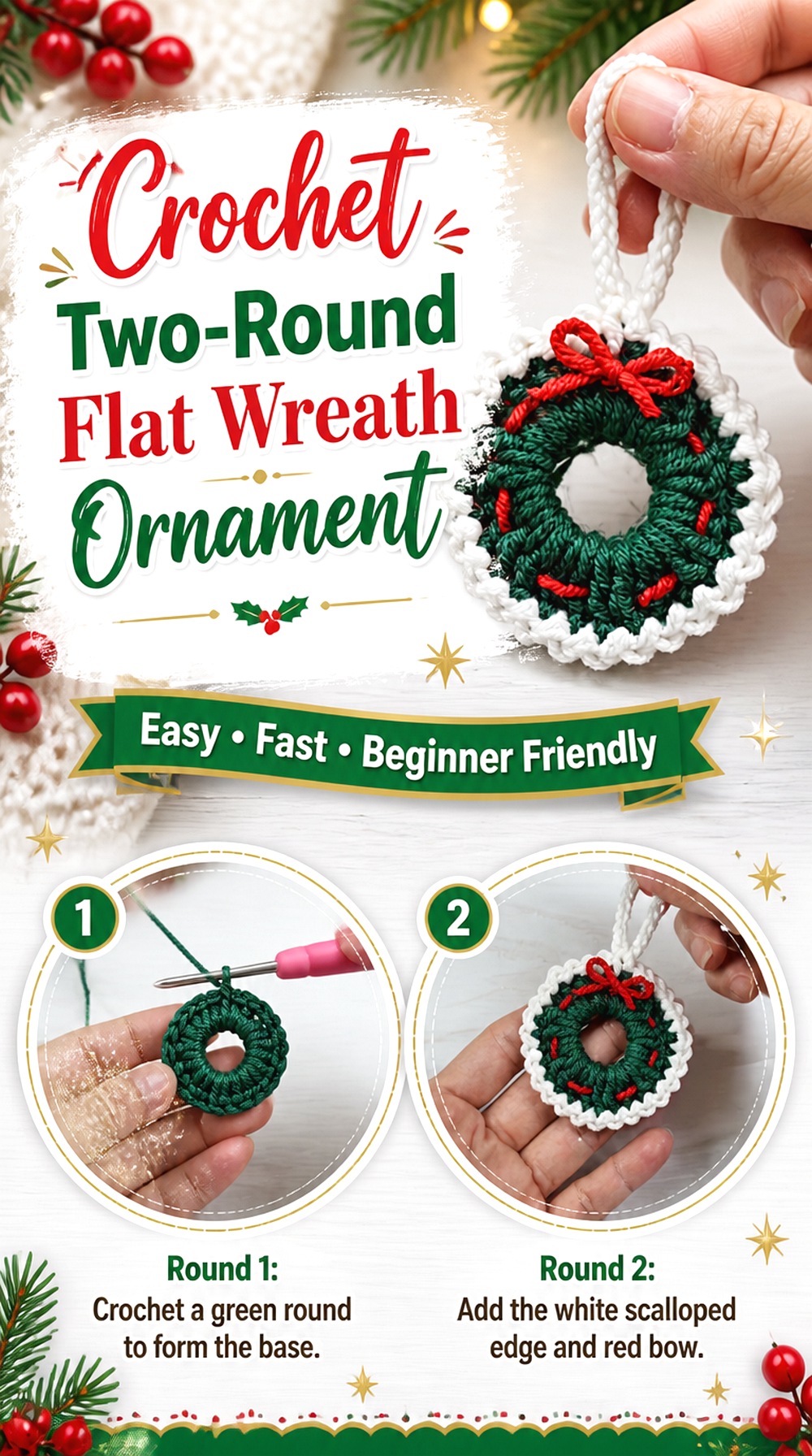
Crochet Musings presents a mini wreath formed in two crochet rounds, followed by a hanging loop and red decorative bow. The compact construction makes the finished piece closer to a flat motif than a padded ring ornament.
That makes this a useful choice for readers who want recognizable Christmas wreaths without introducing separate plastic or wooden forms. Because the crochet creates the circular silhouette itself, it can remain lightweight and relatively simple to store. It also offers an uncomplicated base for color experimentation, provided the center opening remains clear enough to preserve the wreath shape.
A Two-Round Build Keeps Bulk Under Control
With only a small amount of outward construction, the ornament stays visually compact. That is useful on trees where several handmade pieces need to share limited branch space.
When changing yarn weight, remember that the number of crochet rounds may stay the same while the final scale changes substantially. Make one sample first rather than assuming a thicker yarn will simply produce a slightly larger version with identical proportions.
Hanging Loop Placement Affects How the Wreath Sits
On a soft flat ornament, the hanging loop becomes one of the structural reference points. If it pulls from a slightly off-center location, the whole wreath can appear tilted.
Before securing the loop, hold the wreath vertically and identify its natural top. This is especially useful if the bow has already been positioned because the decoration itself may change which orientation looks most balanced.
A Small Bow Should Not Pull the Circle Off Balance
The red bow provides a clear Christmas accent, but its scale should remain appropriate to the wreath. A dense or oversized bow can visually turn a circular ornament into a bow with a small green background.
Place the bow temporarily and view the piece from several feet away. If the open center remains obvious, the wreath identity is still doing its job. If not, reduce or reposition the accent.
Original Tutorial and Creator Credit
Creator: Crochet Musings
11. Crochet Mini Wreath Charm
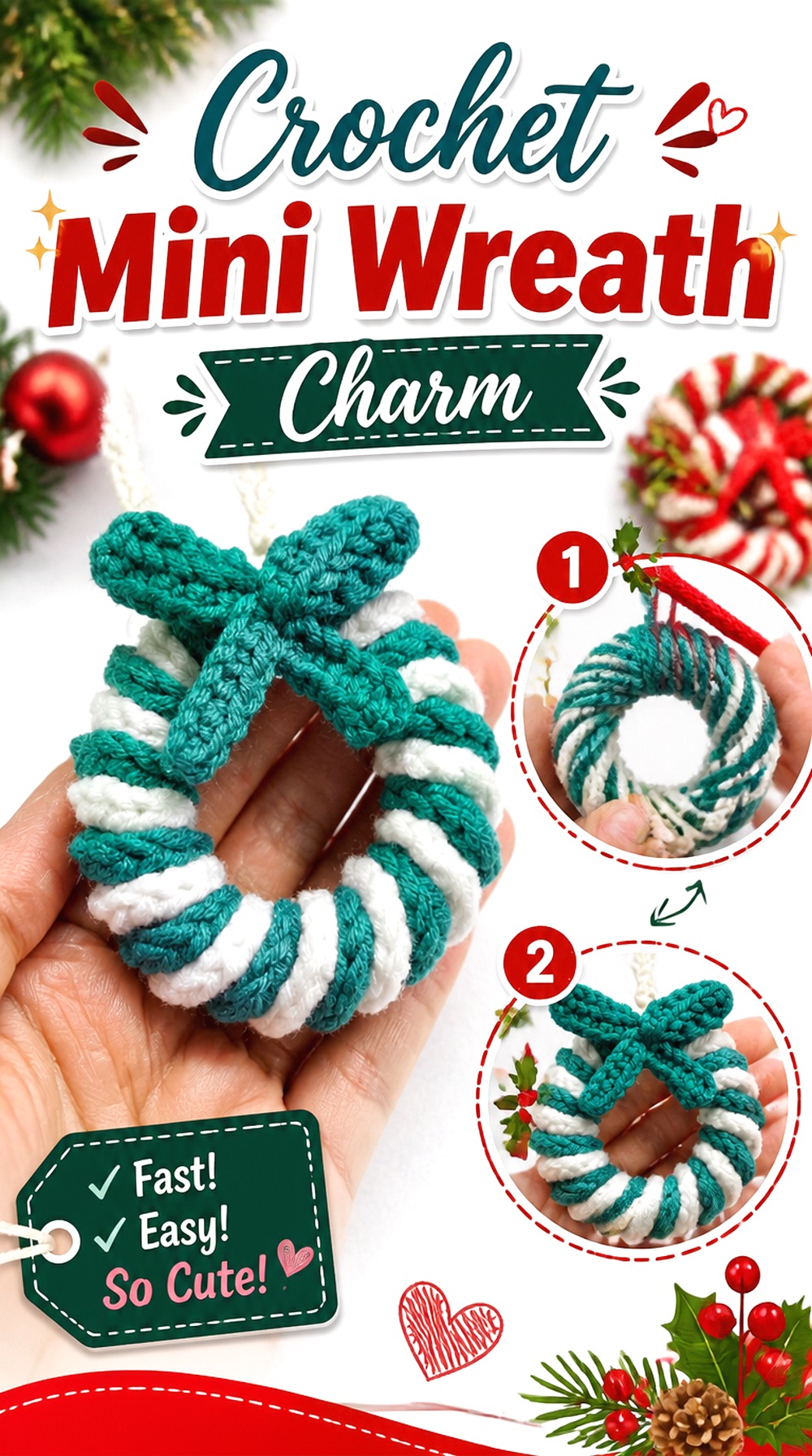
Samia Alexan crochet’s tutorial presents a miniature wreath that can be used as a Christmas ornament and also suggests small-scale uses such as a keychain. That gives this idea a more portable role than wreaths designed exclusively for walls or trees.
The distinction matters because an item used as a charm will be handled more often than a decoration that hangs untouched for a month. Scale, attachment, and yarn ends therefore become more important considerations. It is a practical concept if you like Christmas crochet that can move beyond the tree into bags, small gifts, or other personal accessories.
Charm Scale Changes Where the Wreath Can Be Used
A miniature wreath is easier to incorporate into places where a traditional ornament would feel oversized. The trade-off is that every decorative element occupies a larger percentage of the finished surface.
Choose one primary focal detail rather than automatically adding several. On a tiny wreath, even a modest bow, bead, or color block can provide enough contrast to communicate the holiday theme.
Check Hardware if You Turn It Into a Keychain
A hanging loop made for a Christmas branch and an attachment intended for everyday handling do different jobs. If you adapt the wreath into a bag charm or keychain, evaluate the connection between crochet and hardware rather than assuming the ornament loop is sufficient.
The goal is not to change the creator’s crochet construction, but to match the final attachment method to the way you expect to use the finished piece.
Softer Yarn Can Collapse Without Enough Definition
Small wreaths rely heavily on a recognizable center opening. If the yarn is extremely soft relative to the scale, the circle may fold or lose definition when handled.
After making the body but before adding decorations, hold it vertically and check its outline. If the wreath is intended only for a tree, slight softness may be fine. A frequently handled charm benefits more from maintaining a clearly defined shape.
Original Tutorial and Creator Credit
Creator: Samia Alexan crochet
12. Crochet Two Color Curly Wreath Ornament

Kimcraft’s wreath creates its striped effect through two separate crochet spirals that are combined and shaped around wire, rather than changing colors repeatedly around a conventional wreath ring. The tutorial also allows the general concept to be adjusted in scale.
That construction makes this one of the more structurally distinctive wreaths in the roundup. The twisting colors resemble Christmas candy without requiring a broad padded base. It is a useful choice when you want the outer edge itself to look animated and dimensional while still keeping a clearly open center.
Intertwined Curlicues Create the Stripe Instead of Color Changes
Because separate spirals produce the alternating colors, the finished stripe rhythm depends on how evenly those pieces twist together. The join and overall spacing therefore deserve attention before final fastening.
Shape the full wreath on a flat surface and compare all sides. If one color dominates a section, adjust the spirals before securing the circle. This gives you control over the visual balance without altering the crochet sequence itself.
Wire Support Makes Shape Planning Important
Flexible internal support allows a long crocheted form to become a controlled circle, but it also means the finished outline should be planned carefully. An uneven bend can create a noticeable flat spot.
Form the circle gradually rather than sharply bending one location. Also check that no structural material remains exposed where it could distract from the yarn surface. The crochet and support should read as one finished ornament.
This Construction Adapts Well to Different Display Scales
The spiral idea does not depend on a fixed commercial wreath form, so it offers more freedom in deciding the final circle. However, changing scale also changes how much spiral length is needed and how prominent the twist appears.
Rather than aiming immediately for a large wreath, create a small sample of the combined spirals first. That will show whether your yarn produces the stripe density and volume you want.
Original Tutorial and Creator Credit
Creator: kimcraft
13. Crochet Holly and Berry Ring Wreath

This final option leans into traditional botanical Christmas imagery. Make It Yourself By Papari builds a small ring-based wreath decorated with crochet holly leaves and berries, creating a stronger focal motif than a simple bow-only ornament.
It works particularly well if you want the wreath to look decorated even without added ribbon, beads, or purchased ornaments. Holly also introduces a different type of visual layering: instead of texture appearing evenly around the entire circumference, attention can be concentrated around a deliberate leaf-and-berry grouping.
Holly Leaves Give the Wreath a Botanical Focal Point
Holly immediately distinguishes this wreath from designs that rely mostly on edging or striping. Because leaves project beyond the circular body, their orientation can change the apparent width and balance of the piece.
Arrange them before securing the final placement. A symmetrical cluster feels formal, while a slightly offset arrangement can create more movement. Either approach works better when the open center remains clearly visible.
Berry Placement Works Best as an Accent
Red berries provide strong contrast against green crochet, so a small amount can have significant visual impact. Increasing their number does not automatically make the wreath look more festive; it can instead obscure the leaf shapes that make the holly recognizable.
View the cluster from display distance and check whether you see leaves first, berries first, or a balanced combination. Adjust placement according to the effect you prefer.
Ring Choice Sets the Visual Weight of the Finished Piece
The tutorial uses a ring beneath the crochet, which means the support establishes scale before the holly details are added. A larger or thicker substitute would require the botanical accents to compete with more visible wreath body.
Choose the base with the final proportion in mind. For an ornament, leaves can remain a prominent focal feature. On a larger wreath, similarly small motifs may look more like isolated accents than a defining design element.
Original Tutorial and Creator Credit
Creator: Make It Yourself By Papari
Which Crochet Christmas Wreath Style Fits Your Display?
| If you want… | Strong options from this list | Main planning point |
|---|---|---|
| A larger focal decoration | Leafy Ring Door Wreath, Candy Cane Stripe Statement Wreath | Prioritize support, balance, and visible texture |
| Crisp rigid-ring ornaments | Bracelet-Ring Loop Wreath, Craft-Ring Wreath, Holly-and-Berry Ring Wreath | Choose the ring before judging final scale |
| Flat lightweight pieces | One-Round Wreath, Wreath Appliqué, Two-Round Flat Wreath | Protect the center opening and avoid excess bulk |
| Repeated tree or garland decor | Vintage Spiral Wreath, Garland-Ready Mini Wreath, Mini Wreath Charm, Two-Color Curly Wreath | Make one finished sample before producing a set |
| Functional holiday decor | Lace-Edge Wreath Coaster | Keep the central contact surface flat |
Conclusion
The right crochet Christmas wreath depends more on its job than on a particular red-and-green color combination. For a noticeable wall or door display, the supported leafy and candy-cane options provide more visual volume. Ring-based designs keep smaller ornaments crisp, while flat wreaths are easier to use on gifts, garlands, cards, or crowded trees. The spiral and curly constructions are worth considering when you want the yarn itself to create the shape and movement.
Whichever direction fits your display, decide on scale, support, hanger placement, and embellishment before making several copies. Use the original tutorials linked above for each creator’s exact construction details.
Frequently Asked Questions
What makes a crochet Christmas wreath suitable for a door instead of a Christmas tree?
Scale and support are the biggest differences. A door or wall wreath needs enough overall volume to remain visible from a distance and usually benefits from a firm circular structure. Tree ornaments can be much flatter and lighter. Before enlarging an ornament tutorial for a door, consider whether the original construction can support the added yarn and decorations without sagging or losing its circular outline.
Do crochet Christmas wreath ornaments always need a rigid ring?
No. Several styles in this collection form their circles entirely through crochet, while others use bracelets, craft rings, wire, or other supports. A ring is useful when you want a consistently crisp center. A ringless design may be lighter and easier to store, but its shape depends more heavily on stitch structure, yarn behavior, finishing, and how the ornament is hung.
How can I keep a crochet wreath from looking oval or uneven?
Check the circle before attaching permanent decorations. For rigid-ring designs, confirm that crochet is distributed evenly around the support. For soft or spiral wreaths, shape the finished body on a flat surface and compare the diameter in several directions. Also hang the wreath temporarily. A piece that looks round on a table may appear tilted once a bow or embellishment changes the visual balance.
Can I turn small crochet wreath ornaments into a garland?
Yes, provided the individual pieces are suitable for repeated display. Make one complete sample first, including its bow and finishing, then decide how much space you want between wreaths. Consistency in overall diameter and attachment placement matters more in a garland because the motifs sit side by side. You can also omit individual ornament loops if the garland cord itself will provide the support.
Should I add lots of beads, berries, bows, or bells to a small wreath?
Not automatically. Small wreaths have limited surface area, so one accent can occupy much more visual space than it would on a door wreath. Arrange decorations temporarily before fastening them and make sure the central opening still reads clearly. If you use beads, bells, or other non-yarn pieces, also consider their weight and how securely they need to be attached for the wreath’s intended use.
How should crochet Christmas wreaths be stored between holiday seasons?
Store them in a way that protects the feature most likely to deform. Flat motifs can usually be kept level, while dimensional leaves, loops, bows, and spiral edges need enough surrounding space to avoid being crushed. Rigid-ring wreaths should not be packed under heavy decorations that could bend attached details. Before putting them away, check that removable embellishments and hanging loops are not caught around neighboring items.