16 Crochet Snowflake Garland Ideas for Winter and Christmas Decor
A crochet snowflake garland can be almost weightless and lacy, bold enough to become the main decoration on a wall, or compact enough to wrap around a small tree or shelf. The biggest differences are not simply color. Snowflake scale, yarn body, motif density, blocking, spacing, and the way individual flakes connect all change how the finished strand hangs.
The 16 ideas below use verified video tutorials from different crochet creators. Some tutorials demonstrate a complete garland, while others teach individual snowflakes that can be repeated and attached to your own cord or hanging system. That distinction is useful: you can choose the snowflake design first, then decide whether you want a neat repeating strand, a mixed snowstorm effect, removable ornaments, or a dramatic seasonal display.
Quick List
- Crochet Linked Snowflake Mantel Garland
- Crochet Openwork Snowflake Window Garland
- Crochet Even-Repeat Snowflake Tree Garland
- Crochet Decorative Snowflake Doorway Garland
- Crochet Flat Appliqué Snowflake Ribbon Garland
- Crochet Removable Hanging-Loop Snowflake Garland
- Crochet Mixed-Design Snowstorm Garland
- Crochet Glitter-Finish Snowflake Garland
- Crochet Cotton Snowflake Suncatcher Garland
- Crochet Tiny Snowflake Accent Garland
- Crochet Layered Snowflake Motif Garland
- Crochet Mini Two-Round Snowflake Shelf Garland
- Crochet Adjustable-Scale Snowflake Cascade Garland
- Crochet Soft Winter Snowflake Display Garland
- Crochet Oversized Statement Snowflake Garland
- Crochet Classic Six-Point Snowflake Garland
Plan Snowflake Scale and Spacing Before Making the Whole Strand
A single crochet snowflake can look balanced on its own but feel crowded once several motifs share one cord. Make and finish one sample before committing to the full garland. Measure its blocked width, then place paper markers or the finished sample along the intended mantel, shelf, doorway, or window to judge the visual rhythm.
For example, a garland using compact motifs can handle closer repetition without appearing heavy. Large or highly detailed flakes generally need more visual space around them. Mixed-size arrangements work differently again: rather than aiming for identical gaps, distribute the largest motifs first and use smaller flakes to fill empty areas. Remember that the hanging cord also contributes to the overall look. A thick contrasting cord becomes part of the design, while a finer coordinating strand lets the snowflakes remain the focus.
Choose Yarn for the Way You Want the Snowflakes to Hang
Yarn choice affects more than the finished color. Fine thread or lightweight yarn can emphasize open spaces and delicate points, but a soft motif may need careful blocking or stiffening to maintain a crisp silhouette. A more substantial cotton can give a snowflake additional body, which may reduce how much extra stiffening you want.
Before changing the yarn used in a tutorial, make one sample. A thicker substitute can enlarge open spaces, broaden points, and make the entire garland visually heavier. A very fine substitute does the opposite and may make the strand look sparse unless you increase the number of motifs. Metallic strands and glitter finishes can add reflected light, but they work best as accents when stitch definition is still easy to see. Always check the care instructions for the actual yarn you select.
Block the Snowflakes Before Finalizing the Garland
Blocking is especially useful when the design depends on evenly spaced points, picots, long chains, or open sections. Shape each motif independently before permanently attaching it to the garland so you can correct uneven arms without fighting the weight of the entire strand.
Stiffening is a separate choice. Some tutorials specifically demonstrate it because a firmer snowflake maintains its shape while hanging. Other motifs may have enough structure for the display you want without additional treatment. If you use starch, fabric stiffener, glue mixture, or another product, follow that product’s directions and test it on a spare sample first. For reusable seasonal decor, also consider storage: completely dry the motifs before packing them, and store elaborate points where they will not be crushed.
1. Crochet Linked Snowflake Mantel Garland
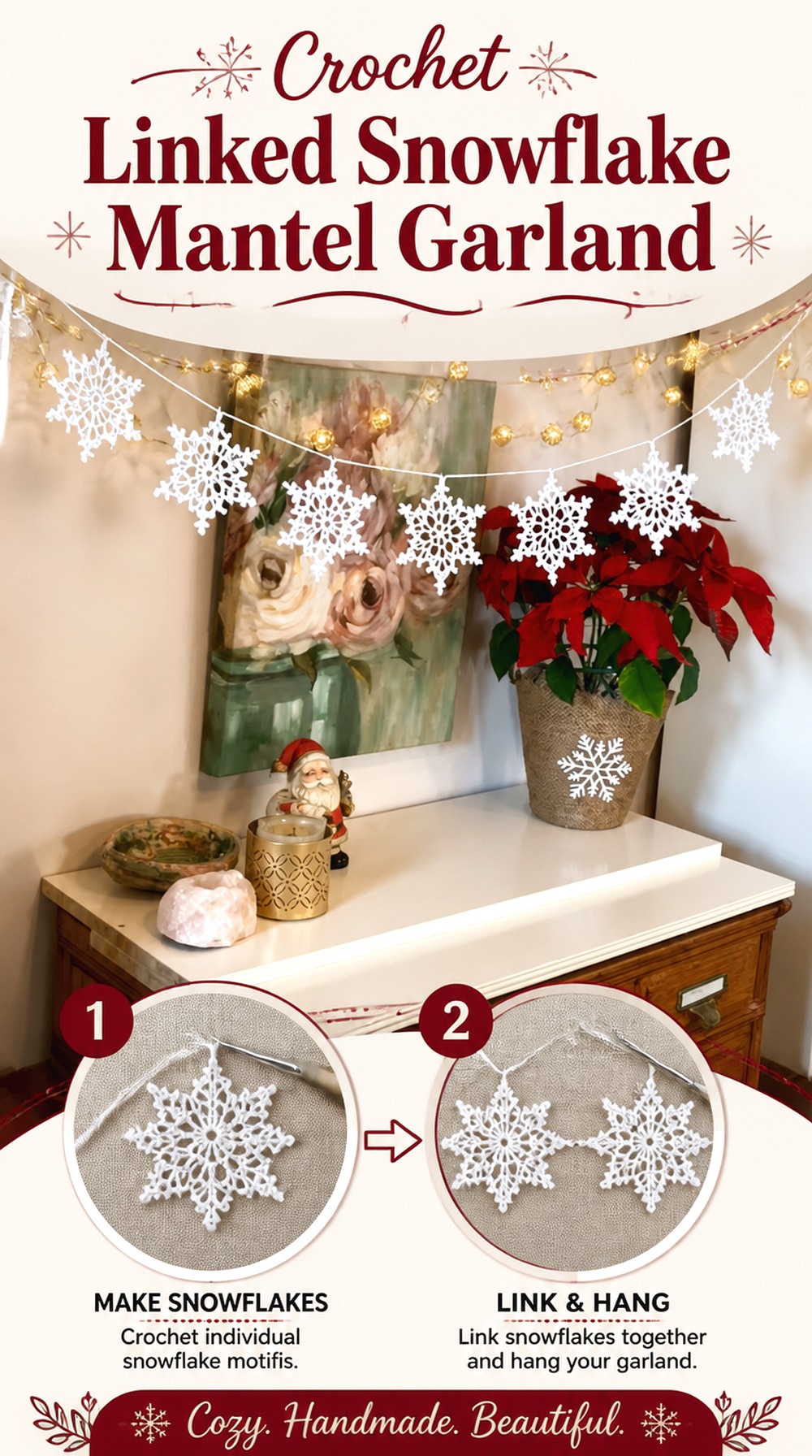
This version is for readers who want the tutorial to address the garland itself rather than stopping at an individual ornament. The repeated snowflakes are connected into one coordinated strand, creating an orderly winter decoration that works particularly well across a mantel, shelf, or horizontal wall area.
The main advantage is consistency. Instead of choosing a separate hanging method after finishing the motifs, you can see how the snowflakes and connecting chain relate as one display. It is a good reference when you want the cord to look like part of the crochet rather than an added ribbon or purchased string.
A Continuous Crochet Connection Creates a Unified Look
A crocheted connecting strand keeps the fiber, texture, and visual weight consistent from one end of the garland to the other. That can be preferable to ribbon when you want a quieter handmade finish.
Before committing to the final connection, arrange the completed flakes on a flat surface. This lets you evaluate whether the intended spacing gives each motif enough room to show its points clearly.
Firm Flakes Hang More Predictably Below the Cord
This tutorial also addresses stiffening, which matters when motifs hang beneath a flexible strand. Soft points can fold or twist forward, particularly when the garland is handled during installation.
If you prefer an unstiffened look, test one snowflake on the actual cord first. If its outline collapses more than you like, you can make the finishing decision before treating every motif.
Measure the Display Area Before Building Extra Length
A mantel garland does not necessarily need to end exactly at the mantel edges. You might prefer a straight horizontal line, shallow center dip, or extra length that falls slightly at each side.
Mock up that silhouette with ordinary string first. The test gives you a practical target without requiring a creator-specific stitch count or number of snowflakes.
Original Tutorial and Creator Credit
Creator: Anita Louise Crochet
2. Crochet Openwork Snowflake Window Garland
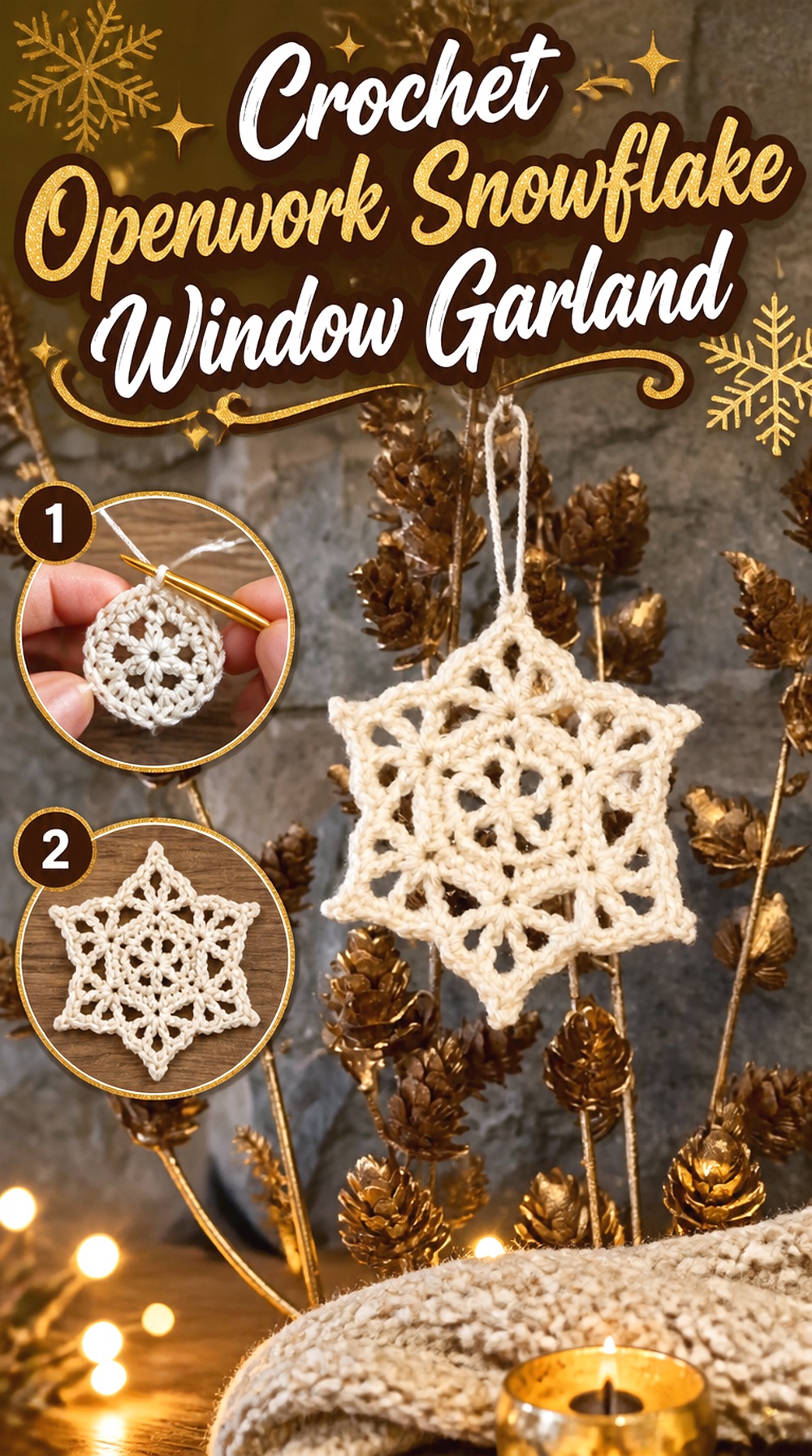
A window is a natural place for an airy crochet snowflake because daylight can show the spaces between the stitches. For this idea, repeat an ornament-style snowflake across a simple strand and allow enough empty space between motifs for each outline to remain readable against the glass.
This approach suits a lighter visual style than a densely packed mantel garland. It can run horizontally across the top of a window or form a shallow swag. The source tutorial includes finishing and shaping, making it particularly relevant when the crispness of the individual snowflakes matters as much as the connecting cord.
Shaping Makes the Outer Silhouette More Important
An open snowflake can lose much of its character when the points dry in different directions. Shape the motifs before deciding on their final spacing, because their finished width may differ from the relaxed, just-crocheted form.
Place several blocked pieces side by side and check the negative space between them. A little breathing room can prevent individual points from visually merging.
Keep the Garland Cord Visually Light
A heavy cord can compete with an openwork motif. For a window display, consider a connection that is visually quieter than the flakes unless a strong horizontal line is intentionally part of your design.
Also check the attachment points before hanging. Connecting every motif at the same corresponding point helps keep the strand visually level.
Original Tutorial and Creator Credit
Creator: Pattern and Craft
3. Crochet Even Repeat Snowflake Tree Garland

Instead of mixing several shapes, this garland uses one snowflake design repeatedly to create a controlled rhythm. That makes it well suited to wrapping around a Christmas tree, where the strand is already competing visually with branches, lights, and ornaments.
The tutorial demonstrates a specific standalone snowflake design from Yarnspirations. For a garland adaptation, the useful editorial choice is repetition: keep the yarn, finishing, orientation, and attachment point consistent so the motifs read as a deliberate sequence while the strand curves around the tree. Test a short section before making the full length because spacing that looks generous on a table can appear different once wrapped around branches.
Consistent Blocking Keeps the Repetition Calm
When every motif is the same design, small differences become more noticeable. Block the snowflakes to comparable widths and check that the major points face the same direction before attaching them.
You do not need mathematical perfection, but a common outer shape prevents the strand from looking as though some motifs have been stretched while others have been compressed.
Let the Tree Determine the Final Spacing
A tree garland bends around a three-dimensional form, so do not assume the gap that works on a mantel will work here. Temporarily place a few finished motifs on the tree and view them from several angles.
If nearby snowflakes overlap or disappear into the branches, widening the spacing may be more effective than making smaller motifs.
The Connecting Strand Should Tolerate Curves
A stiff connection may look neat while flat but resist the repeated curves required around a tree. A more flexible crocheted chain or lightweight cord can follow the branches more naturally.
Whichever connection you use, avoid pulling it so tightly that the snowflakes tilt or curl around the attachment point.
Original Tutorial and Creator Credit
Creator: The Crochet Crowd
4. Crochet Decorative Snowflake Doorway Garland

A doorway gives you more vertical and horizontal space than a shelf, so this idea treats the snowflakes as a loose frame rather than a tightly packed line. Repeat the HappyBerry snowflake along a cord that can span the top of the opening, or let the ends extend downward if your placement allows it safely.
Doorway garlands are seen from both near and far, which makes motif definition particularly important. Before making a long strand, hold one finished snowflake at the height where the garland will sit. A detail that is obvious in your hand may become visually subtle from across the room, especially when worked in a color similar to the wall.
Give Each Motif Enough Room to Read From a Distance
Closely packed flakes can create an attractive lace band, but they stop reading as individual snowflakes sooner than motifs with deliberate gaps.
Decide which effect you want before attaching them. For a more graphic doorway border, repeated negative space usually makes the individual silhouettes easier to see.
Check How the Ends Behave Before Adding Vertical Drops
If you extend the strand down the doorway sides, gravity changes the way the motifs face. A connection that works across the horizontal top may allow side motifs to rotate.
Temporarily clip several snowflakes to a test cord in both orientations. That quick trial can reveal whether you need a different attachment point for the vertical sections.
Original Tutorial and Creator Credit
Creator: HappyBerry Crochet
5. Crochet Flat Appliqué Snowflake Ribbon Garland

Jayda InStitches presents this snowflake as an appliqué, which opens up a different garland construction. Instead of suspending each motif from a crocheted chain, place flat snowflakes along ribbon, fabric tape, or another backing appropriate for your decor plan. The finished strand can read more like bunting because the motifs stay close to the support.
This is useful when you want to decorate a shelf edge, fabric backdrop, wrapped gift display, or other surface where freely swinging ornaments are unnecessary. Because the source snowflake is intended as a decorative appliqué, the adaptation does not depend on each flake having its own hanging loop.
A Flat Backing Changes How the Garland Moves
Attaching motifs directly to ribbon reduces twisting and makes their orientation easier to control. That can be helpful when the snowflake design needs to face forward consistently.
Lay the ribbon flat and position every motif before securing anything permanently. You can then adjust the rhythm without undoing attachments.
Attachment Method Matters More Than a Decorative Knot
Crochet fabric can distort when it is pulled tightly at one small point. If you mount the snowflakes to another material, distribute the attachment in a way that keeps the motif flat without stretching its outer points.
The correct method depends on the ribbon and fiber you choose, so test one motif before assembling the entire garland.
Original Tutorial and Creator Credit
Creator: Jayda InStitches
6. Crochet Removable Hanging Loop Snowflake Garland
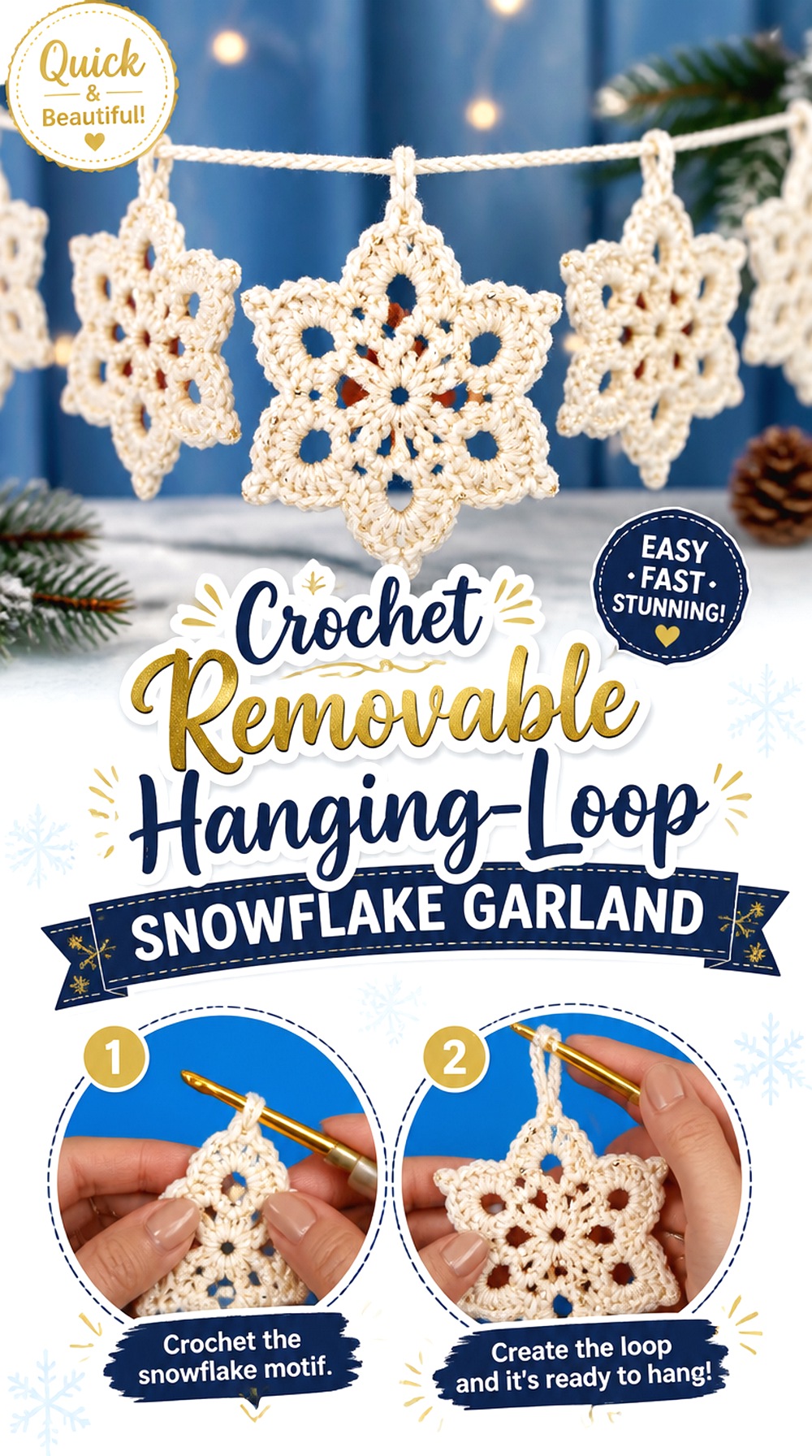
This modular idea treats every snowflake as an individual ornament first and a garland component second. Hooked by Robin’s tutorial includes an optional hanging loop, so the finished flakes can be slipped onto a separate cord instead of permanently joined to it.
That flexibility is useful for seasonal decorating. You can redistribute the ornaments from a mantel strand to a tree, gift, or window without cutting the garland apart. It also makes storage easier because the cord and motifs can be packed separately. For the cleanest look, keep the hanging loops reasonably consistent so the snowflakes sit at similar distances below the main strand.
Removable Motifs Make Rearranging Much Easier
A modular garland lets you change the number of snowflakes without rebuilding the connecting cord. That is particularly useful if you move the decoration between spaces with different widths.
Before making all the loops, test one on the intended cord. The opening needs to work with the connection you actually plan to use.
Yarn Changes Can Alter More Than the Snowflake Size
The tutorial allows flexibility in yarn and hook choice, but a garland magnifies those changes. A bulky version takes more visual room, while a finer version may need more repeats to fill the same span.
Make one sample in the intended yarn and judge it from the actual viewing distance before producing the complete set.
A Modular Garland Can Double as Gift Decor
Because the flakes remain separate, individual ornaments can be removed and tied onto packages without sacrificing the whole strand. If that reuse appeals to you, avoid permanent adhesives or attachments that would prevent the snowflakes from being separated later.
Keep the primary connection simple enough that motifs can be removed without stretching their points.
Original Tutorial and Creator Credit
Creator: Hooked by Robin
7. Crochet Mixed Design Snowstorm Garland

Uniform garlands create rhythm; mixed motifs create movement. Sirin’s Crochet teaches three different snowflake designs in one tutorial, giving you a ready-made way to introduce variation without relying on color alone. Alternate the shapes predictably for a balanced strand, or distribute them more irregularly for a falling-snow effect.
Before joining the motifs, block the full set and arrange them on the floor or a long table. Different silhouettes may occupy different amounts of visual space even if their overall measurements are similar. Plan the layout by eye rather than assuming every gap should be identical. The result can look more natural when the spacing responds to each flake.
Establish a Repeat if You Prefer Order
Three designs do not have to produce a random garland. A repeating sequence can make the variation feel intentional while still preventing visual monotony.
Lay out at least two full repetitions before attaching anything. This makes an accidental cluster of similar-looking motifs much easier to notice.
Random Placement Needs Its Own Kind of Balance
For a looser snowstorm effect, distribute the most visually prominent flakes first. Fill the remaining areas with quieter motifs rather than simply drawing from a pile one at a time.
Step several feet away from the layout before final assembly. Uneven visual weight is often easier to see from a distance.
Keep One Element Consistent Across All Three Designs
When shapes vary, a common yarn color, fiber family, connection style, or blocking finish can hold the collection together. Without a unifying element, the garland may read as leftover ornaments rather than one planned decoration.
Choose that common feature before crocheting the full set.
Original Tutorial and Creator Credit
Creator: Sirin’s Crochet
8. Crochet Glitter Finish Snowflake Garland
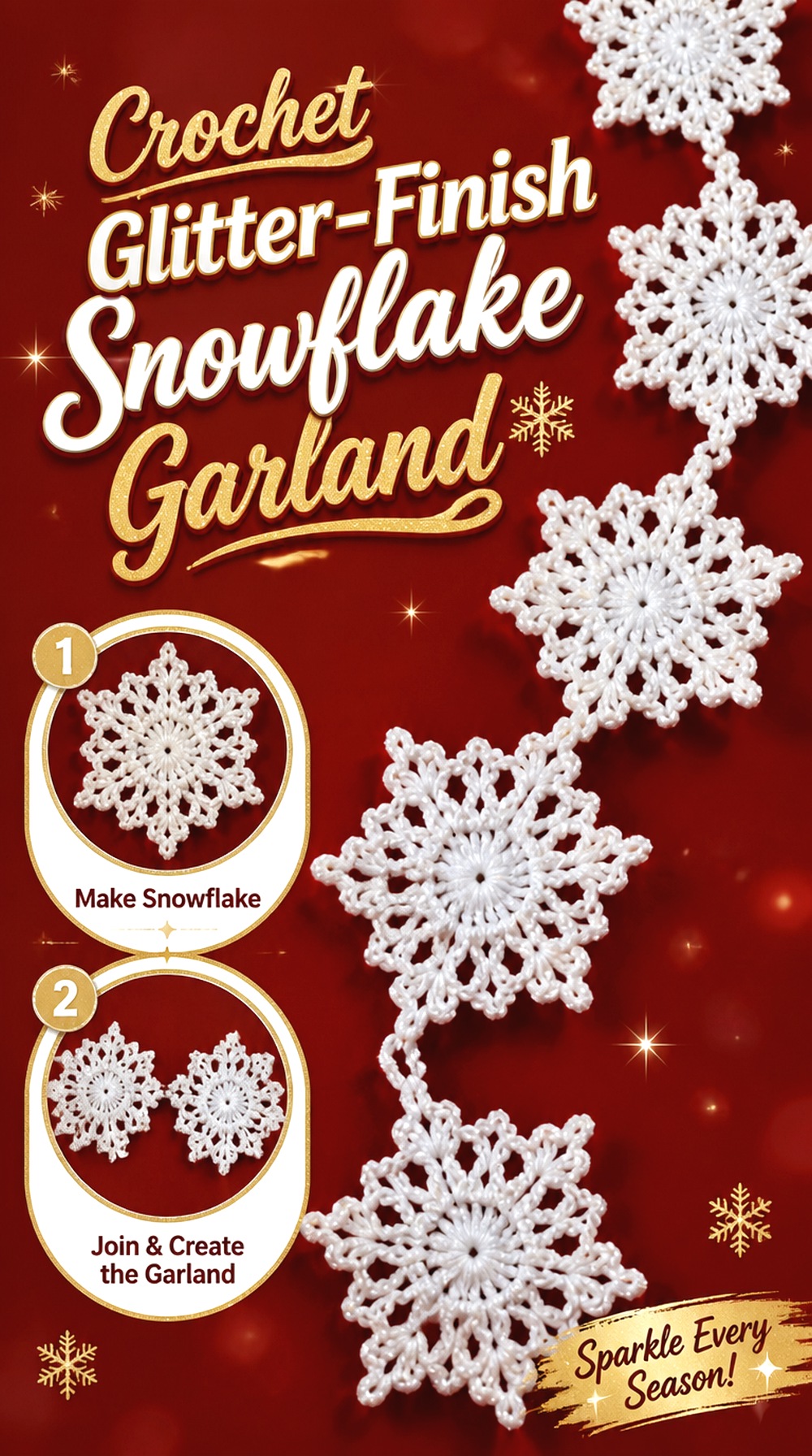
If you want the garland to catch holiday lights, The Purple Poncho offers a useful finishing angle: the tutorial covers both crocheting the snowflake and adding stiffness and glitter. A reflective finish can turn a simple white strand into stronger evening decor without requiring several yarn colors.
Use the effect selectively. A full strand of heavily glittered motifs can become visually busy, particularly beside string lights or metallic ornaments. One option is to finish every snowflake consistently; another is to use glitter on occasional motifs as accents. Whatever treatment you choose, finish and fully dry the individual pieces before attaching them to the garland cord.
Test the Finish on One Snowflake First
Glitter and stiffening products can change both appearance and hand. A test motif lets you judge sparkle level, stiffness, and any color change before treating an entire set.
Use the exact yarn intended for the finished garland because different fibers can react differently to added products.
Reflected Light Can Replace Extra Color
A monochrome snowflake strand can still have visual variation when some surfaces catch the light. That makes glitter useful when you want a white or neutral palette but do not want the display to look flat.
Check the strand in both daylight and the evening lighting where it will actually hang.
Protect Detailed Points During Storage
Once a snowflake is made firmer, the points may resist bending but can also be less forgiving if crushed. Store the finished garland loosely rather than folding stiff motifs sharply against one another.
If possible, separate elaborate flakes with clean tissue or another suitable protective layer.
Original Tutorial and Creator Credit
Creator: The Purple Poncho
9. Crochet Cotton Snowflake Suncatcher Garland

Naztazia’s snowflake uses worsted-weight cotton and is demonstrated as an ornament that can also hang in a window. That makes it a useful foundation for a sturdier window garland where you want visible stitch texture rather than the extremely delicate appearance of thread crochet.
Cotton can give the motif enough presence to stand out against bright glass, but sample-making still matters. The tutorial notes that the demonstrated cotton version holds enough body that extra stiffening may not be necessary for the creator’s result. Your yarn, tension, and desired finish may behave differently, so judge the actual sample instead of assuming all cotton snowflakes will hang identically.
Cotton Body Can Reduce the Need for a Rigid Finish
A more substantial cotton motif can hold its outline differently from a very fine, soft snowflake. If you prefer a natural textile feel, hang one blocked sample before automatically adding stiffener.
If its points remain clear at the intended viewing distance, additional treatment may not improve the display.
Window Light Emphasizes Both Shape and Imperfections
Backlighting can make the snowflake outline attractive, but it also makes inconsistent blocking more obvious. Compare the motifs against the window before connecting them.
Correcting an uneven point or tilted attachment is much easier while each snowflake is still separate.
Leave Enough Space for Each Suncatcher Shape
Because this version has more visual body, crowding can create a heavy horizontal band. Start with generous spacing and move motifs closer only after seeing the strand in place.
A temporary cord and removable clips are useful for this planning stage.
Original Tutorial and Creator Credit
Creator: naztazia
10. Crochet Tiny Snowflake Accent Garland

Small motifs create a different kind of garland: instead of a few large focal pieces, you can build a fine line of repeated flakes that works on compact shelves, miniature trees, package displays, or narrow wall areas. GoldenLucyCrafts demonstrates a tiny snowflake made in thread and also shows a larger-yarn version so the stitches are easier to see.
For the garland, the key decision is scale. Tiny flakes can be spaced closely for a lace-like strand or farther apart for a minimal look. Because small motifs leave little room for uneven finishing to hide, compare their shapes as a group before attaching them.
Fine Thread Changes the Viewing Distance
A miniature thread snowflake can look detailed in your hand but much quieter from across a room. Use this scale where the garland will be viewed fairly close, such as a shelf, cabinet, tabletop display, or gift presentation.
For a high mantel, test whether the motifs remain visible before making a long strand.
Small Motifs Make Color Changes More Subtle
Alternating white, pale blue, silver-gray, or another restrained palette can introduce variety without creating large blocks of color. Because each flake occupies little space, the overall effect remains lighter than the same palette used on oversized motifs.
Lay the colors out in sequence before fastening them to the cord.
A Delicate Garland Needs Gentle Storage
Fine points and thread loops can catch on neighboring motifs. Rather than wrapping the strand tightly around itself, arrange it loosely for storage and avoid pulling individual snowflakes through tangles.
That protects both the motif shape and the connecting strand.
Original Tutorial and Creator Credit
Creator: GoldenLucyCrafts
11. Crochet Layered Snowflake Motif Garland

The Yarnist tutorial provides another full snowflake motif that can be treated as the central decorative element rather than a tiny accent. For this garland concept, let the flakes overlap the visual line of the cord slightly so the strand reads as a continuous band of crochet rather than separate ornaments dangling below it.
This works well along a table edge, low shelf, or straight wall section where the motifs can remain mostly front-facing. Because a fuller motif takes more visual room, make fewer samples first and experiment with partial overlap versus clear gaps. Do not physically stack crocheted points until you know whether that distorts the silhouette.
Overlap Should Look Intentional, Not Crowded
A layered effect does not require one motif to cover half of another. Even a slight visual overlap can create continuity.
Arrange the snowflakes on a flat background and move them closer gradually. Stop before important points or open areas become difficult to distinguish.
Front-Facing Displays Reduce Unwanted Rotation
A low wall or table-edge garland can be easier to control than a freely suspended strand because the motifs do not need to be equally attractive from every angle.
If rotation is distracting, consider a second discreet attachment point or a flatter backing system compatible with your chosen display.
Watch the Overall Weight of a Dense Strand
More crochet fabric per section means more weight on the connection and end supports. Test a short finished length before scaling it to the entire wall.
If the center sags more than expected, either reduce motif density or plan the final silhouette to include that drape deliberately.
Original Tutorial and Creator Credit
Creator: The Yarnist
12. Crochet Mini Two Round Snowflake Shelf Garland
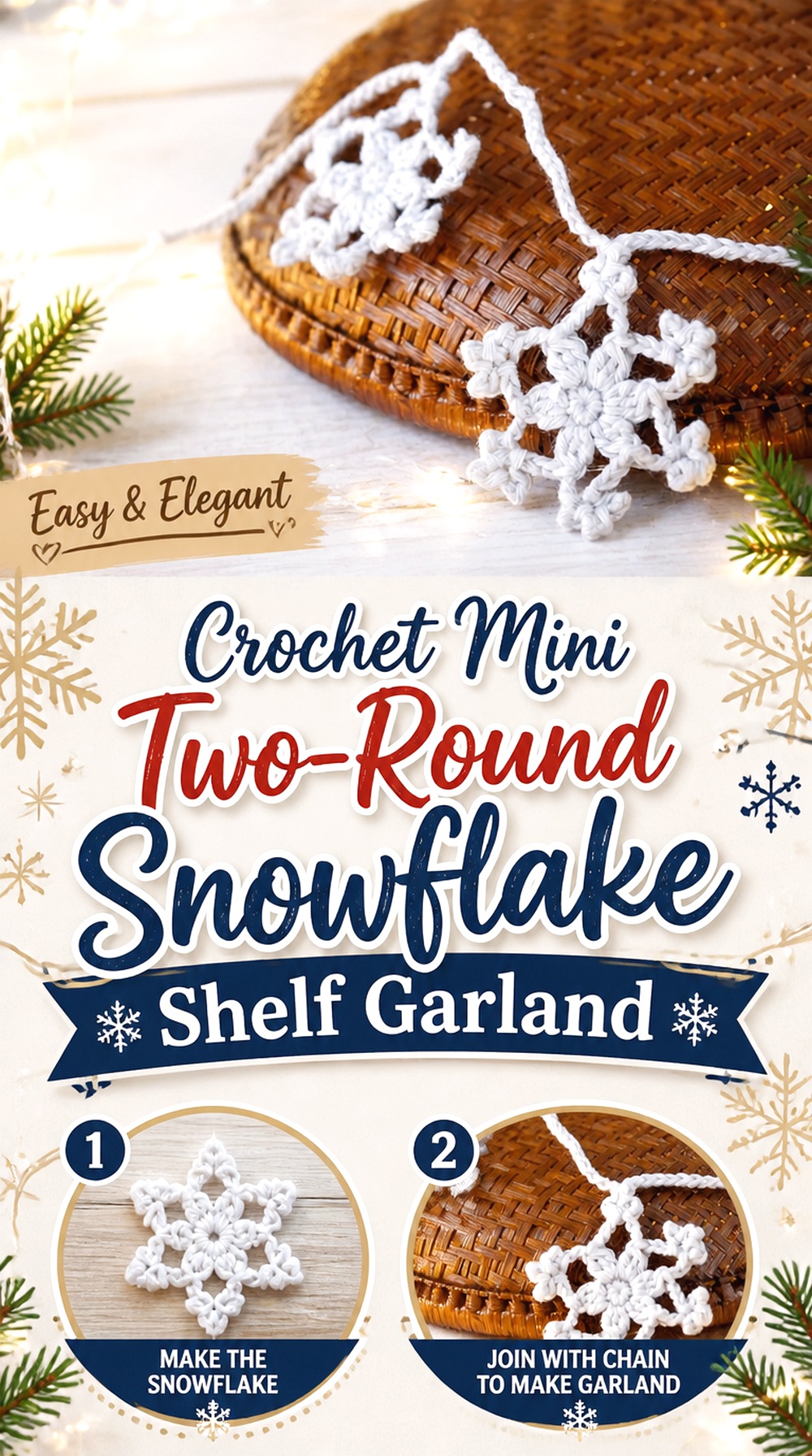
Moara Crochet’s compact snowflake is particularly practical when you need multiple motifs without turning the finished garland into a heavy decoration. The source tutorial uses a short two-round construction and even includes a section on turning the flakes into a garland.
That makes this a strong choice for shelves, narrow ledges, small trees, and places where oversized ornaments would overwhelm the available space. Because the source also demonstrates the garland application, readers can see the relationship between motif and strand rather than having to imagine the conversion from ornament to decor.
Compact Construction Makes Repetition the Main Design Feature
When individual flakes are small, the rhythm of the entire strand becomes more noticeable. Decide whether you want regular spacing or a clustered snowfall effect before making the final connection.
A short test strand is enough to compare those two looks without committing your whole set.
Fine Motifs Benefit From a Proportionate Cord
A thick chain can visually overpower a small snowflake. Compare the cord width with the motif before final assembly and decide whether you want the connection to disappear or deliberately contrast.
The right choice is visual rather than universal; the important point is to make it intentional.
This Tutorial Shows the Garland Adaptation Directly
Unlike an ornament-only source, Moara Crochet’s video includes a garland segment. Use that portion to understand the creator’s intended relationship between the small snowflakes and the finished strand, then follow the tutorial for exact construction rather than recreating it from a written summary here.
Original Tutorial and Creator Credit
Creator: Moara Crochet
13. Crochet Adjustable Scale Snowflake Cascade Garland

MUSHYY’s tutorial explicitly discusses changing snowflake size through yarn and hook choices, which makes it useful for a cascading garland built from visibly different scales. Rather than repeating identical motifs, place larger flakes toward the center or lower points of the display and gradually introduce smaller versions around them.
The concept works well for a window, wall hook, staircase accent, or another location where the strand can dip rather than remain perfectly horizontal. Do not assume a yarn change will preserve every proportion exactly. Crochet a sample at each intended scale and block them before deciding how the final arrangement should transition from large to small.
Make Every Planned Scale Before Choosing the Sequence
Changing yarn thickness alters both motif size and visual weight. Put one finished example of each proposed scale side by side before producing multiples.
You may discover that two versions are too similar to justify both, or that the largest snowflake needs much more spacing than expected.
Put the Heaviest Motifs Where the Strand Can Support Them
If thicker yarn produces a substantially heavier snowflake, consider its position on the garland. Concentrating several large motifs at one unsupported point can increase sagging.
Test the actual arrangement with temporary attachments so the finished drape is known before permanent assembly.
Gradual Changes Usually Read More Clearly Than Random Ones
A cascade becomes easier to understand visually when the scale change has a pattern. You could move from small to large and back again, or place one statement motif at the center with smaller flakes toward the ends.
Choose the sequence based on the display shape rather than making random size substitutions.
Original Tutorial and Creator Credit
Creator: MUSHYY
14. Crochet Soft Winter Snowflake Display Garland
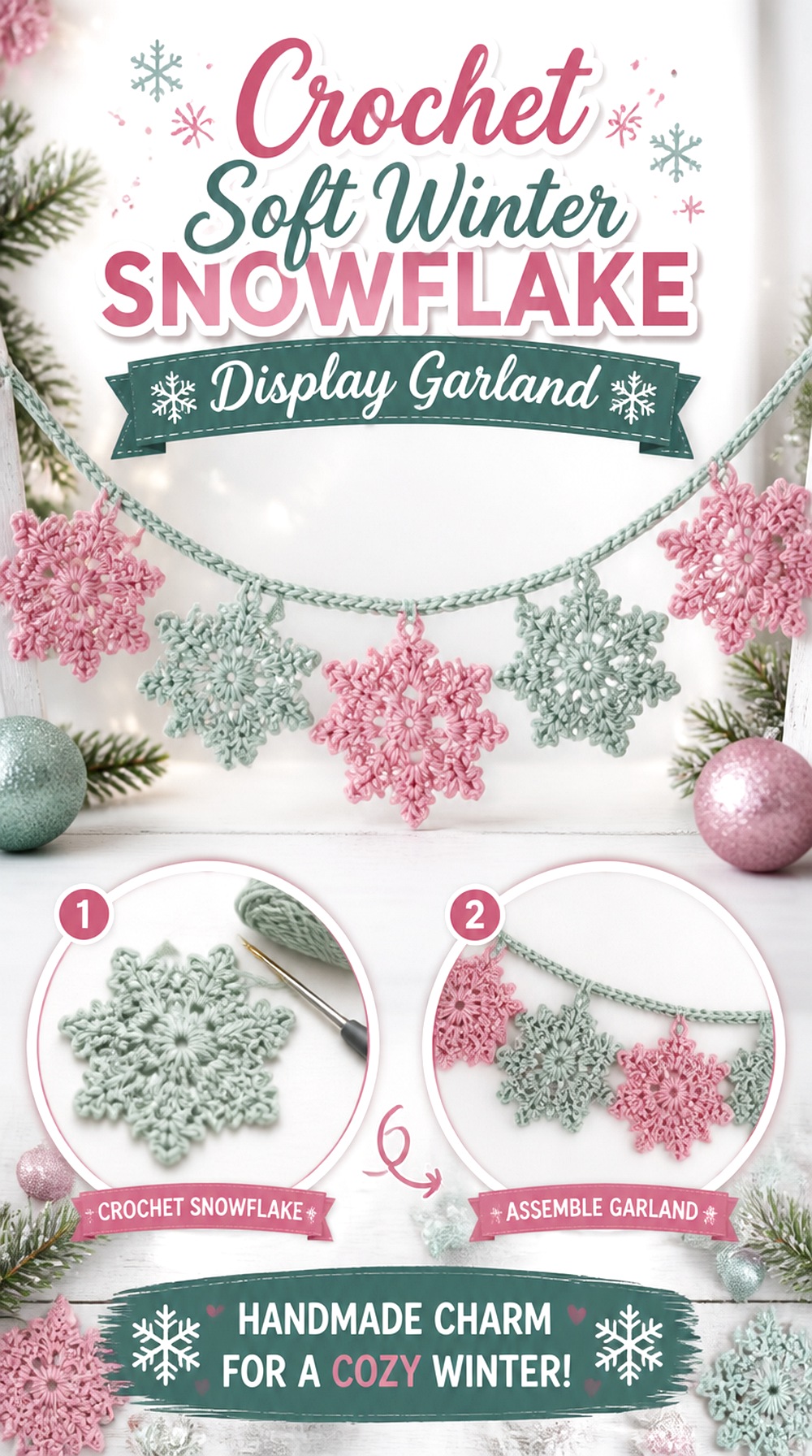
Crochet with Yarnhild’s ornament is presented as suitable for a garland and uses cotton in the demonstrated project. For this idea, keep the finished strand textile-focused rather than heavily starched: block the snowflakes neatly, assess their natural body, and use stronger stiffening only if the actual sample needs it.
A softer garland works well across a wooden shelf, headboard-style decorative wall area, or other indoor setting where you want the crochet to retain some fabric character. Avoid hanging long cords where they could create a hazard for young children or pets, and keep purely decorative strands away from areas where they may be pulled down.
Softness Can Be Part of the Finished Style
Not every snowflake needs to resemble rigid lace. A lightly blocked motif can create a more relaxed textile effect, particularly when several flakes hang together.
Compare one natural sample with one stiffened test piece before deciding which finish matches your room and storage needs.
Let the Snowflakes Hang Before Judging Their Shape
A motif lying flat on a table behaves differently once gravity acts on it. Clip several finished flakes onto the proposed strand and leave them hanging long enough to see whether points droop or centers twist.
That real display test is more useful than choosing a finish based only on photographs.
Keep Decorative Hanging Cords Out of Reach
Garlands are decor rather than toys. In homes with young children or pets, position long strands and loops where they cannot become accessible play objects or snagging hazards.
The same consideration applies to removable embellishments added to the snowflakes.
Original Tutorial and Creator Credit
Creator: Crochet with Yarnhild
15. Crochet Oversized Statement Snowflake Garland
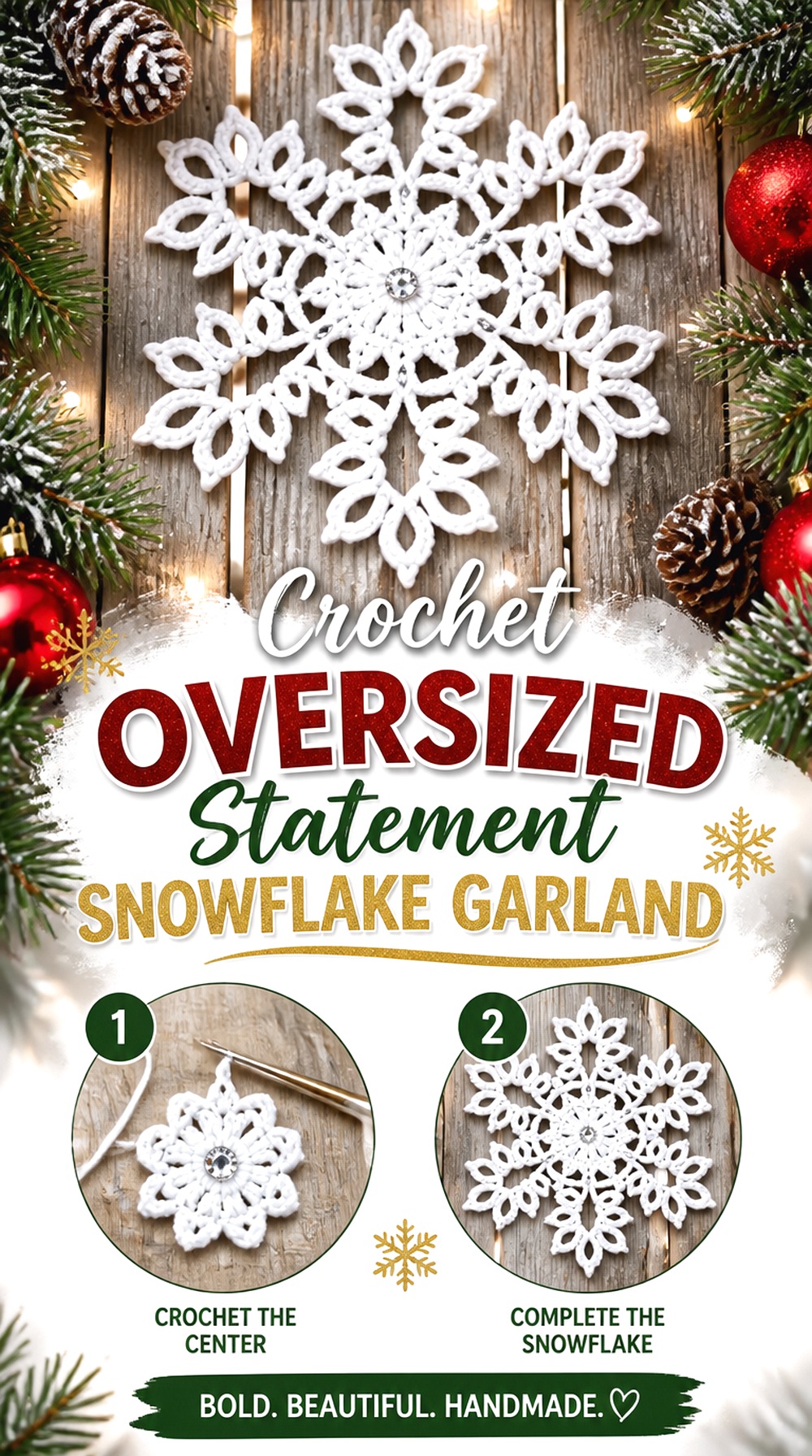
Most snowflake garlands depend on repetition. Bag-O-Day Crochet’s large snowflake creates another option: use only a few oversized motifs and let each become a focal point. The tutorial’s finished snowflake is presented at about 14 inches, so a strand based on that scale will behave more like a hanging installation than traditional miniature bunting.
This can suit a broad wall, large window, or spacious mantel where small motifs disappear visually. Large scale also increases the importance of support and spacing. Make one snowflake first, finish it completely, and hold it in the intended location before deciding how many the space can accommodate.
Large Snowflakes Need Their Own Breathing Room
A statement motif loses its impact if another equally large motif sits immediately beside it. Start with wide spacing and judge the composition from across the room.
You may need far fewer repeats than you would with a typical ornament-scale garland.
Stiffening Becomes More Noticeable at This Scale
The tutorial discusses stiffening the large snowflake. That matters because longer spans of crochet fabric can show drooping or uneven shaping more clearly than tiny motifs.
Follow the creator’s tutorial and your chosen finishing product carefully, and make sure the piece is completely dry before hanging.
Support the Strand Based on Its Actual Weight
Do not select hooks or mounting hardware based only on how light a single snowflake feels in your hand. A complete strand combines several motifs with the cord and any finishing materials.
Choose installation hardware appropriate for the wall or surface and the real finished weight of your decoration.
Original Tutorial and Creator Credit
Creator: Bag-O-Day Crochet
16. Crochet Classic Six Point Snowflake Garland

For a traditional closing option, Crochet Jewel demonstrates a recognizable snowflake motif built from familiar crochet techniques. Repeating one classic shape in a single color can work particularly well when the surrounding holiday decor already contains several patterns, metallic finishes, or bright ornaments.
The design approach here is restraint. Keep the strand consistent, use careful blocking, and let the repeated six-point silhouettes create the decoration rather than adding several competing embellishments. This type of garland can move easily between winter and Christmas settings because its identity comes primarily from the snowflake shape. If you want more contrast, change spacing or scale before automatically adding more colors.
Repetition Makes Uneven Orientation More Visible
A classic six-point motif creates a strong geometric rhythm. Attach every snowflake from the same corresponding point so some do not appear rotated while others sit upright.
Lay out the complete sequence before making the final connection and correct any orientation that interrupts the pattern.
Use Contrast According to the Background
White snowflakes can disappear against a very pale wall, while dark or saturated yarn can produce a much stronger graphic effect. Hold a sample against the actual display surface rather than choosing color in isolation.
You can also create contrast through the cord if you prefer the flakes themselves to remain neutral.
Keep the Final Strand Simple if the Motifs Are the Focus
Extra beads, bows, tassels, and lights are not necessary for every garland. If the repeated snowflake silhouette already has enough visual interest, a plain connection can make the crochet easier to appreciate.
Add another decorative element only when it solves a specific visual problem, such as insufficient contrast or an overly empty gap.
Original Tutorial and Creator Credit
Creator: Crochet Jewel
Comparing the 16 Crochet Snowflake Garland Styles
Choose by display behavior first. For a complete linked-garland demonstration, the Anita Louise Crochet and Moara Crochet sources are especially relevant. If you want removable ornaments, the hanging-loop approach from Hooked by Robin gives you more flexibility.
For scale, GoldenLucyCrafts provides the strongest route toward tiny accents, while Bag-O-Day Crochet moves in the opposite direction with an oversized statement snowflake. Sirin’s Crochet is the standout choice when shape variety matters, and MUSHYY offers a useful starting point when you want deliberate size variation. Readers interested in finishing can compare the stiffening approaches shown by Anita Louise Crochet, Pattern and Craft, The Purple Poncho, and Bag-O-Day Crochet, while Naztazia demonstrates a more substantial cotton approach that may hold enough structure without the same finishing treatment.
Conclusion
The most useful way to choose a crochet snowflake garland is to start with its final location. Tiny or lightweight motifs suit narrow shelves and delicate strands, while large snowflakes need more spacing and stronger visual breathing room. Mixed designs create a natural snowstorm effect; identical motifs make the finished garland calmer and more orderly. Removable loops add flexibility, while directly linked snowflakes create a more unified construction.
Whatever style you choose, make and finish one sample before committing to an entire strand. Check its blocked size, stiffness, viewing distance, and behavior on the intended cord. Then use the original video tutorials for the creators’ exact crochet and finishing instructions.
Frequently Asked Questions
Should crochet snowflakes be blocked before attaching them to a garland?
Usually, blocking the individual motifs first makes planning easier. You can compare their finished width, straighten uneven points, and arrange the actual final shapes before connecting them. This is particularly helpful for openwork snowflakes and designs with long points or picots. If you attach everything first, correcting one uneven motif can become awkward because the surrounding snowflakes and cord restrict how you position it.
Do I have to stiffen every crochet snowflake garland?
No. Stiffening depends on the yarn, motif design, display position, and look you want. Some delicate snowflakes benefit from additional firmness because their points otherwise droop. A more substantial cotton motif may already have enough body for a relaxed indoor display. Make one finished sample, hang it from the intended attachment point, and evaluate its natural shape before deciding whether a stiffening product is necessary.
What type of yarn works well for a delicate snowflake garland?
Fine crochet thread and lightweight yarns can emphasize open spaces and create a lace-like strand. They also produce smaller motifs when paired appropriately, which is useful for compact garlands. However, yarn substitution changes the finished scale and may affect how firmly the points hold their shape. Follow the selected tutorial for its demonstrated materials first, or make a sample before substituting so you can judge the actual result.
How can I combine different crochet snowflake patterns in one garland?
Block all the designs first, then arrange them at their true finished sizes. Place the largest or most visually detailed snowflakes before filling gaps with smaller motifs. You can repeat a fixed sequence for an orderly result or use uneven placement for a snowstorm effect. Keeping at least one feature consistent—such as yarn color, fiber, finishing treatment, or connecting cord—helps several snowflake designs look like one planned collection.
How far apart should crochet snowflakes be on a garland?
There is no universal spacing because the correct gap depends on motif width, display distance, and whether you want a continuous lace effect or clearly separated flakes. Temporarily arrange the finished motifs along a piece of ordinary string before crocheting or assembling the final connection. Check the layout from the distance where it will normally be viewed, not only from close range.
Can I use different-size snowflakes on the same garland?
Yes, and scale variation can create a strong cascading or falling-snow effect. Make one completed sample of each planned size first because changing yarn or hook size can affect more than width. Arrange larger motifs where they have visual space and use smaller versions to bridge gaps. Also account for weight: substantially heavier flakes may change how a long strand sags between its supports.
How should I store a crochet snowflake garland after winter?
Make sure every motif is completely dry, particularly if it has been blocked or treated with a stiffening product. Avoid tightly folding elaborate points or winding delicate snowflakes into a compact ball. A loose arrangement in a clean storage container helps protect the shapes. For removable-loop garlands, storing the snowflakes separately from the cord can reduce tangling and make reshaping easier when the decoration comes out next season.