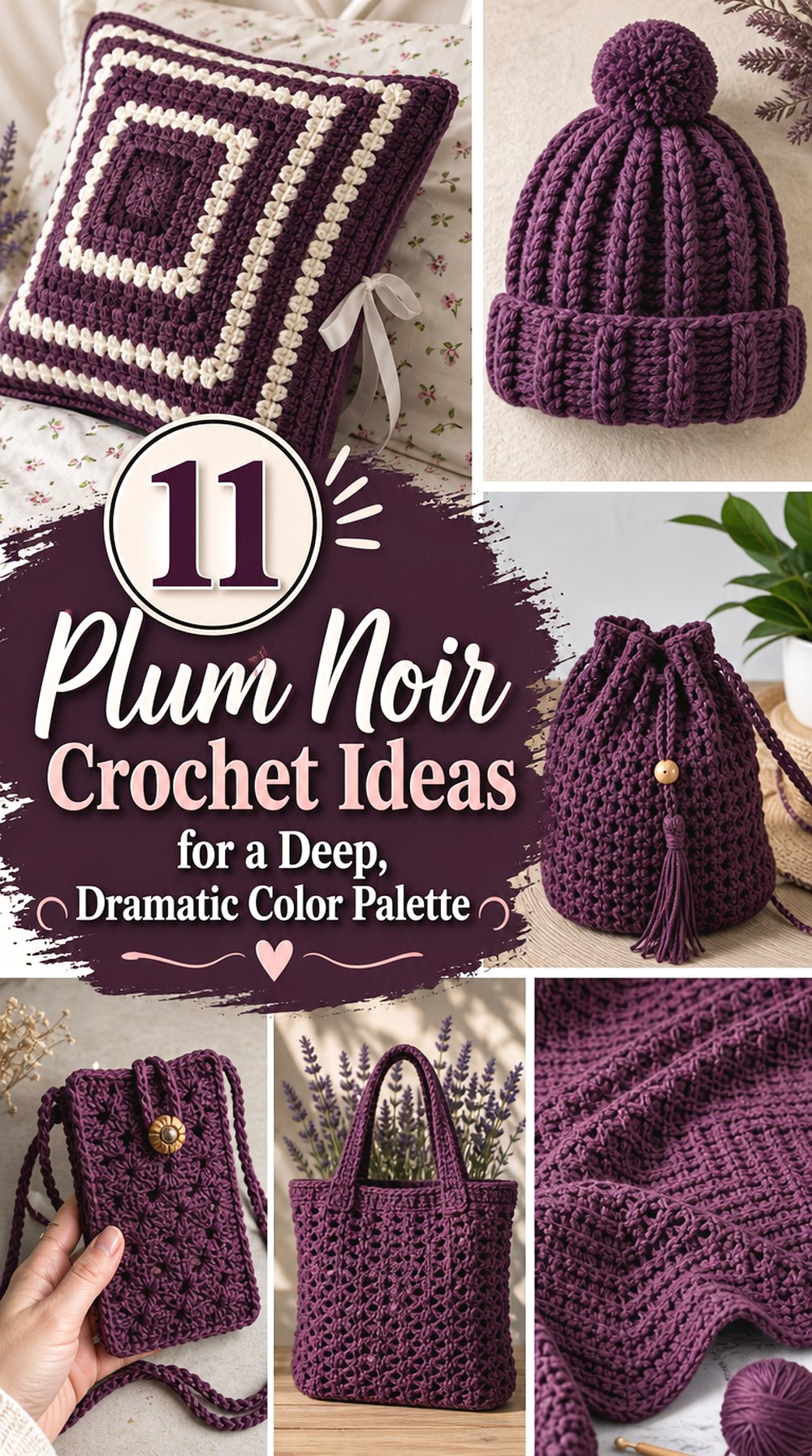
11 Plum Noir Crochet Ideas for a Deep, Dramatic Color Palette
Plum Noir crochet can move in several directions. Deep plum brings more color and dimension than solid black, while black can sharpen borders, straps, ribbing, motifs, and other structural details. The combination works especially well when the project has enough texture or shape variation to keep those dark shades from blending into one flat surface.
These 11 ideas range from garments and cold-weather accessories to bags, a blanket, storage, and decorative crochet. The linked tutorials demonstrate the underlying project constructions; the Plum Noir treatment is an independent color adaptation, so you can decide where plum should dominate and where black should act as an accent. Each idea focuses on choosing and adapting the finished form while leaving exact construction details with the original creator tutorial.
Quick List
- Crochet Plum Noir Chunky Button Cardigan
- Crochet Plum Noir Black-Trim Vest
- Crochet Plum Noir Crocus Granny Blanket
- Crochet Plum Noir Long Unisex Scarf
- Crochet Plum Noir Granny Triangle Shawl
- Crochet Plum Noir Slim Phone Crossbody Bag
- Crochet Plum Noir Classic Bucket Hat
- Crochet Plum Noir Structured Everyday Tote
- Crochet Plum Noir Ribbed Winter Beanie
- Crochet Plum Noir Soft Storage Basket
- Crochet Plum Noir Coquette Pillow Cover
How to Make a Plum Noir Palette Read Clearly in Crochet
Dark colors need deliberate placement because stitch shadows are naturally less obvious in black, charcoal, and very deep purple yarn. If the project has elaborate texture, consider putting the clearer plum shade where you most want the stitch pattern to show and reserving black for borders, ribbing, joining, straps, or simpler sections.
You can also create contrast without introducing a light color. A wine-toned plum beside true black generally separates more clearly than two nearly black purple shades. Yarn surface matters too: a smooth, clearly plied yarn can reveal texture differently from a fuzzy or heavily haloed fiber. Before committing to a large garment or blanket, place your chosen shades together in the lighting where the finished piece will normally be worn or displayed.
Choose Yarn by Function, Not Just by Shade
Matching the Plum Noir palette across several projects does not mean the same yarn is appropriate for every one. A cardigan or shawl may benefit from movement and comfortable drape, while a tote or storage basket generally needs greater shape retention. A pillow cover has another concern: the fabric should suit the insert and intended handling.
Dark yarn also makes sampling useful because differences in texture can be harder to judge from the skein alone. Crochet a small swatch with the stitch style relevant to your project and look at how it behaves after relaxing or blocking according to the yarn’s care information. For wearables, evaluate movement against the body. For bags, handles, and baskets, pay closer attention to stretching and whether the sides collapse more than you want.
Decide Whether Black Is the Framework or the Main Color
Plum Noir looks more intentional when the two colors have different jobs. One option is a plum-dominant project framed with black: black edging on a vest, dark handles on a tote, or a noir border around a blanket. The opposite approach—mostly black with concentrated plum sections—creates a quieter result with small bursts of color.
Motif projects offer another possibility. Rather than alternating colors randomly, decide whether black will unify the motifs through their outer rounds or whether plum will form the continuous visual field. For fitted or shaped pieces, remember that strong contrast can emphasize construction lines. A black band around an armhole, neckline, brim, or opening attracts the eye to that edge, so place contrast where you actually want the shape defined.
1. Crochet Plum Noir Chunky Button Cardigan
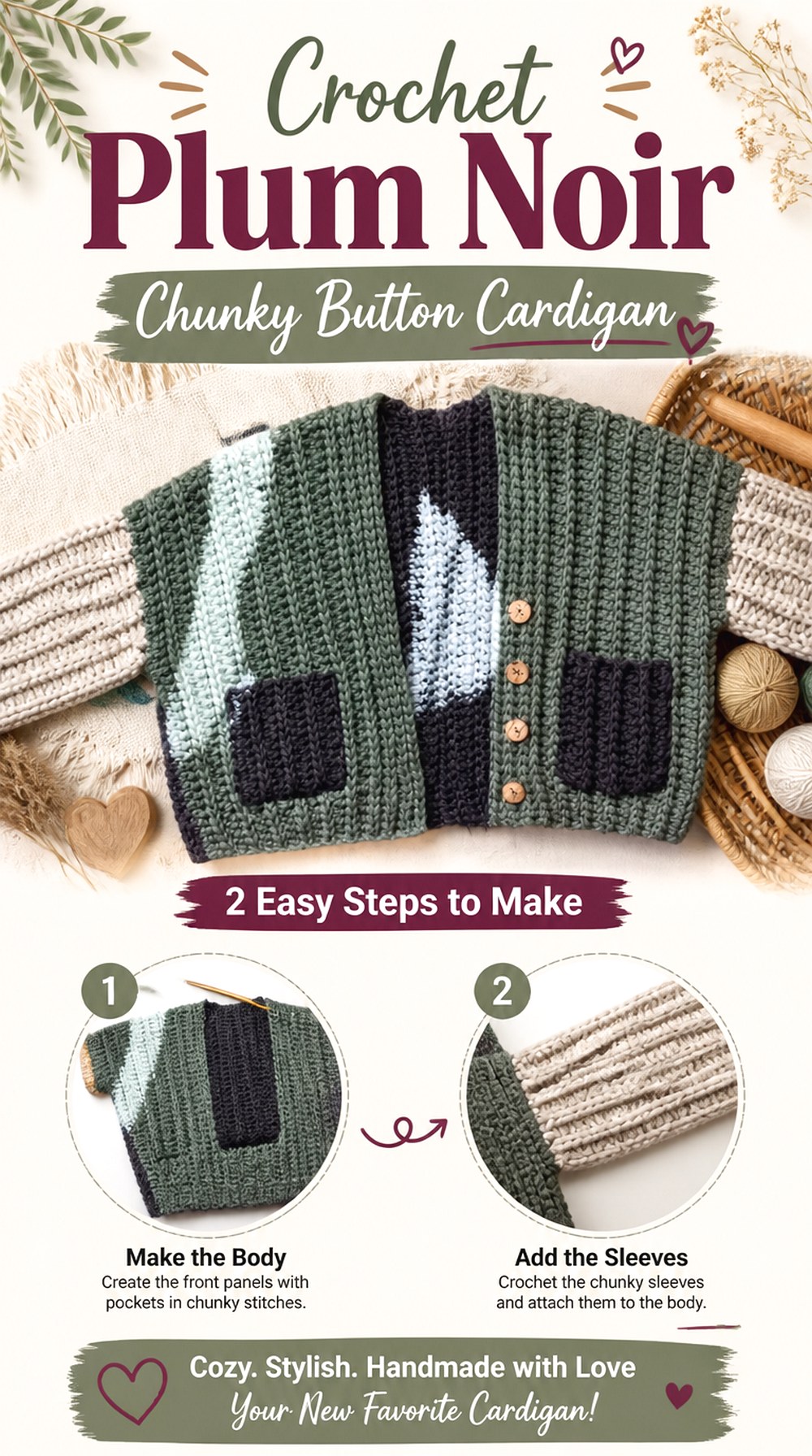
A chunky button cardigan gives the Plum Noir palette enough surface area to look rich rather than simply dark. The Make & Do Crew tutorial demonstrates an oversized cardigan with pockets and buttons, making it particularly useful when you want a substantial outer layer rather than a lightweight open-front piece.
For the color adaptation, deep plum can cover the main body while black defines the button band, cuffs, pocket edging, or another limited area. You could reverse the balance for a mostly noir cardigan with plum accents. Because chunky fabric adds visual and physical volume, consider both fit and finished weight before deciding how oversized you want the garment to feel.
Chunky Fabric Makes Fit Decisions More Noticeable
A roomy cardigan made in substantial yarn does not behave like a thin draped layer. Extra width can create a deliberate oversized silhouette, but it also changes sleeve volume and how the garment sits under a coat. Use the tutorial’s sizing information rather than assuming your usual clothing size will create the silhouette you want. If changing yarn, compare your fabric and gauge with the creator’s requirements before relying on the original dimensions.
Black Edging Can Visually Define the Front
This cardigan already has strong features such as its opening, buttons, and pockets. Placing noir around every possible detail may make the front look busier than intended. Choose one hierarchy instead: for example, a plum body with black front finishing and cuffs, while leaving pocket surfaces plum. That keeps the dark contrast connected to the garment’s structure rather than scattering it across unrelated areas.
Pocket Fabric Should Not Become an Afterthought
Pockets add another layer of crochet to an already substantial garment. If your substitute yarn feels noticeably heavier or stretchier than the source yarn, examine how a swatch hangs before committing to the same pocket treatment. The practical checkpoint is not simply whether the yarn matches the color palette; it is whether the finished pocket stays visually integrated with the cardigan instead of pulling at the surrounding fabric.
2. Crochet Plum Noir Black Trim Vest

A sleeveless vest gives black contrast a natural place to work: around edges that already define the garment. Tanya’s tutorial shows a crochet vest with black trim and describes a one-panel construction with minimal sewing, making the source particularly close to the Plum Noir concept even though you can choose your own plum shade for the main fabric.
Compared with the chunky cardigan, this option removes sleeve bulk and places more attention on the armholes, neckline, and front edges. That makes it useful as a layering piece over a fitted top or shirt when you want the color combination to remain visible without committing to a full plum-and-black outer layer.
Armhole Contrast Draws Attention to Fit
A dark contrasting trim does more than finish the opening—it outlines it. If the armhole is tighter, deeper, or wider than you prefer, a black border can make that shape more noticeable. Check the vest against the intended layer before considering the fit finished. A vest worn over a shirt may need to feel different around the armhole than one intended over a thin tank or tee.
One-Panel Construction Changes Color Planning
Because the source tutorial works the top in one panel, you do not have separate front and back pieces to color-block independently in the same way as a traditionally paneled vest. That can be an advantage for a clean Plum Noir look. Consider keeping the main panel consistently plum and concentrating black at the finishing edges instead of interrupting the body with many unrelated color changes.
Let the Trim Stay Proportional
Black can visually overpower a muted plum if the contrasting border becomes very broad. Before extending or modifying any edging, look at the vest from a few feet away. The goal is to decide whether the trim reads as a frame or starts becoming a major color block. Follow the creator’s construction for the actual border and use your color choice—not an invented stitch alteration—to adjust the visual emphasis.
Original Tutorial and Creator Credit
Creator: Tanya
3. Crochet Plum Noir Crocus Granny Blanket
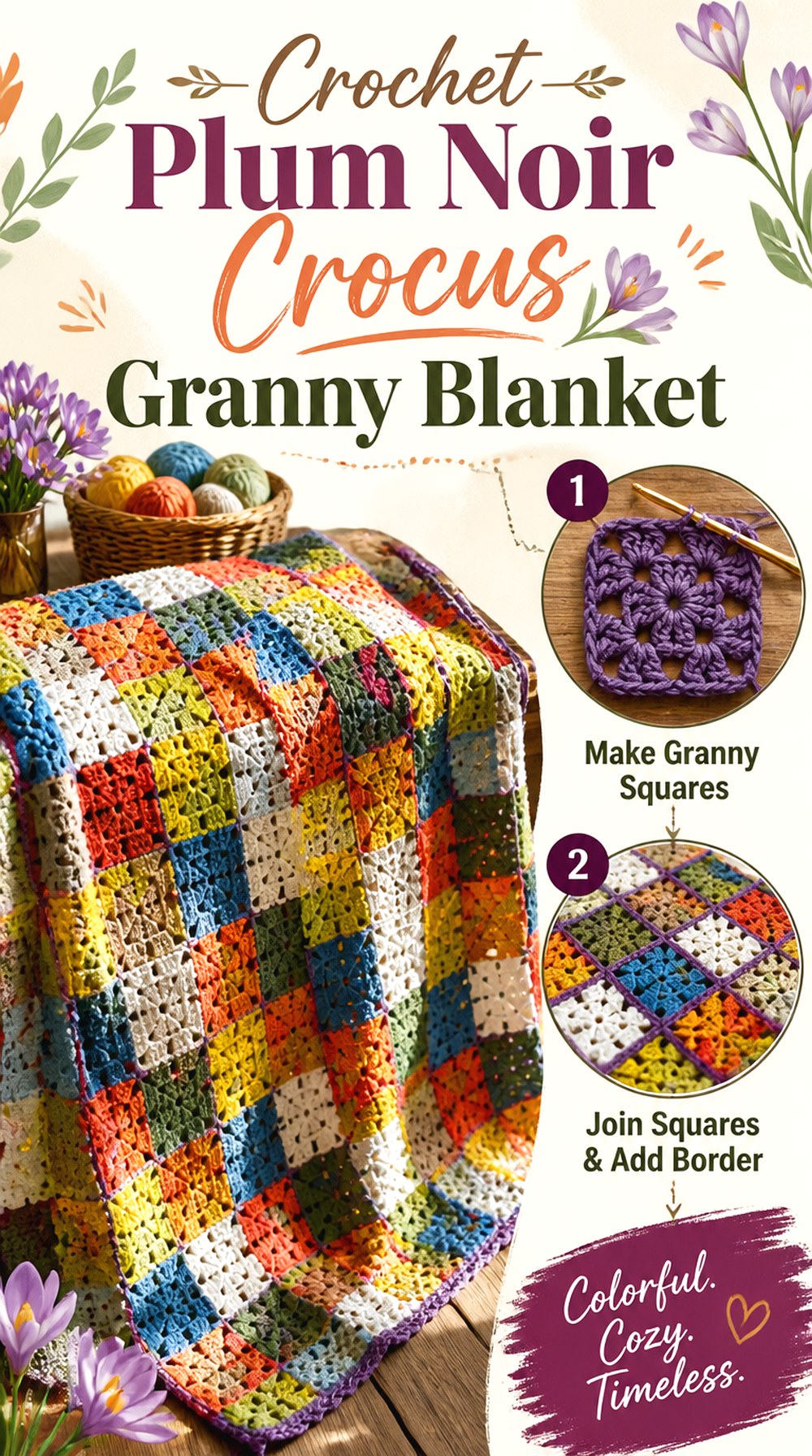
A granny blanket gives you far more room to distribute plum and black than a small accessory. The Crocus Blanket tutorial from Ophelia Talks Crochet covers the granny-square construction, joining, and border, so the color plan can develop across the entire surface rather than appearing only at the edge.
For a Plum Noir version, consider several related plum values with black used consistently in one repeating position, or simplify the scheme to one plum plus black. This project differs from the wearables because visual balance matters across a large flat field. Small color choices repeated dozens of times can become much stronger once the motifs are assembled.
Lay Out the Darkest Motifs Before Joining
Black-heavy motifs can create visual holes or stripes when several land beside one another. Arrange the completed pieces on a flat surface before the final join and view them from farther away. If one area feels much darker than the rest, moving motifs can often balance the blanket without changing any crochet. This is especially useful when plum shades vary slightly between skeins or yarn lots.
Borders Can Unify a Busy Plum Palette
When several wine, berry, and aubergine shades appear inside the blanket, a consistent dark border can make the finished piece feel more deliberate. Black is an obvious Plum Noir choice, but it will also strongly frame the perimeter. If the motif field is already predominantly black, using plum at the outer edge may give the blanket more separation instead of adding another heavy dark band.
Check Motif Dimensions Before Assembly
Color does not correct mismatched squares. If different shades come from yarns that vary in thickness, fiber, or tension response, compare the blocked dimensions before joining. Motifs that are visibly different in size can pull at seams and disrupt the layout. It is better to resolve dimensional differences while the pieces are separate than to depend on the joining stage to force everything into alignment.
Original Tutorial and Creator Credit
Creator: Ophelia Talks Crochet
4. Crochet Plum Noir Long Unisex Scarf
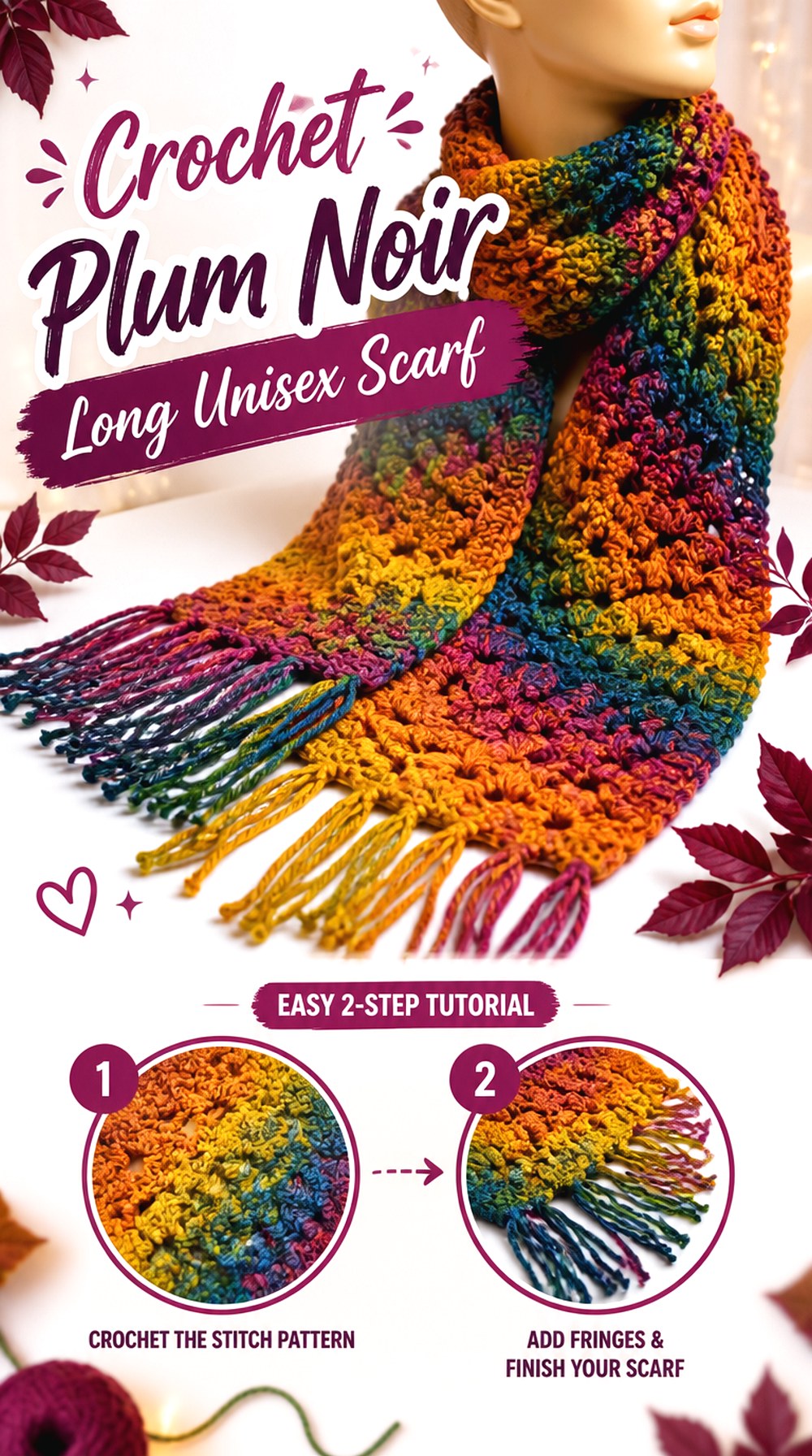
A long scarf is one of the simplest places to let a dark palette stand on its own. Bag-O-Day Crochet’s tutorial presents a unisex scarf, giving you a straightforward rectangular form without the fit complications of a cardigan or vest.
Plum Noir can be introduced through broad color blocks, a mostly plum body with black ends, or a darker understated combination in which the shades alternate less frequently. Since a scarf folds, twists, and overlaps when worn, remember that a color arrangement seen flat will not remain perfectly visible around the neck. Strong blocks often remain easier to read than many narrow changes.
Texture Needs Enough Light to Remain Visible
Very dark yarn can conceal stitch relief, especially indoors. If texture is an important reason you chose the scarf, compare your plum and black swatches in both daylight and ordinary room light. A slightly clearer plum may reveal the crochet surface more effectively than a near-black purple. You can keep the overall Noir mood without making both shades equally dark.
Plan Color Placement for a Folded Scarf
A symmetrical flat layout is not always necessary because scarf ends often hang at different heights or disappear under a coat. Decide whether you want matching black ends, a single contrasting section, or an intentionally asymmetric color arrangement. That decision affects the finished styling more than adding extra decorative details that may be hidden once the scarf is wrapped.
Original Tutorial and Creator Credit
Creator: Bag-O-Day Crochet
5. Crochet Plum Noir Granny Triangle Shawl

The triangular shape of a granny shawl creates a very different color opportunity from the straight scarf. Hooked by Robin’s tutorial demonstrates a classic granny triangle shawl, with the piece expanding outward into a broad wearable shape.
In Plum Noir, that expansion can be emphasized through increasingly dark sections, repeated plum-and-black bands, or a single noir border around a plum field. Because a triangle shawl exposes a large amount of fabric across the back, its color distribution reads more like a composition than a narrow accessory. It can also be styled around the shoulders or closer to the neck, changing how much of each shade remains visible.
A Dark Border Gives the Triangle a Strong Outline
Using black around the outer edge can make the shawl’s triangular geometry more distinct. That is effective when the central fabric is visibly plum. If the center already contains large black areas, however, another dark perimeter can visually compress the color. Lay the unfinished shawl against clothing similar to what you expect to wear underneath before choosing the final color emphasis.
Drape Matters More Than a Perfect Color Match
Two yarns can look ideal together in a skein and still behave differently in the same shawl. If one is springier, thicker, or more rigid, alternating them may affect the fabric as well as the appearance. Make a sample combining both shades rather than swatching them separately. You are checking whether the transitions remain smooth and whether the shawl still moves the way you want.
Size Changes the Color Rhythm
A color repeat that looks balanced in a small shawlette may become repetitive in a much larger wrap. Before beginning frequent color changes, think about the intended finished scale. Wider blocks may suit a large statement shawl, while smaller repeated accents can work when you want a more blended surface. Use the creator’s tutorial for construction and treat color spacing as your separate planning decision.
Original Tutorial and Creator Credit
Creator: Hooked by Robin
6. Crochet Plum Noir Slim Phone Crossbody Bag

A phone bag concentrates the Plum Noir theme into a small vertical accessory. Chenda DIY’s tutorial demonstrates a crochet phone bag, making this a different choice from the larger tote later in the collection.
A deep plum body with a black strap can look especially coherent because the dark strap functions as a visual frame rather than another decorative stripe. You could also reverse it with a black body and plum strap for a quieter look. Since this project is intended around a specific object, the most important adaptation is not color but compatibility: compare the intended phone and any case with the finished opening and dimensions supported by the tutorial.
The Opening Should Suit What You Actually Carry
Do not assume that a phone bag designed around one device will suit every phone-and-case combination. Check the source construction and compare it with the item you plan to carry before committing to finishing details. If you want room for more than a phone, this slim format may not be the right project at all; the larger tote is a more flexible option.
Strap Stretch Can Change Where the Bag Hangs
Crochet straps can lengthen under load depending on their construction, yarn, and dimensions. That matters even for a small bag because a strap that grows can move the phone from the intended chest or hip position. Before treating the strap length as final, consider how the fabric behaves with the actual contents. Reinforcement is an optional adaptation to investigate if stretch becomes a practical problem.
Original Tutorial and Creator Credit
Creator: Chenda DIY
7. Crochet Plum Noir Classic Bucket Hat
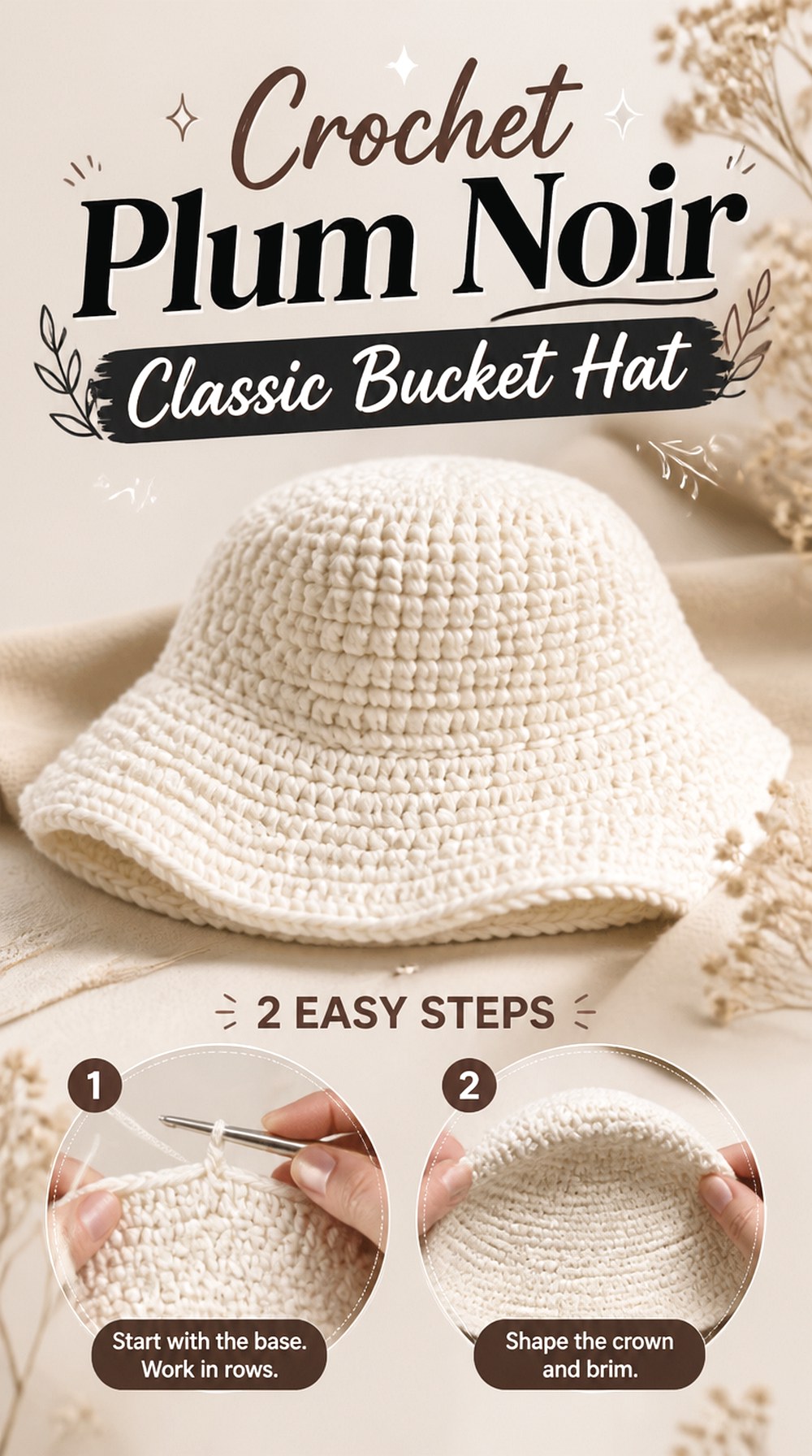
A bucket hat brings the palette into a compact three-dimensional shape. VivCrochets’ tutorial demonstrates the recognizable crown, side, and brim structure and notes that the hat can be adjusted for different sizes.
For Plum Noir, the shape naturally divides into color zones. A plum crown and body with a black brim produces a clear frame around the face, while a black crown with plum lower sections creates a stronger top-to-bottom contrast. You could also keep the entire hat plum and reserve black for one narrow structural accent if you want the silhouette to remain the main feature rather than the color blocking.
The Brim Is the Strongest Color Break
Because the brim projects outward, a color change there is more noticeable than a narrow stripe in the crown. Decide whether you want black to emphasize that edge before starting the final section. If the goal is a softer continuous look, keep the brim in plum and introduce noir elsewhere rather than automatically turning the most prominent section black.
Fit Should Be Checked Before Decorative Changes
The tutorial provides adjustment guidance, but the finished hat still needs to suit the intended wearer and yarn behavior. Dark yarn can make it tempting to focus entirely on color placement, yet crown circumference and brim behavior affect whether the finished piece is actually wearable. Confirm the size and shape first, then treat the Plum Noir distribution as the visual layer.
Original Tutorial and Creator Credit
Creator: VivCrochets
8. Crochet Plum Noir Structured Everyday Tote
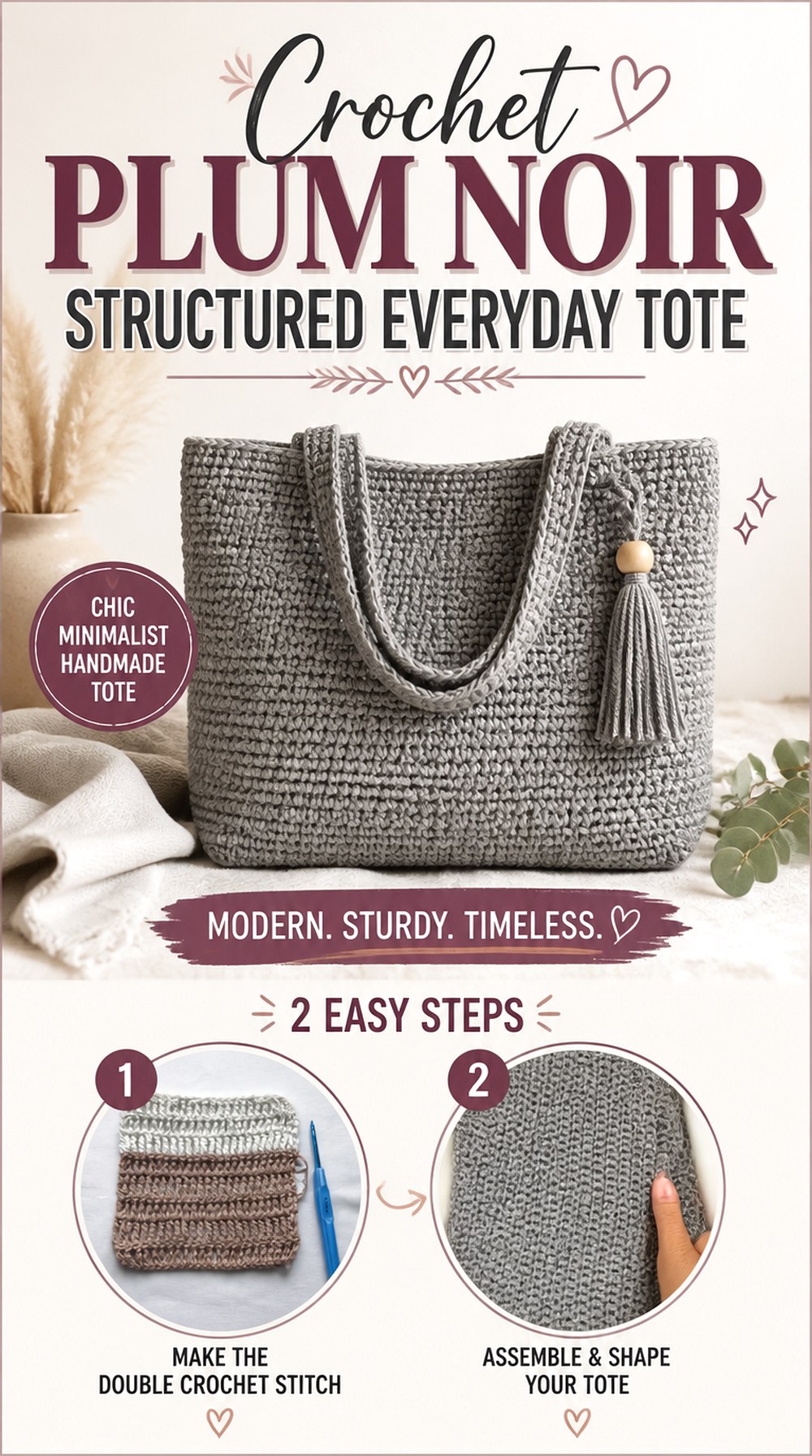
The tote offers more carrying space than the phone bag and places greater importance on base shape, handles, and fabric stretch. Tejelu crochet’s tutorial demonstrates a tote that can also be approached as a backpack-style bag, giving the project a practical, larger-format silhouette.
Plum works well across the broad bag body because it gives the surface more visible color than solid black. Noir can then move to the base, upper edge, or handle area. If you expect frequent use, choose color placement with wear in mind as well as appearance; high-contact areas can behave differently from decorative panels.
The Base Sets the Bag’s Finished Character
A bag that needs to stand more clearly benefits from different fabric behavior than one meant to collapse softly when empty. Before substituting yarn for color alone, examine whether your chosen yarn makes a fabric suited to the source bag’s construction. A very drapey replacement may change the silhouette even if you reproduce the creator’s dimensions correctly.
Handles Deserve Their Own Stretch Check
The broad body of a tote and its handles experience different kinds of stress. A yarn that looks stable in the main fabric may still lengthen in a narrow strap. Make your decision based on how the handle fabric behaves under realistic use rather than assuming the same stitch density will react identically everywhere.
Lining Changes Function More Than Appearance
If small items slipping through the fabric or interior stretch would be a problem, lining is an adaptation worth evaluating. Do not assume it is included unless the tutorial explicitly shows it. A black lining can preserve the Noir palette without competing with the exterior, but its construction should be planned separately rather than improvised into the crochet instructions.
Original Tutorial and Creator Credit
Creator: Tejelu crochet
9. Crochet Plum Noir Ribbed Winter Beanie
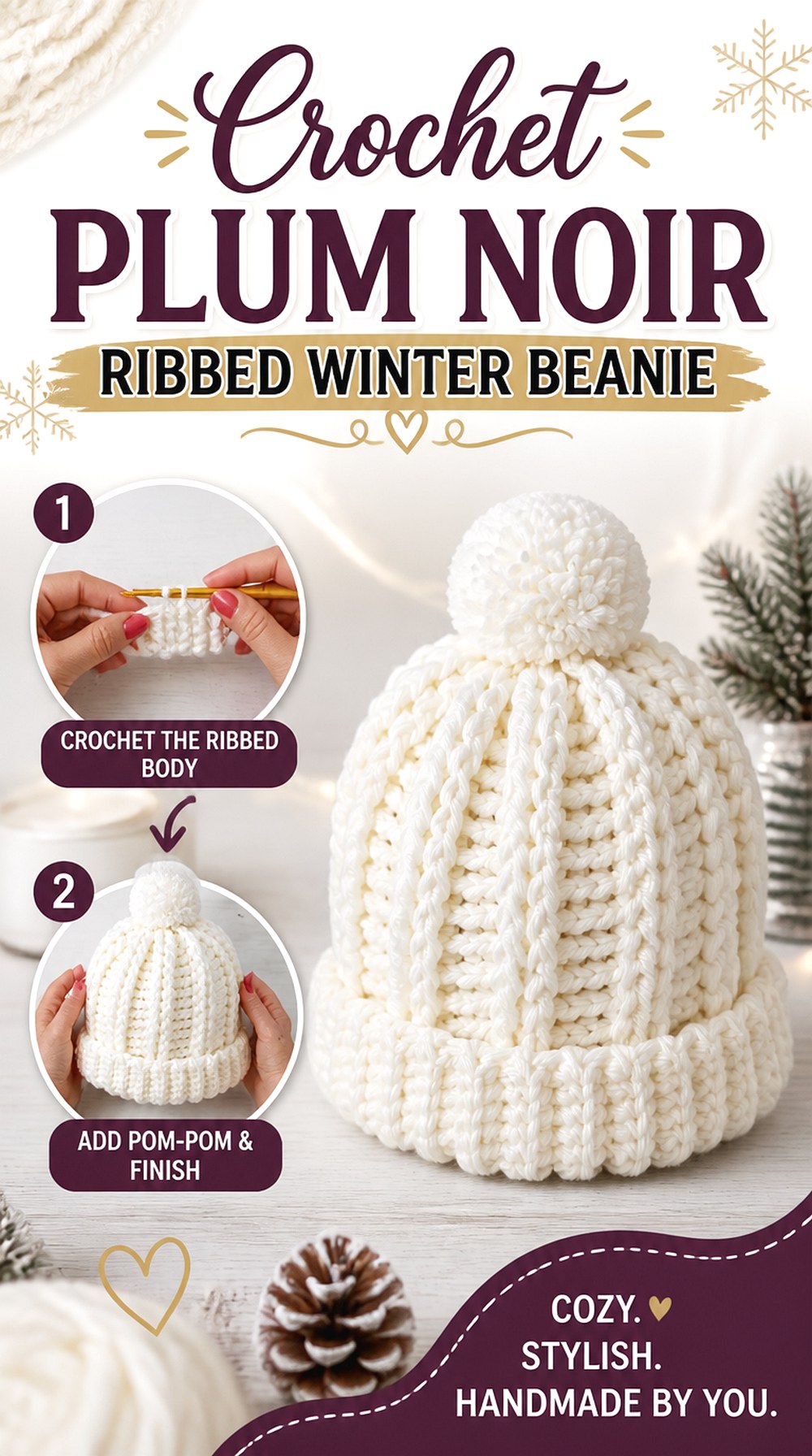
A ribbed beanie turns the color scheme into a close-fitting accessory where texture is important. Di’s Handicrafts’ tutorial includes a ribbed band and post-stitch texture, along with guidance for multiple sizes.
For Plum Noir, a plum body with a black lower band can emphasize the ribbing around the face. Another option is to keep the hat nearly monochromatic in dark plum and make only the optional top detail black. Because the tutorial relies on stretchy fabric for fit, yarn substitution deserves more care here than it would on a decorative pillow or loose scarf.
Ribbing Needs Contrast You Can Actually See
Black ribbing against an almost-black plum body may disappear visually except in strong daylight. If emphasizing the band is the goal, compare your skeins side by side after crocheting them rather than relying on labels or online color photos. A clearly wine-toned plum will usually create a more readable two-color effect than two shades that merge at normal viewing distance.
Stretch Is Part of the Sizing System
The creator provides size-adjustment information tied to the stretchy construction. If you replace the yarn, do not assume the same elasticity will automatically transfer. Compare the source gauge and your fabric, and use the tutorial’s sizing logic rather than relying only on an unstretched circumference. A beanie can measure neatly on a table and still fit poorly if the fabric recovers differently.
Keep the Top Detail in Proportion
If you add the tutorial’s pom-pom option, a black version creates a concentrated noir accent at the top. That can balance a black lower band, but it may also make the two darkest elements dominate a small hat. If the body contains only a narrow area of plum, a plum top detail may produce a more balanced result.
Original Tutorial and Creator Credit
Creator: Di’s Handicrafts (Crochet and Knitting)
10. Crochet Plum Noir Soft Storage Basket

A crochet basket takes Plum Noir out of the wardrobe and into home storage. Lallaulab’s tutorial demonstrates a customizable basket construction, so the focus can shift from fit and drape to shape retention and how the piece sits on a shelf or tabletop.
A plum body with a black upper edge produces a clean two-tone container, while a dark base can visually anchor the basket. This is also one of the few projects where a slightly stiffer fabric may be more desirable than flowing drape. Before changing the material used by the tutorial, consider whether your substitute will keep the walls upright enough for your intended purpose.
Storage Contents Should Influence the Structure
A basket used for lightweight yarn, folded accessories, or display does not need to behave exactly like one holding denser objects. Avoid making unsupported load-bearing assumptions from appearance alone. Instead, compare the basket’s stiffness with what you plan to store and use it where the structure feels appropriate. If the sides collapse when empty, that may be a style feature or a limitation depending on your goal.
A Noir Rim Creates a Useful Visual Finish
Black at the top edge can hide some visual wear while creating a crisp boundary between the basket and its surroundings. It also helps separate a plum basket from plum-toned contents. If the basket will sit inside a dark shelving unit, however, a plum rim may remain easier to see. Placement in the room is a practical part of the color decision.
Original Tutorial and Creator Credit
Creator: Lallaulab
11. Crochet Plum Noir Coquette Pillow Cover
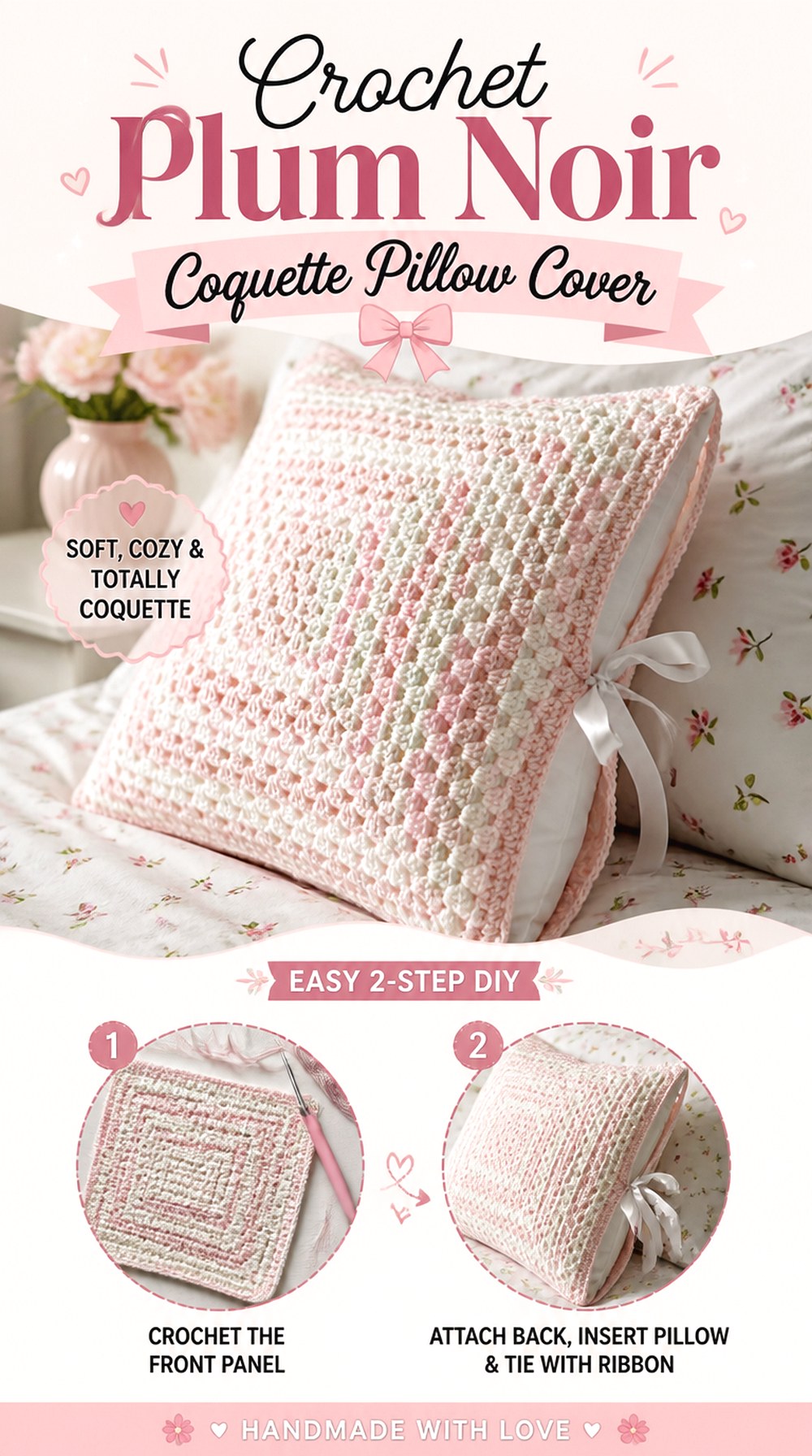
A decorative pillow gives the dark palette a softer, more styled finish. crochet daniela’s tutorial demonstrates a coquette-inspired crochet pillow cover, making this idea intentionally different from the practical basket and blanket.
Plum can keep the surface warm and jewel-toned while black adds a more dramatic edge to the otherwise romantic shape. This project is also a good place to decide how literal you want “Noir” to feel. A black-dominant version can become quite graphic, while plum across the larger areas preserves more softness and lets the darker accent act as contrast.
Match the Cover to the Insert Before Finishing
A pillow cover that is too loose can lose stitch definition and look unfinished; one stretched excessively over an insert may distort texture or openings. Use the dimensions and construction information supplied by the creator and compare them with the insert you actually intend to use. If you change yarn thickness, make the sizing decision before completing decorative finishing rather than hoping the insert will correct the shape.
Decorative Details Need Clear Color Separation
Small accents can disappear against dark backgrounds. If the coquette styling depends on a detail being noticeable, make that element either distinctly plum against black or distinctly black against a lighter plum. Using two almost identical near-black shades may preserve mood but reduce the very contrast that makes a decorative accent visible.
Think About Removal and Cleaning Early
A decorative cover still needs a realistic care plan. Check the chosen yarn’s care instructions and determine whether the tutorial’s construction suits how you expect to clean the finished pillow. If you want a removable insert, confirm how the cover opens before adapting decorative elements near that area. Avoid blocking access simply because an embellishment looks attractive there.
Which Plum Noir Project Fits Your Goal?
For a statement wardrobe piece, the chunky cardigan gives the palette the most visual space, while the black-trim vest offers a lighter layering option. The scarf, shawl, bucket hat, and beanie are easier ways to introduce the colors without planning a full garment.
The granny blanket is the strongest choice when you want to experiment with repeated color placement, while the pillow keeps the palette decorative and concentrated. For function, choose the slim phone bag when you want minimal carrying space, the tote when capacity and handles matter more, or the basket when the project will stay at home. The construction should lead the choice first; Plum Noir can then be adapted to suit that form.
Conclusion
Plum Noir works most convincingly when the colors have distinct roles rather than being alternated without a plan. Use black to outline a vest or hat, reinforce the visual structure of a bag, frame a blanket, or create focused accents against a richer plum field. If you prefer a darker result, reverse that balance and let plum become the smaller highlight.
Choose the cardigan or blanket for the largest color statement, the shawl or scarf for more drape, the hats for compact wearables, and the bags, basket, or pillow when function or decor matters more than fit. Once you choose a direction, use the original tutorials for the creators’ exact construction details.
Frequently Asked Questions
Do the original tutorials have to use plum and black yarn?
No. These ideas use the tutorials for their project shapes and construction, while Plum Noir is the proposed color adaptation. Follow the creator’s requirements for gauge, sizing, materials, and construction where applicable. Changing color is usually far less disruptive than changing yarn thickness, fiber behavior, or construction, so do not treat a color substitution as permission to ignore the technical specifications of the project.
How can I stop black yarn from hiding the crochet texture?
Look at a small swatch under the lighting where the finished project will normally be seen. Smooth yarn, clear stitch definition, and stronger contrast between black and plum can make texture easier to read. If an intricate section disappears in black, consider placing plum there and moving noir to simpler borders, bands, straps, or joining areas where silhouette matters more than detailed stitch visibility.
Should plum or black be the dominant color?
That depends on the effect you want. A plum-dominant project usually shows more warmth and makes black feel like framing. A black-dominant project is quieter and more dramatic, with plum functioning as a jewel-toned accent. On small pieces such as hats and phone bags, even a small black section can look strong. Larger blankets and cardigans have more room for both colors without either overwhelming the design.
Can I use the same Plum Noir yarn for the cardigan, tote, and basket?
Only if the yarn’s behavior suits all three projects and also meets each tutorial’s technical requirements. Wearables often need comfortable drape and movement, while totes and baskets may benefit from firmer fabric and better shape retention. Color alone is not a good reason to force one yarn into every project. Compare gauge, stretch, fabric density, care requirements, and the original creator’s material information first.
How can I add black accents without changing the creator’s pattern?
Keep the construction unchanged and alter only where the yarn color changes at natural visual boundaries already present in the project. Examples include an existing border, brim, band, handle, edging section, or motif round. Do not add new rounds, resize sections, or reconstruct a creator’s design merely to create a color block. The safest adaptation is one that changes appearance while preserving the tutorial’s intended structure.
What is the most important check when using very dark plum and black together?
Make sure the two colors are distinguishable at normal viewing distance. Skeins that appear different under bright craft lighting may merge into one near-black surface indoors. Crochet a small sample containing both shades and view it in daylight and ordinary room light. If the separation disappears, decide whether that subtle result is intentional; if not, move to a clearer wine or aubergine plum while keeping black as the darkest anchor.