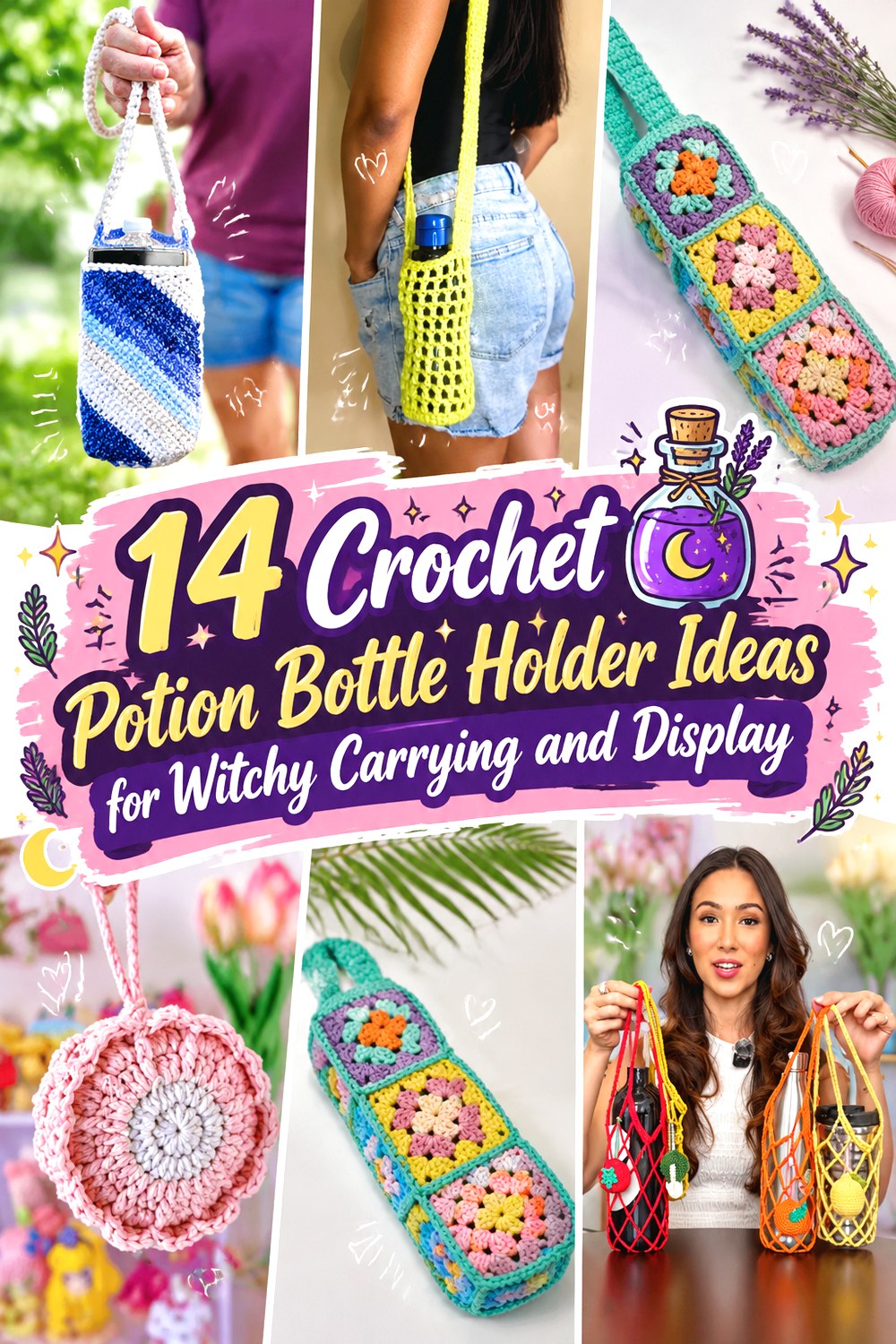
14 Crochet Potion Bottle Holder Ideas for Witchy Carrying and Display
A crochet potion bottle holder can be much more than a colored sleeve around a container. Depending on the construction, it might become a wearable fantasy accessory, a soft bottle-shaped storage pouch, an open sling that keeps decorative glass visible, or a structured cover intended mainly for gifting and display.
The ideas below draw from both potion-specific projects and original bottle-holder tutorials that can provide useful starting points for fantasy adaptations. That distinction matters: a water-bottle or wine-bottle tutorial should not be treated as though its original dimensions automatically fit a tiny apothecary vial. This collection instead helps you compare fabric density, openings, straps, motif scale, neck treatment, and carrying style before choosing a direction for your own bottle.
Quick List
- Cork-Top Crochet Potion Bottle Holder Pouch
- Moon-Sigil Crochet Potion Bottle Storage Holder
- Flower-Base Crochet Potion Bottle Holder
- Market-Net Crochet Potion Bottle Sling
- Mosaic Forest Crochet Potion Bottle Gift Holder
- Patchwork Granny Crochet Potion Bottle Carrier
- Scalloped Drawcord Crochet Potion Bottle Cozy
- Textured Column Crochet Potion Bottle Holder
- Growing-Vines Crochet Potion Bottle Belt Carrier
- Ocean-Lace Crochet Potion Bottle Sling
- Celestial Star-Stitch Crochet Potion Bottle Holder
- Twin-Handle Crochet Potion Bottle Cover
- Web-Mesh Crochet Potion Bottle Carrier
- Utility-Pocket Crochet Potion Bottle Holder
Fit the Crochet to the Bottle, Not the Label
Bottle circumference is only one part of a good fit. Look at the base, widest body point, shoulder, neck, and stopper before deciding how high the crochet should extend. A squat round apothecary bottle behaves differently from a tall straight vial even when both hold a similar amount.
When adapting a full-size bottle tutorial, compare the developing base directly with the container rather than shrinking every feature by the same proportion. Open mesh that looks balanced around a water bottle can become oversized around a small vial, while a large granny square or mosaic repeat may dominate the entire container. Let the actual bottle determine whether a source construction is suitable at all.
For display bottles, leaving the shoulder and stopper exposed often preserves more of the recognizable potion silhouette.
Choose the Carrying Method Before Adding Fantasy Details
A holder worn crossbody needs different planning from one hanging at the waist or sitting on a shelf. Long straps can stretch depending on yarn and construction, while a belt loop or single carabiner concentrates the load near one attachment area. Decorative bottles can also tilt if the holder is much taller than necessary.
Test the planned carrying position with the intended container before permanently placing appliqués, labels, bows, or charms. An embellishment centered while the holder lies flat may rotate out of view when the bottle hangs naturally.
If the source tutorial teaches a shoulder strap but you want a belt loop, treat that loop as a separate adaptation rather than assuming the original attachment instructions transfer directly.
Balance Structure, Visibility, and Bottle Safety
Dense crochet hides more of the bottle but can create a stronger visual surface for texture or colorwork. Mesh and lace expose decorative glass and labels, yet large openings need extra attention around narrow bottles. Neither fabric should be treated as impact protection for glass.
For a real liquid container, the bottle’s own cap, cork, or stopper must provide the secure closure. A crocheted drawcord is an accessory closure, not a substitute for a liquid-tight bottle seal.
Yarn choice can also change stretch, thickness, and drape. If you substitute materials, compare the developing holder with the actual container frequently. Be cautious with loose beads, detachable charms, long cords, or other small decorations around young children and pets.
1. Cork Top Crochet Potion Bottle Holder Pouch
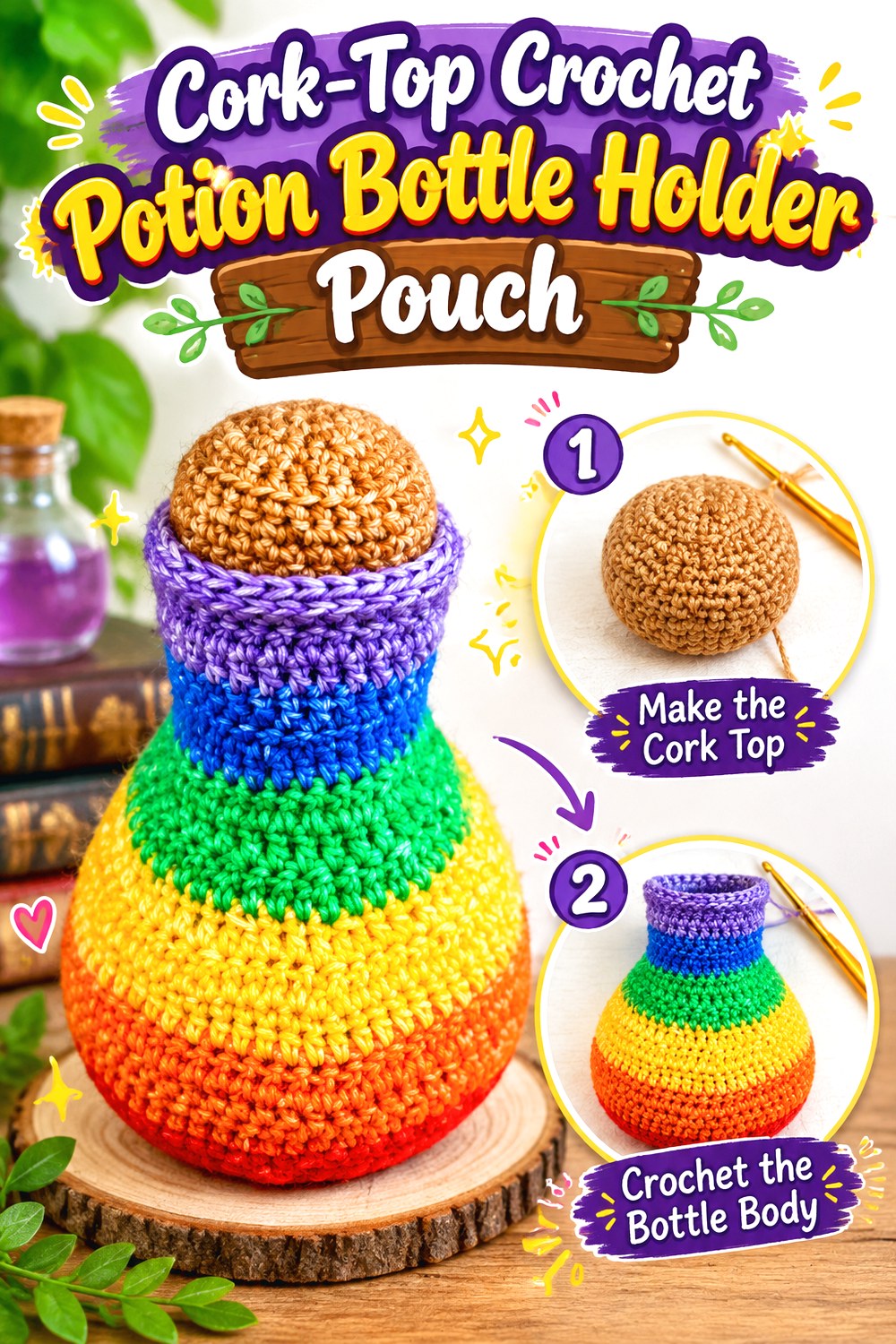
Crochet With Kim’s project is one of the closest fantasy matches in this collection because the crochet itself forms a potion-bottle-shaped storage pouch rather than surrounding a separate bottle. The design includes a contrasting stuffed cork element and a shaped body, giving the finished piece an immediately readable potion silhouette. The creator also notes that firm stitching helps the bottle form retain its structure.
That makes this direction especially useful when you want a fantasy holder without carrying glass. It could hold lightweight gaming or costume items while still looking like an oversized potion bottle. Changing the palette can shift it from bright magical styling to a darker alchemist or witch-apothecary look without changing its fundamental form.
Keep the Bottle Silhouette Easy to Read
The neck and cork do much of the visual work. If you add leaves, labels, cords, or charms, avoid crowding the transition between the bottle body and stopper. That outline is what lets the project read as a potion bottle from a distance.
A limited palette can make the shaping more obvious. If you prefer several colors, use them in broad intentional zones rather than allowing small changes to obscure the bottle profile.
Decide Whether It Is Storage or Decoration
A hollow pouch needs different finishing priorities from a stuffed display bottle. If you intend to carry dice, tokens, or other lightweight items, keep the storage cavity accessible and make sure added decoration does not interfere with the opening.
For a purely decorative version, shaping can take priority over access. Avoid assuming that either version can safely carry a glass container—the original project is itself the bottle-shaped pouch.
Original Tutorial and Creator Credit
Creator/Site: Crochet With Kim
2. Moon Sigil Crochet Potion Bottle Storage Holder
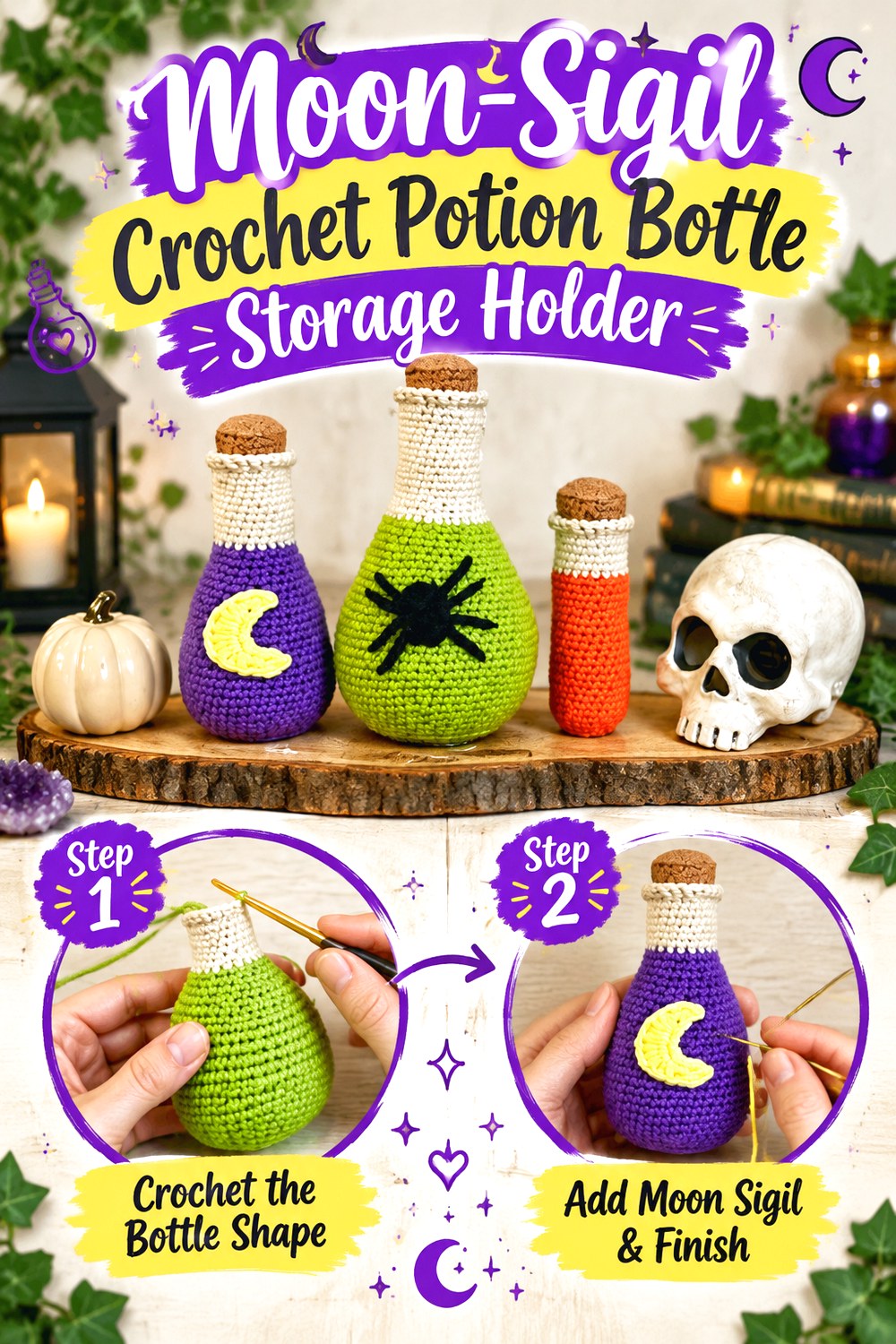
Green Fox Farms Designs offers another direct potion-bottle concept, but this one takes the surface styling in a more explicitly magical direction. The Potion of Moonlight design can function as a potion-shaped storage piece, and its moon appliqué gives the bottle a clear outward-facing focal point. The source also distinguishes between using the form as storage and creating a stuffed decorative piece.
That makes the project useful for readers who want fantasy imagery built into the bottle rather than relying entirely on yarn color. A moon can suggest a sleep potion, lunar elixir, divination theme, or nighttime apothecary display without requiring a complex collection of dangling embellishments.
Position the Sigil for the Finished Use
Before permanently placing a moon, rune, label, or similar focal detail, decide how the bottle will normally be seen. A motif centered for tabletop display may need a slightly different placement on a pouch worn at the hip.
Temporarily pin the decoration in place and hold the project at its intended viewing angle. This is especially worthwhile if you plan to add a belt loop as an adaptation.
Do Not Let Shaping Consume the Storage Space
Stuffing can sharpen a decorative form, but it also occupies internal volume. If storage is the goal, avoid adding shaping material simply because a display version uses it.
Instead, judge whether the crocheted fabric already creates enough structure for the lightweight items you want to carry. A storage pouch and a stuffed ornament can share a visual language without needing identical finishing.
Original Tutorial and Creator Credit
Creator/Site: Green Fox Farms Designs
3. Flower Base Crochet Potion Bottle Holder

Vivi Crochet’s bottle-holder tutorial starts with a visible flower-shaped base and builds upward around the container. The floral foundation makes it particularly adaptable to healing-potion, fairy-garden, herbalist, or enchanted-forest styling because the decoration is structural rather than simply sewn onto a plain sleeve.
For a potion adaptation, consider letting a tinted bottle provide most of the color while the flower creates a contrasting frame at the bottom. This is more display-oriented than a minimal utility sling and works particularly well when the lower edge will remain visible on a shelf or table as well as while carried.
Check How Much Flower Extends Beyond the Bottle
A decorative base needs enough visibility to look intentional, but an exaggerated overhang can make a small vial unstable or visually top-heavy. Compare the bottle with the developing flower before continuing into the vertical body.
A slightly wider flower may work beautifully under a broad bottle. A narrow vial may need a subtler interpretation so the foundation does not overwhelm the container.
Let the Neck Stay Recognizably Potion-Like
Many fantasy bottles narrow sharply at the shoulder. If crochet continues too high, it can hide the very transition that gives the container its apothecary silhouette.
Try the holder on the bottle before finalizing the upper treatment. Showing some glass between the crochet body and stopper can provide better visual balance than covering every surface.
Original Tutorial and Creator Credit
Creator: Vivi Crochet 🌷
4. Market Net Crochet Potion Bottle Sling
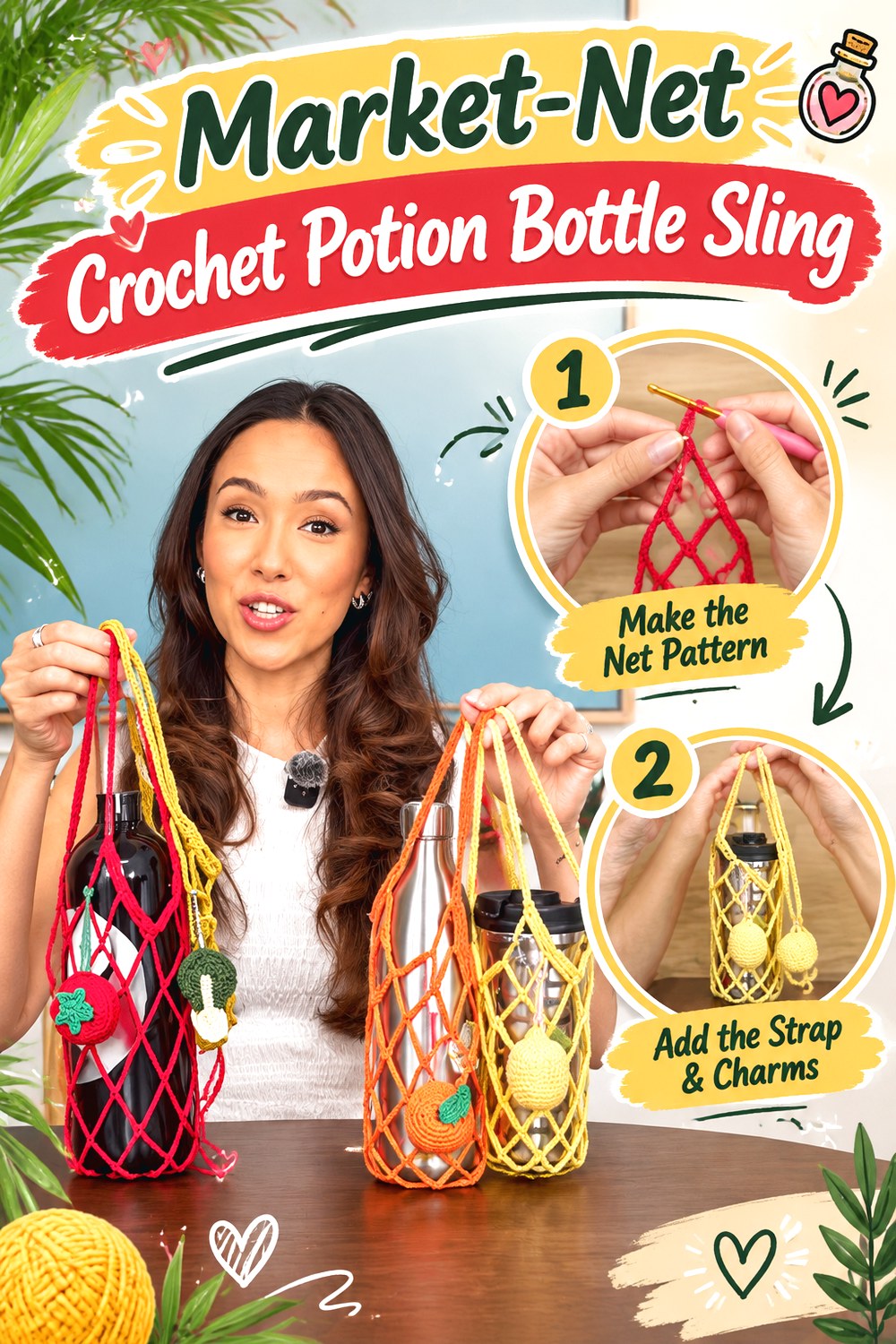
Rhi’s tutorial uses a market-bag-inspired bottle holder, creating an open structure that lets the container underneath remain highly visible. The source describes it as suitable for several types of drink containers, so the construction is designed around a bottle or cup being visually present inside the crochet rather than completely concealed.
That makes this a strong adaptation for amber glass, colored bottles, painted labels, or unusual stoppers. Instead of turning the holder into the main visual object, the net acts more like a frame around the potion. It also offers a lighter-looking alternative to dense cylindrical covers.
Scale the Openings Along With the Holder
Shortening a full-size bottle bag is not enough when adapting it for a narrow vial. The mesh openings themselves need to look proportionate to the container.
Inspect both the bottle base and the narrowest part of its body. If either can push awkwardly through the openings, a denser construction—or a larger decorative bottle—is a better pairing.
Use Contrast to Make the Bottle Part of the Pattern
Because so much glass remains visible, yarn and bottle color should be chosen together. Dark mesh around amber or green glass gives a very different effect from pale yarn over a brightly painted container.
Set the yarn beside the actual bottle in natural light before beginning. That quick comparison is often more informative than choosing colors from separate photographs.
Original Tutorial and Creator Credit
Creator: Rhi
5. Mosaic Forest Crochet Potion Bottle Gift Holder
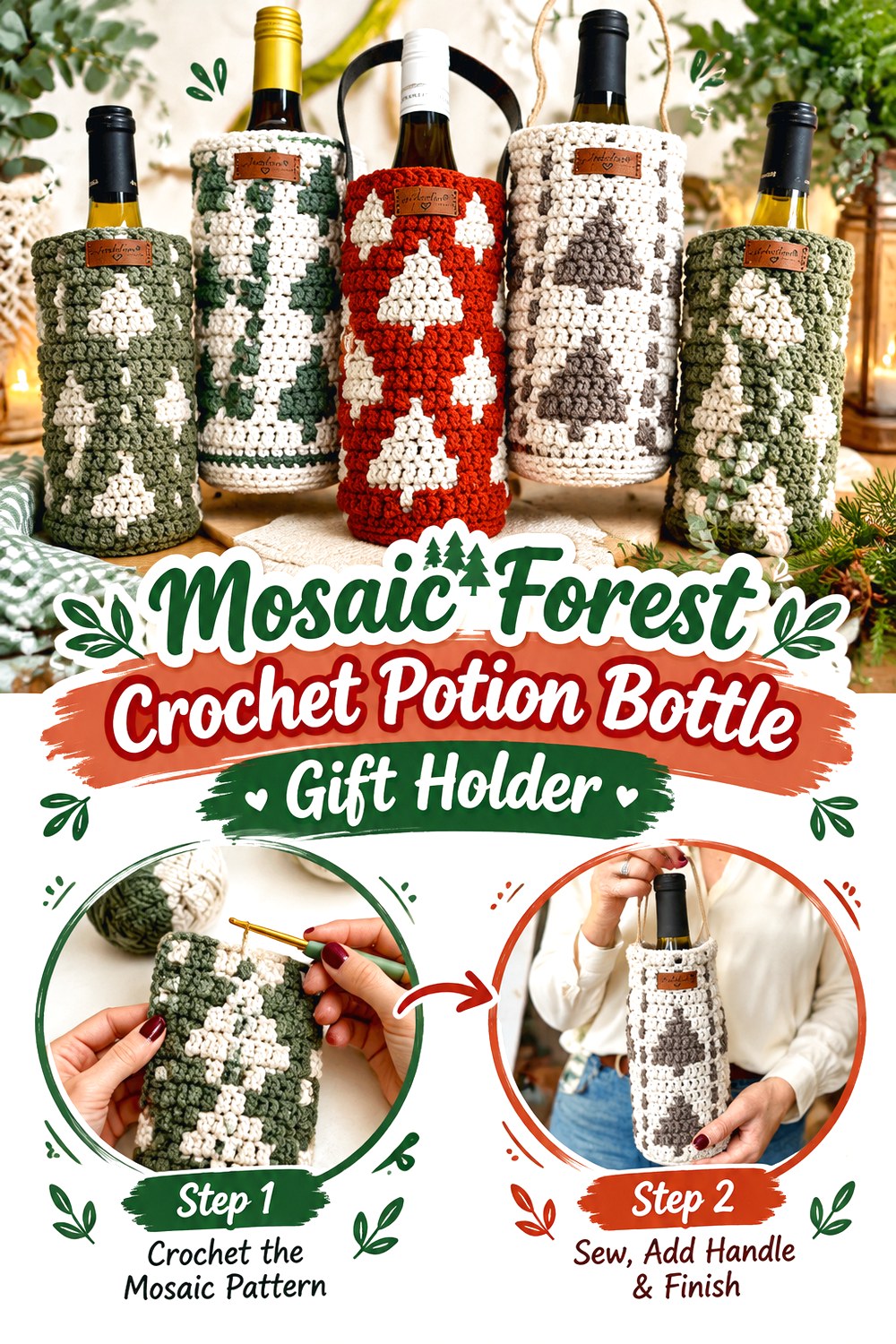
HanJan Crochet’s original project is a wine-bottle holder featuring overlay mosaic crochet and repeated Christmas-tree imagery. It is a larger gift-oriented project rather than a small potion carrier, but its dense patterned cylinder provides an interesting construction reference for an enchanted-forest potion sleeve.
Unlike mesh, this direction lets the crochet fabric carry most of the visual story. Woodland motifs, strong geometric repeats, or carefully selected colorwork can transform a plain bottle into a display piece. Because the source is proportioned for wine bottles, a miniature adaptation should not assume that the existing motif repeat can simply be reduced without affecting the graphic.
Respect the Motif Repeat When Resizing
Colorwork has stricter resizing limits than a plain tube. Removing circumference can interrupt a repeat or leave the image incomplete at the join.
Before choosing a small potion bottle, check whether the desired motif can still establish itself clearly at that scale. A larger apothecary bottle may actually produce a stronger result.
Decide Whether the Bottle or Crochet Gets Attention
Dense mosaic fabric can hide labels and colored glass. That is an advantage when the crochet motif should dominate, but a drawback when you have a sculptural or hand-painted bottle you want to display.
Use this style for presentation pieces, themed gifts, or shelf decor where the textile surface is meant to be noticed first.
Original Tutorial and Creator Credit
Creator/Site: HanJan Crochet
6. Patchwork Granny Crochet Potion Bottle Carrier
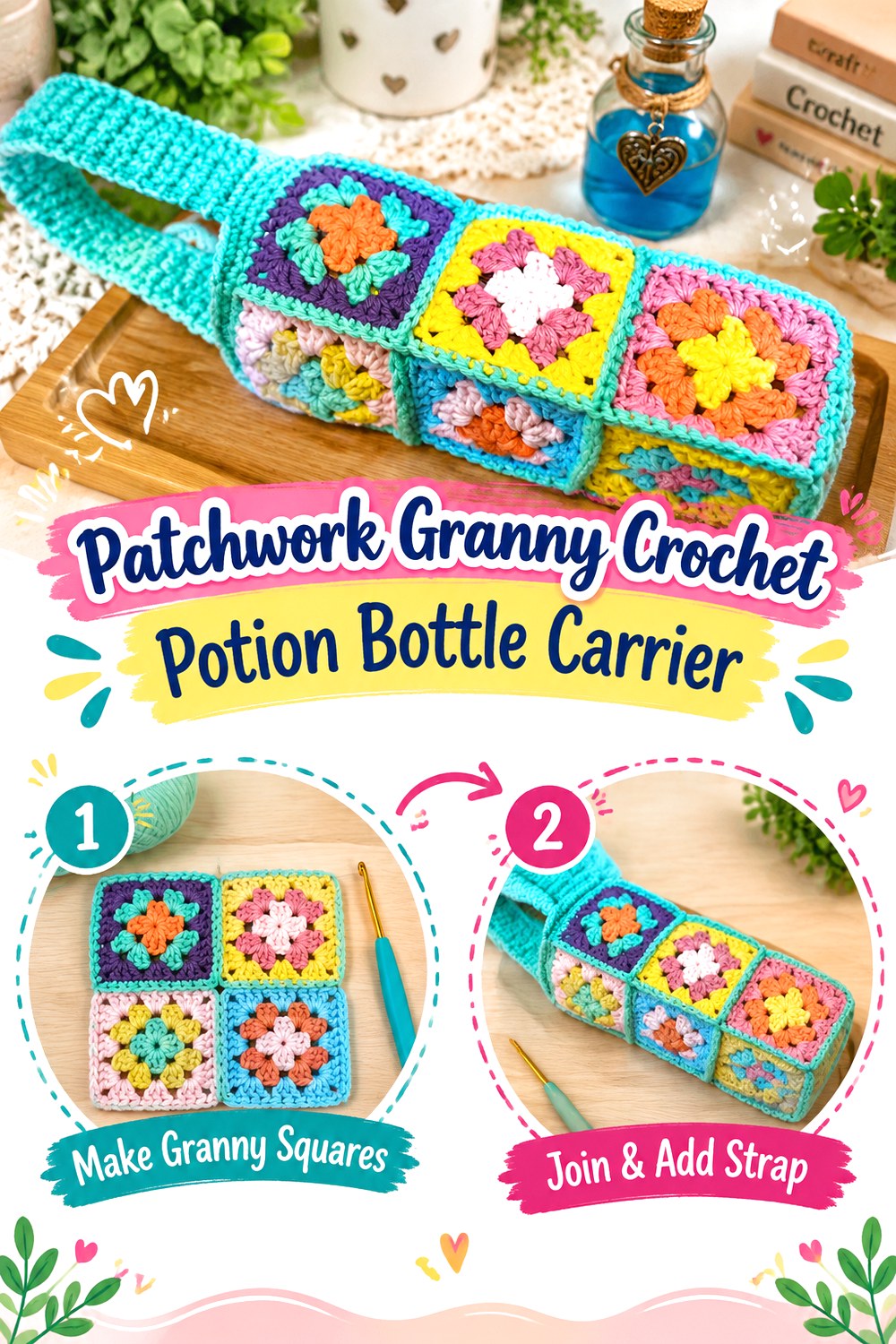
Katia Creates constructs a water-bottle holder from joined granny squares, giving the project a modular structure rather than one continuous crocheted tube. The tutorial also discusses altering motif size for a smaller holder, making motif proportion an explicit part of the original project.
For potion styling, the joined squares could create a traveling-herbalist, patchwork witch, or fantasy-market aesthetic. This approach looks especially different from plain mesh because the seams and individual motifs remain visible. It suits bottles large enough to support a recognizable grid; a very narrow vial may leave too little space for the square layout to work convincingly.
Mock Up the Motifs Before Joining
One advantage of modular crochet is that you can place finished motifs beside the real bottle before committing to assembly.
Check how many squares are needed around the circumference, where the seams will land, and whether the grid rises too far above the bottle shoulder. That preview can reveal scale problems while they are still easy to solve.
Turn Joins Into a Deliberate Design Feature
Contrasting seams can outline each granny square and make the holder look almost like stained glass. Low-contrast joining creates a quieter patchwork surface.
Neither is inherently better. Decide which effect supports the potion theme before assembly, because the joining color will influence the finished carrier almost as much as the motifs themselves.
Original Tutorial and Creator Credit
Creator: Katia Creates
7. Scalloped Drawcord Crochet Potion Bottle Cozy
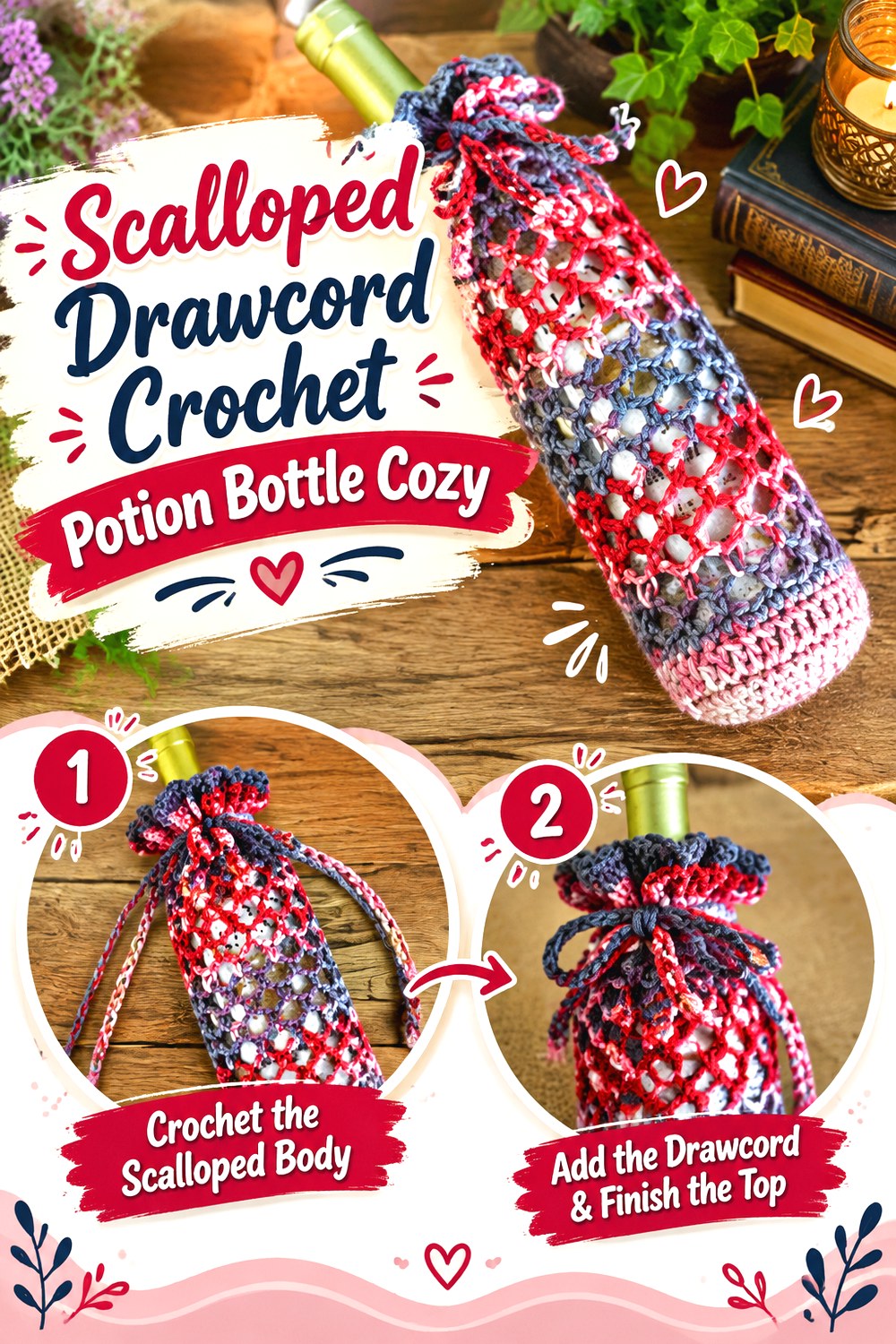
The Yarny Way’s crocheted wine bottle cozy combines an open body with a scalloped upper edge and a separate cord threaded near the bottle neck. The original creator also shows that the basic cozy can be interpreted with different yarn treatments, including a beaded variation.
For a potion bottle, that gathered neck treatment feels naturally suited to an elixir or apothecary theme. The scallops soften the otherwise cylindrical shape, while the open fabric keeps portions of colored glass visible. This is better suited to decorative presentation than to a rugged carrier when reproduced at a small scale.
Keep the Scallops Proportional
A large decorative edge can swallow the neck of a miniature bottle. Compare the finished or planned scallop depth with the distance between the shoulder and stopper.
If the entire neck disappears behind crochet, the potion silhouette may become less recognizable. A larger bottle or subtler upper treatment may be the better match.
Treat the Drawcord as Decoration and Retention
A cord can gather crochet around the neck, but it should not be expected to seal a bottle containing liquid. The stopper or cap still needs to do that job.
Keep the tie accessible rather than burying it under several charms. If beads or other small embellishments are added, consider how they affect weight, care, and suitability around children or pets.
Original Tutorial and Creator Credit
Creator/Site: The Yarny Way
8. Textured Column Crochet Potion Bottle Holder
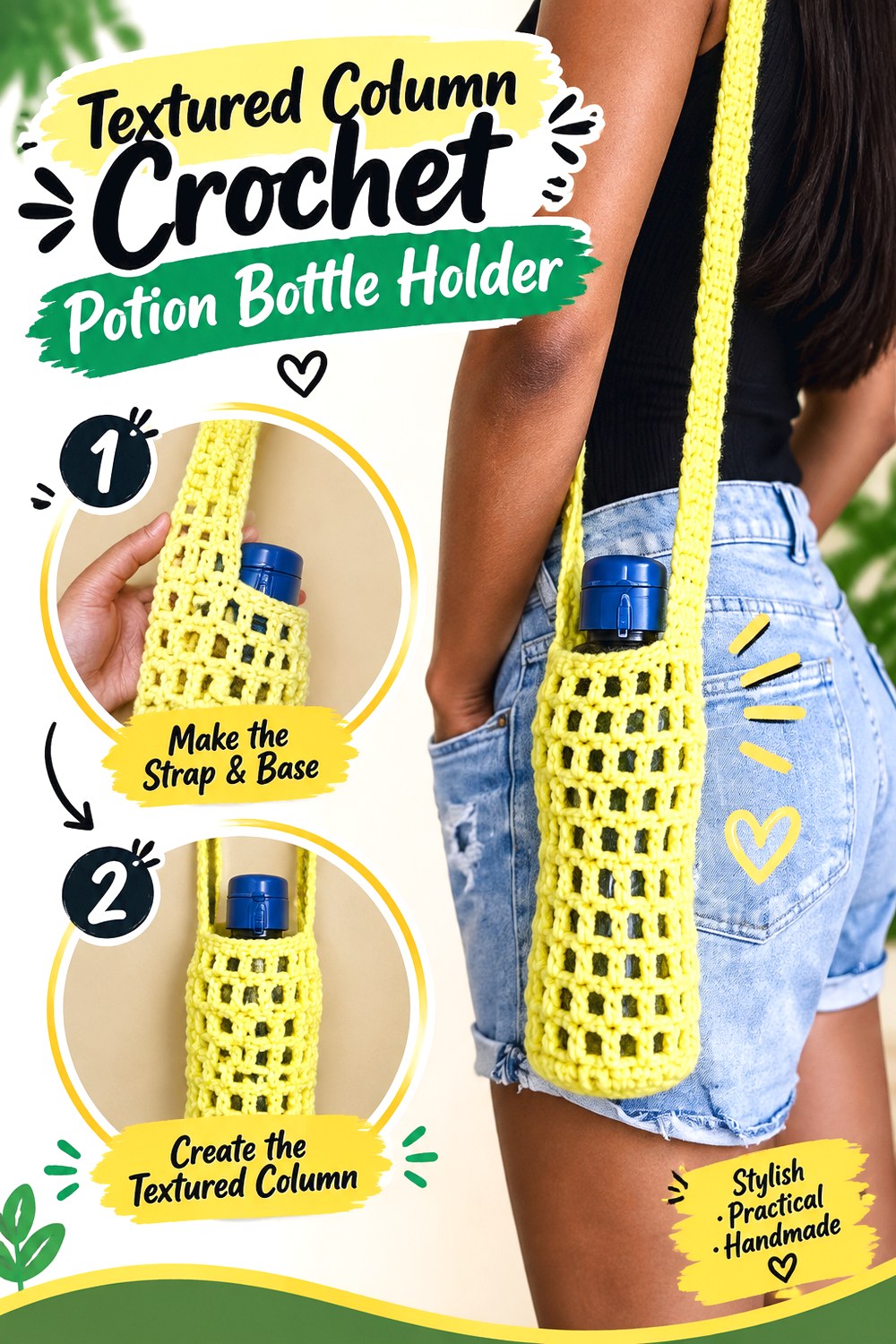
Tejelu crochet’s video demonstrates a bottle holder built from combinations of basic stitches that create a visibly textured surface. That gives the project a different character from motif-heavy or very open carriers: the stitch relief itself supplies much of the decoration.
A potion adaptation could lean gothic, rustic, or alchemical depending on the yarn and bottle underneath. Because the surface already contains substantial visual movement, this approach does not need many charms or appliqués. It can be especially effective around a plain container that benefits from additional textile interest.
Choose Yarn That Lets the Texture Read
If raised stitch definition is the main attraction, a very fuzzy or extremely busy yarn can obscure it.
Make a small sample or work enough of the holder to view the texture from normal display distance. If the relief disappears, a smoother yarn or quieter color treatment may show the construction more clearly.
Limit Competing Embellishment
A textured body already creates shadow and pattern. Adding several leaves, beads, labels, and bows can make the surface difficult to read.
For a potion theme, one strong focal feature near the neck or outward-facing side is usually enough. Let the stitch pattern supply the rest of the visual detail.
Original Tutorial and Creator Credit
Creator: Tejelu crochet
9. Growing Vines Crochet Potion Bottle Belt Carrier
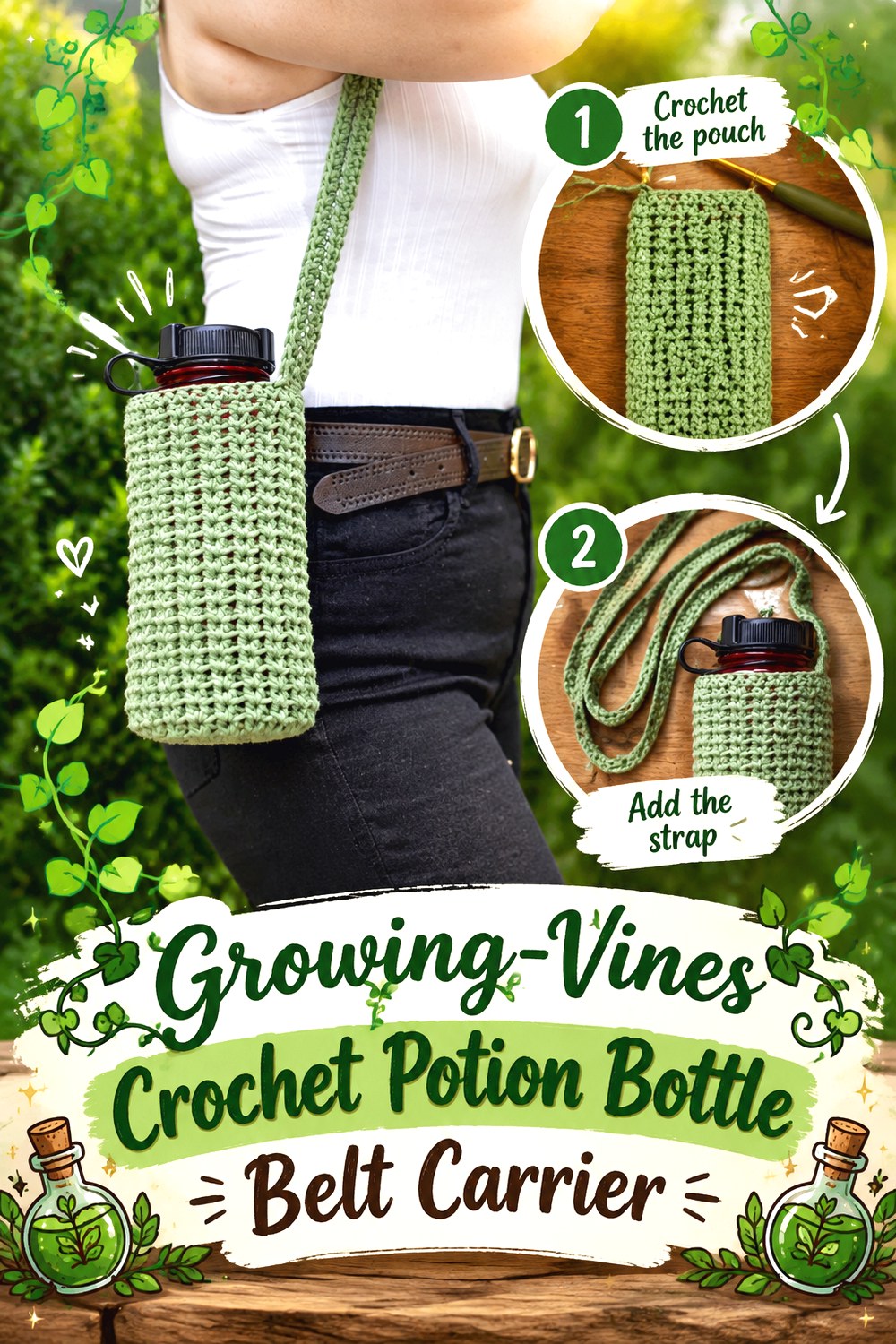
Winding Road Crochet’s Growing Vines holder stands out because the original design discusses several carrying options: a long shoulder strap, a short belt-style strap, and optional carabiner attachment. The pattern is also written with adjustment for different bottle sizes in mind.
Those features make it one of the most naturally compatible starting points for a wearable potion-bottle carrier. Instead of removing a long strap and inventing a completely new waist attachment, readers can study a source that already considers compact and clip-on carrying methods. A smaller fantasy bottle still requires its own fit checks.
Test How the Bottle Hangs From One Side
A carabiner or compact belt connection changes the balance compared with a strap attached on opposite sides.
Load the intended bottle, hold the carrier at the planned attachment point, and see whether it stays upright or tilts outward. This is particularly important with top-heavy bottles or unusually large stoppers.
Keep a Hip-Worn Potion Compact
A tall container may bump the leg or swing more than expected. Before committing to the full height, hold the bottle at the waist and walk a few steps.
A short, broad apothecary bottle can be more comfortable for belt wear than a tall vial even when the taller shape looks more dramatic on a shelf.
Original Tutorial and Creator Credit
Creator/Site: Winding Road Crochet
10. Ocean Lace Crochet Potion Bottle Sling

Concrete Gems combines textured crochet with lace sections in the Ocean Coral Water Bottle Holder, producing a surface that alternates between denser and more open areas. The original design also provides options for changing holder dimensions and carrying length.
That mix translates well to a potion concept because it gives you controlled windows of exposed glass without turning the entire carrier into mesh. A dark, sea-green, blue, or weathered neutral interpretation could suggest an ocean elixir, mermaid potion, or storm-witch accessory. It also offers a useful middle ground between solid colorwork and barely-there netting.
Plan What the Lace Will Reveal
An opening becomes more effective when it deliberately frames an attractive part of the bottle.
During fitting, rotate the container inside the holder and check where a label, colored-glass section, or unusual contour appears through the lace. Small placement choices can make the finished adaptation look much more intentional.
Watch the Transition Between Fabric Densities
Dense and open sections may stretch differently, especially when the bottle presses against them.
Rather than judging circumference only at the base, try the holder on the bottle as the different textures develop. You want the transition to remain smooth instead of creating one tight band and one loose band.
Original Tutorial and Creator Credit
Creator/Site: Concrete Gems
11. Celestial Star Stitch Crochet Potion Bottle Holder

Jo to the World Creations uses star stitch as the defining surface of its water-bottle holder. The original pattern includes more than one size and allows the height and strap to be customized, making proportion and carrying length part of the design rather than fixed assumptions.
The repeated star texture offers a natural celestial potion direction without requiring an appliqué. Dark blue, charcoal, plum, or muted silver-toned yarn could create a night-sky effect, while brighter colors can make the same surface feel more whimsical. Because star stitch produces a stronger visual fabric than simple netting, the holder itself becomes the focus.
Give the Stars Enough Room to Establish
Tiny potion vials may not provide enough circumference for a repeated textured motif to look balanced.
Before scaling down dramatically, compare the repeat size with the bottle body. A medium decorative apothecary bottle may show the stitch pattern much more effectively than the smallest vial in your collection.
Consider Fabric Thickness Around the Bottle
A highly textured stitch can create more substance than open mesh. That can help a plain bottle look intentionally dressed, but excessive thickness can visually overwhelm a miniature container.
Judge the yarn, stitch texture, and bottle together. If the crochet appears larger than the potion itself, scale may be working against the design.
Original Tutorial and Creator Credit
Creator/Site: Jo to the World Creations
12. Twin Handle Crochet Potion Bottle Cover
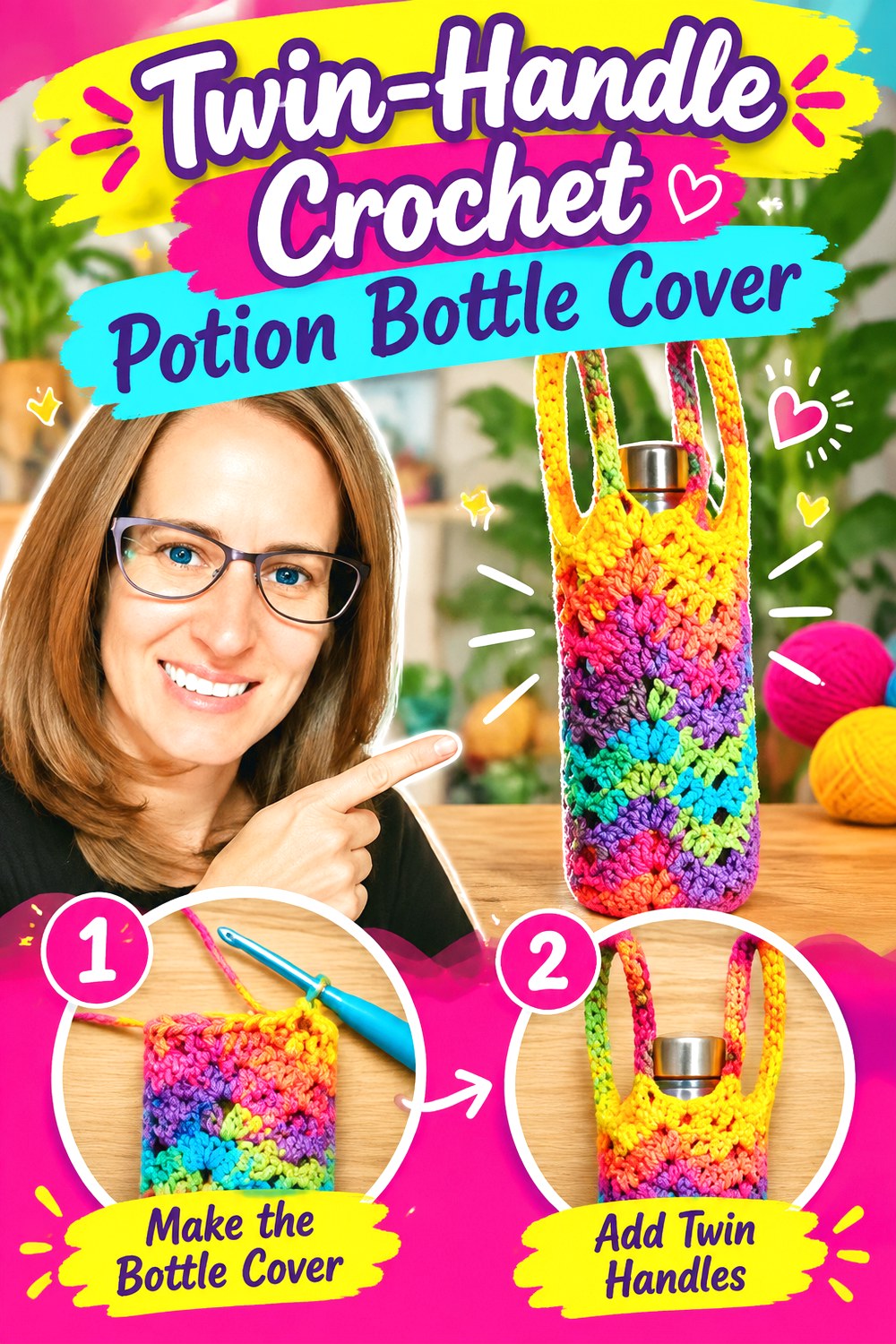
Crochet with Clare’s water bottle cover uses an open repeating body and finishes with two carrying handles worked into the upper section. That paired-handle arrangement makes it visually different from the many single-strap slings in this collection.
Adapted to a fantasy bottle, the shape can read almost like a miniature handled potion basket. It is better suited to hand carrying, gifting, or display than a long-distance wearable accessory. A broad or medium-height apothecary bottle would likely suit this concept more naturally than a very narrow vial because the handles need enough separation to look purposeful.
Keep Both Handles Balanced
Two handles draw attention to symmetry. If one attachment area stretches more than the other, the bottle may lean or the opening may pull unevenly.
Before finishing, set the filled holder upright and compare both sides. A balanced upper edge matters more here than it does on a loosely gathered drawcord cozy.
Use the Handles as Part of the Fantasy Styling
The handles can support the visual theme without extra appliqués. They might frame a dramatic stopper, coordinate with a contrasting edge, or make a small potion gift feel like its own miniature carrier.
Avoid loading the top with bulky decorations that interfere with hand access. The paired handles are already a defining feature.
Original Tutorial and Creator Credit
Creator/Site: Crochet with Clare
13. Web Mesh Crochet Potion Bottle Carrier
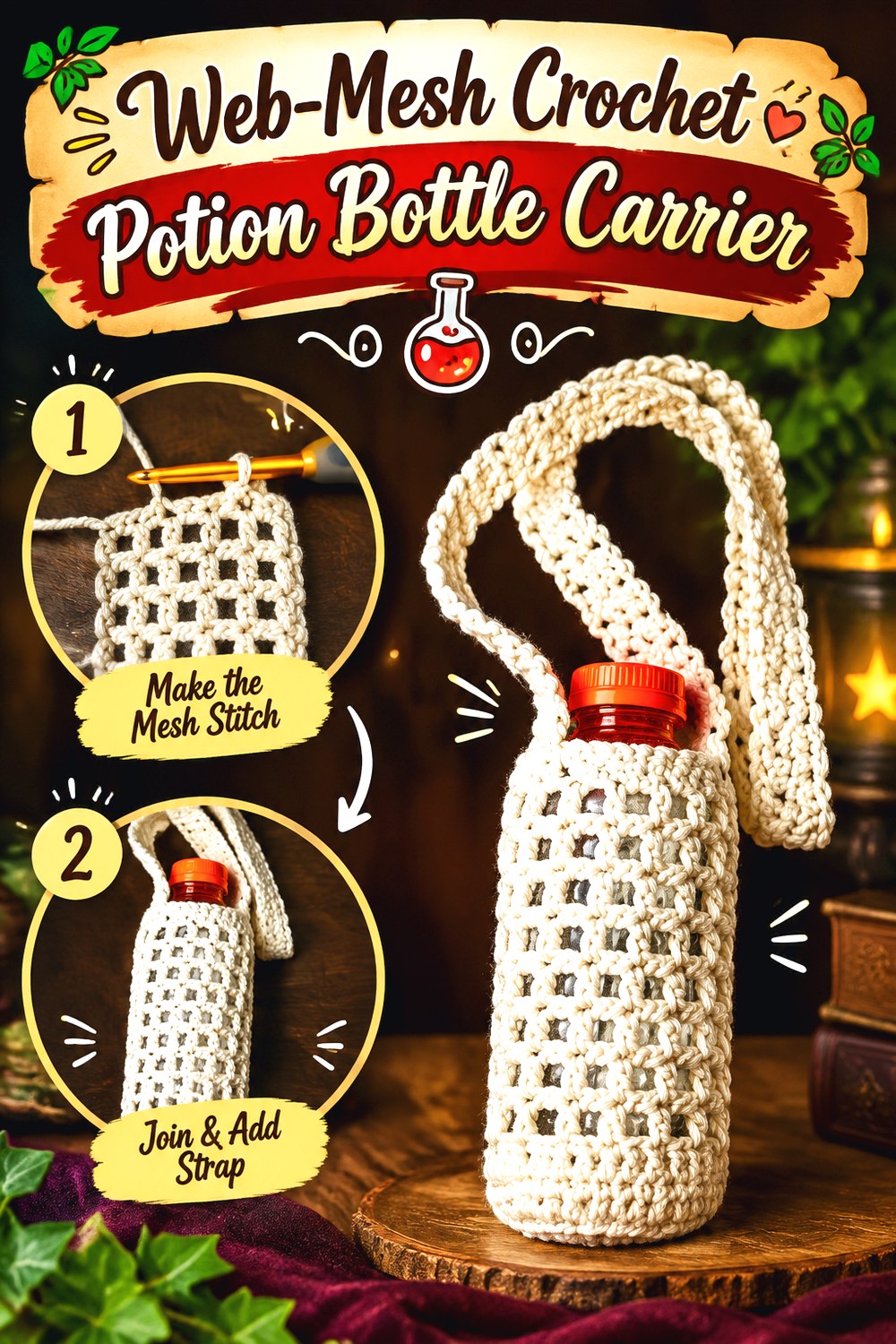
Goddess Crochet’s original water-bottle holder is an open mesh design supported by both written instructions and a crochet chart. That strong negative-space geometry makes it a useful starting point for a potion carrier with a web, lattice, or magical-containment feel.
Black yarn around green or purple glass can make the openings read as part of the fantasy styling, but the same construction can look lighter in cream, gray, or muted botanical colors. This works best when the bottle itself deserves to remain visible. It is less appropriate when you want the crochet to conceal a label or ordinary container.
Let Negative Space Be the Motif
Web-like fabric already creates a strong graphic surface. Covering it with many appliqués defeats the purpose of choosing an open geometric holder.
Instead, use one intentional detail at the top or attachment area if the potion needs extra character. The spaces between stitches should remain visible enough to define the design.
Use the Chart to Evaluate Scale
Charts can make repeat relationships easier to understand before you change the circumference.
When adapting for a potion bottle, look at how the repeat travels around the original holder. If a smaller circumference would break the pattern relationship, changing yarn scale or choosing a larger bottle may produce a cleaner result than forcing a miniature conversion.
Original Tutorial and Creator Credit
Creator/Site: Goddess Crochet
14. Utility Pocket Crochet Potion Bottle Holder
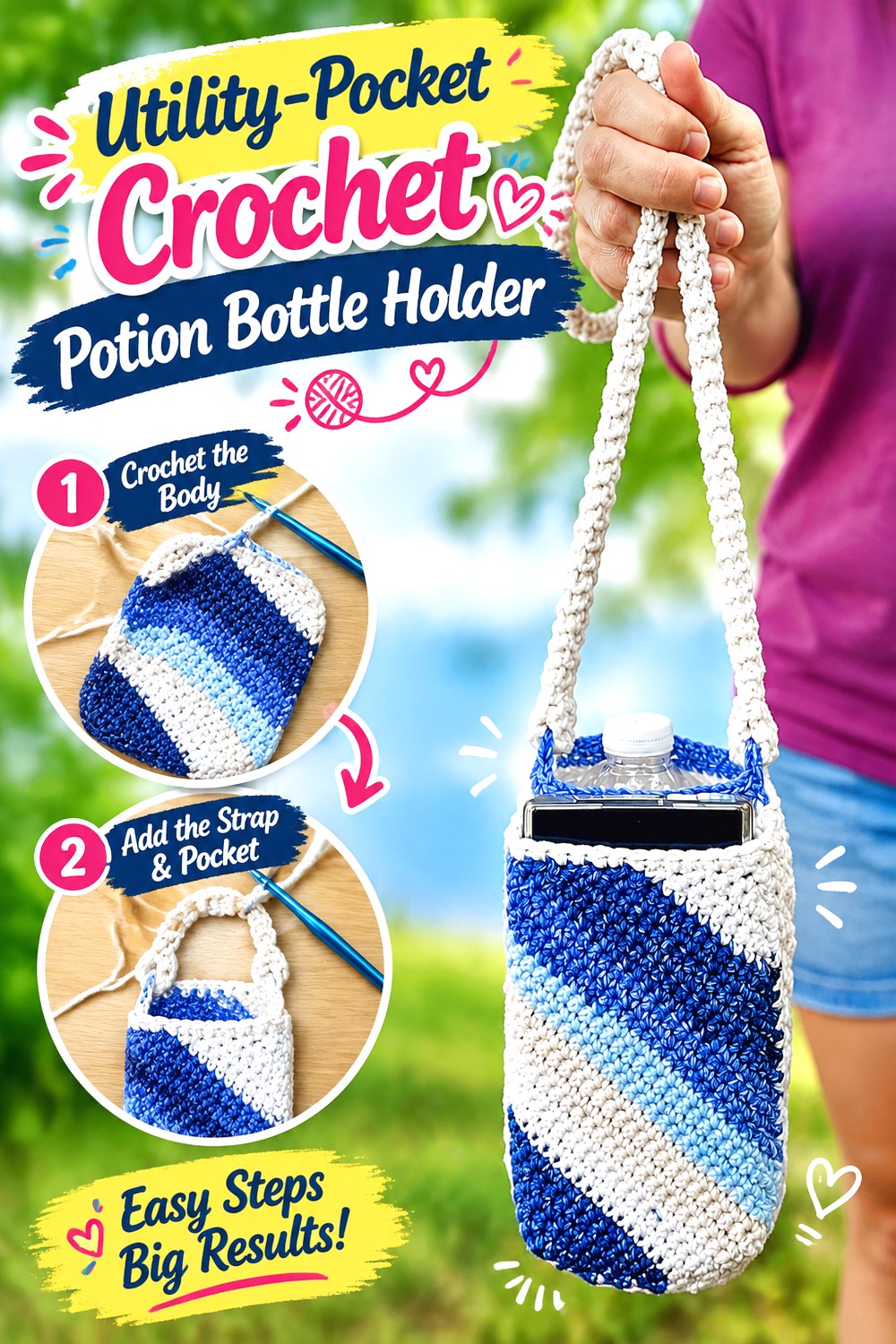
A Crocheted Simplicity turns the bottle carrier into a more substantial utility accessory by combining a granny-stitch bottle body with a separate corner-to-corner phone pocket and multiple strap options. The original tutorial also discusses customizing the carrier for different bottle dimensions.
For a potion adaptation, the extra pocket could hold a lightweight costume card, fabric spell note, gaming token pouch, or other small accessory rather than a phone. That gives this idea an adventurer or traveling-alchemist character that a simple bottle sling does not have. Because the extra compartment changes the balance and bulk, it makes most sense on a reasonably sized potion bottle rather than a miniature vial.
Make the Extra Pocket Serve a Real Purpose
A secondary compartment adds fabric and weight. Include it because you genuinely want layered storage or the visual character of an alchemist’s utility pouch—not merely because the source offers one.
For a fantasy version, keeping the pocket lightly loaded will help the main bottle remain the focus and reduce uneven pulling.
Match the Strap to the Combined Load
The source provides different strap approaches, which becomes particularly relevant once a pocket is added. A holder carrying both a bottle and another item places more demand on the carrying system than an empty decorative sleeve.
Test the completed adaptation with the actual lightweight contents before using it extensively. If converting it to belt wear, treat that attachment as a separate structural modification.
Watch How Granny Openings Interact With the Bottle
The open granny body allows the container color to show through. That can create attractive layering, especially with amber, green, violet, or smoky glass.
If the inner bottle has a busy commercial label you would rather conceal, this construction may not be the best choice unless an appropriate inner layer is added independently.
Original Tutorial and Creator Credit
Creator/Site: A Crocheted Simplicity
How the 14 Crochet Potion Bottle Holder Styles Compare
For the most literal fantasy look, the Cork-Top and Moon-Sigil projects make the crochet itself resemble a potion bottle. Flower-Base, Mosaic Forest, Star-Stitch, and Textured Column styles give the yarn a stronger decorative role, while Market-Net, Web-Mesh, and Ocean-Lace constructions keep more glass visible.
Patchwork Granny is the most modular option, and the Scalloped Drawcord Cozy emphasizes presentation around the bottle neck. Growing Vines is especially relevant for compact wearable carrying because the original source already considers belt-style and carabiner use. Twin-Handle suits hand carrying, while the Utility-Pocket version makes sense when a second compartment genuinely adds value.
Conclusion
The most convincing crochet potion bottle holder starts with function and proportion rather than a Halloween color palette. Decide whether you want to carry a real bottle, create a soft potion-shaped storage pouch, show off decorative glass, conceal the container with texture, or build an accessory that hangs comfortably from the body.
From there, the differences become easier to evaluate. Mesh emphasizes the bottle, dense texture emphasizes the crochet, motifs need enough surface area to remain readable, and compact carrying attachments deserve more structural thought than purely decorative sleeves.
Use the credited original tutorials for exact construction details, then make any potion-themed changes cautiously around the bottle, fabric behavior, and intended use.
Frequently Asked Questions
Can I resize a water bottle holder for a small potion bottle?
Often the construction concept can be adapted, but simply making the holder shorter is rarely enough. A smaller bottle changes the required base diameter, circumference, height, opening scale, and sometimes motif repeat. Compare the developing crochet directly with the intended bottle. For granny squares, mosaic work, star stitch, or other strongly repeated designs, confirm that the pattern can still establish itself clearly before reducing the project dramatically.
Which crochet fabric works best if I want the potion bottle visible?
Mesh, lace, granny-style openings, and other openwork fabrics keep more of the container visible. They are useful for colored glass, decorative labels, unusual bottle shapes, and dramatic stoppers. The trade-off is that the opening size must remain appropriate for the bottle. Dense textured crochet is usually a better aesthetic choice when you want the yarn surface to dominate or when the underlying container is visually plain.
Can a crochet potion bottle holder protect a glass bottle?
Do not rely on crochet as impact protection. A holder may make a bottle easier to carry or provide a textile layer around it, but that does not make glass unbreakable. Inspect the base, opening, strap or belt attachment, and balance with the real container in place. For active costumes, conventions, or crowded events, a lightweight non-glass prop may be a more practical choice.
Should the crochet extend all the way to the stopper?
Not necessarily. Leaving the shoulder, neck, and stopper visible can strengthen the recognizable potion-bottle silhouette. A drawcord or decorative edge may sit below the neck, while a fitted sleeve might deliberately stop around the shoulder. Try the developing holder on the actual bottle and judge which stopping point gives both enough support and the visual effect you want.
What yarn should I use for a potion bottle holder?
The best choice depends on the construction and intended use, so follow the original tutorial’s material guidance before substituting. In general, yarn changes can affect stretch, thickness, stitch definition, and drape. Smooth yarn can make texture or colorwork easier to see, while very soft or stretchy fabric may behave differently in a long strap. Always compare substitutions against the actual bottle as you work.
Can I add a belt loop to a crossbody bottle-holder pattern?
You can treat a belt loop as an adaptation, but it changes how the load reaches the holder. A crossbody strap typically connects across a wider area, while a compact loop concentrates force near the top. Test placement and balance with the intended contents before wearing the holder. Open mesh may also need a different attachment strategy from dense fabric, so do not assume one belt-loop method suits every construction.
How should I care for an embellished crochet potion bottle holder?
Care depends on the yarn and any added components. Follow the yarn label and the original creator’s care guidance where available. Buttons, beads, charms, stuffing, mixed fibers, or attached hardware can change what cleaning method is appropriate. Remove the bottle before cleaning unless the source specifically says otherwise, and inspect decorative attachments afterward so loose pieces do not become a problem.


