14 Crochet Opera Gloves Ideas for Long Lace, Mesh, and Textured Styles
Crochet opera gloves can move in very different directions. A fine fishnet pair creates a light evening look, deep ribbing makes a long glove feel more substantial, and lace, scallops, cables, flowers, or bows can shift the same basic silhouette toward vintage, romantic, or statement styling.
This collection mixes tutorials that already produce long fingerless gloves or arm warmers with shorter decorative glove designs that can inspire a carefully planned opera-length adaptation. That distinction matters: extending a short mitt is not simply a matter of adding arbitrary rows, because forearm width, stitch repeats, thumb placement, and fabric stretch all affect the finished fit. The ideas below help you compare those differences before choosing a direction, while the original tutorials remain the source for exact construction details.
Quick List
- Crochet Fishnet Evening Opera Gloves
- Crochet Cable-Texture Opera Arm Warmers
- Crochet Victorian-Inspired Opera Gloves
- Crochet Sleek Long Fingerless Opera Gloves
- Crochet Blossom Scallop Opera Gloves
- Crochet Long Ribbed Opera Mitts
- Crochet Bow-Trim Opera Gloves
- Crochet Starlight Lace Opera Gloves
- Crochet Autumn-Leaf Opera Gloves
- Crochet Ribbed Everyday Opera Arm Warmers
- Crochet Vintage Lace Opera Gloves
- Crochet Clean-Line Opera Arm Warmers
- Crochet Modern Flat-Panel Opera Gloves
- Crochet Cabled Open-Finger Opera Gloves
How to Plan Opera Length Without Losing Fit
Long gloves create more fit decisions than wrist-length mitts because the fabric has to relate to several different circumferences. The hand, wrist, lower forearm, fuller forearm, and upper edge may all need consideration. A tube that fits comfortably at the wrist can become restrictive farther up, while a shape wide enough for the forearm may slide if the upper edge lacks enough recovery.
Before extending any design, compare the intended finished circumference with the wearer at several points along the arm. Also check where the thumb opening will sit when the glove is pulled to its intended height. Crochet fabric can behave differently depending on stitch pattern and yarn, so a small fabric sample is more useful than assuming the same adjustment will work for mesh, lace, ribbing, and dense texture.
Mesh, Lace, Ribbing, or Dense Texture?
The stitch character changes both appearance and behavior. Open fishnet and lace keep the visual weight light and can work particularly well when the goal is decorative layering. Their larger openings, however, make consistent tension noticeable. A mismatched repeat or abrupt increase can be much easier to see across a long forearm.
Ribbed constructions generally create stronger visual lines and may offer useful flexibility, depending on how the ribbing is formed. Cable and heavily textured fabrics bring more surface detail but can feel visually and physically heavier over a long glove.
Yarn substitution can change every one of those effects. Before committing to a full pair, check whether the new yarn preserves the fabric character you liked in the original tutorial rather than relying only on a similar label category.
When a Short Glove Tutorial Becomes an Opera-Length Adaptation
Several decorative tutorials in this collection stop around the wrist or lower forearm. They are included because their lace, scallop, flower, bow, or texture treatments offer a useful design direction—not because the original creator necessarily made an opera-length version.
For those projects, treat the long forearm as a separate adaptation. First understand how the original hand section fits and where its stitch pattern can logically continue. Then determine whether added circumference shaping is necessary as the glove travels upward. Decorative repeats may also need repositioning rather than simple repetition.
Make one glove far enough to assess the upper-arm fit before duplicating the entire second glove. That gives you a chance to correct length, flare, or motif placement while there is still only one piece to revise.
1. Crochet Fishnet Evening Opera Gloves

A long fishnet glove is one of the clearest ways to translate crochet into an opera-glove silhouette without creating a visually heavy accessory. The Diving Ducks Crochet tutorial specifically presents long fingerless gloves in a fishnet pattern, making this one of the closest direct matches in the collection rather than an extension of a short mitt.
The open network keeps the arm visible and places most of the visual emphasis on the repeating geometry. That makes this direction useful for evening outfits, costume styling, layered accessories, or occasions where a dense winter fabric would feel out of place. Because the openings form such a strong grid, consistent tension matters more than decorative complexity.
Watch the Upper-Arm Transition
A mesh tube can look balanced at the wrist yet need additional room higher on the forearm. Rather than assuming that openwork will stretch enough to compensate, compare the developing glove with the intended wearer as its circumference changes. Any increase strategy should preserve the visual rhythm of the mesh instead of introducing an obvious patch of irregular holes.
Keep the Fishnet Pattern Visually Even
Open crochet exposes differences in loop size more readily than a compact solid stitch. If the first few inches show noticeably different openings, correcting tension early will usually produce a cleaner long glove than hoping the irregularity disappears later. The paired gloves should also be compared side by side so the mesh density and final length look intentionally matched.
Original Tutorial and Creator Credit
Creator: Diving Ducks Crochet
2. Crochet Cable Texture Opera Arm Warmers
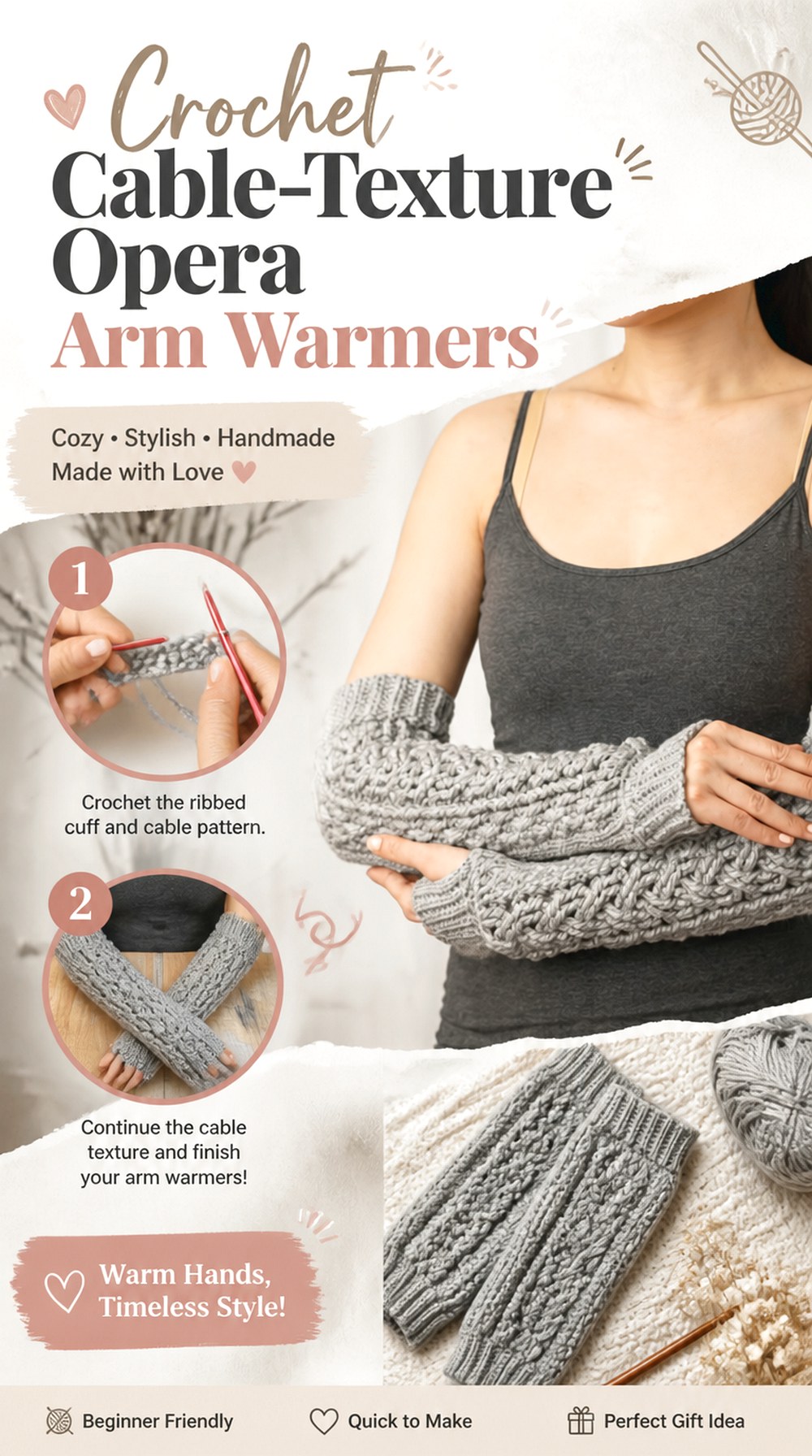
For a more substantial statement, the TCDDIY arm-warmer tutorial combines raised cable detail with additional textured fabric instead of relying on an all-over open pattern. The source covers a complete arm-warmer project and visibly separates details such as the textured body, side treatment, upper band, and thumb opening.
That surface depth makes this direction noticeably different from delicate evening mesh. Extended toward an opera-glove silhouette, it becomes an accessory where the crochet itself is a focal point. It can work especially well when you want long coverage and visible stitch architecture. The trade-off is that a richly textured fabric can add bulk, so proportions and yarn substitution deserve more attention than they would in an airy lace version.
Let the Texture Lead the Proportions
Raised details consume visual space. On a long arm warmer, too many competing treatments can make the forearm look crowded, while a clearly placed cable or textured panel gives the eye a path along the glove. When adapting length, consider whether the existing panel should continue, finish before the upper edge, or be framed by a simpler section.
Check Movement Before Adding More Length
Long textured crochet has to flex as the wrist and elbow move. Once enough of the first glove exists to reach well up the forearm, bend the wrist and arm naturally and check for excessive stiffness or bunching. If a yarn substitution has made the fabric noticeably firmer than expected, extending it farther may amplify that issue.
Original Tutorial and Creator Credit
Creator: TCDDIY
3. Crochet Victorian Inspired Opera Gloves

Victorian-inspired fingerless gloves bring a historical mood to the collection without requiring a literal reproduction of period handwear. Ooty knitting and crochet demonstrates a vintage Victorian-style fingerless glove, providing a decorative starting point for readers who want something more ornamental than contemporary ribbed arm warmers.
The original project is not presented as a full above-the-elbow opera glove, so extra forearm length should be treated as an adaptation. The appeal lies in carrying the source’s vintage character farther up the arm while keeping the hand section proportionate. This style can suit theatrical wardrobes, romantic outfits, historical-inspired looks, or modern clothing that benefits from a deliberately old-fashioned accessory.
Extend the Silhouette, Not Every Detail
A successful long adaptation does not require multiplying every decorative feature. The hand and wrist can remain the most intricate area while the added forearm becomes quieter. That approach can prevent a vintage motif from feeling visually overloaded once it occupies substantially more space than the original glove.
Test the Top Edge Against the Styling Goal
An opera-length glove needs a deliberate stopping point. Decide whether the upper edge should sit on the forearm, near the elbow, or higher, then evaluate that position with the clothing it will accompany. Sleeve length can completely change how much crochet remains visible, so styling the first glove with the intended outfit is a useful checkpoint.
Original Tutorial and Creator Credit
Creator: Ooty knitting and crochet
4. Crochet Sleek Long Fingerless Opera Gloves

Chenda DIY’s tutorial is another strong direct match because it specifically teaches long fingerless gloves. Rather than beginning with a decorative short mitt and engineering a new forearm section, readers can use an existing long silhouette as their starting point.
This makes the project appealing when proportion is more important than elaborate surface decoration. A simple elongated glove can complement fitted dresses, sleeveless tops, costume pieces, or layered streetwear without competing with the rest of an outfit. It is also a useful base for customization because embellishment can be added selectively after the overall form has been established. Any added trim should still respect the stretch and movement already built into the glove.
Prioritize Symmetry Between the Pair
Minimal styling leaves fewer details to distract from differences in length or fit. As the second glove develops, compare it regularly with the first rather than waiting until finishing. Upper-edge position, thumb placement, and overall hand length are especially visible when both gloves are worn together.
Add Embellishment Only After Fit Is Settled
Beads, bows, appliqués, or surface decoration can change how the fabric hangs and how easy it is to care for. If customization is planned, complete and assess the basic long gloves first. That way, decoration can be positioned according to the finished fit rather than being forced to accommodate later size corrections.
Original Tutorial and Creator Credit
Creator: Chenda DIY
5. Crochet Blossom Scallop Opera Gloves

Crochet with Linni’s Blossom Scalloped Fingerless Gloves combine lace, a scalloped border, and a small decorative flower. The associated pattern information also describes the gloves as made to measure and notes that fit and length can be adjusted, making this a particularly adaptable decorative source.
For an opera-glove interpretation, the flower and scalloped detail can remain concentrated around the hand or edge while the lace continues farther along the forearm. That distribution keeps the embellishment recognizable without making the entire long glove equally busy. The result suits readers who want a soft botanical direction rather than fishnet geometry, dense cables, or plain ribbing.
Decide Where the Flower Belongs First
A floral accent draws immediate attention, so placement should be planned around the finished glove rather than attached wherever space happens to remain. Consider whether the flower should sit near the wrist, hand, or upper edge. Placing the embellishment consistently on both gloves is more important than maximizing the number of decorations.
Protect the Scalloped Edge From Crowding
Scallops need visual room to read clearly. If the opera-length adaptation changes the circumference near the edge, check that the final repeat still sits comfortably instead of appearing compressed. A decorative border that worked at wrist circumference may need thoughtful repositioning when moved to a wider part of the arm.
Original Tutorial and Creator Credit
Creator: Crochet with Linni
6. Crochet Long Ribbed Opera Mitts
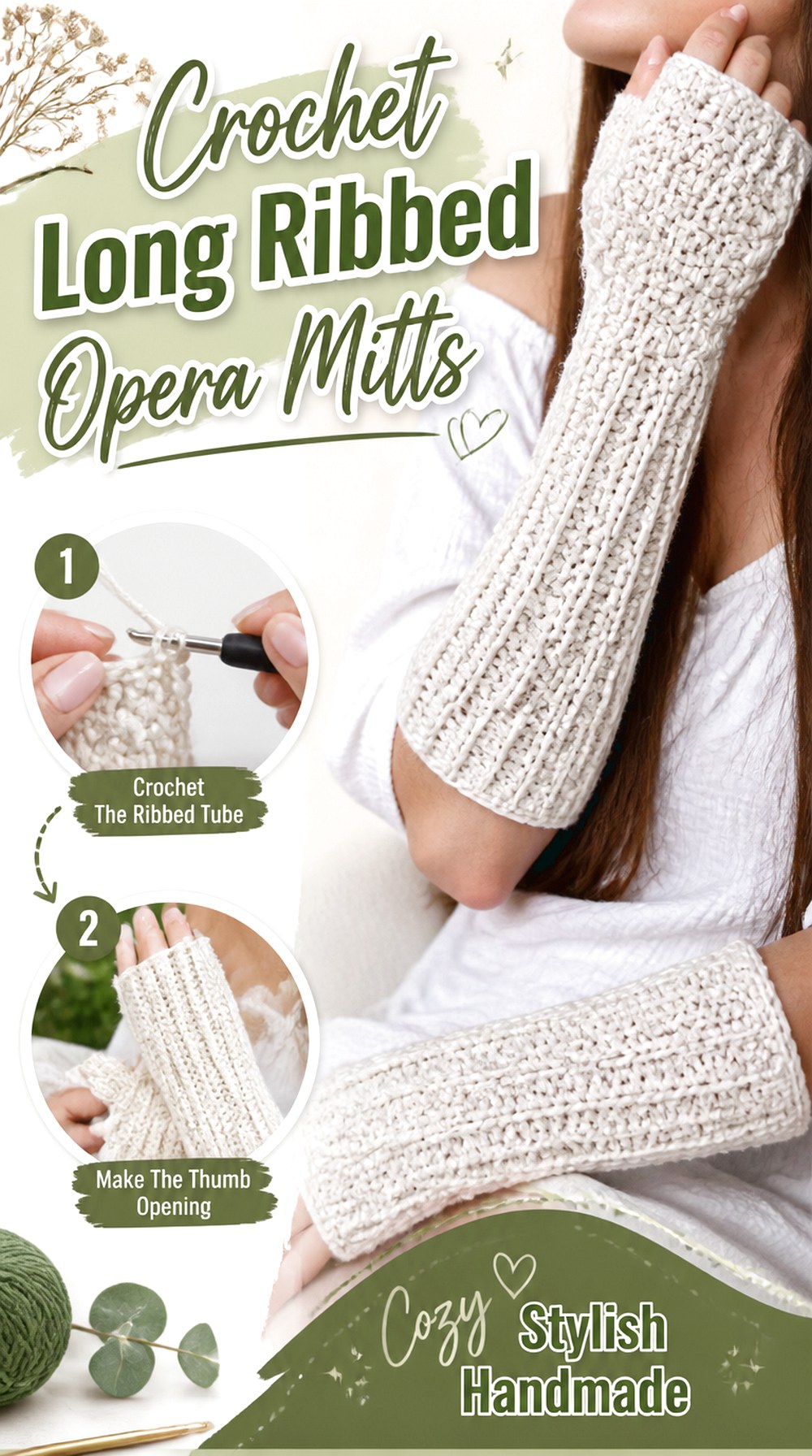
Winding Road Crochet demonstrates long wrist warmers or fingerless mitts, giving this option an established elongated shape from the outset. The visual direction is more grounded and wearable than the delicate fishnet or floral options, with the length itself doing much of the styling work.
A long ribbed or linear-looking mitt is useful when you want the drama of extended gloves without making lace the central feature. Depending on the chosen yarn and fabric behavior, this kind of shape can work over bare arms or as a layered cold-weather accessory. Because the forearm occupies so much of the project, maintaining an even vertical appearance becomes an important finishing consideration.
Use Ribbing as a Fit Tool, Not a Guarantee
Ribbed crochet may provide useful flexibility, but its recovery depends on construction, yarn, and tension. Check the upper portion after it has been worn briefly rather than assuming it will automatically stay in place. If the fabric relaxes noticeably, the final upper-edge fit may need to account for that behavior.
Keep the Long Lines Straight
Vertical or ribbed texture makes twisting obvious. Periodically lay the glove flat while working and check whether the visual lines track consistently from wrist to forearm. Small alignment issues that barely register on a cuff can become much more noticeable when extended over the length of an opera-style mitt.
Original Tutorial and Creator Credit
Creator: Winding Road Crochet
7. Crochet Bow Trim Opera Gloves

Mahum’s tutorial includes fingerless gloves with ribbed construction, a thumb opening, and decorative bows, providing a playful base for a romantic opera-length interpretation. The source itself should be followed for its actual proportions; extending the glove farther along the forearm is a separate design choice.
The bow changes the emphasis of the finished piece. Instead of relying entirely on stitch texture, the glove gains a clearly placed three-dimensional accent. For a long version, that means deciding whether one bow should remain the focal point or whether multiple small bows are appropriate. Restraint can help preserve the elongated silhouette rather than dividing it into too many decorative zones.
Position Bows Around Real Arm Movement
A bow may look attractive in a flat photograph but become inconvenient if it sits where the wrist repeatedly bends or where a sleeve overlaps the glove. Pin or temporarily place the decoration first, then move the hand and arm normally before attaching it permanently.
Consider Care Before Adding More Trim
Extra decorations introduce more surfaces that can catch, flatten, or shift during cleaning and storage. Care should follow the yarn label and any guidance given by the creator, with added consideration for the embellishments. A simpler trim layout can also make a pair easier to store without crushing the decorative elements.
Original Tutorial and Creator Credit
Creator: mahum 🎀
8. Crochet Starlight Lace Opera Gloves

HookedOnViktoriya’s Starlight Hand Warmer tutorial combines an adjustable cuff and thumb opening with an open lace treatment and decorative border. The creator’s description also addresses glove-length adjustment, making it a practical source for exploring a longer version without pretending that every finished length is identical.
An opera-style adaptation can emphasize the contrast between a more defined cuff area and an airy forearm. Compared with fishnet, this lace direction has more decorative rhythm, while still feeling lighter than cables or dense winter fabric. The main planning challenge is keeping the lace repeat balanced as circumference changes farther up the arm.
Preserve the Lace Rhythm While Shaping
When more room is required along the forearm, inserting changes randomly can interrupt a recognizable lace pattern. Before extending the project, identify where the design naturally permits adjustment and confirm the creator’s construction approach. If the repeat does not adapt cleanly, a separate transition band may look more deliberate than forcing irregular additions into the lace.
Check the Border at Its Final Circumference
A decorative edge is affected by the circumference where it is placed. If you relocate or reproduce an edging at the top of a longer glove, assess it on the actual arm rather than assuming it will behave exactly as it does closer to the wrist. Excess flare can change an otherwise sleek silhouette.
Original Tutorial and Creator Credit
Creator: HookedOnViktoriya
9. Crochet Autumn Leaf Opera Gloves

Bag-O-Day Crochet’s Autumn Leaves wrister tutorial offers a nature-inspired textured direction for fingerless gloves. To create an opera-style version, the original wrister should be treated as the hand and wrist reference while any longer forearm section is planned independently.
This idea is most useful for readers who prefer recognizable organic texture over floral appliqués or open lace. On a long glove, the leaf-inspired feature can become a controlled panel rather than an uninterrupted all-over effect. That distinction helps preserve the visual identity of the motif without making an extended glove unnecessarily dense.
Choose a Motif Zone Deliberately
A leaf-inspired detail can sit near the hand, travel along one side of the forearm, or appear as a focal section between simpler fabric. Sketching the approximate placement on a glove outline can help determine whether the motif should repeat or remain concentrated. The goal is balanced placement, not simply filling every available inch.
Match Motif Direction on Both Hands
Directional texture makes pair consistency important. Before finishing, place both gloves in their worn orientation and compare where the primary decorative areas begin and end. Mirrored or intentionally identical placement can both work; accidental differences tend to be more distracting on long pieces.
Original Tutorial and Creator Credit
Creator: Bag-O-Day Crochet
10. Crochet Ribbed Everyday Opera Arm Warmers
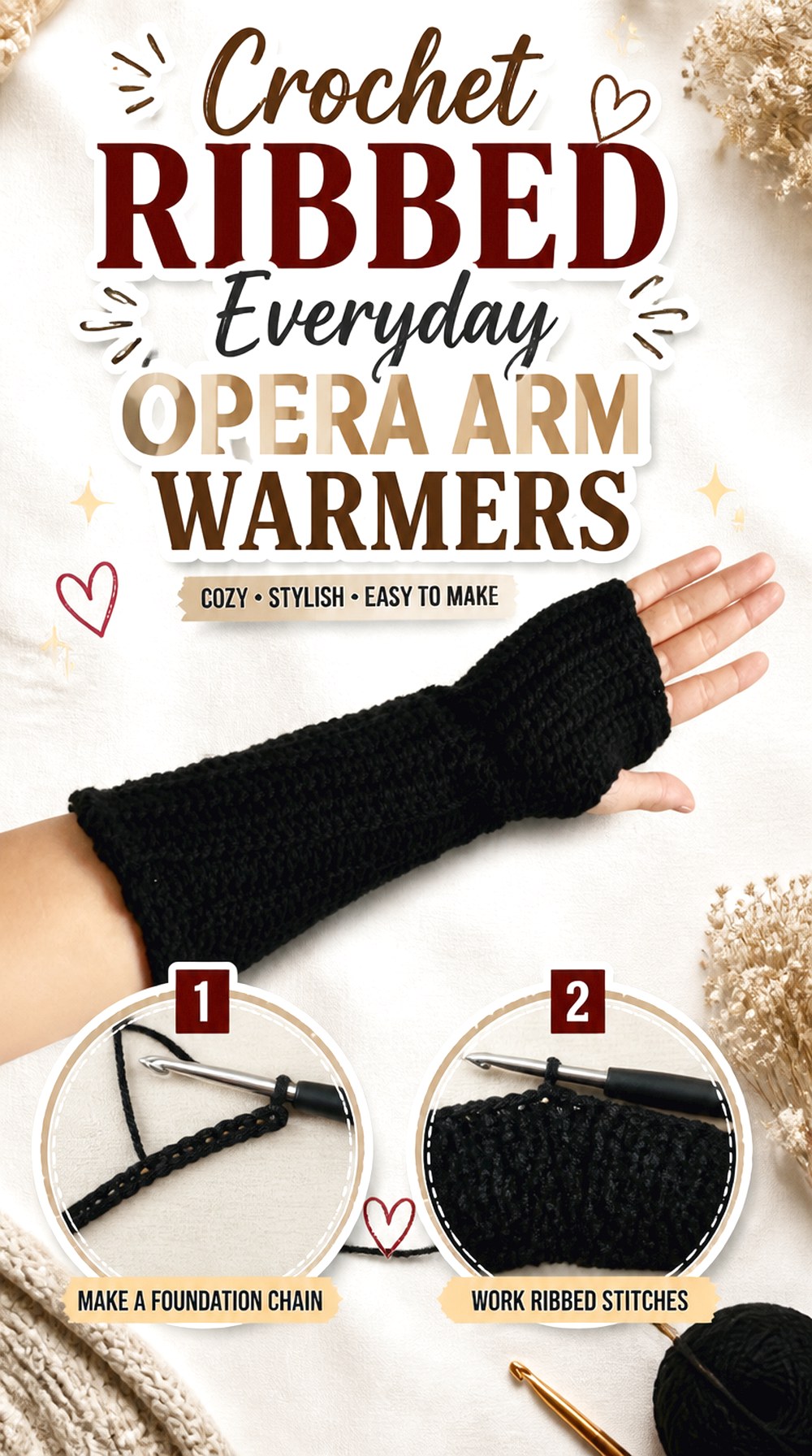
Ariel Tong’s tutorial focuses on customizable crochet arm warmers or fingerless gloves and demonstrates a ribbed-effect design with a thumb opening. Because the source already approaches the project as an arm warmer, this option requires less conceptual stretching than a short decorative cuff.
The resulting direction is casual and streamlined. It works well for readers who like the long-glove silhouette but want texture that can sit comfortably beside everyday clothing rather than looking specifically theatrical or vintage. Customization remains important, since the point where a long warmer ends can dramatically change both comfort and appearance.
Measure Where the Upper Edge Will Actually Sit
Do not choose the top circumference while measuring at a different point on the arm. First decide the intended finished length, then measure at that location. An arm warmer that finishes mid-forearm has different fit demands from one that approaches the elbow or continues above it.
Let the Ribbing Complement Layered Clothing
If the warmers will be worn with long sleeves, compare the two fabrics before finalizing length. A bulky overlap may feel very different from the same glove worn on bare skin. Testing the intended combination also reveals whether the upper edge stays visible or disappears underneath the sleeve.
Original Tutorial and Creator Credit
Creator: Ariel Tong
11. Crochet Vintage Lace Opera Gloves
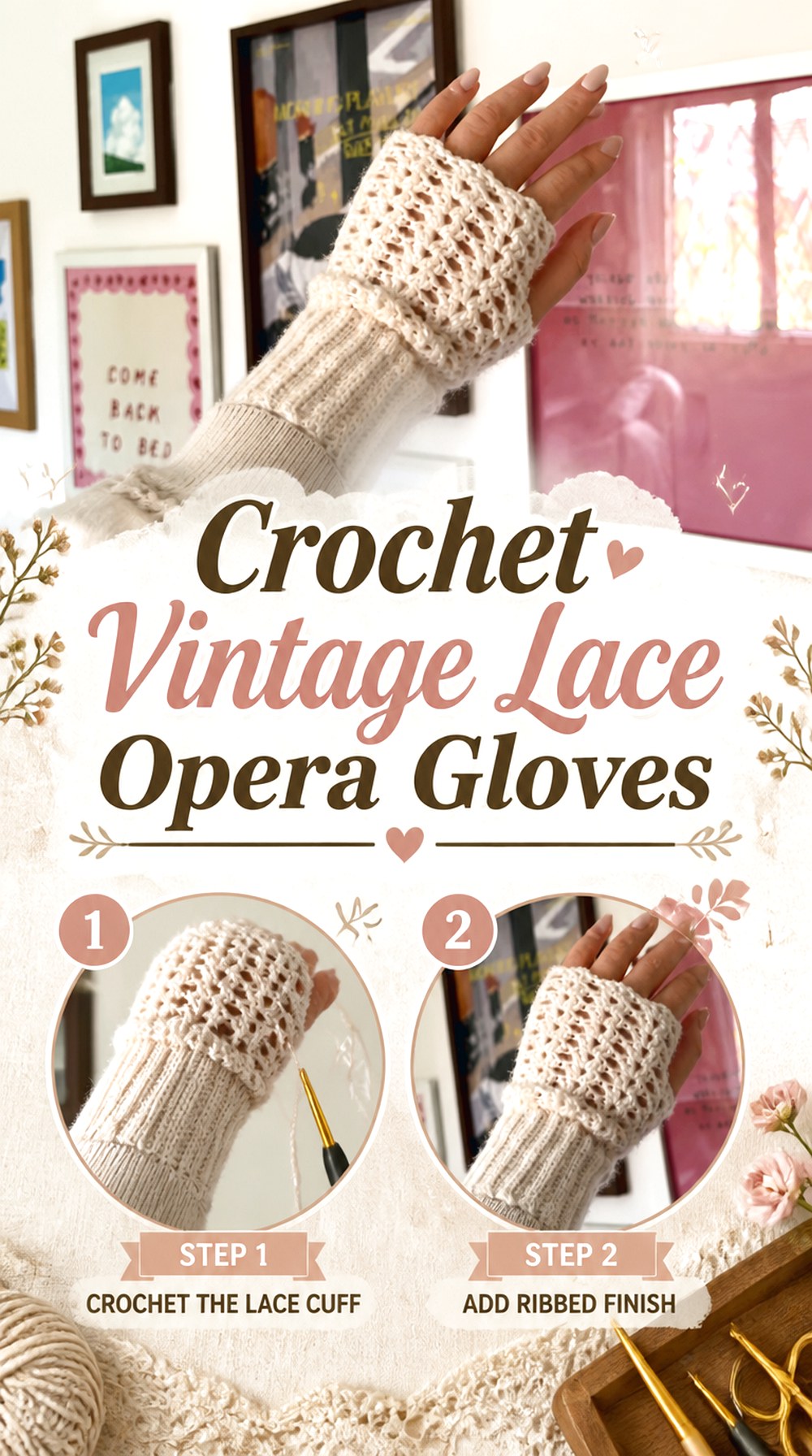
Mucie Studio’s lace fingerless-glove tutorial pairs ribbing with an airy vintage-looking lace section, giving this idea a softer decorative character than the sharper geometry of fishnet. The original project is shorter than a classic opera silhouette, so the extra forearm should be regarded as a considered adaptation.
A long version could keep the ribbed area close to the hand while allowing lace to become the dominant forearm feature. That contrast creates a useful balance between a visually stable base and lighter openwork. It also makes this design suitable for readers who want detail without adding separate flowers, bows, or beads.
Sample the Lace Before Committing to Length
A lace repeat that looks attractive over a few inches can behave differently over a long section. Make enough fabric to judge drape, openness, and visual scale before committing to an elbow-length extension. If the holes appear much larger or smaller than expected after yarn substitution, reconsider the combination early.
Finish With the Intended Outfit in Mind
Vintage-inspired lace can change character depending on what sits beneath it. Testing the glove against bare skin, a contrasting sleeve, or a similarly colored garment can reveal which arrangement makes the stitch pattern most readable. This is a styling decision rather than a change to the original construction.
Original Tutorial and Creator Credit
Creator: Mucie Studio
12. Crochet Clean Line Opera Arm Warmers
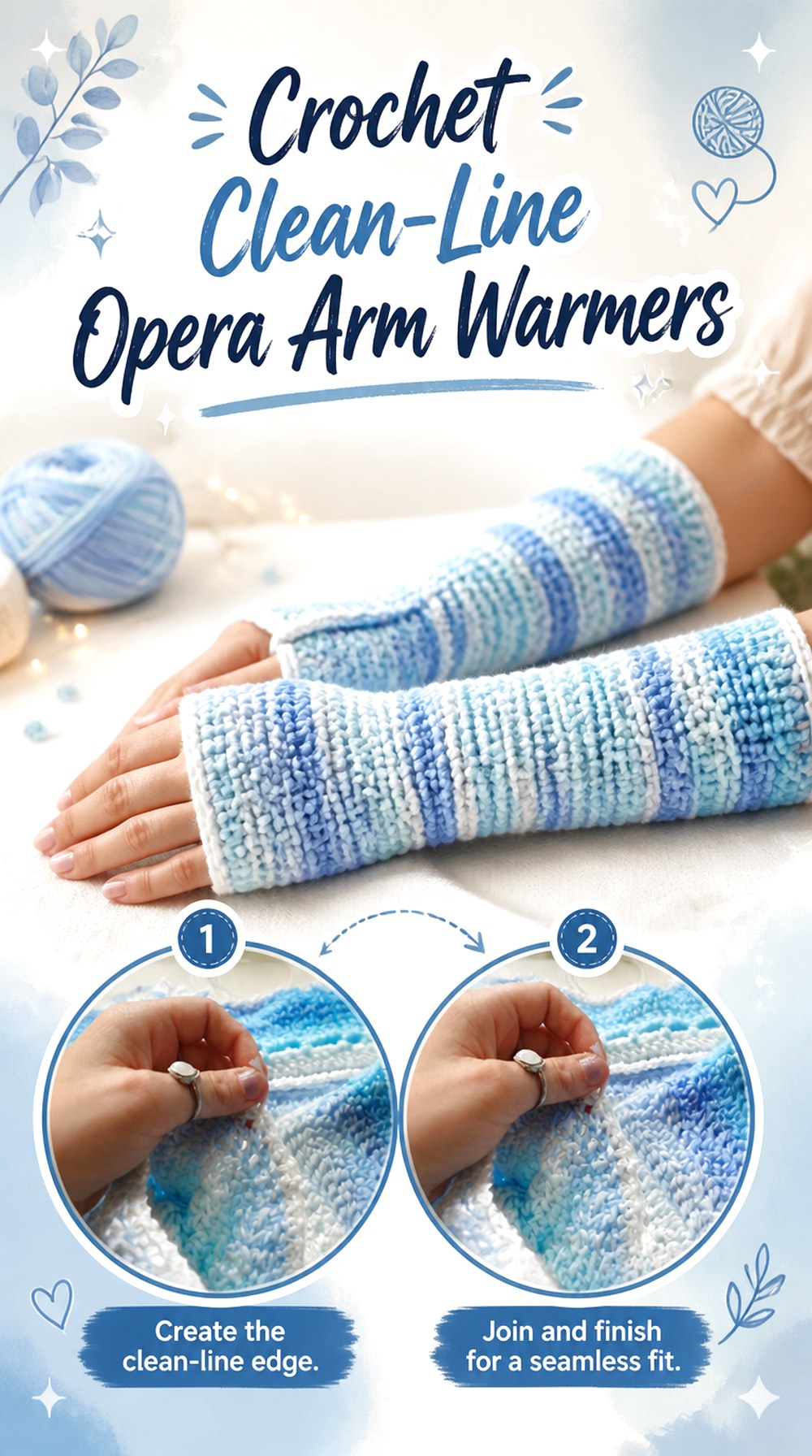
Gabrielle McAuley’s Crochet Arm Warmers Tutorial supplies a straightforward arm-warmer reference that can support a comparatively minimal opera-glove direction. Rather than depending on a large motif, scallop, or attached decoration, this concept puts more emphasis on the extended form itself.
That makes it a useful counterpoint to the detail-heavy projects in the collection. A restrained long warmer can be styled casually, incorporated into coordinated handmade outfits, or customized later with color changes or limited surface decoration. Because there is less ornament to disguise proportion differences, neat finishing and a well-chosen upper-edge position become particularly important.
Make Length the Main Design Decision
With minimal arm warmers, a few extra inches can noticeably change the overall impression. Stop periodically and view the piece on the arm instead of deciding length only from a flat measurement. The most flattering stopping point depends on the wearer’s proportions and the clothing planned for the finished accessory.
Keep Customization Secondary to Fit
A clean base invites personalization, but color blocking, trim, appliqués, or embroidery should not interfere with movement or recovery. Establish the fit first. Once both arm warmers sit consistently, decorative changes can be positioned symmetrically without compensating for unresolved sizing differences.
Original Tutorial and Creator Credit
Creator: Gabrielle McAuley
13. Crochet Modern Flat Panel Opera Gloves
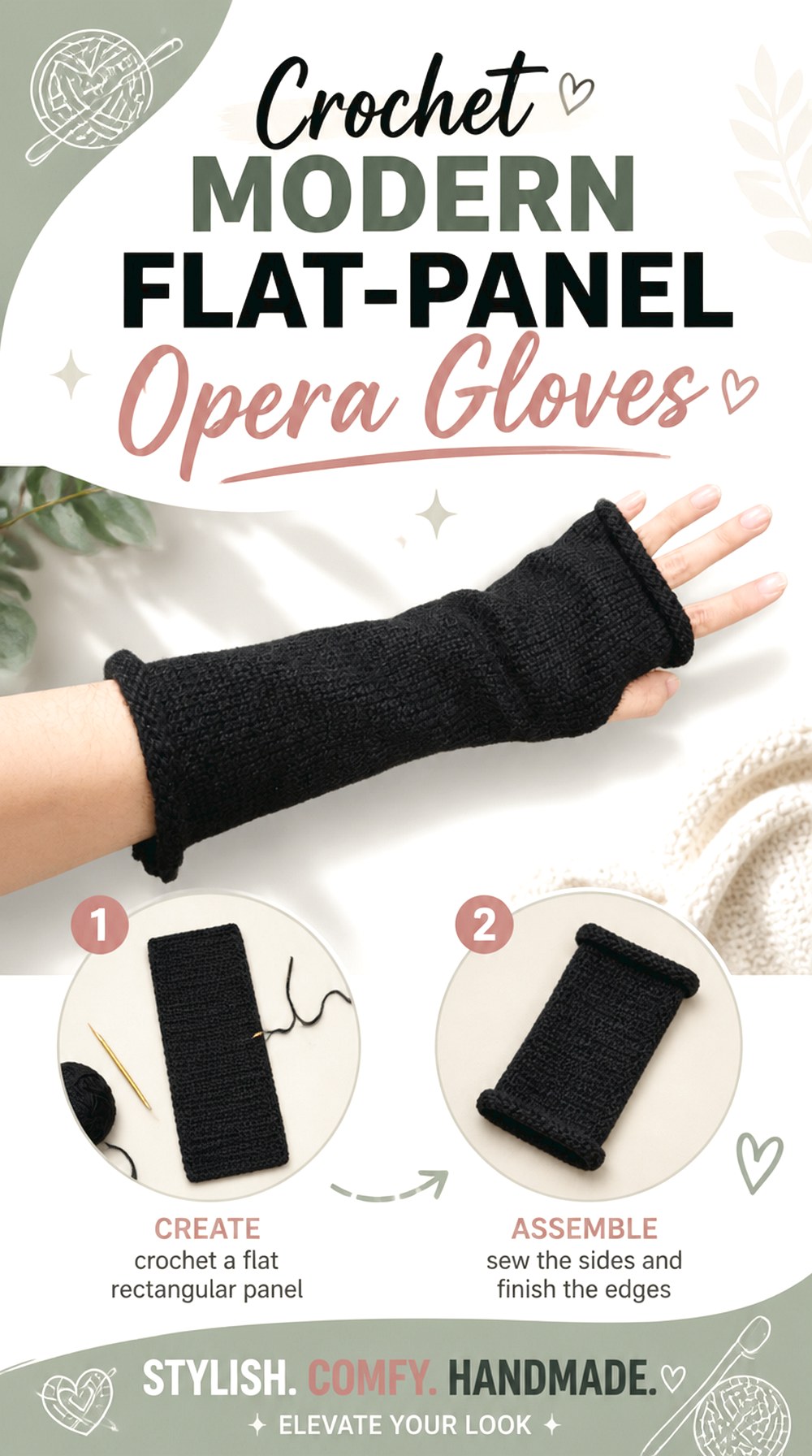
Yaejiyea’s arm-warmer video contains both knit and crochet versions; the crocheted version is the relevant source for this idea. Its clean contemporary styling offers a useful alternative to ornate Victorian and botanical looks.
For an opera-glove interpretation, this direction works best when the extended shape remains visually simple. A flatter construction can also make it easier to judge length and width before final assembly, although the creator’s tutorial should remain the guide for the actual construction method. The key reader decision is whether a sleek, handmade accessory with minimal surface interruption better suits the intended outfit than visibly lacy or heavily textured gloves.
Check Width Before Final Assembly
Whenever a project allows the fabric to be viewed flat during construction, use that opportunity to compare its width with several points on the intended arm. Remember that flat width does not automatically equal comfortable worn circumference; the actual stretch and joining method still affect fit.
Keep the Crochet Version Distinct
Because the source video includes both knit and crochet projects, follow the crochet portion rather than borrowing assumptions from the knitted version. The two crafts can create different stretch, density, and edge behavior even when the finished accessories share a similar visual concept.
Original Tutorial and Creator Credit
Creator: yaejiyea
14. Crochet Cabled Open Finger Opera Gloves

Secret Crochet Box’s original tutorial is one of the most structurally distinctive sources in the collection. Its long fingerless gloves combine a raised cabled ornament with separate short openings for the fingers and thumb rather than stopping at one broad fingerless hand opening.
That extra hand shaping makes this idea feel more glove-like than many tube-style arm warmers. It suits readers who want extended coverage but still prefer exposed fingertips for dexterity. The cable feature also gives the front of the glove a clear orientation, so alignment across the hand and forearm becomes part of the finished appearance. Follow the original page for its exact construction rather than trying to reconstruct the shaping from a visual description.
Give Finger Openings a Comfort Check
Individual openings introduce more fit points than a single fingerless edge. Before treating the first glove as finished, move and spread the fingers naturally and check that the openings are comfortable. Yarn substitution can alter how firmly those small areas sit even when the overall hand circumference seems appropriate.
Keep the Cable Facing Consistently
A prominent raised ornament establishes a definite front. When making the second glove, compare motif placement in worn orientation rather than merely laying the pieces in the same direction on a table. This helps ensure the decorative panels relate correctly to the backs of the hands.
Original Tutorial and Creator Credit
Creator/Site: Secret Crochet Box
Comparing the 14 Crochet Opera Glove Directions
| Project | Main Visual Direction | Length Starting Point | Key Planning Decision |
|---|---|---|---|
| Fishnet Evening | Open geometric mesh | Already long | Keep mesh and upper fit consistent |
| Cable-Texture | Raised, substantial texture | Arm warmer | Balance bulk, mobility, and length |
| Victorian-Inspired | Decorative vintage styling | Shorter glove source | Design the added forearm separately |
| Sleek Long Fingerless | Minimal elongated shape | Already long | Match both gloves precisely |
| Blossom Scallop | Lace, flower, scalloped edge | Adjustable decorative glove | Place motifs without crowding |
| Long Ribbed | Linear, substantial mitt | Already long | Check recovery at the upper edge |
| Bow-Trim | Ribbing with 3D accents | Shorter accessory source | Position bows away from movement zones |
| Starlight Lace | Open lace with decorative border | Length-adjustable hand warmer | Preserve repeats while shaping |
| Autumn-Leaf | Directional organic texture | Wrister source | Decide where the motif should stop |
| Ribbed Everyday | Casual arm-warmer styling | Arm warmer | Measure the actual top position |
| Vintage Lace | Ribbing plus delicate openwork | Shorter glove source | Sample lace before extending |
| Clean-Line | Minimal arm-warmer form | Arm warmer | Let proportion carry the design |
| Modern Flat-Panel | Contemporary, restrained surface | Arm warmer | Check width before joining |
| Cabled Open-Finger | Cable detail with finger openings | Already long | Check individual openings and motif orientation |
The most direct routes to a long silhouette are the fishnet, Chenda DIY, Winding Road Crochet, arm-warmer, and Secret Crochet Box sources. The shorter lace, Victorian, bow, and motif-focused tutorials offer more decorative possibilities, but they also require more independent fit planning if you want to turn them into true opera-length pieces.
Conclusion
These 14 crochet opera gloves ideas show how dramatically the same long-arm concept can change through construction and surface design. Fishnet and lace keep the look airy, ribs and clean lines emphasize length, cables create stronger texture, while flowers, scallops, bows, and leaf-inspired details turn the glove into a focal accessory.
Choose first according to the silhouette you actually want, then consider how much adaptation the source requires. A tutorial that already produces long gloves reduces some proportion decisions, while a shorter decorative mitt gives you more freedom but also more responsibility for shaping the forearm correctly. Whichever direction you choose, use the linked original tutorials for exact construction details and verify fit as the first glove develops.
Frequently Asked Questions
How long should crochet opera gloves be?
There is no single crochet measurement that fits every wearer or styling goal. Traditional opera-glove styling suggests a noticeably extended glove, often approaching or passing the elbow, but the best finished point depends on arm proportions and clothing. Decide where you want the top edge to sit first, then measure the circumference at that exact location instead of relying on a generic length.
Can I extend any short fingerless-glove tutorial to opera length?
Not automatically. A short glove may have a stitch repeat or fixed circumference that works around the wrist but becomes too narrow farther up the forearm. Before extending it, identify how the fabric can accommodate increasing circumference without disrupting lace, mesh, cables, or motifs. When the original creator does not provide a lengthening method, treat your added forearm as a separate adaptation rather than part of the original pattern.
How can I reduce the chance of long crochet gloves sliding down?
Upper-edge fit, fabric recovery, yarn behavior, and the glove’s total weight can all matter. Check the circumference where the glove will actually end and assess how the fabric behaves after being worn for a short period. Ribbing may help in some constructions, but it is not a universal guarantee. Avoid making an upper edge uncomfortably tight simply to compensate for a fabric that relaxes.
Which style works best for a lightweight decorative look?
Open fishnet and lace usually create less visual mass than dense cables or heavily textured fabric, making them useful starting points when the glove is intended primarily as a decorative layer. The exact result still depends on yarn, tension, and stitch scale. A small sample can show whether the chosen combination looks delicate and fluid or much denser than expected before you commit to two long gloves.
Should crochet opera gloves be blocked?
Blocking depends on the yarn, stitch pattern, embellishments, and the creator’s guidance. Lace may benefit visually from careful shaping in some cases, while other fibers or decorative elements may require different treatment. Do not assume every glove should be stretched aggressively. Follow the yarn label and original tutorial where care information is provided, and test cautiously when you have substituted materials.
How do I make two textured or lace opera gloves look alike?
Compare the pair throughout construction rather than relying only on final measurements. Check overall length, thumb position, motif direction, repeat count, upper-edge position, and visible fabric density. With hand-dyed or highly variegated yarn, color distribution may also differ naturally. For directional cables, flowers, leaves, or bows, decide in advance whether the pair should mirror each other or repeat the same orientation.